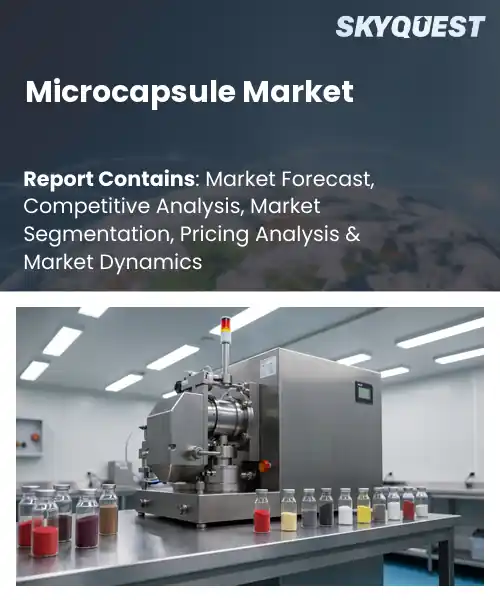
Microcapsule Market
Report ID: SQMIG15E3167
Report ID: SQMIG15E3167
[email protected]
USA +1 351-333-4748
Report ID:
SQMIG15E3167 |
Region:
Global |
Published Date: February, 2026
Pages:
188
|Tables:
144
|Figures:
70


Global Microcapsule Market size was valued at USD 11.2 Billion in 2024 and is poised to grow from USD 12.3 Billion in 2025 to USD 25.98 Billion by 2033, growing at a CAGR of 9.8% during the forecast period (2026-2033).
Numerous industries, including the pharmaceutical, food and beverage, personal care, agrochemical, and textile sectors, have adopted microencapsulation technology at an increasing rate.
The microencapsulation technology provides controlled release, stability improvements, and protection of active ingredients, thus enhancing the performance of the products. Therefore, microencapsulation technology is increasingly being utilized in the development of drug delivery systems, fortified foods, long-lasting fragrances, and controlled-release agrochemicals. Microencapsulation of drugs allows for controlled-release formulations that improve both therapeutic efficacy and patient compliance. In the food and beverage sector, microencapsulation helps prevent damage to sensitive nutrients, probiotics, and flavourings during manufacturing and storage.
Microencapsulation technology enhances fragrance release and ingredient stability in all types of personal care and household products. The demand for high functional performance has triggered growth in this market sector through an increase in the number of environmentally friendly formulations supported by ongoing innovations in polymeric and biodegradable microencapsulation materials. Several factors limit the growth of this technology, including the significant costs associated with production, technical complexities and the many stringent food and pharmaceutical regulatory requirements that may delay commercialization of products as well as limit the adoption of products by smaller manufacturers.
Why is AI Reducing Trial-and-error in Microencapsulation Processes?
The microcapsule market is experiencing the increasing impact of artificial intelligence (AI) as a method to enhance product development, process optimization, and quality control. Through the use of AI and machine learning (ML) models, manufacturers can analyze large data sets collected during both formulation trials and production processes to determine which materials are best for creating core-shell microcapsules, what conditions should be applied to encapsulate products, and the best release profile for those products. Thus, AI helps to minimize trial-and-error experimentation, speeds the time it takes to bring products to market, and reduces production costs while simultaneously increasing the uniformity and performance of microcapsules, making them suitable for use in the pharmaceutical, functional food, beauty and agriculture sectors. Additionally, AI allows for automated inspection of quality during the manufacturing of microcapsules via ML algorithms that identify defective or out-of-standard-sized microcapsules from the manufacturing operation, increasing microcapsule yields and minimizing waste.
Market snapshot - 2026-2033
Global Market Size
USD 39.14 Billion
Largest Segment
Food & Beverages
Fastest Growth
Pharmaceuticals
Growth Rate
5.96% CAGR
To get more insights on this market click here to Request a Free Sample Report
Global Microcapsule Market is segmented by Application Type, Technology Type, End Use Industry, Form Type and region. Based on Application Type, the market is segmented into Pharmaceuticals, Cosmetics and Food and Beverage. Based on Technology Type, the market is segmented into Coacervation, Spray Drying and Melt Encapsulation. Based on End Use Industry, the market is segmented into Healthcare, Personal Care and Food Industry. Based on Form Type, the market is segmented into Liquid Microcapsules and Powder Microcapsules. Based on region, the market is segmented into North America, Europe, Asia Pacific, Latin America and Middle East & Africa.
Polymer microcapsules currently dominate the industry due to their versatility, strength, and ability to accurately control when materials are released from them. The pharmaceutical, food & beverage, cosmetics, and agriculture industries all utilize polymer microcapsules because the properties of polymers allow for the development of biodegradable, temperature-sensitive, and pH-responsive microcapsule systems. Furthermore, polymer microcapsules' compatibility with various microencapsulation methods and their widespread regulatory acceptance makes both the adaptability and widespread adoption of polymer microcapsules possible.
As per the global microcapsule market forecast, starch-based microcapsules are experiencing rapid growth as a subsegment of the microencapsulation product market, largely driven by the increasing demand for biodegradable, sustainable, and plant-derived products. As the number of consumers preferring clean label food products, environmentally friendly agricultural inputs, and natural cosmetics continues to grow, so too will the number of manufacturers be implementing starch-based encapsulation systems.
As per the global microcapsule market outlook, the pharmaceuticals segment dominates the market. The microencapsulation of medications allows the pharmaceuticals to provide controlled-release-type delivery, mask taste, and protect the sensitive active components of the medications. Due to the increasing rate of chronic diseases and need for improved medicine performance to enable patient compliance, there has been significant usage within the pharmaceutical segment.
As per the global microcapsule market analysis, the food & beverages segment is growing at the fastest pace, driven by rising demand for functional foods, fortified products, probiotics, and flavor encapsulation. The use of microcapsules enables food manufacturers to protect nutrients throughout the shelf life of their products, extend the shelf life of their products, as well as create a form of "controlled release" for the nutrients that are utilized whenever a consumer consumes that nutrient. These attributes of microcapsule technology fit perfectly in relation to changing consumer desires and needs for health-oriented and value-added food products.
To get detailed segments analysis, Request a Free Sample Report
The North America microcapsule market is a mature and innovative market with strong support from the pharmaceutical, food and beverage, nutraceutical, agriculture and personal care industries. The North American region has advanced R&D capacity, early adoption of controlled-release technologies, and a focus on product performance, safety and regulatory compliance. Pharmaceutical applications represent the highest demand within the North American microcapsule market. The most common pharmaceutical product types are sustained release formulations of medications.
As per microcapsule market regional forecast, the United States is the dominant player in North America for microencapsulation. The U.S. is home to many pharmaceutical manufacturers and has the highest healthcare spending in the world. Due to ongoing research in advanced drug delivery systems, polymer-based and biodegradable microencapsulated products, the U.S. is a leading innovator for microencapsulation. Microencapsulated products are also commonly used in nutraceuticals, agrochemicals, and cosmetics.
In Canada, microencapsulation (or microencapsulated products) has been increasing in use and adoption due to food fortification, agricultural use and healthcare applications. The Canadian government is placing an emphasis on providing a sustainable and clean-label product, leading consumers to seek out natural and biodegradable materials for their encapsulation needs.
As per microcapsule market regional outlook, the Asia-Pacific region is growing the fastest of all regional markets as a result of industrialization, developing healthcare, and increasing consumer awareness of product functionality and quality. An emerging market most likely, the region's benefits are primarily based on the large and growing population centres, the increasing number of pharmaceutical products being manufactured, the expanding food processing industry, and a strong demand for agricultural solutions.
As per microcapsule industry analysis, Japan has a particular focus on unique technological and high-value applications as well as a significant emphasis in the pharmaceutical sector, functional foods, and premium personal care. There is a constant demand for advanced microcapsule formulations based on the high-quality research and development (R&D) capabilities of the country and the high standards of quality enforced in the country.
South Korea market is expected to continue to be driven by the cosmetics and skincare industries as well as the pharmaceutical sector. Korea is at the forefront of the use of smart formulation technologies and encourages the adoption of microencapsulation technology as a method for controlling the release and increasing differentiation between products.
Europe is one of the world's largest, most developed and advanced markets for microcapsules, primarily due to an advanced pharmaceutical sector, high-end food & beverage production, and significant global influence from its cosmetics/personal care sectors. As a result of this high level of concern with product safety, regulatory compliance and sustainability, Europe has become one of the world's leading innovators in the development of biodegradable, bio-based and clean label microencapsulation materials.
Germany has established itself as the most dominant European microcapsule market due to its robust pharmaceutical & chemical industries and specialty materials industries. A well-established manufacturing base and a focus on producing high-precision formulations also contribute to the overall demand for polymer and inorganic microcapsules, particularly in the healthcare and industrial sectors.
The UK microcapsule market is being driven by ongoing improvements in pharmaceutical research and development, nutraceutical innovations and an ever-increasing incidence of the use of microencapsulation within functional food products. Academic and industry partnerships are also key to the ongoing advancement of microcapsule technology.
France has a significant presence in the global cosmetics, personal care and food markets. Microcapsules are often used for the encapsulation of fragrances, stabilizing active ingredients, and developing premium product formulations, thereby contributing significantly to the continued growth of the microcapsule market.
To know more about the market opportunities by region and country, click here to
Buy The Complete Report
Increased Demand for Controlled Release and Stability of Ingredients
Advancement in Encapsulation Materials and Technologies
High Production Costs of Microcapsule Production
Regulatory Complexity
Request Free Customization of this report to help us to meet your business objectives.
The microcapsule industry is being transformed by a blend of established multinational chemical and life-science companies and disruptive newcomers that have emerged in recent years. The dominant names, such as BASF SE, Balchem Corporation, Lonza Group SA, Givaudan S.A., Koninklijke DSM N.V., Encapsys LLC (a division of Aenova / Milliken), and Sensient Technologies Corporation maintain a significant microcapsule market share with complete portfolios that include a broad diversity of microencapsulation solutions. Their offerings serve industries, including pharmaceuticals, functional foods, cosmetics, and agriculture.
SkyQuest’s ABIRAW (Advanced Business Intelligence, Research & Analysis Wing) is our Business Information Services team that Collects, Collates, Correlates, and Analyses the Data collected by means of Primary Exploratory Research backed by robust Secondary Desk research.
As per SkyQuest analysis, the microcapsule market growth is attributed to the increasing demand for controlled release and the protection of active components in the pharmaceutical, food & beverage, personal care, and agrochemical sectors. Increased need for stability, higher efficacy, and longer release formulations has led to manufacturers delivering more effective, efficient, and safe products to their customers. Another factor driving this growth is the increased interest in and adoption of new polymer and biodegradable microencapsulation technologies that support current sustainability and eco-compatible initiatives. Despite this growth, the market continues to face significant challenges, including the high costs associated with production and the complexity of the manufacturing processes, as well as very stringent requirements for many pharmaceutical and food products that may delay or prevent new products from being commercialized or adopted. In addition, as companies invest in AI-assisted formulation and process improvements, development time and resources can be expedited while ensuring product improvement using AI-assisted technology to produce improved R&D timeframes and quality control of products. One emerging trend includes the introduction of biodegradable and plant-based microcapsules to satisfy consumer interests in sustainability.
| Report Metric | Details |
|---|---|
| Market size value in 2024 | USD 11.2 Billion |
| Market size value in 2033 | USD 25.98 Billion |
| Growth Rate | 9.8% |
| Base year | 2024 |
| Forecast period | 2026-2033 |
| Forecast Unit (Value) | USD Billion |
| Segments covered |
|
| Regions covered | North America (US, Canada), Europe (Germany, France, United Kingdom, Italy, Spain, Rest of Europe), Asia Pacific (China, India, Japan, Rest of Asia-Pacific), Latin America (Brazil, Rest of Latin America), Middle East & Africa (South Africa, GCC Countries, Rest of MEA) |
| Companies covered |
|
| Customization scope | Free report customization with purchase. Customization includes:-
|
To get a free trial access to our platform which is a one stop solution for all your data requirements for quicker decision making. This platform allows you to compare markets, competitors who are prominent in the market, and mega trends that are influencing the dynamics in the market. Also, get access to detailed SkyQuest exclusive matrix.
Table Of Content
Executive Summary
Market overview
Parent Market Analysis
Market overview
Market size
KEY MARKET INSIGHTS
COVID IMPACT
MARKET DYNAMICS & OUTLOOK
Market Size by Region
KEY COMPANY PROFILES
Methodology
For the Microcapsule Market, our research methodology involved a mixture of primary and secondary data sources. Key steps involved in the research process are listed below:
1. Information Procurement: This stage involved the procurement of Market data or related information via primary and secondary sources. The various secondary sources used included various company websites, annual reports, trade databases, and paid databases such as Hoover's, Bloomberg Business, Factiva, and Avention. Our team did 45 primary interactions Globally which included several stakeholders such as manufacturers, customers, key opinion leaders, etc. Overall, information procurement was one of the most extensive stages in our research process.
2. Information Analysis: This step involved triangulation of data through bottom-up and top-down approaches to estimate and validate the total size and future estimate of the Microcapsule Market.
3. Report Formulation: The final step entailed the placement of data points in appropriate Market spaces in an attempt to deduce viable conclusions.
4. Validation & Publishing: Validation is the most important step in the process. Validation & re-validation via an intricately designed process helped us finalize data points to be used for final calculations. The final Market estimates and forecasts were then aligned and sent to our panel of industry experts for validation of data. Once the validation was done the report was sent to our Quality Assurance team to ensure adherence to style guides, consistency & design.
Analyst Support
Customization Options
With the given market data, our dedicated team of analysts can offer you the following customization options are available for the Microcapsule Market:
Product Analysis: Product matrix, which offers a detailed comparison of the product portfolio of companies.
Regional Analysis: Further analysis of the Microcapsule Market for additional countries.
Competitive Analysis: Detailed analysis and profiling of additional Market players & comparative analysis of competitive products.
Go to Market Strategy: Find the high-growth channels to invest your marketing efforts and increase your customer base.
Innovation Mapping: Identify racial solutions and innovation, connected to deep ecosystems of innovators, start-ups, academics, and strategic partners.
Category Intelligence: Customized intelligence that is relevant to their supply Markets will enable them to make smarter sourcing decisions and improve their category management.
Public Company Transcript Analysis: To improve the investment performance by generating new alpha and making better-informed decisions.
Social Media Listening: To analyze the conversations and trends happening not just around your brand, but around your industry as a whole, and use those insights to make better Marketing decisions.
REQUEST FOR SAMPLE
 REQUEST FREE CUSTOMIZATION
Global Microcapsule Market size was valued at USD 39.14 Billion in 2025 and is poised to grow from USD 41.47 Billion in 2026 to USD 62.20 Billion by 2033, growing at a CAGR of 5.96% during the forecast period (2026-2033).
The microcapsule industry is being transformed by a blend of established multinational chemical and life-science companies and disruptive newcomers that have emerged in recent years. The dominant names, such as BASF SE, Balchem Corporation, Lonza Group SA, Givaudan S.A., Koninklijke DSM N.V., Encapsys LLC (a division of Aenova / Milliken), and Sensient Technologies Corporation maintain a significant microcapsule market share with complete portfolios that include a broad diversity of microencapsulation solutions. Their offerings serve industries, including pharmaceuticals, functional foods, cosmetics, and agriculture. 'BASF SE', 'Evonik Industries AG', 'Koninklijke DSM N.V.', 'Givaudan S.A.', 'Syngenta Crop Protection AG', 'International Flavors & Fragrances Inc.', 'Balchem Corporation', 'Sensient Technologies Corporation', 'Symrise AG', 'Lycored Corp.', 'Encapsys, LLC', 'Aveka Group'
Microcapsules provide environmental protection of heat, light and oxygen to sensitive ingredients (e.g. drugs, vitamins, probiotics, flavours and fragrances). By providing controlled release over time and improving efficacy, microcapsule products have improved performance and longevity. Heightened demand for sustained release of drug formulations, fortified nutrient-rich functional foods (food), long-lasting fragrance formulations and stability of active ingredients in personal care products, has boosted the market’s revenue potential.
Integration of Artificial Intelligence (AI) and Digital Technology into Microcapsule Manufacturing: Artificial Intelligence (AI) and Machine Learning are beginning to be used to improve the efficiency of the formulation and manufacturing process of micro-capsules, enabling manufacturers to optimize the conditions necessary for the encapsulation process, as well as more efficiently enhancing the release profile of the microcapsules, while also reducing the need to perform trial-and-error testing to obtain optimal results. This microcapsule market trend will be accelerated by rapid technological advancements that will take place in 2024, improving the quality and consistency of microcapsules.
Why Does North America Represent a Mature and Innovation-Driven Microcapsule Market?


Want to customize this report? This report can be personalized according to your needs. Our analysts and industry experts will work directly with you to understand your requirements and provide you with customized data in a short amount of time. We offer $1000 worth of FREE customization at the time of purchase.
Feedback From Our Clients


 USA (+1) 351-333-4748

