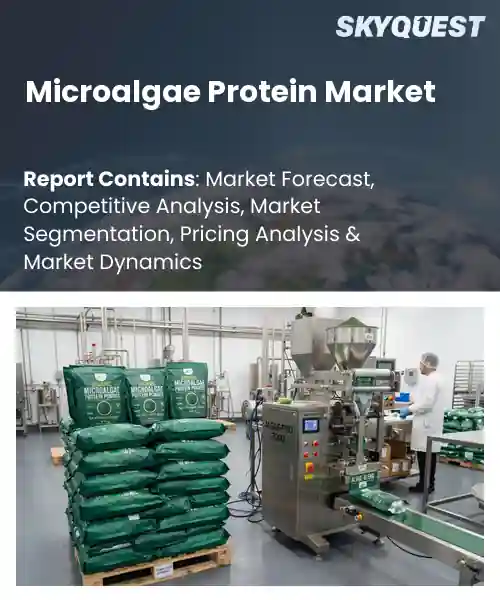
Microalgae Protein Market
Report ID: SQMIG30I3260
Report ID: SQMIG30I3260
[email protected]
USA +1 351-333-4748
Report ID:
SQMIG30I3260 |
Region:
Global |
Published Date: September, 2026
Pages:
157
|Tables:
119
|Figures:
77


Global Microalgae Protein Market size was valued at USD 790.0 Million in 2024 and is poised to grow from USD 851.62 Million in 2025 to USD 1553.09 Million by 2033, growing at a CAGR of 7.8% during the forecast period (2026-2033).
Microalgae protein has emerged as a segment within the protein industry, driven primarily by rising consumer demand for sustainable nutrition. The market includes extracts from species such as Spirulina, Chlorella, and Nannochloropsis, harvested, processed, and sold to food, feed, and nutraceutical manufacturers. Its importance stems from protein yield per hectare, land use, and carbon capture while providing amino acids, thereby addressing climate concerns. In decade, venture capital and regulatory approvals have accelerated commercialization; for example, Algaia’s 2021 launch of a protein isolate and Corbion’s 2023 partnership with a aquaculture firm illustrate the significant shift from supplements to ingredient global use. A key factor shaping the microalgae protein market is its expanding use in animal feed, which reinforces market momentum. By substituting soy or fishmeal with algae protein, producers lower feed‑cost volatility, reduce deforestation pressure, and improve livestock nutrition, leading to higher growth rates and lower greenhouse‑gas emissions. This advantage has spurred partnerships like Cargill’s 2022 joint venture with Algaia for aquaculture feed and DSM’s 2023 collaboration with a Brazilian poultry integrator. Regulatory acceptance of algae as a safe, sustainable ingredient widens investment pipelines, enabling photobioreactor scale‑up and price competitiveness that opens doors to broader global food‑service and plant‑based new lines.
How is AI-driven fermentation influencing the scalability of the microalgae protein market?
AI‑driven fermentation is reshaping the microalgae protein market by automating strain selection, optimizing growth conditions and reducing cycle times. Machine learning models analyze metabolic pathways and predict nutrient mixes that maximize protein yield while minimizing waste. This digital layer allows producers to scale from pilot ponds to industrial bioreactors with consistent quality. Companies are integrating sensors that feed real‑time data into algorithms, creating feedback loops that adjust temperature, light and carbon supply on the fly. The result is faster ramp‑up of production volumes and lower cost per kilogram, making microalgae protein more competitive with traditional animal and plant sources. Investors see the technology as a catalyst for broader adoption in food, feed and nutraceuticals.Algaia June 2024, launched an AI‑driven fermentation platform that accelerates microalgae protein production and supports rapid scale‑up, reinforcing market growth through improved efficiency.
Market snapshot - (2026-2033)
Global Market Size
USD 790.0 Million
Largest Segment
Spirulina Protein
Fastest Growth
Chlorella Protein
Growth Rate
7.8% CAGR
To get more insights on this market click here to Request a Free Sample Report
Global microalgae protein market is segmented by product type, form, application, end user and region. Based on product type, the market is segmented into Spirulina Protein, Chlorella Protein and Other Microalgae Proteins. Based on form, the market is segmented into Powder, Liquid and Protein Concentrates & Isolates. Based on application, the market is segmented into Food & Beverages, Dietary Supplements & Sports Nutrition, Animal Feed & Aquaculture and Other Applications. Based on end user, the market is segmented into Food & Beverage Manufacturers, Nutraceutical & Supplement Manufacturers, Feed Manufacturers and Retail Consumers. Based on region, the market is segmented into North America, Europe, Asia Pacific, Latin America and Middle East & Africa.
Spirulina protein segment dominates because it offers a unique combination of high protein density, natural pigments, and a clean label that resonates with health conscious manufacturers. Its robust nutrient profile aligns with consumer demand for plant based alternatives, while its established cultivation processes deliver consistent quality at scale. This convergence of functional benefits and supply reliability positions spirulina protein as the preferred choice across food, supplement, and feed categories.
However, chlorella protein segment is witnessing the strongest growth momentum as its rich chlorophyll content and bioactive compounds attract innovative product developers. Emerging research underlines its antioxidant and immune supporting properties, prompting manufacturers to incorporate it into functional beverages and nutraceuticals, thereby accelerating market expansion and opening new application avenues.
Liquid segment leads because its ready to drink format aligns with the convenience trend driving sports nutrition consumption. The solubility of microalgae protein in aqueous solutions enables seamless blending with performance beverages, while preserving bioavailability and natural flavor. Manufacturers benefit from shorter processing times and reduced need for additional stabilizers, making liquid microalgae protein an attractive ingredient for on the go athletes seeking clean label, functional nutrition.
On the other hand, powder segment emerges as the fastest expanding area as consumers prioritize portability and dosage precision in supplement routines. Advances in spray drying technology preserve the protein’s functional integrity while enabling compact packaging, encouraging brands to launch protein powders and snack mixes that leverage microalgae’s sustainable image.
To get detailed segments analysis, Request a Free Sample Report
North America leads the global microalgae protein market through a blend of advanced research ecosystems, strong venture capital support, and forward‑looking regulatory policies that welcome novel food ingredients. The region’s mature biotechnology infrastructure accelerates strain development, cultivation optimization, and downstream processing. Consumer awareness of sustainable nutrition fuels demand across food, feed, and cosmetic applications, prompting major manufacturers and supplement brands to embed microalgae protein in product lines. Collaborative networks linking universities, research institutes, and industry speed technology transfer, while a well‑established supply chain ensures reliable sourcing and distribution. Intellectual property protection and government incentives for renewable protein further lower commercial barriers, and extensive coastal facilities provide abundant sunlight and seawater, enhancing production efficiency. These combined strengths position North America as the benchmark for innovation and scale in the microalgae protein sector.
United States Microalgae Protein Market
Microalgae Protein Market in the United States benefits from a dense concentration of biotech startups and research universities that drive continuous strain improvement and process innovation. Strong consumer demand for plant‑based and sustainable protein fuels collaborations between food manufacturers and algae producers. Federal programs that support renewable feedstock development lower entry barriers, while established distribution networks enable rapid market penetration across retail, foodservice, and emerging health‑focused outlets globally today.
Canada Microalgae Protein Market
Microalgae Protein Market in Canada is shaped by strong governmental commitment to clean technology and a collaborative research environment that links provincial universities with industry partners. Access to abundant freshwater resources and cold‑adapted algal strains supports year‑round cultivation in diverse geographic zones. Consumer preference for locally sourced sustainable protein drives partnerships between regional food processors and algae producers, while federal incentives for low‑carbon feedstock encourage significant scaling of production facilities.
Europe’s microalgae protein market expands rapidly thanks to a cohesive policy landscape that prioritizes circular bioeconomy and sustainable food systems. Robust public research programs and university clusters across key nations accelerate strain selection, photobioreactor design, and downstream purification. Consumer appetite for plant‑based and environmentally responsible protein fuels collaborations between food innovators and algae producers, while stringent food safety standards ensure high product credibility. The presence of well‑established feed and aquaculture sectors creates additional demand channels, and regional trade networks facilitate cross‑border distribution. Incentives for low‑carbon feedstock and renewable protein further lower cost barriers, encouraging both startups and established agro‑food corporations to invest in large‑scale cultivation. Together these drivers position Europe as a leading hub for innovative, high‑quality microalgae protein solutions.
Germany Microalgae Protein Market
Microalgae Protein Market in Germany benefits from a network of biotech research institutes and an industrial base that accelerates technology transfer. Governmental sustainability agendas and funding schemes promote algae cultivation for food and feed applications. Consumer demand for plant protein drives partnerships between major food manufacturers and algae producers, while stringent quality regulations ensure product safety. Export‑oriented logistics and a central European location further enhance market reach across the continent.
United Kingdom Microalgae Protein Market
Microalgae Protein Market in the United Kingdom is propelled by a food‑tech ecosystem and strong consumer enthusiasm for sustainable protein sources. Academic collaborations with commercial partners accelerate strain optimization and low‑energy cultivation methods. Government incentives for low‑carbon feedstock encourage algae producers to scale operations, while retailers incorporate microalgae protein into plant‑based product lines. The country’s robust regulatory framework ensures compliance, and its trade links support export growth to nearby markets.
France Microalgae Protein Market
Microalgae Protein Market in France is emerging through collaborative initiatives between research institutes and niche food producers focused on high‑value applications. Government programs that support green biotechnology encourage pilot projects for algae cultivation in coastal and inland facilities. Consumer interest in gourmet plant‑based ingredients drives experimentation with microalgae protein in specialty foods and nutraceuticals. Although scale remains limited, strategic partnerships with European distributors are building pathways for broader market penetration.
Asia Pacific strengthens its position in the microalgae protein market through a combination of intensive research investment, government‑backed sustainability agendas, and a cultural openness to novel food ingredients. Leading universities and private labs in the region pioneer high‑productivity strains and energy‑efficient photobioreactor designs, while national policies promote low‑carbon protein sources for food security. Growing consumer awareness of health benefits and environmental impact fuels demand for algae‑derived protein in functional foods, sports nutrition, and aquaculture feed. Strategic collaborations between technology providers and food manufacturers accelerate commercialization, and the region’s extensive coastline offers abundant sunlight and seawater resources that lower production costs. Together these factors enable rapid scaling and position Asia Pacific as a dynamic hub for innovative microalgae protein solutions for global partners.
Japan Microalgae Protein Market
Microalgae Protein Market in Japan is driven by marine biotechnology research and a tradition of incorporating algae into food. Government initiatives that fund protein projects encourage development of cultivation systems suited to the country’s environment. Consumer interest in functional foods supports integration of microalgae protein into beverages, snacks, and dietary supplements. Partnerships between research institutes and food corporations accelerate scale, while quality standards ensure product safety and market acceptance.
South Korea Microalgae Protein Market
Microalgae Protein Market in South Korea is propelled by government support for bio‑based industries and a growing consumer base. Research universities collaborate with private firms to optimize strain productivity and reduce energy consumption in photobioreactors. The country’s emphasis on sustainable food solutions drives incorporation of microalgae protein into fortified meals, sports nutrition, and animal feed. Export‑focused strategies and strategic partnerships with regional distributors expand market reach beyond domestic global boundaries.
To know more about the market opportunities by region and country, click here to
Buy The Complete Report
Rising Demand for Sustainable Protein
Advances in Algal Cultivation Technologies
High Capital Expenditure Requirements
Regulatory Uncertainty Across Regions
Request Free Customization of this report to help us to meet your business objectives.
The competitive landscape of the global microalgae protein market is shaped by intense rivalry as firms pursue differentiated technology platforms, strategic acquisitions, and cross‑industry partnerships to secure supply chains and expand product portfolios. Recent M&A activity consolidates key production capacities, while collaborations with food manufacturers accelerate the launch of high‑protein algae ingredients, driving market momentum and intensifying competition.
Top Player’s Company Profile
Recent Developments
SkyQuest’s ABIRAW (Advanced Business Intelligence, Research & Analysis Wing) is our Business Information Services team that Collects, Collates, Correlates, and Analyses the Data collected by means of Primary Exploratory Research backed by robust Secondary Desk research. As per SkyQuest analysis the global microalgae protein market is being propelled primarily by a rising demand for sustainable protein that encourages food and feed makers to adopt algae‑based ingredients, while advances in algal cultivation technologies such as improved photobioreactors further accelerate scale‑up and cost efficiency. The market’s growth is tempered by the high capital expenditure required to build large‑scale cultivation facilities, which limits entry for many players. North America remains the dominant region thanks to its strong research ecosystem, venture capital flow and supportive regulations. Within the product landscape, spirulina protein leads the segment due to its high protein density and clean‑label appeal, reinforcing the overall expansion.
| Report Metric | Details |
|---|---|
| Market size value in 2024 | USD 790.0 Million |
| Market size value in 2033 | USD 1553.09 Million |
| Growth Rate | 7.8% |
| Base year | 2024 |
| Forecast period | (2026-2033) |
| Forecast Unit (Value) | USD Million |
| Segments covered |
|
| Regions covered | North America (US, Canada), Europe (Germany, France, United Kingdom, Italy, Spain, Rest of Europe), Asia Pacific (China, India, Japan, Rest of Asia-Pacific), Latin America (Brazil, Rest of Latin America), Middle East & Africa (South Africa, GCC Countries, Rest of MEA) |
| Companies covered |
|
| Customization scope | Free report customization with purchase. Customization includes:-
|
To get a free trial access to our platform which is a one stop solution for all your data requirements for quicker decision making. This platform allows you to compare markets, competitors who are prominent in the market, and mega trends that are influencing the dynamics in the market. Also, get access to detailed SkyQuest exclusive matrix.
Table Of Content
Executive Summary
Market overview
Parent Market Analysis
Market overview
Market size
KEY MARKET INSIGHTS
COVID IMPACT
MARKET DYNAMICS & OUTLOOK
Market Size by Region
KEY COMPANY PROFILES
Methodology
For the Microalgae Protein Market, our research methodology involved a mixture of primary and secondary data sources. Key steps involved in the research process are listed below:
1. Information Procurement: This stage involved the procurement of Market data or related information via primary and secondary sources. The various secondary sources used included various company websites, annual reports, trade databases, and paid databases such as Hoover's, Bloomberg Business, Factiva, and Avention. Our team did 45 primary interactions Globally which included several stakeholders such as manufacturers, customers, key opinion leaders, etc. Overall, information procurement was one of the most extensive stages in our research process.
2. Information Analysis: This step involved triangulation of data through bottom-up and top-down approaches to estimate and validate the total size and future estimate of the Microalgae Protein Market.
3. Report Formulation: The final step entailed the placement of data points in appropriate Market spaces in an attempt to deduce viable conclusions.
4. Validation & Publishing: Validation is the most important step in the process. Validation & re-validation via an intricately designed process helped us finalize data points to be used for final calculations. The final Market estimates and forecasts were then aligned and sent to our panel of industry experts for validation of data. Once the validation was done the report was sent to our Quality Assurance team to ensure adherence to style guides, consistency & design.
Analyst Support
Customization Options
With the given market data, our dedicated team of analysts can offer you the following customization options are available for the Microalgae Protein Market:
Product Analysis: Product matrix, which offers a detailed comparison of the product portfolio of companies.
Regional Analysis: Further analysis of the Microalgae Protein Market for additional countries.
Competitive Analysis: Detailed analysis and profiling of additional Market players & comparative analysis of competitive products.
Go to Market Strategy: Find the high-growth channels to invest your marketing efforts and increase your customer base.
Innovation Mapping: Identify racial solutions and innovation, connected to deep ecosystems of innovators, start-ups, academics, and strategic partners.
Category Intelligence: Customized intelligence that is relevant to their supply Markets will enable them to make smarter sourcing decisions and improve their category management.
Public Company Transcript Analysis: To improve the investment performance by generating new alpha and making better-informed decisions.
Social Media Listening: To analyze the conversations and trends happening not just around your brand, but around your industry as a whole, and use those insights to make better Marketing decisions.
REQUEST FOR SAMPLE
 REQUEST FREE CUSTOMIZATION


Want to customize this report? This report can be personalized according to your needs. Our analysts and industry experts will work directly with you to understand your requirements and provide you with customized data in a short amount of time. We offer $1000 worth of FREE customization at the time of purchase.
Feedback From Our Clients


 USA (+1) 351-333-4748

