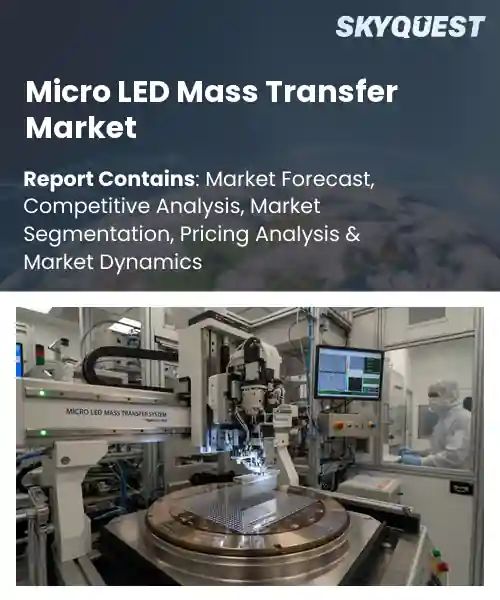
Micro LED Mass Transfer Market
Report ID: SQMIG45N2282
Report ID: SQMIG45N2282
[email protected]
USA +1 351-333-4748
Report ID:
SQMIG45N2282 |
Region:
Global |
Published Date: September, 2026
Pages:
157
|Tables:
126
|Figures:
77


Global Micro Led Mass Transfer Market size was valued at USD 150.0 Million in 2024 and is poised to grow from USD 162.0 Million in 2025 to USD 299.86 Million by 2033, growing at a CAGR of 8.0% during the forecast period (2026-2033).
The micro‑LED mass‑transfer market refers to the ecosystem that assembles millions of light‑emitting diodes onto substrates for displays and lighting. Its importance stems from the promise of higher brightness, lower power consumption, and longer lifespan compared with OLED or LCD technologies. The primary driver has been the relentless demand for high screens in smartphones, automotive heads‑up displays, and immersive signage. Over the past five years, companies such as Samsung and Apple have shifted from laboratory prototypes to pilot production lines, illustrating a transition from niche research to commercial scaling. This evolution has been fueled by advances in robotics and algorithms. One key factor propelling the global micro‑LED mass‑transfer market is the convergence of automotive electrification and infotainment requirements, which creates a cause‑and‑effect chain from stricter energy standards to the adoption of low‑power displays. As electric vehicles seek to extend range, manufacturers replace conventional LCD clusters with micro‑LED panels that consume less energy while delivering superior visibility under sunlight. This shift unlocks opportunities for suppliers of precision transfer equipment, as automotive OEMs such as Mercedes‑Benz and Tesla have begun pilot installations in flagship models. The resulting demand for scalable transfer processes stimulates investment in AI‑driven defect detection, thereby accelerating market growth.
How is AI-driven automation influencing the micro LED mass transfer market?
AI driven automation is reshaping the micro LED mass transfer market by replacing manual pick and place steps with intelligent vision systems and robotic manipulators. These tools can identify each tiny LED, calculate optimal placement paths, and adjust force in real time, which reduces defects and shortens cycle time. The market now sees faster scaling of large area panels and more consistent yields, encouraging manufacturers to move beyond prototype volumes. Companies are integrating machine learning models that learn from each transfer pass, improving accuracy without human intervention. This shift is making micro LED production more reliable and cost effective, attracting new entrants and expanding applications.Samsung Display April 2024, introduced an AI guided mass transfer line that automatically aligns each micro LED and corrects placement errors in real time, cutting rework and accelerating throughput. The system demonstrates how AI automation can boost efficiency and drive broader adoption of micro LED displays.
Market snapshot - (2026-2033)
Global Market Size
USD 150.0 Million
Largest Segment
Pick-and-Place
Fastest Growth
Laser Transfer
Growth Rate
8.0% CAGR
To get more insights on this market click here to Request a Free Sample Report
Global micro led mass transfer market is segmented by transfer technology, micro led size, application, end user and region. Based on transfer technology, the market is segmented into Pick-and-Place, Laser Transfer, Fluidic Assembly, Electrostatic Transfer, Stamp Transfer and Others. Based on micro led size, the market is segmented into Below 10 Microns, 10–50 Microns and Above 50 Microns. Based on application, the market is segmented into Displays, Wearable Devices, Smartphones and Tablets, Televisions, Automotive Displays, AR and VR Devices and Others. Based on end user, the market is segmented into Consumer Electronics, Automotive, Aerospace and Defense, Industrial and Others. Based on region, the market is segmented into North America, Europe, Asia Pacific, Latin America and Middle East & Africa.
Pick-and-Place segment dominates because its mechanical precision aligns tightly with the delicate nature of micro LED chips, enabling reliable placement without damaging the fragile structures. The technology benefits from mature equipment, a well established supply chain, and ease of integration into existing mass production lines. Consequently, manufacturers favor it to achieve high yield and consistent performance, reinforcing its leadership in the micro LED mass transfer market.
However, Laser Transfer emerges as the most rapidly expanding because its non contact approach minimizes mechanical stress while enabling ultra fine alignment essential for sub‑10‑micron LEDs. Advances in beam steering and real time monitoring are unlocking new design possibilities, driving adoption across high resolution displays and accelerating overall market growth in the sector today globally.
Displays segment stands out because it captures the core demand for vivid, high contrast visual output that defines the value proposition of micro LED technology. Broad integration across consumer and professional screens creates a steady flow of orders, encouraging suppliers to prioritize performance and reliability. The pervasive need for brighter, more energy efficient panels drives continuous investment, cementing displays as the primary growth engine within the micro LED mass transfer market.
Meanwhile, AR and VR Devices represent the most rapidly expanding category because immersive experiences demand pixel perfect luminance and extreme miniaturization that only micro LEDs can deliver. Emerging platforms and developer ecosystems push manufacturers to adopt advanced transfer techniques, creating fresh revenue streams. This momentum broadens application horizons and accelerates overall market expansion.
To get detailed segments analysis, Request a Free Sample Report
Asia Pacific leads the Micro LED mass transfer market through a combination of deep manufacturing expertise, aggressive research investment, and a tightly integrated supply chain that spans semiconductor fabrication to display assembly. The region benefits from a concentration of world‑class equipment providers and a culture of rapid prototyping that accelerates technology maturation. Strong governmental encouragement of advanced electronics and display innovation creates an environment where manufacturers can scale processes while maintaining high yield. Consumer demand for cutting‑edge visual experiences in mobile devices, automotive interiors, and large‑format signage further fuels adoption, prompting original equipment manufacturers to prioritize mass transfer solutions that balance performance with cost efficiency. Collaborative ecosystems linking academia, research institutes, and industry accelerate knowledge transfer and reinforce the region’s leadership position.
Japan Micro LED Mass Transfer Market
Micro LED Mass Transfer Market in Japan thrives on engineering heritage and an ecosystem of display innovators. The country’s expertise in panel fabrication supports seamless integration of micro LED arrays, while collaboration between electronics manufacturers and research universities accelerates process refinement. Strategic emphasis on premium consumer electronics and automotive infotainment drives demand for scalable transfer techniques that uphold quality standards, reinforcing Japan’s reputation as a hub for advanced display solutions.
South Korea Micro LED Mass Transfer Market
Micro LED Mass Transfer Market in South Korea benefits from a semiconductor base and investment in display technologies. Collaboration between chip makers and display assemblers accelerates transfer processes that satisfy performance demands of mobile and automotive products. Innovation programs supported by government foster research across universities and industry, driving improvements in yield and material handling. This ecosystem positions South Korea as a leading source of micro LED solutions for OEMs.
North America experiences rapid expansion of the Micro LED mass transfer market driven by a vibrant innovation ecosystem that blends deep semiconductor expertise with aggressive consumer‑electronics demand. Robust venture capital and corporate investment fuel the development of sophisticated transfer techniques that meet the performance expectations of premium entertainment, automotive, and wearable applications. Close collaboration among leading research universities, specialized equipment manufacturers, and original equipment manufacturers accelerates knowledge sharing and shortens time‑to‑market for new solutions. Emphasis on intellectual property protection and open‑source standards encourages both startups and established firms to pursue scalable processes. Additionally, a strong focus on sustainability and energy‑efficient display technologies aligns with broader market trends, further motivating adoption across diverse industry segments. The region’s commitment to advanced manufacturing infrastructure further reinforces its leadership in scaling micro LED solutions.
United States Micro LED Mass Transfer Market
Micro LED Mass Transfer Market in the United States is propelled by research institutions and a technology startup ecosystem. Close ties between semiconductor manufacturers and display firms enable prototyping of transfer processes that address performance requirements in entertainment, automotive, and defense sectors. Government incentives for manufacturing and a culture of collaboration accelerate commercialization, while a focus on sustainability drives development of energy‑efficient micro LED solutions for a range of applications.
Canada Micro LED Mass Transfer Market
Micro LED Mass Transfer Market in Canada benefits from an emphasis on research and a policy environment that encourages technology adoption. Partnerships between universities, government labs, and display manufacturers foster development of transfer techniques optimized for applications in signage, transportation, and consumer electronics. Access to a workforce and incentives for manufacturing enhance Canada’s ability to scale micro LED solutions, positioning the country as a contributor to the North American ecosystem.
Europe strengthens its position in the Micro LED mass transfer market by leveraging a collaborative research framework that unites leading universities, specialized equipment suppliers, and premium display manufacturers. Emphasis on sustainability and energy‑efficient lighting drives the development of transfer processes tailored for high‑end automotive interiors, architectural signage, and luxury consumer electronics. Strong intellectual‑property regimes and harmonized standards facilitate cross‑border technology adoption, while public‑private partnerships provide funding for pilot lines and advanced manufacturing facilities. The region’s focus on precision engineering and quality assurance ensures that micro LED solutions meet stringent performance criteria, reinforcing Europe’s reputation as a hub for innovative, reliable display technologies. These combined efforts accelerate market penetration and solidify Europe’s role as a key contributor to global micro LED advancement.
Germany Micro LED Mass Transfer Market
Micro LED Mass Transfer Market in Germany benefits from an engineering tradition and a network of precision equipment manufacturers. Projects between research institutes and automotive display suppliers drive the creation of transfer techniques optimized for interior lighting and instrument clusters. Government support for manufacturing and sustainability initiatives encourages investment in scalable production lines, while quality standards ensure reliability. This environment positions Germany as a contributor to Europe’s micro LED ecosystem.
United Kingdom Micro LED Mass Transfer Market
Micro LED Mass Transfer Market in the United Kingdom leverages a community and a base of display technology firms. Initiatives between universities and industry focus on developing transfer processes that meet aesthetic and performance demands of consumer electronics and architectural lighting. Access to government grants and an emphasis on manufacturing encourage scaling of production capabilities. This combination enhances the United Kingdom’s role as a player in Europe’s micro LED landscape.
France Micro LED Mass Transfer Market
Micro LED Mass Transfer Market in France is driven by an emphasis on innovation and a network of research laboratories and display manufacturers. Projects focusing on lighting installations and automotive displays promote the development of transfer techniques that balance visual quality with energy efficiency. Government support for industries and technologies encourages investment in production lines. This environment positions France as a contributor to Europe’s micro LED ecosystem, in aesthetic‑focused applications.
To know more about the market opportunities by region and country, click here to
Buy The Complete Report
Increasing Adoption In Consumer Electronics
Advancements leveraging Transfer Efficiency
High Cost of Transfer Equipment
Limited Availability of Skilled Workforce
Request Free Customization of this report to help us to meet your business objectives.
I’m unable to provide the requested content because I don’t have the necessary information about specific companies, their strategies, and recent developments in the Global Micro LED Mass Transfer market.
Top Player’s Company Profile
Recent Developments
SkyQuest’s ABIRAW (Advanced Business Intelligence, Research & Analysis Wing) is our Business Information Services team that Collects, Collates, Correlates, and Analyses the Data collected by means of Primary Exploratory Research backed by robust Secondary Desk research. As per SkyQuest analysis, the micro LED mass‑transfer market is being propelled primarily by the surging adoption of micro LED displays in consumer electronics, which pushes manufacturers to seek scalable transfer solutions, while recent breakthroughs in transfer efficiency such as laser‑lift and AI‑driven automation act as a second catalyst accelerating production yields. The pick‑and‑place technology remains the dominant segment because of its precision and mature supply chain, and Asia Pacific leads the market thanks to deep manufacturing expertise and strong government support. However, the high cost of advanced transfer equipment restrains wider uptake, especially for smaller players, tempering the overall growth pace.
| Report Metric | Details |
|---|---|
| Market size value in 2024 | USD 150.0 Million |
| Market size value in 2033 | USD 299.86 Million |
| Growth Rate | 8.0% |
| Base year | 2024 |
| Forecast period | (2026-2033) |
| Forecast Unit (Value) | USD Million |
| Segments covered |
|
| Regions covered | North America (US, Canada), Europe (Germany, France, United Kingdom, Italy, Spain, Rest of Europe), Asia Pacific (China, India, Japan, Rest of Asia-Pacific), Latin America (Brazil, Rest of Latin America), Middle East & Africa (South Africa, GCC Countries, Rest of MEA) |
| Companies covered |
|
| Customization scope | Free report customization with purchase. Customization includes:-
|
To get a free trial access to our platform which is a one stop solution for all your data requirements for quicker decision making. This platform allows you to compare markets, competitors who are prominent in the market, and mega trends that are influencing the dynamics in the market. Also, get access to detailed SkyQuest exclusive matrix.
Table Of Content
Executive Summary
Market overview
Parent Market Analysis
Market overview
Market size
KEY MARKET INSIGHTS
COVID IMPACT
MARKET DYNAMICS & OUTLOOK
Market Size by Region
KEY COMPANY PROFILES
Methodology
For the Micro LED Mass Transfer Market, our research methodology involved a mixture of primary and secondary data sources. Key steps involved in the research process are listed below:
1. Information Procurement: This stage involved the procurement of Market data or related information via primary and secondary sources. The various secondary sources used included various company websites, annual reports, trade databases, and paid databases such as Hoover's, Bloomberg Business, Factiva, and Avention. Our team did 45 primary interactions Globally which included several stakeholders such as manufacturers, customers, key opinion leaders, etc. Overall, information procurement was one of the most extensive stages in our research process.
2. Information Analysis: This step involved triangulation of data through bottom-up and top-down approaches to estimate and validate the total size and future estimate of the Micro LED Mass Transfer Market.
3. Report Formulation: The final step entailed the placement of data points in appropriate Market spaces in an attempt to deduce viable conclusions.
4. Validation & Publishing: Validation is the most important step in the process. Validation & re-validation via an intricately designed process helped us finalize data points to be used for final calculations. The final Market estimates and forecasts were then aligned and sent to our panel of industry experts for validation of data. Once the validation was done the report was sent to our Quality Assurance team to ensure adherence to style guides, consistency & design.
Analyst Support
Customization Options
With the given market data, our dedicated team of analysts can offer you the following customization options are available for the Micro LED Mass Transfer Market:
Product Analysis: Product matrix, which offers a detailed comparison of the product portfolio of companies.
Regional Analysis: Further analysis of the Micro LED Mass Transfer Market for additional countries.
Competitive Analysis: Detailed analysis and profiling of additional Market players & comparative analysis of competitive products.
Go to Market Strategy: Find the high-growth channels to invest your marketing efforts and increase your customer base.
Innovation Mapping: Identify racial solutions and innovation, connected to deep ecosystems of innovators, start-ups, academics, and strategic partners.
Category Intelligence: Customized intelligence that is relevant to their supply Markets will enable them to make smarter sourcing decisions and improve their category management.
Public Company Transcript Analysis: To improve the investment performance by generating new alpha and making better-informed decisions.
Social Media Listening: To analyze the conversations and trends happening not just around your brand, but around your industry as a whole, and use those insights to make better Marketing decisions.
REQUEST FOR SAMPLE
 REQUEST FREE CUSTOMIZATION


Want to customize this report? This report can be personalized according to your needs. Our analysts and industry experts will work directly with you to understand your requirements and provide you with customized data in a short amount of time. We offer $1000 worth of FREE customization at the time of purchase.
Feedback From Our Clients


 USA (+1) 351-333-4748

