Methyl Methacrylate (MMA) Monomer Market
Report ID: SQMIG15E3390
Report ID: SQMIG15E3390
[email protected]
USA +1 351-333-4748
Report ID:
SQMIG15E3390 |
Region:
Global |
Published Date: March, 2026
Pages:
157
|Tables:
91
|Figures:
76


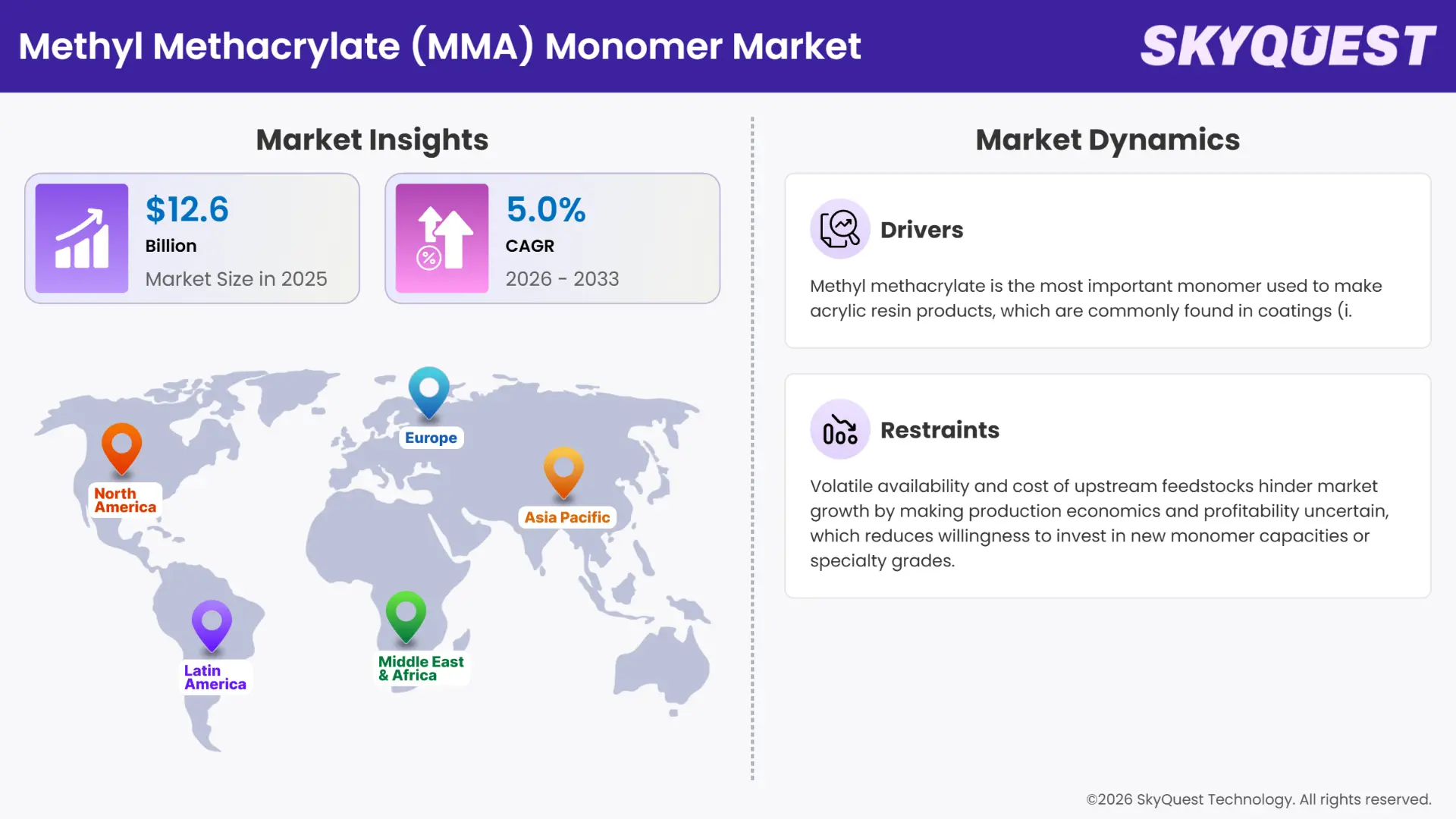
Global Methyl Methacrylate (MMA) Monomer Market size was valued at USD 12.0 Billion in 2024 and is poised to grow from USD 12.6 Billion in 2025 to USD 18.62 Billion by 2033, growing at a CAGR of 5.0% during the forecast period (2026-2033).
Key Takeaways: Market Trends & Insights
The increasing demand from consumers for acrylic polymers that offer both durability and optical quality when used in products such as auto glass, architectural panels, LED lighting, and electrical appliances is the main factor driving the global methyl methacrylate (MMA) monomer market. The MMA monomer market provides the primary raw material used to make poly methyl methacrylate (PMMA), along with other resins, thereby supporting these industries focused on lightweight transparent products and UV resistance. Historically, the way MMA has been produced has changed from the traditional use of small batch production to an integrated manufacturing with continuous plants and innovative methods of producing feedstock.
Major producers have expanded their production capacity in the Middle East and China in order to meet the growing demands for MMA. Global MMA dynamics are also affected by three additional factors i.e. the availability of feedstock (the raw materials used to produce MMA), the cost of feedstock and production economics, the cost of feedstock has a direct effect on margins and responsiveness for production and supply. If options for producing feedstock from acetone and benzene become price competitive, manufacturers increase production volume and reduce the cost of MMA, thus increasing the amount of acrylic sheeting sold for construction and acrylic lenses manufactured for vehicles.
How is Automation Improving Production Efficiency in the Methyl Methacrylate (MMA) Monomer Market?
The methyl methacrylate (MMA) monomer industry has experienced efficiency gains through automation by enhancing both the control of processes and connectivity between facilities and real-time data analytics. Some examples are advanced sensors, on-going process monitoring, predictive maintenance strategies, and model-based manufacturing processes, which lower the variability in production and reduce unplanned production downtime.
As a result, many MMA producers today incorporate integrated control systems and online analytical capabilities for stabilizing reaction processes, increasing product quality, and decreasing energy consumption. All of these factors have been impacted by the demand for new production capacity along with expectations for reliability and flexibility from producers. Several examples exist ranging from vendors developing real time monitoring products for the synthesis of acrylates to well established automating projects at MMA facilities, demonstrating measurable improvements in operational reliability and throughput.
Röhm in March 2025, achieved successful implementation of LiMA process technology, coupled with modern integrated control systems, at its MMA production plant in Bay City, and the combination of new chemistry and automation have already proven to increase yield.
To get more insights on this market click here to Request a Free Sample Report
Global methyl methacrylate (mma) monomer market is segmented into production route, application segment, end-use industry and region. Based on production route, the market is segmented into ACH process, ethylene-based (C4) process and isobutylene/tert-butanol process. Based on application segment, the market is segmented into PMMA (polymethyl methacrylate) production, surface coatings & paints, adhesives & sealants and emulsion polymers. Based on end-use industry, the market is segmented into automotive, building & construction and electronics & signage. Based on region, the market is segmented into North America, Europe, Asia Pacific, Latin America and Middle East & Africa.
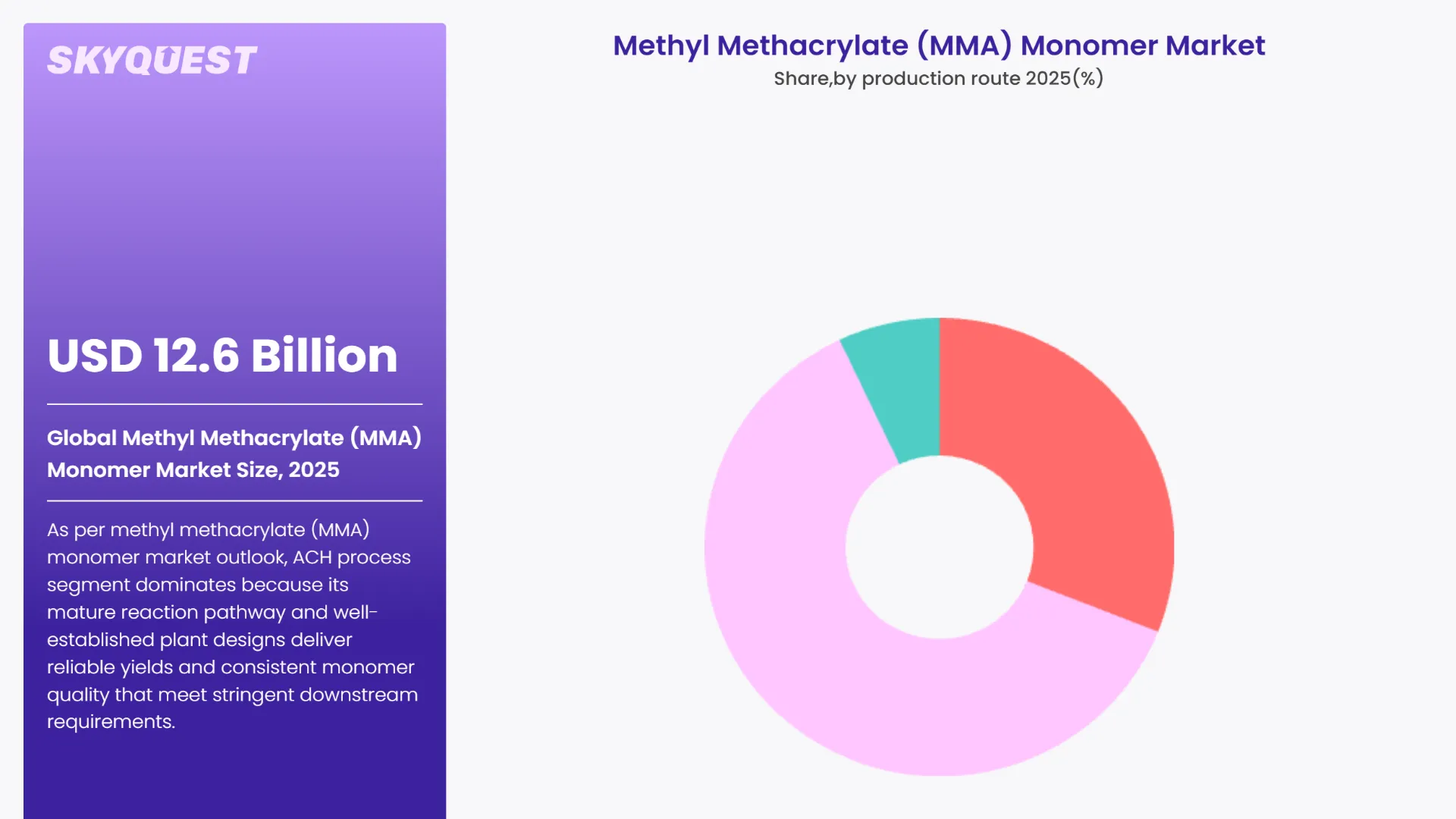
As per methyl methacrylate (MMA) monomer market outlook, ACH process segment dominates because its mature reaction pathway and well-established plant designs deliver reliable yields and consistent monomer quality that meet stringent downstream requirements. The predictable operating profile reduces feedstock sensitivity and allows tighter impurity control, which lowers effective production risk and supports long term commercial agreements, encouraging capital allocation and capacity optimization around this route.
As per methyl methacrylate (MMA) monomer market forecast, isobutylene/tert-butanol process is emerging as the most rapidly expanding route driven by growing interest in feedstock flexibility and lower lifecycle emissions. Its compatibility with alternative or bio-based inputs and suitability for modular plant configurations attracts new investment and process innovation, accelerating development of specialty MMA grades and opening novel commercialization opportunities across diversified applications.
PMMA production segment dominates with large global methyl methacrylate (MMA) monomer market share because PMMA producers require high purity and precisely controlled monomer characteristics to achieve optical clarity, mechanical performance and processing consistency in finished products. These requirements necessitate increased quality specifications, require stricter impurity and residual monomer limits, and create contractual supply priorities which cause PMMA producers to implement advanced purification methods and improve production methods to meet the above-mentioned requirements.
As per methyl methacrylate (MMA) monomer market analysis, the emulsion polymers segment is seeing the largest increase in growth from waterborne and low VOC (volatile organic compounds) systems, as demand for new and innovative coating and adhesive technologies grows. Regulatory pressures coupled with a customer preference for low emission formulations, along with advances in formulations that include high levels of MMA (methyl methacrylate) copolymers, has created a new demand for monomers which will cause suppliers to develop new grades that will be designed for optimal emulsion polymerization results and stability.
To get detailed segments analysis, Request a Free Sample Report
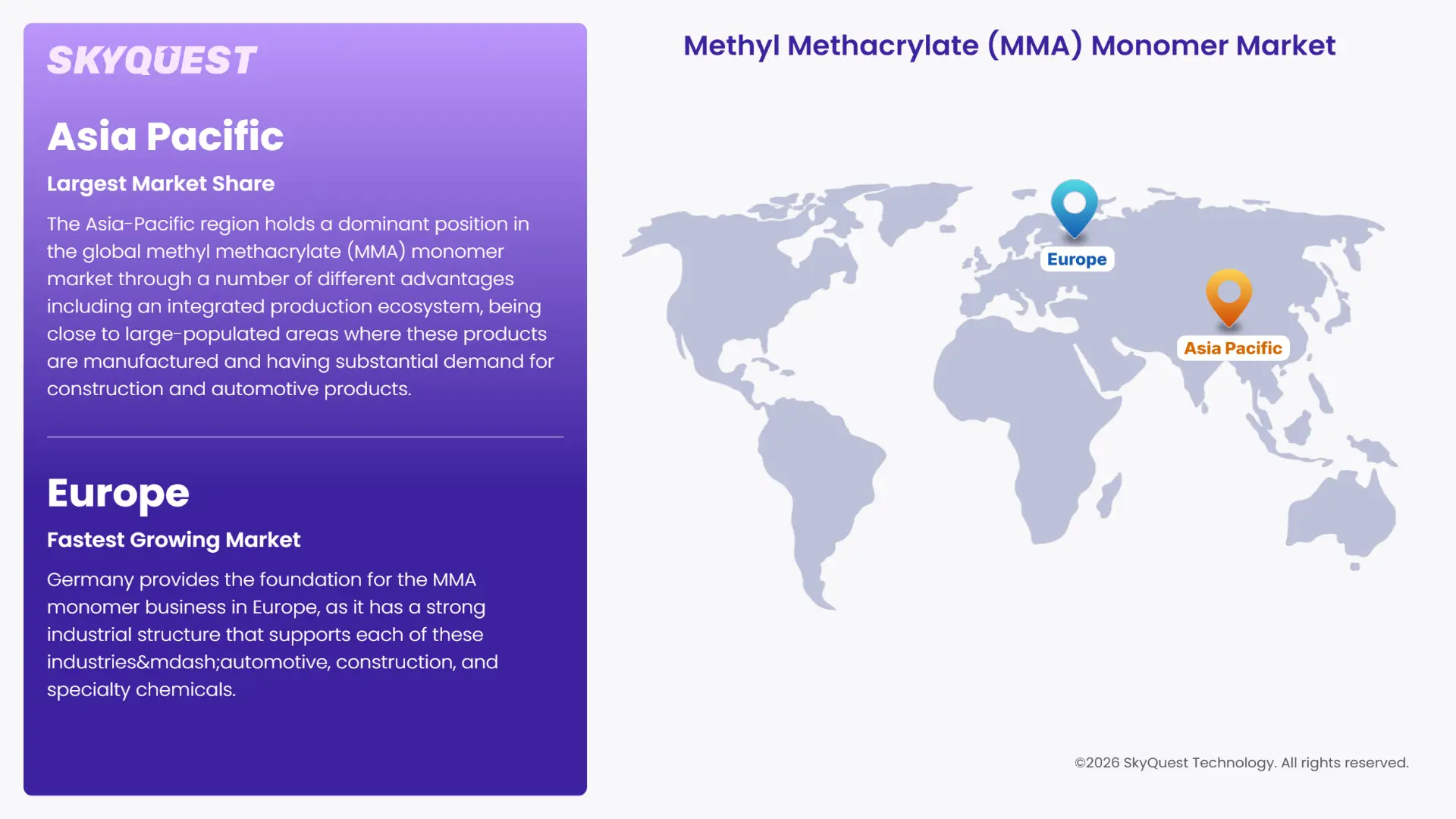
The Asia-Pacific region holds a dominant position in the global methyl methacrylate (MMA) monomer market through a number of different advantages including an integrated production ecosystem, being close to large-populated areas where these products are manufactured and having substantial demand for construction and automotive products. In a number of ways, regional manufacturers benefit from the established chemical complexes that are located in the region and from the availability of raw materials (feedstock) to support production. Long-term strategic investments in capacity expansion and technology development also benefit the regional producer by allowing them to adapt quickly to changes in the market. In addition, supply chain linkages for companies that are in neighbouring markets provide increased agility to respond to customer demands and improve logistics performance. Policy frameworks and industry incentives implemented by government authorities promote greater competitiveness for manufacturers within the regional economy. In addition, a number of different types of end-use applications for MMA create a stable domestic market for the regional economy.
As per methyl methacrylate (MMA) monomer market regional outlook, Japan has been established with advanced specialty chemical production facilities that support precision manufacturing activities. The majority of domestic consumption is focused on the optical industry, where MMA is used for optical medallions; as well as electronic encapsulation products and high-performance coatings. Their use of research and development collaborations with researchers will help to improve their production processes through better technology adaptation because the majority of Japanese manufacturers focus on quality and product innovation.
As per methyl methacrylate (MMA) monomer market regional forecast, South Korea is strong because of the diverse range of products produced in the downstream manufacturing segment, which includes electronics, optical materials and specialty coatings. Manufacturers in South Korea have developed manufacturing capabilities that facilitate rapid response times by using flexible manufacturing processes that enable them to meet customer-defined specifications. The use of global suppliers and their participation in regional supply networks enhances material availability and logistics efficiency for manufacturers located in South Korea.
The rapid growth of the methyl methacrylate (MMA) monomer market in Europe is fueled by a variety of factors including a diverse range of end uses, sophisticated manufacturing technologies used by downstream manufacturers, and coordinated regulatory frameworks that support the adoption of higher-performance materials. A strong focus on specialty applications such as architectural glass, automotive coatings, and precision coatings contributes to a drive for premium products. Investment in environmentally sustainable production methods and continued improvement of manufacturing processes to enhance competitiveness among regional suppliers. Close cooperation between chemical manufacturers, converters, and research institutions provides an accelerated path for new product development and provides efficient logistics systems and established trade relationships to deliver products throughout Europe. Incentivized circular chemistry policies, access to technical capability, further enhance supply chain resilience, and support differentiated products in national markets.
Germany provides the foundation for the MMA monomer business in Europe, as it has a strong industrial structure that supports each of these industries—automotive, construction, and specialty chemicals. German producers have placed significant emphasis on process efficiency and utilizing state-of-the-art production technologies. They also benefit from their geographic location, proximity to leading converters, and an ample supply of highly skilled technical support to deliver customized products.
In the UK, the industry provides most of an emerging market for methyl methacrylate (MMA) monomers with increased importance being placed on these products to serve new bespoke applications and coatings. Recent innovation in architectural materials has increased domestic demand for MMA and is having a positive effect on consumer-initiated innovation resulting in MMS (manufactured modular system) manufacturers creating custom formulations and products. The flexibility of MMA converters, availability of technical service providers and accessibility of global trade routes is helping to provide faster than; ever response to demands within the UK MMA market. Collaboration between industry and research partners is building a platform that helps provide a sustainable ecosystem within which further growth and expansion will occur.
The demand for methyl methacrylate (MMA) monomer products in France is soaring. This methyl methacrylate (MMA) monomer market trend will translate into accelerated growth and development activities in French MMA producers and converters that are being challenged to create new innovative resin formulations and custom coating technologies that fulfill ever-changing design and performance standards. Research universities and industry link to each other and encourage the development of new productive processes so that they may expedite commercialization of those changes for the respective French market.
The methyl methacrylate (MMA) monomer market will continue to strengthen in North America as the region improves integration of feedstocks by producers and consumers, as well as applying newer technologies. By strategically using the North American chemical infrastructure, producers create more flexible production methods that lead to capacity optimization and utilize modern manufacturing techniques, which produce products with improved consistency and lower costs.
The U.S. market utilizes existing chemical infrastructure in conjunction with its close relationship with the coatings and plastics industries to make competitive products. Producers strive for flexible production methods and are engaged in developing applications that meet specific performance requirements. The U.S. has a robust logistics network and is in proximity to the converters, which allows for reliable product supply and cost-effective distribution. Research and development partnerships help producers work together with research institutions to create high-performance formulations, making the U.S. a major contributor in the market in North America.
As per methyl methacrylate (MMA) monomer industry analysis, Canada market has reliable access to feedstocks and has many specialty chemical manufacturers supporting their purchasing efforts. Producers focus on customizing products to meet specific requirements while demonstrating their commitment to producing environmentally friendly chemicals, enhancing customer confidence. Canada has excellent transportation infrastructure connecting to North American producers to ensure the timely movement of goods. Producers work with converters to create tailored product solutions.
To know more about the market opportunities by region and country, click here to
Buy The Complete Report
Rising Demand from Coatings Industry
Methyl methacrylate is the most important monomer used to make acrylic resin products, which are commonly found in coatings (i.e., protective and decorative). They possess chemical properties that help manufacturers create durable and aesthetically pleasing products that meet the high-performance standards set by manufacturers. As formulators look for durable and low-maintenance finishes on construction, automotive, and industrial projects, the need for MMA will continue to grow to provide flexibility in the design of resins and compatibility with various additives. This direct correlation between the requirements of the end-user and the formulation of choices made by the resin manufacturer results in a greater need for procuring MMA, allowing for the growth and innovation of supply chains.
Growth in the Use of Acrylic Sheets
With an increased emphasis on using acrylic sheet products in the areas of architecture, signage and optically specific applications, there is a corresponding and growing reliance on methyl methacrylate as the primary monomer used in the production of polymethyl methacrylate. In addition to being aesthetically pleasing due to its high optical clarity, ease of forming and weather resistance, MMA has become the primary monomer used by resin suppliers who develop MMA-based formulas to suit specific applications. Thus, the continued preference for acrylic sheet products creates reliable signals for MMA suppliers, which allows them to invest in reliable supply chains, while also developing tailored grades of MMA to accommodate the ever-wider array of processing and end-use requirements.
Feedstock Price Volatility
Volatile availability and cost of upstream feedstocks hinder market growth by making production economics and profitability uncertain, which reduces willingness to invest in new monomer capacities or specialty grades. When manufacturers are faced with volatile input costs they may delay their capacity expansion efforts, focus on short-term inventory management rather than grow their business long term, and instead pass the increased prices they pay for raw materials on to their customers which will erode demand stability therefore creating a downward cycle of diminishing demand to fulfill capacity. Furthermore, the economic uncertainty surrounding upstream feedstock volatility complicates the establishment of long-term supplier and buyer contracts and/or strategic planning by both suppliers and buyers hampering the market’s ability to maintain steady growth trajectories.
Cost of Complying with Increasingly Strict Environmental Regulations
Increasing regulation concerning environmental issues forces producers to invest capital in abatement systems, effluent treatment, and safety systems creating increased operating costs associated with compliance that also act as barriers to entry for smaller, less capitalized producers. In addition, producers are required to modify their production processes to meet compliance requirements, limiting their production flexibility, and slowing the development and introduction of specialty grades/products. Increased compliance costs impact how producers choose sites for their manufacturing facilities as well as how they will plan their capacity therefore creating a concentration of production where there is supportive infrastructure for compliance costs thereby limiting the intended growth in the overall market. The costs and operational limits placed on producers by compliance obstacles limit the ability of the overall market to rapidly expand and diversify.
Request Free Customization of this report to help us to meet your business objectives.
The top performers in the global industry aim to capitalize on the current trends of expansion in capacity, innovative feedstock and circularity, and multiple partnerships to compress margins and drive vertical integration. They do by entering joint ventures and developing new facilities, as demonstrated by the recent partnership between Röhm & OQ (Oman) and the Mitsubishi Chemical Gulf Coast project. Agilyx and Låkril Technologies are putting pressure on conventional ACH technology by piloting new recycling methods and using their licensing practices.
SkyQuest’s ABIRAW (Advanced Business Intelligence, Research & Analysis Wing) is our Business Information Services team that Collects, Collates, Correlates, and Analyses the Data collected by means of Primary Exploratory Research backed by robust Secondary Desk research.
As per SkyQuest analysis, there is expected to be continuing growth in the global methyl methacrylate (MMA) monomer industry due to the increase in acrylic polymer usage. This will be driven by both the demand for products that give us optical clarity and durable weather resistance in coatings & PMMA applications. The price volatility of feedstock represents a primary restriction which can squeeze margins and reduce capital expenditures for capacity additions. Asia Pacific dominates (both in the consumption of MMA and in the production of MMA) due to large, integrated chemical clusters and increased downstream demand. The PMMA segment of the market continues to be the largest application driver as the need for high-purity monomer requirements leads to the production of higher-grade materials. Secondly, acrylic sheet applications for glazing and signage continue to increase and will maintain long-term demand for MMA monomers as well as drive capacity expansions in this segment.
| Report Metric | Details |
|---|---|
| Market size value in 2024 | USD 12.0 Billion |
| Market size value in 2033 | USD 18.62 Billion |
| Growth Rate | 5.0% |
| Base year | 2024 |
| Forecast period | 2026-2033 |
| Forecast Unit (Value) | USD Billion |
| Segments covered |
|
| Regions covered | North America (US, Canada), Europe (Germany, France, United Kingdom, Italy, Spain, Rest of Europe), Asia Pacific (China, India, Japan, Rest of Asia-Pacific), Latin America (Brazil, Rest of Latin America), Middle East & Africa (South Africa, GCC Countries, Rest of MEA) |
| Companies covered |
|
| Customization scope | Free report customization with purchase. Customization includes:-
|
To get a free trial access to our platform which is a one stop solution for all your data requirements for quicker decision making. This platform allows you to compare markets, competitors who are prominent in the market, and mega trends that are influencing the dynamics in the market. Also, get access to detailed SkyQuest exclusive matrix.
Table Of Content
Executive Summary
Market overview
Parent Market Analysis
Market overview
Market size
KEY MARKET INSIGHTS
COVID IMPACT
MARKET DYNAMICS & OUTLOOK
Market Size by Region
KEY COMPANY PROFILES
Methodology
For the Methyl Methacrylate (MMA) Monomer Market, our research methodology involved a mixture of primary and secondary data sources. Key steps involved in the research process are listed below:
1. Information Procurement: This stage involved the procurement of Market data or related information via primary and secondary sources. The various secondary sources used included various company websites, annual reports, trade databases, and paid databases such as Hoover's, Bloomberg Business, Factiva, and Avention. Our team did 45 primary interactions Globally which included several stakeholders such as manufacturers, customers, key opinion leaders, etc. Overall, information procurement was one of the most extensive stages in our research process.
2. Information Analysis: This step involved triangulation of data through bottom-up and top-down approaches to estimate and validate the total size and future estimate of the Methyl Methacrylate (MMA) Monomer Market.
3. Report Formulation: The final step entailed the placement of data points in appropriate Market spaces in an attempt to deduce viable conclusions.
4. Validation & Publishing: Validation is the most important step in the process. Validation & re-validation via an intricately designed process helped us finalize data points to be used for final calculations. The final Market estimates and forecasts were then aligned and sent to our panel of industry experts for validation of data. Once the validation was done the report was sent to our Quality Assurance team to ensure adherence to style guides, consistency & design.
Analyst Support
Customization Options
With the given market data, our dedicated team of analysts can offer you the following customization options are available for the Methyl Methacrylate (MMA) Monomer Market:
Product Analysis: Product matrix, which offers a detailed comparison of the product portfolio of companies.
Regional Analysis: Further analysis of the Methyl Methacrylate (MMA) Monomer Market for additional countries.
Competitive Analysis: Detailed analysis and profiling of additional Market players & comparative analysis of competitive products.
Go to Market Strategy: Find the high-growth channels to invest your marketing efforts and increase your customer base.
Innovation Mapping: Identify racial solutions and innovation, connected to deep ecosystems of innovators, start-ups, academics, and strategic partners.
Category Intelligence: Customized intelligence that is relevant to their supply Markets will enable them to make smarter sourcing decisions and improve their category management.
Public Company Transcript Analysis: To improve the investment performance by generating new alpha and making better-informed decisions.
Social Media Listening: To analyze the conversations and trends happening not just around your brand, but around your industry as a whole, and use those insights to make better Marketing decisions.
REQUEST FOR SAMPLE
 REQUEST FREE CUSTOMIZATION
Global Methyl Methacrylate (Mma) Monomer Market size was valued at USD 12.0 Billion in 2024 and is poised to grow from USD 12.6 Billion in 2025 to USD 18.62 Billion by 2033, growing at a CAGR of 5.0% during the forecast period (2026-2033).
Competitive dynamics in the global MMA monomer market center on capacity expansion, feedstock and circularity innovation, and strategic partnerships that compress margins and spur vertical integration. Major incumbents pursue joint ventures and new plants such as Röhm with OQ and Mitsubishi Chemical Gulf Coast projects, while recyclers and bio routes from Agilyx and Låkril Technologies pressure traditional ACH technology with pilots and licensing plays. 'Mitsubishi Chemical Corporation', 'BASF SE', 'Evonik Industries AG', 'Lucite International', 'Dow Chemical Company', 'LG Chem', 'Trinseo S.A.', 'Sumitomo Chemical Co., Ltd.', 'Arkema S.A.', 'Hexion Inc.', 'AOC Aliancys', 'Chemart Group', 'GCR Group', 'Wanhua Chemical Group Co., Ltd.', 'Shandong Longchang Chemical Co., Ltd.', 'Zhejiang Luanhe Chemical Co., Ltd.', 'Jilin Petrochemical Company', 'Alpha Chemicals', 'Zhejiang Jiangshan Chemical Co., Ltd.', 'Sanwa Chemical Corp.'
Methyl methacrylate is a primary monomer for acrylic resins used extensively in protective and decorative coatings; its chemical properties impart enhanced weatherability, gloss retention, and adhesion that manufacturers rely on to meet stringent performance expectations. As formulators seek durable, low-maintenance finishes for construction, automotive, and industrial applications, demand for MMA increases because it enables versatile resin design and compatibility with additives. This direct linkage between end-use performance requirements and resin formulation choices encourages higher procurement of MMA and supports capacity expansion and innovation across the supply chain.
Bio Based And Circular Solutions: Growing corporate commitments to sustainability are accelerating development of bio based methyl methacrylate and recycled acrylic feedstocks. Producers are exploring renewable materials, chemical recycling routes and closed loop partnerships with downstream users to reduce lifecycle emissions and enhance brand value. This shift encourages process innovation, cross industry collaborations and premium pricing for low carbon grades, while reshaping supply chains toward traceability and certification frameworks that support customer procurement policies and investor environmental goals and driving investment in sustainable manufacturing capacity.
Asia Pacific Dominate the Global Methyl Methacrylate (MMA) Monomer Market.
The ACH (Acetone Cyanohydrin) Process currently dominates the global MMA Monomer market due to its established production infrastructure, proven efficiency, and widespread industrial adoption.
PMMA (Polymethyl Methacrylate) Production represents the largest application segment, as MMA serves as the key raw material for manufacturing acrylic sheets, automotive components, signage materials, and optical products.
Automation technologies such as advanced sensors, predictive maintenance systems, real-time monitoring, and integrated process controls are improving production efficiency, reducing downtime, and enhancing product quality across MMA manufacturing facilities.


Want to customize this report? This report can be personalized according to your needs. Our analysts and industry experts will work directly with you to understand your requirements and provide you with customized data in a short amount of time. We offer $1000 worth of FREE customization at the time of purchase.
Feedback From Our Clients


 USA (+1) 351-333-4748

