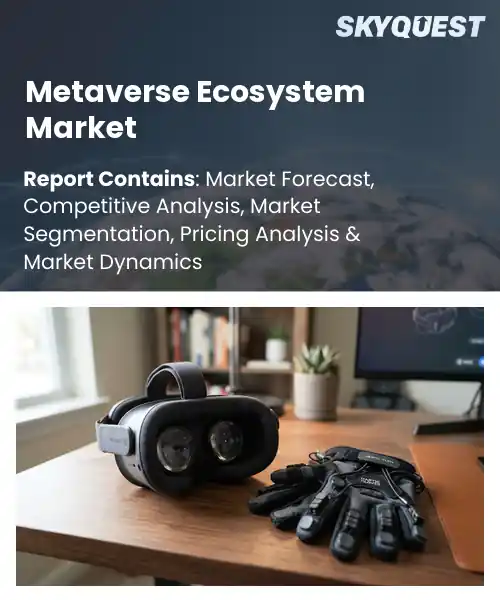
Metaverse Ecosystem Market
Report ID: SQMIG45E3357
Report ID: SQMIG45E3357
[email protected]
USA +1 351-333-4748
Report ID:
SQMIG45E3357 |
Region:
Global |
Published Date: November, 2026
Pages:
157
|Tables:
124
|Figures:
77


Global Metaverse Ecosystem Market size was valued at USD 68.4 Billion in 2024 and is poised to grow from USD 90.63 Billion in 2025 to USD 861.0 Billion by 2033, growing at a CAGR of 32.5% during the forecast period (2026-2033).
The metaverse ecosystem market includes platforms, hardware, content creators, and service providers that enable virtual environments. Its primary driver is the convergence of technologies especially virtual‑reality headsets and augmented‑reality overlays with a digital economy that values virtual goods. This matters because it opens monetization pathways for brands, entertainment firms, and solutions while reshaping interaction. Historically the market moved from early 3‑D spaces such as Second Life to hubs like Roblox, Fortnite Creative and Horizon Worlds, each showing scalability and integration. The decisive shift occurred when players, such as Meta’s multi‑billion‑dollar VR investment, signaled confidence that an economy could rival traditional markets. Enterprise adoption stands as the pivotal catalyst shaping the global metaverse ecosystem market, because companies see immersive platforms as cost‑effective venues for collaboration, training, and product visualization. Remote‑work policies and the need for rapid prototyping push firms toward digital‑twin environments where engineers test designs without physical models. Consequently, providers such as Nvidia’s Omniverse and Microsoft Mesh secure contracts with manufacturers and design studios, illustrating a revenue stream beyond consumer entertainment. This corporate demand fuels hardware upgrades, expands cloud‑rendering services, and attracts investors, unlocking opportunities in sectors from pharmaceuticals to real‑estate where virtual showrooms and simulated trials promise significant efficiency gains.
How is AI-driven blockchain reshaping monetization in the Metaverse ecosystem market?
AI driven blockchain is redefining how creators and brands capture value in the Metaverse by automating trust, scarcity and personalization. Smart contracts powered by machine learning models can adjust royalty splits in real time, match virtual goods to user preferences, and validate provenance without manual oversight. This convergence enables micro transactions at scale, turning fleeting interactions into revenue streams for developers, influencers and advertisers. Recent pilots show virtual concerts where AI predicts demand and allocates limited edition NFTs, while gaming worlds use adaptive token economies to reward skill and engagement. As the ecosystem matures, these mechanisms are turning speculative assets into sustainable income sources.Enjin March 2024, launched an AI powered blockchain platform that creates dynamic NFTs whose attributes evolve with player behavior, allowing creators to monetize ongoing engagement rather than one time sales. The tool streamlines royalty distribution and boosts user retention, illustrating how AI driven blockchain fuels growth in the Metaverse ecosystem.
Market snapshot - (2026-2033)
Global Market Size
USD 68.4 Billion
Largest Segment
Software & Platforms
Fastest Growth
Hardware
Growth Rate
32.5% CAGR
To get more insights on this market click here to Request a Free Sample Report
Global metaverse ecosystem market is segmented by component, technology, application, end user and region. Based on component, the market is segmented into Hardware, Software & Platforms and Services. Based on technology, the market is segmented into Virtual Reality, Augmented Reality, Mixed Reality, Blockchain & Digital Assets and Artificial Intelligence. Based on application, the market is segmented into Gaming & Entertainment, Social Interaction, Education & Training, Virtual Commerce, Industrial Digital Twins, Healthcare and Other Applications. Based on end user, the market is segmented into Consumers, Enterprises, Educational Institutions and Government & Public Sector. Based on region, the market is segmented into North America, Europe, Asia Pacific, Latin America and Middle East & Africa.
Hardware segment dominates because it forms the physical gateway that enables immersive experiences, anchoring user interaction within the metaverse. Advanced sensors, high‑resolution displays, and ergonomic designs create the tactile realism required for sustained engagement. This foundational role drives continuous investment from device manufacturers and fosters ecosystem partnerships, ensuring that hardware remains the linchpin for market traction and consumer acceptance across multiple use cases and content genres driving long‑term ecosystem vitality.
Meanwhile, Software & Platforms segment emerges as the most rapidly expanding area in the Metaverse Ecosystem Market. Open development environments, cross‑reality engines, and low‑code creation tools lower barriers for creators, fueling a surge in immersive content and services. This acceleration unlocks new revenue streams and attracts diverse participants, propelling overall market growth.
Artificial Intelligence segment dominates because it infuses adaptive intelligence into virtual environments, enabling personalized avatars, predictive content recommendation, and real‑time behavior modeling. By processing vast interaction data, AI creates responsive ecosystems that deepen user immersion and streamline developer workflows. Its capacity to automate world building and enhance social dynamics drives widespread adoption across creators and enterprises, cementing AI as the core engine of metaverse evolution across diverse industry verticals and creative domains.
Conversely, Blockchain & Digital Assets segment is witnessing the strongest growth momentum in the Metaverse Ecosystem Market. Decentralized ownership models, NFTs, and secure transaction layers empower users to monetize creations and join economies. This surge fuels investment in tokenized experiences, broadening economic incentives and attracting new participants, thereby accelerating market expansion and unlocking monetization pathways.
To get detailed segments analysis, Request a Free Sample Report
North America’s dominance stems from a confluence of deep technology expertise, robust venture ecosystems, and a culture that embraces digital experimentation. The region hosts leading cloud infrastructure providers and advanced graphics hardware manufacturers, creating a fertile environment for immersive platform development. Strong academic research institutions feed talent pipelines, while a permissive regulatory climate encourages rapid product iteration and cross‑industry collaboration. Moreover, consumer readiness for virtual experiences is amplified by high broadband penetration and a media landscape that integrates gaming, social interaction, and commerce. These attributes collectively reinforce a feedback loop where innovation, investment, and adoption accelerate each other, securing North America’s leading position in the global metaverse ecosystem.
Metaverse Ecosystem Market activity in the United States is driven by a dense concentration of pioneering firms that blend entertainment, enterprise solutions, and emerging hardware. The synergy between Silicon Valley innovators and major entertainment studios fuels a continuous flow of immersive content, while corporate adopters experiment with virtual collaboration spaces. Academic partnerships and research hubs further nurture cutting‑edge advancements in AI‑enhanced avatars and spatial computing, reinforcing a dynamic ecosystem that attracts global talent and investment.
Metaverse Ecosystem Market development in Canada benefits from strong governmental support for digital innovation and a thriving creative sector. Collaborative initiatives between tech startups and established gaming studios generate diverse immersive experiences, while research institutions focus on human‑computer interaction and mixed‑reality interfaces. The country’s multilingual talent pool and proximity to the United States enable cross‑border partnerships, enhancing the depth and reach of its metaverse offerings.
Asia Pacific’s rapid expansion is propelled by a blend of cultural affinity for interactive media, aggressive adoption of mobile technologies, and strategic investments in next‑generation infrastructure. The region’s leading consumer electronics manufacturers are integrating advanced display and sensor capabilities, enabling richer immersive experiences. Simultaneously, strong gaming traditions and a vibrant creator community fuel a steady stream of localized content that resonates with diverse audiences. Government initiatives that prioritize digital economies and smart‑city frameworks further incentivize enterprises to explore virtual commerce, education, and tourism applications, creating a synergistic environment where technology, culture, and policy converge to accelerate market growth.
Metaverse Ecosystem Market activity in Japan is anchored by a long‑standing expertise in animation, gaming, and robotics. Leading entertainment studios leverage their storytelling prowess to craft compelling virtual narratives, while hardware innovators focus on high‑resolution displays and haptic feedback devices. Collaborative ecosystems linking universities, research labs, and corporate R&D centers drive forward-thinking experiments in digital twins and immersive education, positioning Japan as a hub for culturally rich and technologically sophisticated metaverse solutions.
Metaverse Ecosystem Market progress in South Korea is characterized by a fast‑adopting consumer base and a strong telecom infrastructure that supports low‑latency experiences. The nation’s vibrant esports scene and mobile gaming culture translate seamlessly into immersive social platforms and virtual concerts. Major conglomerates invest heavily in mixed‑reality research, fostering innovations in avatar realism and real‑time rendering, while startups explore novel applications in virtual retail and remote collaboration, reinforcing South Korea’s reputation as a dynamic catalyst for metaverse growth.
Europe strengthens its position through a strategic emphasis on standards, sustainability, and cross‑border collaboration. The region’s policy frameworks encourage interoperable architectures, facilitating seamless interaction across diverse platforms and devices. Strong artistic heritage and design excellence inform immersive content that balances aesthetic appeal with functional utility. Public‑private partnerships fund research into ethical AI, data privacy, and inclusive virtual environments, aligning technological advancement with societal values. Additionally, a network of innovation clusters across multiple countries nurtures talent exchange and joint ventures, enabling Europe to present a cohesive and forward‑looking metaverse ecosystem that resonates with global stakeholders.
Metaverse Ecosystem Market initiatives in Germany are driven by a robust engineering tradition and a focus on industrial applications. Leading manufacturers integrate virtual simulations and digital twins into production processes, enhancing efficiency and predictive maintenance. Academic institutions collaborate closely with tech firms to advance high‑fidelity visualization and real‑time data integration, while policy incentives promote sustainable virtual solutions that reduce physical resource consumption.
Metaverse Ecosystem Market development in the United Kingdom benefits from a thriving creative sector and strong financial services expertise. Media and entertainment firms produce immersive storytelling experiences, while fintech innovators explore virtual marketplaces and blockchain‑based asset ownership. Research centers concentrate on user experience design and accessibility, ensuring that virtual environments cater to a broad demographic and support inclusive participation.
Metaverse Ecosystem Market activity in France combines artistic flair with cutting‑edge technology research. Cultural institutions experiment with virtual exhibitions and heritage preservation, while startups focus on social interaction layers and AI‑driven personalization. Collaborative programs linking fashion, gaming, and tech sectors generate uniquely French immersive experiences that highlight both creativity and technical sophistication.
To know more about the market opportunities by region and country, click here to
Buy The Complete Report
Growing Corporate Adoption Of Metaverse
Expanding Consumer Demand For Immersive Experiences
Regulatory Uncertainty Around Digital Assets
High Infrastructure Cost And Energy Consumption
Request Free Customization of this report to help us to meet your business objectives.
The metaverse ecosystem is shaped by intense rivalry among platform owners, hardware makers, and cloud providers, driving rapid M&A, strategic alliances, and cutting‑edge tech rollouts; Meta’s acquisition of Owlchemy Labs and Beat Games accelerates its creator tools, while Microsoft’s purchase of Activision Blizzard expands its gaming‑to‑metaverse pipeline, and Nvidia’s partnership with Meta fuels AI‑enhanced virtual worlds through the Omniverse platform.
Top Player’s Company Profile
Recent Developments
SkyQuest’s ABIRAW (Advanced Business Intelligence, Research & Analysis Wing) is our Business Information Services team that Collects, Collates, Correlates, and Analyses the Data collected by means of Primary Exploratory Research backed by robust Secondary Desk research. As per SkyQuest analysis the global metaverse ecosystem market is being propelled primarily by growing corporate adoption which pushes firms to invest in immersive platforms for collaboration, training and product visualization, while expanding consumer demand for richer immersive experiences adds a second powerful driver that fuels content creation and platform expansion. The hardware segment remains dominant because it provides the essential gateways—headsets, sensors and high‑performance computing—required for any metaverse interaction. North America leads the market thanks to its deep technology talent, robust cloud infrastructure and high broadband penetration. However, regulatory uncertainty around digital assets restrains investment and slows broader rollout of new services.
| Report Metric | Details |
|---|---|
| Market size value in 2024 | USD 68.4 Billion |
| Market size value in 2033 | USD 861.0 Billion |
| Growth Rate | 32.5% |
| Base year | 2024 |
| Forecast period | (2026-2033) |
| Forecast Unit (Value) | USD Billion |
| Segments covered |
|
| Regions covered | North America (US, Canada), Europe (Germany, France, United Kingdom, Italy, Spain, Rest of Europe), Asia Pacific (China, India, Japan, Rest of Asia-Pacific), Latin America (Brazil, Rest of Latin America), Middle East & Africa (South Africa, GCC Countries, Rest of MEA) |
| Companies covered |
|
| Customization scope | Free report customization with purchase. Customization includes:-
|
To get a free trial access to our platform which is a one stop solution for all your data requirements for quicker decision making. This platform allows you to compare markets, competitors who are prominent in the market, and mega trends that are influencing the dynamics in the market. Also, get access to detailed SkyQuest exclusive matrix.
Table Of Content
Executive Summary
Market overview
Parent Market Analysis
Market overview
Market size
KEY MARKET INSIGHTS
COVID IMPACT
MARKET DYNAMICS & OUTLOOK
Market Size by Region
KEY COMPANY PROFILES
Methodology
For the Metaverse Ecosystem Market, our research methodology involved a mixture of primary and secondary data sources. Key steps involved in the research process are listed below:
1. Information Procurement: This stage involved the procurement of Market data or related information via primary and secondary sources. The various secondary sources used included various company websites, annual reports, trade databases, and paid databases such as Hoover's, Bloomberg Business, Factiva, and Avention. Our team did 45 primary interactions Globally which included several stakeholders such as manufacturers, customers, key opinion leaders, etc. Overall, information procurement was one of the most extensive stages in our research process.
2. Information Analysis: This step involved triangulation of data through bottom-up and top-down approaches to estimate and validate the total size and future estimate of the Metaverse Ecosystem Market.
3. Report Formulation: The final step entailed the placement of data points in appropriate Market spaces in an attempt to deduce viable conclusions.
4. Validation & Publishing: Validation is the most important step in the process. Validation & re-validation via an intricately designed process helped us finalize data points to be used for final calculations. The final Market estimates and forecasts were then aligned and sent to our panel of industry experts for validation of data. Once the validation was done the report was sent to our Quality Assurance team to ensure adherence to style guides, consistency & design.
Analyst Support
Customization Options
With the given market data, our dedicated team of analysts can offer you the following customization options are available for the Metaverse Ecosystem Market:
Product Analysis: Product matrix, which offers a detailed comparison of the product portfolio of companies.
Regional Analysis: Further analysis of the Metaverse Ecosystem Market for additional countries.
Competitive Analysis: Detailed analysis and profiling of additional Market players & comparative analysis of competitive products.
Go to Market Strategy: Find the high-growth channels to invest your marketing efforts and increase your customer base.
Innovation Mapping: Identify racial solutions and innovation, connected to deep ecosystems of innovators, start-ups, academics, and strategic partners.
Category Intelligence: Customized intelligence that is relevant to their supply Markets will enable them to make smarter sourcing decisions and improve their category management.
Public Company Transcript Analysis: To improve the investment performance by generating new alpha and making better-informed decisions.
Social Media Listening: To analyze the conversations and trends happening not just around your brand, but around your industry as a whole, and use those insights to make better Marketing decisions.
REQUEST FOR SAMPLE
 REQUEST FREE CUSTOMIZATION


Want to customize this report? This report can be personalized according to your needs. Our analysts and industry experts will work directly with you to understand your requirements and provide you with customized data in a short amount of time. We offer $1000 worth of FREE customization at the time of purchase.
Feedback From Our Clients


 USA (+1) 351-333-4748

