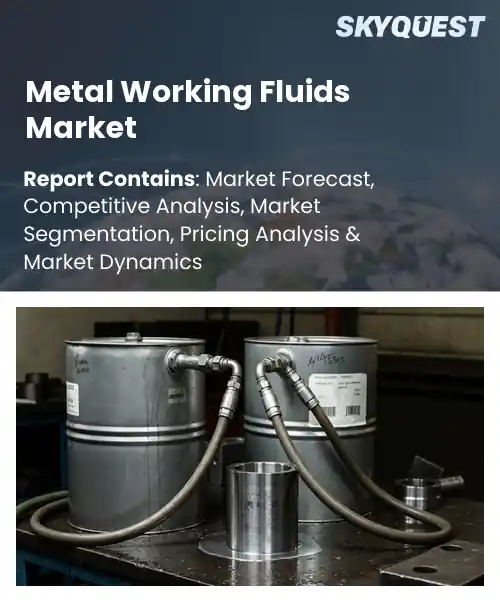
Metal Working Fluids Market
Report ID: SQMIG15E3950
Report ID: SQMIG15E3950
[email protected]
USA +1 351-333-4748
Report ID:
SQMIG15E3950 |
Region:
Global |
Published Date: July, 2026
Pages:
157
|Tables:
121
|Figures:
77


Global Metal Working Fluids Market size was valued at USD 12.15 Billion in 2024 and is poised to grow from USD 12.68 Billion in 2025 to USD 17.82 Billion by 2033, growing at a CAGR of 4.35% during the forecast period (2026-2033).
The global metal‑working fluids market, including cutting oils, emulsions and synthetic lubricants, is what props up a lot of high-precision manufacturing stuff, like automotive machining but also aerospace component fabrication. The point is, these fluids aren’t just there for “lubrication” talk; they cut down friction, they move away heat, and they keep the tool from wearing too fast. And that somehow ends up shaping both how efficiently that helps in running production, and how good the final product looks.
Now, building on that regulatory shift, fluid management systems have become major factor for the metal working fluids market growth because monitoring helps curb excess use and also stretches fluid life. Integrated sensors catch temperature surges and coolant contamination, and then automated dosing tweaks kick in, which lowers operating costs , in foundries , by as much as 12%. One Taiwanese aerospace supplier went with a cloud platform to align fluid analytics across multiple lines, and they got about a 20% cut in downtime. After that, predictive maintenance became much more practical, like not just theory, but actually usable. So it’s why vendors that combine eco‑friendly formulations with digital services end up winning more deals. And that expands the market beyond standard OEM relationships into newer areas too, like electric‑vehicle battery tooling.
AI is reshaping the metal working fluids market outlook by making formulation and operations more data driven, while also enabling real time condition monitoring and predictive maintenance. Machine learning models look at temperature patterns, load behavior and wear traces to suggest the right fluid blend, so friction goes down, but volatile organic compounds stay lower too. Plus, when sensors are tied into cloud analytics, degradation can be spotted early, and replenishment becomes more precise. That extends the serviceable life of the fluid, which means less waste , less wasted energy, and better part quality overall. There’s also the closed loop recycling angle, where manufacturers can tighten environmental compliance without losing performance. In short, these tools turn fluids from a disposable expense into a smart asset that supports efficiency across turning, milling, and drilling operations.
Market snapshot - (2026-2033)
Global Market Size
USD 12.15 Billion
Largest Segment
Protecting Fluids
Fastest Growth
Treating Fluids
Growth Rate
4.35% CAGR
To get more insights on this market click here to Request a Free Sample Report
The global metal working fluids market is segmented by product type, chemical formulation, fluid delivery state, end-use industry and region. Based on product type, the market is segmented into Removal Fluids, Forming Fluids, Protecting Fluids and Treating Fluids. Based on chemical formulation, the market is segmented into Mineral Oil-Based Fluids, Synthetic Fluids, Semi-Synthetic Fluids and Bio-Based Fluids. Based on fluid delivery state, the market is segmented into Neat Oils and Soluble Oils. Based on end-use industry, the market is segmented into Automotive Manufacturing, Aerospace Manufacturing, Machinery Construction, Metal Fabrication, Power Generation and Others. Based on region, the market is segmented into North America, Europe, Asia Pacific, Latin America and Middle East & Africa.
As per the metal working fluids market analysis, the Removal fluids segment takes the lead, not just because it “addresses” the machining part, but because it hits the real critical operations where metal removal efficiency and tool wear mitigation matter most. The formulation offers better cooling plus lubrication, so heat buildup is reduced, and tool life tends to go longer. That basically matches what manufacturers want, like lower operational costs, and keeping production throughput high. And since turning, drilling, and milling are everywhere in industry, this segment is locked in as a core role across many different industrial use cases.
However, the Forming fluids segment shows up as the fastest mover, mostly because advanced high strength alloys and additive manufacturing keep pulling demand toward accurate deformation. Newer formulations enhance formability and surface integrity, which makes them easier to pick for adoption. At the same time, sustainability pressure is pushing manufacturers to fluids that cut energy use, or at least reduce wasted input. That combination creates real momentum , which then supports market growth and opens up some fresh opportunity lanes.
According to the metal working fluids market forecast, the Bio based fluids category is changing the way sustainability strategy gets handled, because they align with stricter ecological regulations and the broader sustainability goals companies are trying to meet. They’re basically becoming the greener lubricants that help reduce environmental footprint, while also meeting performance expectations better than people might’ve expected before. Improved renewable oil technologies, in practice, are now getting closer to conventional performance levels , but with a smaller environmental impact.
Whereas the mineral oil‑based fluids segment still leads overall in many settings because the long standing formulation gives a dependable balance of lubrication, cooling, and corrosion protection that manufacturers have leaned on for years. These fluids are generally stable, and they cover a wide temperature range, so system design and maintenance stay simpler and it don’t end up changing fluids as often. The production cost is also manageable and compatibility with existing equipment helps keep mineral oil options as the default choice in a lot of metalworking operations.
To get detailed segments analysis, Request a Free Sample Report
As per the metal working fluids market regional forecast, Asia Pacific is leading the market due to lots of manufacturing capacity , rapid adoption of technology, and this strong mindset for steady continuous improvement. In the region, automotive plus precision engineering folks want fluids that do better, not just “fine” fluids—things that help stretch tool life and also improve energy efficiency. So local suppliers end up pushing innovations quite a lot, sometimes faster than elsewhere. And when equipment manufacturers sit down with fluid producers , they can work through greener formulations quicker, like refining together rather than tossing things over the wall. There s also a big focus on sustainable production habits , which naturally supports the move toward high-efficiency fluids, that lower coolant usage and reduce waste generation. Plus, the big original equipment manufacturers are around in large numbers, and that means demand for customized fluid solutions too. That last part creates a whole ecosystem of smaller niche providers , each one trying to fit specific machining routines, and sometimes very specific conditions.
Japan Metal Working Fluids Market
The Metal Working Fluids sector in Japan rides on a long tradition of precise machining, plus a dense map of high tech manufacturers. The whole industry is quite focused on dependability and environmental responsibility, so suppliers tend to craft ultra clean , high performance formulations. There’s also close cooperation with major automotive and electronics players , which pushes product upgrades and refinement. On top of that, strict regulatory standards keep fluids aligned with safety rules and emission expectations, so Japan stays known as a quality benchmark in this space.
South Korea Metal Working Fluids Market
The Metal Working Fluids Market outlook in South Korea is shaped mostly by manufacturing intensity, and a practical stance on sustainability. Leading steel makers and automotive producers ask for efficient fluids that help with faster cutting while keeping environmental impact in check. Suppliers answer with additive technologies , basically boosting lubrication and cooling strength. Research institutes also stay closely tied with industry, so new solutions land sooner. This gives South Korea a stronger position in fluid development, not just adoption.
Europe s metal working fluids market is expanding quickly because there are several forces stacked together , and they reinforce each other. First come the strict environmental regulations, then there are high value engineering sectors, plus a long standing culture of cooperative innovation. In countries where automotive and aerospace are already mature, companies need fluids that improve tool life and keep emissions low, so they invest a lot into green formulations and recycling technologies. The region s circular economy approach also pushes bio based, water based solutions, and it s not a casual preference. Meanwhile, research institutions are fairly widespread , which supports ongoing product upgrades. Also, global equipment leaders show up and that encourages close partnerships that match fluids to very specific machining requirements, reinforcing Europe as a place for high performance, sustainable fluid tech. And it doesn’t stop there—skilled engineering workforces along with advanced digital manufacturing tools allow real time monitoring of fluid performance. That speeds adoption of tuned solutions across different industrial uses, even when the applications vary.
Germany Metal Working Fluids Market
The Metal Working Fluids Market penetration in Germany is supported by automotive and precision engineering companies that want high reliability, plus strong efficiency. The market also benefits from a strict standards structure , which pressures continuous improvement in formulation work. The emphasis tends to be low toxicity and dependable lubrication performance. OEMs and specialty chemical producers work closely together too, and that helps produce tailored fluids for tricky machining tasks. Add vocational training programs on top, and it gets a workforce that's ready to manage fluid handling properly in day to day operations.
United Kingdom Metal Working Fluids Market
The Metal Working Fluids industry in the United Kingdom is driven by an aerospace presence and an emphasis on additive manufacturing. Businesses look for fluids that can handle design changes, while still holding onto high precision and keeping environmental impact low. University teams plus fluid specialists collaborate, so the introduction of new bio based additives moves along faster. The rules and regulatory tone also favors recycling and more efficient, advanced fluid usage, so the UK tends to position itself as a hub for fresh, innovative fluid solutions.
France Metal Working Fluids Market
The Metal Working Fluids Market in France is developing alongside an automotive supply chain , and with more equipment production growing over time. French manufacturers aim for fluids that line up with strict European environmental requirements , so interest rises around biodegradable options and low VOC alternatives. Partnerships with research clusters help create additives that can reduce energy consumption during machining. And government incentives for green manufacturing make adoption of sustainable fluid technologies more likely too, so France is shaping up as a market that offers fluid solutions with a clearer environmental angle.
North America keeps reinforcing its metal working fluids position, like by mixing tech leadership with a wide industrial spread and active environmental stewardship. The United States has a broad base of automotive, aerospace and heavy equipment manufacturers, and they all need high‑performance fluids for tricky machining duties. Plus there is ongoing investment in R and D, which brings forward advanced additive chemistries that help extend tool life and also cut down on waste, in practice. Meanwhile Canada leans hard into sustainable manufacturing, and its renewable energy sector keeps expanding, so demand tends to shift toward low‑toxicity, water‑based solutions. Supply chain collaboration matters too, backed by solid standards organizations, so quality stays steady and innovative fluid technologies can be taken up faster in both established and newer market segments. Digital monitoring platforms then add real time assessment of fluid performance, so makers can fine tune usage, and reduce the overall environmental footprint. And on the human side, training programs—comprehensive ones—help make sure skilled operators apply best practices the same way, each time.
United States Metal Working Fluids Market
The Metal Working Fluids Market in the United States is pushed by a large web of automotive, aerospace, and industrial equipment manufacturers that care about efficiency plus precision. The market leans on strong R and D muscle to develop high‑performance fluids, with enhanced cooling and lubrication characteristics. Close cooperation between chemical producers and end users speeds up the introduction of low‑emission formulations, and at the same time, strict safety standards help with compliance across all machining environments across the supply chain, globally, without gaps.
Canada Metal Working Fluids Market
In Canada, the Metal Working Fluids Market points clearly toward sustainable manufacturing, along with a rising role in renewable energy equipment production. Canadian manufacturers look for low‑toxicity, water‑based fluids that match tough environmental rules and also support high‑precision machining. There are collaborative research efforts, often between universities and fluid innovators, aimed at biodegradable additives that reduce waste and overall residue. National standards bodies also promote best practices, which makes consistent take up of eco friendly solutions more likely across the country’s varied industrial fabric, and that helps it stay aligned with policy goals.
To know more about the market opportunities by region and country, click here to
Buy The Complete Report
Increasing Demand for High‑Performance Fluids
Stringent Environmental Regulations Prompt Adoption
High Cost of Specialty Formulations
Limited Awareness of Performance Benefits
Request Free Customization of this report to help us to meet your business objectives.
The competitive landscape feels more and more tense as manufacturers push ahead with advanced multi-purpose, and almost neo-synthetic, formulations to satisfy the tight accuracy needs coming out of electric vehicle production, so the older players start leaning into strategic M&A and alliance-type arrangements that widen their fluid range and help speed up technology adoption across both automotive and aerospace supply channels.
Top Player’s Company Profile
SkyQuest’s ABIRAW (Advanced Business Intelligence, Research & Analysis Wing) is our Business Information Services team that Collects, Collates, Correlates, and Analyses the Data collected by means of Primary Exploratory Research backed by robust Secondary Desk research.
As per SkyQuest analysis, the global metal working fluids market is moving forward mainly because the demand for high performance fluids is rising, driven by more automotive and aerospace machining activity. A second momentum factor is digital monitoring, plus AI enabled sensors that help optimize fluid usage and trim downtime. The removal fluids segment keeps the biggest portion of the market, because it helps extend tool life directly and lowers operating expenses over time. Still, uptake isn’t fully smooth, since specialty formulations can be expensive, and that can discourage price sensitive manufacturers from switching. In terms of geography, Asia Pacific leads, supported by its enormous manufacturing footprint and a strong push for sustainable, efficient fluid solutions across the industry.
| Report Metric | Details |
|---|---|
| Market size value in 2024 | USD 12.15 Billion |
| Market size value in 2033 | USD 17.82 Billion |
| Growth Rate | 4.35% |
| Base year | 2024 |
| Forecast period | (2026-2033) |
| Forecast Unit (Value) | USD Billion |
| Segments covered |
|
| Regions covered | North America (US, Canada), Europe (Germany, France, United Kingdom, Italy, Spain, Rest of Europe), Asia Pacific (China, India, Japan, Rest of Asia-Pacific), Latin America (Brazil, Rest of Latin America), Middle East & Africa (South Africa, GCC Countries, Rest of MEA) |
| Companies covered |
|
| Customization scope | Free report customization with purchase. Customization includes:-
|
To get a free trial access to our platform which is a one stop solution for all your data requirements for quicker decision making. This platform allows you to compare markets, competitors who are prominent in the market, and mega trends that are influencing the dynamics in the market. Also, get access to detailed SkyQuest exclusive matrix.
Table Of Content
Executive Summary
Market overview
Parent Market Analysis
Market overview
Market size
KEY MARKET INSIGHTS
COVID IMPACT
MARKET DYNAMICS & OUTLOOK
Market Size by Region
KEY COMPANY PROFILES
Methodology
For the Metal Working Fluids Market, our research methodology involved a mixture of primary and secondary data sources. Key steps involved in the research process are listed below:
1. Information Procurement: This stage involved the procurement of Market data or related information via primary and secondary sources. The various secondary sources used included various company websites, annual reports, trade databases, and paid databases such as Hoover's, Bloomberg Business, Factiva, and Avention. Our team did 45 primary interactions Globally which included several stakeholders such as manufacturers, customers, key opinion leaders, etc. Overall, information procurement was one of the most extensive stages in our research process.
2. Information Analysis: This step involved triangulation of data through bottom-up and top-down approaches to estimate and validate the total size and future estimate of the Metal Working Fluids Market.
3. Report Formulation: The final step entailed the placement of data points in appropriate Market spaces in an attempt to deduce viable conclusions.
4. Validation & Publishing: Validation is the most important step in the process. Validation & re-validation via an intricately designed process helped us finalize data points to be used for final calculations. The final Market estimates and forecasts were then aligned and sent to our panel of industry experts for validation of data. Once the validation was done the report was sent to our Quality Assurance team to ensure adherence to style guides, consistency & design.
Analyst Support
Customization Options
With the given market data, our dedicated team of analysts can offer you the following customization options are available for the Metal Working Fluids Market:
Product Analysis: Product matrix, which offers a detailed comparison of the product portfolio of companies.
Regional Analysis: Further analysis of the Metal Working Fluids Market for additional countries.
Competitive Analysis: Detailed analysis and profiling of additional Market players & comparative analysis of competitive products.
Go to Market Strategy: Find the high-growth channels to invest your marketing efforts and increase your customer base.
Innovation Mapping: Identify racial solutions and innovation, connected to deep ecosystems of innovators, start-ups, academics, and strategic partners.
Category Intelligence: Customized intelligence that is relevant to their supply Markets will enable them to make smarter sourcing decisions and improve their category management.
Public Company Transcript Analysis: To improve the investment performance by generating new alpha and making better-informed decisions.
Social Media Listening: To analyze the conversations and trends happening not just around your brand, but around your industry as a whole, and use those insights to make better Marketing decisions.
REQUEST FOR SAMPLE
 REQUEST FREE CUSTOMIZATION
Global Metal Working Fluids Market size was valued at USD 12.15 Billion in 2024 and is poised to grow from USD 12.68 Billion in 2025 to USD 17.82 Billion by 2033, growing at a CAGR of 4.35% during the forecast period (2026-2033).
The competitive landscape is shaped by intensified rivalry as manufacturers adopt advanced multi‑purpose and neo‑synthetic formulations to meet the precision demands of electric‑vehicle production, prompting incumbents to pursue strategic M&A and partnership deals that broaden their fluid portfolios and accelerate technology integration across automotive and aerospace supply chains. 'Quaker Chemical Corporation', 'FUCHS SE', 'BP p.l.c.', 'Chevron Corporation', 'Exxon Mobil Corporation', 'TotalEnergies SE', 'Shell plc', 'Idemitsu Kosan Co., Ltd.', 'Yushiro Chemical Industry Co., Ltd.', 'Blaser Swisslube AG', 'Cimcool Industrial Products LLC', 'Master Fluid Solutions', 'Motul S.A.', 'Petrofer Chemie', 'Henkel AG & Co. KGaA', 'Valvoline Inc.', 'ENEOS Corporation', 'Lukoil PJSC', 'China Petroleum & Chemical Corporation', 'Indian Oil Corporation Limited'
The automotive and aerospace sectors are expanding rapidly, requiring machining processes that deliver tighter tolerances and longer tool life. Advanced metal working fluids provide superior cooling, lubrication, and anti‑wear characteristics, directly supporting these performance goals. As manufacturers adopt more complex materials, the reliance on high‑efficiency fluids grows, encouraging suppliers to develop innovative formulations. This interdependence drives increased procurement volumes and stimulates research investment, consequently expanding the overall market for metal working fluids. Customers also value the environmental benefits of water‑based solutions, further reinforcing demand across multiple industries.
Sustainable Formulations Gain Traction: Manufacturers are increasingly prioritizing environmentally friendly metalworking fluids to meet stricter regulatory standards and growing customer demand for greener production. This shift drives investment in biodegradable base oils, low‑toxicity additives, and water‑based emulsions that reduce hazardous emissions and waste. Companies that adopt sustainable formulations gain competitive advantage through enhanced brand reputation, easier compliance, and lower long‑term disposal costs, while also aligning with broader corporate sustainability goals across the supply chain and contributing to industry-wide circular economy initiatives globally for future.
Why does Asia Pacific Dominate the Global Metal Working Fluids Market? |@12


Want to customize this report? This report can be personalized according to your needs. Our analysts and industry experts will work directly with you to understand your requirements and provide you with customized data in a short amount of time. We offer $1000 worth of FREE customization at the time of purchase.
Feedback From Our Clients


 USA (+1) 351-333-4748

