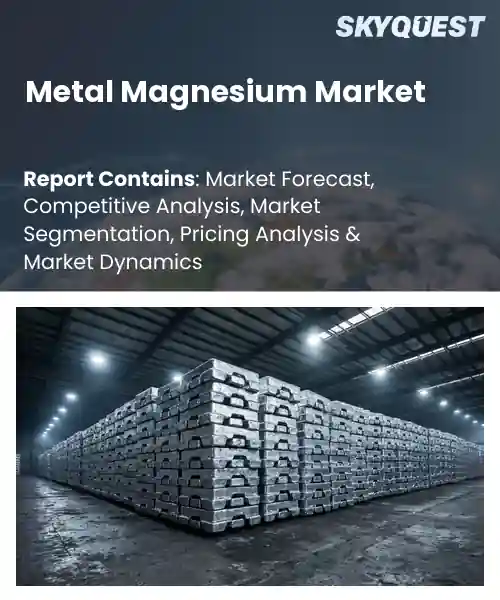
Metal Magnesium Market
Report ID: SQMIG15J2179
Report ID: SQMIG15J2179
[email protected]
USA +1 351-333-4748
Report ID:
SQMIG15J2179 |
Region:
Global |
Published Date: May, 2026
Pages:
157
|Tables:
177
|Figures:
79


Global Metal Magnesium Market size was valued at USD 5.75 Billion in 2024 and is poised to grow from USD 6.09 Billion in 2025 to USD 9.63 Billion by 2033, growing at a CAGR of 5.9% during the forecast period (2026-2033).
The primary driver of the metal magnesium market is lightweighting demand across transportation and electronics, which has steadily elevated magnesium from a niche alloying element to a strategic industrial metal. Magnesium markets encompass primary production, fabricated products and secondary recycling, and they matter because weight reduction yields fuel efficiency, lower emissions and longer battery range. Over decades the market evolved from small European and North American smelters to large-scale Chinese electrolytic capacity, creating structural surpluses and price cycles. For example, automotive adoption of magnesium-intensive components and smartphone casings showed how design trends and geopolitical supply concentration reshape investment and policy.
A critical factor shaping the global magnesium market is decarbonization and the rise of electric vehicles, which cause manufacturers to prioritize lightweight materials and increase magnesium demand. As stricter fuel and emissions standards force automakers and aerospace firms to substitute heavier metals, suppliers scale die-casting capabilities and invest in corrosion-resistant alloys to meet safety and longevity requirements. That investment reduces unit costs and broadens applications worldwide, creating opportunities in consumer electronics chassis, medical biodegradable implants and additive manufacturing for complex parts. Simultaneously, producing low-carbon magnesium via renewables-powered smelting and expanded recycling networks lowers carbon footprint and strengthens long-term supply resilience.
How is AI improving production efficiency in the magnesium metal market?
AI improves production efficiency in the magnesium metal market by linking sensors, data models and control systems to optimize key steps. Machine learning helps stabilize electrolytic cells and refinery stages while predictive maintenance reduces unplanned downtime. AI also speeds metallurgical testing and process design so producers can evaluate feedstock alternatives and energy options faster. As market demand for lightweight materials grows, these digital tools help newer domestic projects scale more predictably and reduce operational waste. Practical examples include partnerships applying AI to mineral processing and companies using AI for supply chain planning and process scaling.
Latrobe Magnesium March 2026, the company announced a sustained demonstration run producing high grade magnesium oxide, and when combined with AI driven process optimization this type of progress supports smoother scale up and better energy efficiency for future metal production.
Market snapshot - (2026-2033)
Global Market Size
USD 5.75 Billion
Largest Segment
Magnesium Alloys
Fastest Growth
Recycled Magnesium
Growth Rate
5.9% CAGR
To get more insights on this market click here to Request a Free Sample Report
Global metal magnesium market is segmented by product type, form, application, end user industry, production process, distribution channel and region. Based on product type, the market is segmented into Primary Magnesium, Magnesium Alloys and Recycled Magnesium. Based on form, the market is segmented into Ingots, Powder, Granules, Sheets & Plates and Others. Based on application, the market is segmented into Die Casting, Aluminum Alloying, Steel Desulfurization, Titanium Reduction, Chemical Production and Others. Based on end user industry, the market is segmented into Automotive, Aerospace & Defense, Electronics, Metallurgy, Chemical Industry and Others. Based on production process, the market is segmented into Pidgeon Process and Electrolysis Process. Based on distribution channel, the market is segmented into Direct Sales and Distributors & Traders. Based on region, the market is segmented into North America, Europe, Asia Pacific, Latin America and Middle East & Africa.
Magnesium Alloys segment dominates because alloy formulations deliver tailored mechanical and corrosion performance that meet demanding lightweighting and structural requirements across end users. Their superior strength to weight ratio and compatibility with established manufacturing methods prompts designers to specify alloyed magnesium for high value components, which in turn fosters upstream investment in alloy production, quality control, and specialized supply chains that reinforce sustained market preference.
However, Recycled Magnesium segment is emerging as the most rapidly expanding area, driven by growing circular economy priorities and cost pressures that push manufacturers to secure secondary feedstock. Advances in recycling technology and material sorting are improving feedstock purity, while sustainability mandates and corporate procurement strategies create new demand for recycled metal, accelerating opportunities for closed loop supply and value creation in the market.
Die Casting segment dominates because its ability to produce complex, thin walled, and lightweight components at scale aligns closely with magnesium’s castability and performance advantages. The efficiency of high volume die casting reduces assembly and material usage, prompting widespread adoption in industries seeking weight and cost savings, which sustains steady consumption of cast-grade magnesium and drives investments in related tooling and alloy development.
Meanwhile, Aluminum Alloying segment is witnessing the strongest growth momentum as magnesium additions enable novel alloy combinations that enhance strength and reduce density in aluminum products. Ongoing metallurgical research and application development expand use cases in automotive and electronics, while performance and efficiency targets incentivize alloy innovation, creating rising demand for magnesium as an alloying element and new pathways for market expansion.
To get detailed segments analysis, Request a Free Sample Report
Asia Pacific dominance is rooted in a confluence of manufacturing strength, raw material access, and technological depth concentrated in major industrial hubs. The region benefits from integrated supply chains linking mining, primary production, and downstream alloying and component manufacturing, which supports efficient material flows and responsiveness to customer needs. Strong demand from electronics, automotive, and industrial applications drives innovation in lightweighting and high-performance alloys. Established research ecosystems and close collaboration between producers and original equipment manufacturers foster process improvements and specialty grades. Trade orientation and export capabilities amplify regional influence, while investments in recycling and secondary processing enhance material circularity and resource security. Together these elements create a resilient competitive position that shapes global supply and standards.
Metal Magnesium Market in Japan is characterized by a focus on high-purity production and specialty alloy development tailored to precision industries. Domestic manufacturers emphasize material consistency, stringent quality controls, and niche applications in electronics and advanced mobility components. Collaboration between producers and OEMs supports bespoke alloy formulations and just-in-time supply patterns. Recycling and material recovery initiatives are integrated with production to support circularity and reduce dependency on primary feedstock. The market orientation favors premium products and technically demanding segments.
Metal Magnesium Market in South Korea exhibits strong integration with the automotive and electronics manufacturing ecosystem. Producers concentrate on lightweight alloy solutions for mobility applications and on fine-tuning processes for consistent metallurgical properties suited to high-volume assembly lines. Close industry links promote rapid adoption of material innovations and coordinated supply chain adjustments. Emphasis on efficiency and downstream processing capacity supports competitiveness. Investment in recycling and secondary processing complements primary production to enhance supply stability and environmental performance.
Expansion in Europe is driven by a strategic shift toward material substitution for lightweighting, sustainability priorities, and efforts to secure diversified supply chains. Industry demand is fueled by automotive and aerospace sectors seeking weight reduction for efficiency gains, as well as by engineering and manufacturing segments pursuing material solutions that balance performance and environmental impact. Regulatory frameworks and corporate commitments encourage recycling, circularity, and the development of low-impact production routes. Investments in domestic production capabilities and cross-border collaborations aim to reduce exposure to supply disruptions while supporting specialized alloy development. Strong industrial clusters and research networks accelerate commercialization of novel processes and applications, reinforcing the region as a dynamic growth area.
Metal Magnesium Market Germany is anchored by deep engineering expertise and strong demand from automotive and industrial machinery sectors. Producers and downstream suppliers work closely with original equipment manufacturers to develop alloys that meet rigorous performance and safety requirements. The market emphasizes industrial-scale quality control, process reliability, and integration with broader manufacturing value chains. Recycling and material recovery play an important role in supply strategies, reflecting environmental priorities and resource efficiency goals. Germany serves as a focal point for technical standards and applied research.
Metal Magnesium Market United Kingdom is emerging around innovation in materials engineering and advanced manufacturing applications. The market is shaped by research institutions, specialist producers, and a growing base of users in aerospace and high-performance engineering. Emphasis is placed on developing application-specific alloys and production processes that align with decarbonization and resource efficiency objectives. Cross-sector collaboration and pilot projects support scaling of new technologies. Market activity reflects an emphasis on flexibility, high-value applications, and integration with broader industrial modernization efforts.
Metal Magnesium Market France is experiencing rapid growth driven by strategic industrial initiatives and strong demand from transport and energy sectors. The market prioritizes development of low-impact production routes and enhanced recycling infrastructure to support circular material flows. Industrial partnerships focus on adapting alloy compositions for specific structural and functional applications, while research centers drive process innovation. Policy support and industry alignment encourage investment in domestic capacity and downstream processing, positioning the market as a dynamic and fast-moving segment within the regional landscape.
North America is strengthening its role through a mix of reshoring initiatives, investment in domestic capacity, and targeted technological development aimed at supply resilience and application diversity. Stakeholders are prioritizing secure sourcing strategies, partnerships across the value chain, and deployment of advanced manufacturing techniques to produce specialty grades and bespoke alloys. Demand from mobility, aerospace, and industrial sectors supports uptake, while emphasis on environmental performance encourages improvements in production routes and recycling systems. Collaborative ventures between industry and research organizations are accelerating process optimization and new product introductions. Strategic focus on competitiveness and supply chain robustness is enhancing regional relevance in the global market.
Metal Magnesium Market United States is characterized by efforts to expand domestic production capability and to integrate advanced processing technologies. Industry activity centers on supplying automotive, aerospace, and industrial customers with tailored alloy solutions and reliable logistics. Emphasis on reducing supply chain vulnerability has led to investments in recycling and secondary processing to support circular material flows. Collaboration between manufacturers and research institutions is fostering innovation in production efficiency and material performance. The market outlook reflects priorities on resilience, technological advancement, and application-driven growth.
Metal Magnesium Market Canada is developing around strategic resource advantages and growing interest in value-added processing. The market emphasizes sustainable sourcing, recycling initiatives, and alignment with regional manufacturing needs. Producers focus on supplying niche industrial and mobility applications that require consistent metallurgical properties and environmental stewardship. Collaboration with research entities supports process improvements and product diversification. Market dynamics are influenced by a focus on long-term supply stability and integration with broader North American value chains.
To know more about the market opportunities by region and country, click here to
Buy The Complete Report
Rising Demand From Automotive Industry
Growth In Aerospace Applications
Supply Chain Constraints
Environmental And Regulatory Challenges
Request Free Customization of this report to help us to meet your business objectives.
Competitive dynamics in the global magnesium market are shifting as low-carbon new entrants challenge legacy supply and buyers prioritize decarbonized, secured sources driven by regulatory decarbonization and automotive lightweighting. Observed strategies include technology-led pilots and strategic partnerships such as Magrathea’s EQT-backed pilot and Wogen offtake. Government-supported pilots and MOUs exemplified by Magnium Australia have accelerated project development. Investor-driven consolidation among producers is also visible.
SkyQuest’s ABIRAW (Advanced Business Intelligence, Research & Analysis Wing) is our Business Information Services team that Collects, Collates, Correlates, and Analyses the Data collected by means of Primary Exploratory Research backed by robust Secondary Desk research.
As per SkyQuest analysis, the global metal magnesium market is being driven primarily by lightweighting demand across transportation and electronics, with decarbonization and the rise of electric vehicles serving as a secondary driver that further accelerates adoption of magnesium alloys. However, supply chain constraints linked to concentrated primary production and logistical disruptions remain a key restraint, creating procurement uncertainty. The market is dominated regionally by Asia Pacific, supported by integrated manufacturing and feedstock access, while the magnesium alloys segment leads product value due to superior strength-to-weight benefits and die-casting compatibility. These dynamics favor investment in recycling, low-carbon production and alloy innovation.
| Report Metric | Details |
|---|---|
| Market size value in 2024 | USD 5.75 Billion |
| Market size value in 2033 | USD 9.63 Billion |
| Growth Rate | 5.9% |
| Base year | 2024 |
| Forecast period | (2026-2033) |
| Forecast Unit (Value) | USD Billion |
| Segments covered |
|
| Regions covered | North America (US, Canada), Europe (Germany, France, United Kingdom, Italy, Spain, Rest of Europe), Asia Pacific (China, India, Japan, Rest of Asia-Pacific), Latin America (Brazil, Rest of Latin America), Middle East & Africa (South Africa, GCC Countries, Rest of MEA) |
| Companies covered |
|
| Customization scope | Free report customization with purchase. Customization includes:-
|
To get a free trial access to our platform which is a one stop solution for all your data requirements for quicker decision making. This platform allows you to compare markets, competitors who are prominent in the market, and mega trends that are influencing the dynamics in the market. Also, get access to detailed SkyQuest exclusive matrix.
Table Of Content
Executive Summary
Market overview
Parent Market Analysis
Market overview
Market size
KEY MARKET INSIGHTS
COVID IMPACT
MARKET DYNAMICS & OUTLOOK
Market Size by Region
KEY COMPANY PROFILES
Methodology
For the Metal Magnesium Market, our research methodology involved a mixture of primary and secondary data sources. Key steps involved in the research process are listed below:
1. Information Procurement: This stage involved the procurement of Market data or related information via primary and secondary sources. The various secondary sources used included various company websites, annual reports, trade databases, and paid databases such as Hoover's, Bloomberg Business, Factiva, and Avention. Our team did 45 primary interactions Globally which included several stakeholders such as manufacturers, customers, key opinion leaders, etc. Overall, information procurement was one of the most extensive stages in our research process.
2. Information Analysis: This step involved triangulation of data through bottom-up and top-down approaches to estimate and validate the total size and future estimate of the Metal Magnesium Market.
3. Report Formulation: The final step entailed the placement of data points in appropriate Market spaces in an attempt to deduce viable conclusions.
4. Validation & Publishing: Validation is the most important step in the process. Validation & re-validation via an intricately designed process helped us finalize data points to be used for final calculations. The final Market estimates and forecasts were then aligned and sent to our panel of industry experts for validation of data. Once the validation was done the report was sent to our Quality Assurance team to ensure adherence to style guides, consistency & design.
Analyst Support
Customization Options
With the given market data, our dedicated team of analysts can offer you the following customization options are available for the Metal Magnesium Market:
Product Analysis: Product matrix, which offers a detailed comparison of the product portfolio of companies.
Regional Analysis: Further analysis of the Metal Magnesium Market for additional countries.
Competitive Analysis: Detailed analysis and profiling of additional Market players & comparative analysis of competitive products.
Go to Market Strategy: Find the high-growth channels to invest your marketing efforts and increase your customer base.
Innovation Mapping: Identify racial solutions and innovation, connected to deep ecosystems of innovators, start-ups, academics, and strategic partners.
Category Intelligence: Customized intelligence that is relevant to their supply Markets will enable them to make smarter sourcing decisions and improve their category management.
Public Company Transcript Analysis: To improve the investment performance by generating new alpha and making better-informed decisions.
Social Media Listening: To analyze the conversations and trends happening not just around your brand, but around your industry as a whole, and use those insights to make better Marketing decisions.
REQUEST FOR SAMPLE
 REQUEST FREE CUSTOMIZATION
Global Metal Magnesium Market size was valued at USD 5.75 Billion in 2024 and is poised to grow from USD 6.09 Billion in 2025 to USD 9.63 Billion by 2033, growing at a CAGR of 5.9% during the forecast period (2026-2033).
Competitive dynamics in the global magnesium market are shifting as low-carbon new entrants challenge legacy supply and buyers prioritize decarbonized, secured sources driven by regulatory decarbonization and automotive lightweighting. Observed strategies include technology-led pilots and strategic partnerships such as Magrathea’s EQT-backed pilot and Wogen offtake. Government-supported pilots and MOUs exemplified by Magnium Australia have accelerated project development. Investor-driven consolidation among producers is also visible. 'US Magnesium', 'RIMA Industrial', 'Dead Sea Magnesium', 'Latrobe Magnesium', 'Western Magnesium Corporation', 'Magontec', 'Yinguang Magnesium Industry', 'Ningxia Huiye Magnesium Marketing Group', 'Shanxi Wenxi Hongfu Magnesium', 'Shanxi Yinguang Huasheng Magnesium', 'Taiyuan Tongxiang Magnesium', 'Shanxi Bada Magnesium', 'Fugu Jinwantong Magnesium Industry', 'Nanjing Yunhai Special Metals', 'Hebei Meishen Technology', 'Qinghai Salt Lake Magnesium Industry', 'Shanxi Credit Magnesium', 'Dolomit Eger', 'POSCO Magnesium', 'Meridian Lightweight Technologies'
Automotive manufacturers have increasingly specified magnesium components to achieve vehicle lightweighting goals, which directly supports demand for magnesium. Design engineers favor magnesium for its high strength to weight ratio and suitability for complex castings, enabling substitution of heavier metals in body and powertrain parts. As automakers move toward electrification and fuel efficiency priorities, procurement and tier one suppliers integrate magnesium alloys into designs and sourcing plans, creating sustained industrial demand across supply chains and encouraging capacity expansion and investment.
Lightweighting Drives Design Innovation: Demand for lighter components is prompting automotive, aerospace, and electronics designers to adopt magnesium alloys, encouraging material substitution and design thinking. Manufacturers emphasize part consolidation, thin wall casting, and hybrid assemblies to unlock system level weight savings while balancing stiffness and durability. This trend stimulates investment in alloy development, surface treatments, and joining techniques, enabling broader acceptance across premium segments. Collaboration among OEMs, tier suppliers, and material producers accelerates qualification cycles and supports scalable manufacturing pathways for magnesium market solutions.
Why does Asia Pacific Dominate the Global Metal Magnesium Market? |@12


Want to customize this report? This report can be personalized according to your needs. Our analysts and industry experts will work directly with you to understand your requirements and provide you with customized data in a short amount of time. We offer $1000 worth of FREE customization at the time of purchase.
Feedback From Our Clients


 USA (+1) 351-333-4748

