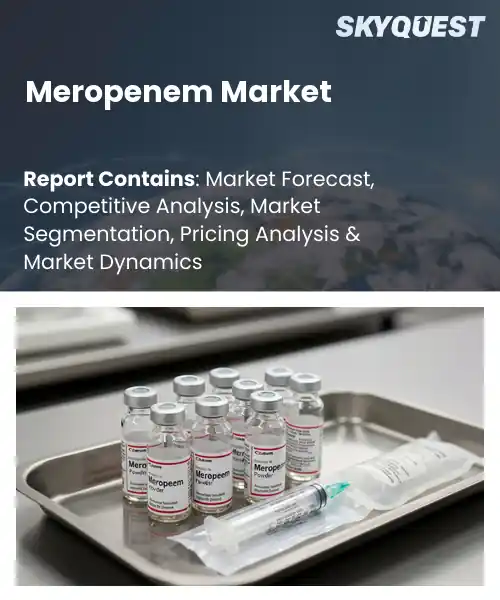
Meropenem Market
Report ID: SQMIG35A3329
Report ID: SQMIG35A3329
[email protected]
USA +1 351-333-4748
Report ID:
SQMIG35A3329 |
Region:
Global |
Published Date: March, 2026
Pages:
157
|Tables:
114
|Figures:
77


Global Meropenem Market size was valued at USD 655.90 Million in 2024 and is poised to grow from USD 720.18 Million in 2025 to USD 1521.45 Million by 2033, growing at a CAGR of 9.8% during the forecast period (2026-2033).
The international market for meropenem is largely driven by the global need for broad-spectrum carbapenem antibiotics that can be administered to patients in hospitals who have serious infections caused by bacteria, specifically the growing number of multiresistant Gram-negative bacteria that cannot be effectively treated with older medications. The significance of the meropenem market is due to the fact that meropenem ("Merrem") is most commonly used as a last-line therapy for treating complicated intra-abdominal infections, nosocomial (hospital-acquired) pneumonias and sepsis, and any unavailability of this medication has an impact on the quality of care delivered, as well as on hospitals' ability to manage the use of antibiotics appropriately.
Over time the market evolved from limited hospital use toward expanded adoption as resistance patterns shifted, exemplified by increased procurement in tertiary care centers during regional outbreaks of carbapenem-resistant Enterobacteriaceae, and regulatory scrutiny increased.
Following increased regulatory attention and rising resistance, the key trend driving the global meropenem sector, is clinical demand driven by severe hospital-acquired infections and constrained alternative therapies, which causes hospitals to prioritize procurement, stockpiling, and investment in rapid diagnostics that confirm meropenem-susceptible pathogens. Consequently, pharmaceutical manufacturers accelerate production, pursue lifecycle extensions such as fixed-dose combinations with novel beta-lactamase inhibitors, and where rising intensive care capacity creates latent demand. Real-world examples include higher meropenem utilization in intensive care units treating sepsis and post-surgical infections; public health tenders that translate resistance surveillance into predictable volume purchases, and thus opportunities.
How is AI Improving Demand Forecasting in the Meropenem Market?
The use of AI to improve demand forecasting in the market for Meropenem involves creating adaptive models that integrate clinical use patterns, hospital procurement data, signals of epidemiology, and constraints of suppliers. These adaptive models update as conditions change; they go beyond just using simple, historical averages as the basis for forecasting and identify significant changes in either the number of hospital admissions or an increase in the number of regional outbreaks of disease. Organizations and companies that manufacture and distribute meropenem will have the opportunity to make necessary adjustments to their production and allocation plans thanks to these systems.
Market snapshot - 2026-2033
Global Market Size
USD 655.9 Million
Largest Segment
Injectable Formulations
Fastest Growth
Oral Formulations
Growth Rate
9.8% CAGR
To get more insights on this market click here to Request a Free Sample Report
The meropenem market is segmented by product type, therapeutic application, end user, distribution channel and region. Based on product type, the market is segmented into injectable formulations and oral formulations. Based on therapeutic application, the market is segmented into hospital acquired infections and complicated intra-abdominal infections. Based on end user, the market is segmented into hospitals, clinics and pharmacies. Based on distribution channel, the market is segmented into direct sales and third-party distributors. Based on region, the market is segmented into North America, Europe, Asia Pacific, Latin America and Middle East & Africa.
Based on the global meropenem market growth, injectable formulations segment dominates because meropenem’s clinical use centers on severe, life-threatening infections that require rapid, reliable systemic exposure achievable only through parenteral administration. Clinicians favor injectable dosing for dose titration purposes due to their reliable pharmacokinetic properties in addition to compatibility with critical care environments; this creates demand within hospital procurement systems, guidance documents, and continued demand for these products. Furthermore, the manufacturing and distribution systems have been developed specifically around sterile injectable products, which helps ensure supply reliability and helps instill clinician confidence. Both of these factors contribute to maintaining leadership in the marketplace.
However, oral formulations are emerging as the most rapidly expanding area due to advances in oral prodrug chemistry, growing interest in outpatient antimicrobial therapy, and efforts to reduce hospitalization. Improved oral bioavailability candidates and regulatory encouragement for stewardship support expanding use, creating new pathways for home based treatment and extending meropenem’s market reach.
Hospitals segment leads because inpatient settings concentrate the highest volumes of severe infections and critically ill patients who require timely broad spectrum empiric therapy with meropenem. All these things working together (hospital formularies, antimicrobial stewardship teams, rapid diagnostic testing, and protocolized intensive care protocols) ensure hospitals are the primary drivers of organization for protocolized use and predictable procurement. In addition, the other factors of centralized purchasing, cold chain capabilities, and physician experience with intravenous administration help to support hospitals as the primary engine of all clinical adoption and demand.
On the other hand, pharmacies are witnessing the strongest growth momentum as outpatient treatment models and outpatient parenteral antimicrobial therapy expand. Retail and specialty pharmacies are increasing capacity for dispensing complex antibiotic regimens, supporting stewardship through compliance services, and enabling transitions of care, which opens new commercial pathways and broadens meropenem access beyond traditional inpatient channels.
To get detailed segments analysis, Request a Free Sample Report
North As per the global meropenem market share, America maintains leadership in the industry due to a combination of advanced clinical infrastructure, concentrated research capabilities, and well developed pharmaceutical ecosystems. Established methods used by hospitals to procure drugs and dependable cold-chain distribution help to ensure a steady supply of this therapy.
Regulatory and reimbursement systems that allow access to markets together with the significant number of both international and national manufacturers have supported a consistent supply and depth of product offerings. Significant amounts of clinical research and early adoption of current treatment guidelines have led to the development of confidence in clinical outcomes from using these drugs. All of these factors have resulted in the availability of therapies in larger quantities and more quickly than before for patients who need them.
Meropenem market in the United States benefits from dense tertiary hospital networks, extensive critical care services, and a mature biotechnology and pharmaceutical sector that support robust availability and clinical adoption. Procurement and distribution systems that are well-organized, in addition to their active involvement in clinical trials and therapy based upon guidelines, allow access in a timely manner. Strong partnerships among clinicians, teaching hospitals, and industry will lead to faster formulary inclusion and the support of stewardship programs that continually optimize the clinical use of pharmaceutical products and outcomes.
Meropenem market in Canada is shaped by a universal healthcare landscape and regional procurement practices that emphasize equitable access across provinces. The use of central clinical guidelines and consolidated purchasing for hospitals makes supply more predictable and supports our urge to use new technology in these specific hospitals. In addition, domestic and international partners in the manufacturing sector help ensure distribution continues to be able to deliver the necessary therapies/pantries across the country in accordance with the prescribed schedule.
Based on the global meropenem regional forecast, European expansion is driven by heightened clinical recognition of severe bacterial infections and coordinated policy responses across major healthcare systems. Improved hospital purchasing systems and procurement processes in public tenders have resulted in more effective therapies (carbapenems) being used across multiple regions. The harmonisation of regulatory processes throughout the region has improved the ability of organisations to comparatively review both established therapeutics and generic alternatives for submission for approval purposes, thus speeding up the bringing of new products to the market.
The increasing focus on antimicrobial stewardship and diagnostic stewardship has led to an increase in the targeted use of antibiotics and diagnostics within tertiary care facilities. The active participation of manufacturers with the respective national health authorities helps to enhance the collaborative research opportunities available.
Meropenem market in Germany is characterized by strong hospital procurement processes, a robust pharmaceutical manufacturing base, and influential clinical leadership that guides antibiotic selection. The design of Integrated hospital networks and tendering mechanisms provides assurance of reliable supply from large academic medical centres and specialized infectious diseases units is contributing to clinical adoption evidence generation and has enabled outcomes to be represented on a national network basis. The collaboration between industry, regulatory and clinical experts has contributed to the development of guiding principles for the use of formulary in critical care environment across the national network.
Meropenem market in United Kingdom is shaped by centralized procurement frameworks, active antimicrobial stewardship programs, and established hospital infectious disease capacity. National health service pathways influence formulary decisions and encourage prudent, guideline aligned use in tertiary centers. Regional centers of excellence aimed at expanding diagnostic capacity support targeted therapy. The public health agency, academic hospital, and industry partnerships will allow for the generation of evidence to be included in formularies and will allow for improved access through national care networks.
Meropenem market in France is experiencing notable uptake driven by hospital based infectious disease programs and public health initiatives addressing antimicrobial resistance. The procurement processes and tendering for teaching hospitals facilitate the inclusion of clinical guidelines within the hospital's entire formulary. As new clinical guidelines develop, more accurate diagnoses of severe infections will allow for a more targeted use of these drugs. National health authorities, teaching hospitals and manufacturers working together in a network will ensure that the drugs are equally available to all hospitals within a region by establishing supply systems and encouraging best practices for using these drugs in critical care and specialized departments.
As per the global meropenem regional outlook, Asia Pacific is strengthening its role through coordinated investments in healthcare infrastructure, expanded capacity of tertiary hospitals, and growing manufacturing capabilities that support both domestic supply and regional exports. Heightened awareness of antimicrobial resistance and government led initiatives to improve antibiotic stewardship and diagnostic support stimulate clinical demand for reliable carbapenem therapies.
Regional regulatory reforms and faster approval pathways facilitate market entry for established products and generics, while partnerships between multinational firms and local manufacturers expand distribution reach. Increasing clinical research activity in major centers, coupled with procurement reforms and improved cold chain logistics, enhances availability and clinical adoption, positioning Asia Pacific as an increasingly important and self reliant player in the global meropenem landscape. Focused training for clinicians and investment in antimicrobial surveillance networks further support informed prescribing and strengthen regional supply resilience.
Meropenem market in Japan reflects strong regulatory standards, high quality manufacturing capacity, and advanced hospital systems that favor rapid clinical integration in tertiary centers. Domestic pharmaceutical firms and university hospitals have established relationships that enhance clinical research and use of guidelines-based on research to improve safety and efficacy. Extensive distribution systems (e.g., wholesale distributors) and stringent quality standards create a reliable supply of medical products (for example, drugs). Antimicrobial stewardship and appropriate laboratory diagnosis require thoughtful and evidence-based adoption in critical care and specialized infectious disease departments.
Meropenem market in South Korea is advancing through expanding hospital capacity, proactive public health initiatives, and growing domestic pharmaceutical involvement in carbapenem production and distribution. Laboratory diagnostics that are better focused on clinical use in specialty centres will assist in guiding target use of resources through stewardship (business accountability) and to enhance the supply chain with government-driven purchasing strategies that involve working in collaboration with multinational companies. Research generated from clinical leaders and industries (between) will help generate evidence and promote inclusion in hospital networks.
To know more about the market opportunities by region and country, click here to
Buy The Complete Report
Rising Antimicrobial Resistance
Expanded Hospital Formulary Adoption
Increasing Generic Competition
Stringent Regulatory Requirements
Request Free Customization of this report to help us to meet your business objectives.
Competition in the global meropenem market outlook is driven by generics consolidation and emerging diagnostic and adjuvant innovators that shift prescribing and supply dynamics. Competitive moves are concrete: product launches and regional market entries, licensing and acquisitions to secure combinations against resistance, and manufacturing upgrades to protect supply chains. Examples include Hikma’s US meropenem launch, Venus Remedies’ MET-X rights acquisition to pursue beta lactam combinations, and Cipla’s API manufacturing investments.
Hospital Antimicrobial Stewardship Rise
Emerging Market Access Expansion
SkyQuest’s ABIRAW (Advanced Business Intelligence, Research & Analysis Wing) is our Business Information Services team that Collects, Collates, Correlates, and Analyses the Data collected by means of Primary Exploratory Research backed by robust Secondary Desk research.
As per SkyQuest analysis, the global meropenem industry is being driven primarily by rising antimicrobial resistance, which sustains demand for broad-spectrum carbapenems in severe hospital infections, while expanded hospital formulary adoption further propels uptake as institutions standardize procurement and stewardship protocols. As more generic products enter the market and compete for price and margin share, growth continues to be affected. North America is the largest market for injectable medications, primarily due to its well-established clinical systems, large tertiary care facilities and dependable distribution networks; therefore, parenteral routes of administration have the greatest impact on the care of patients receiving parenteral therapy (e.g., critically ill patients).
| Report Metric | Details |
|---|---|
| Market size value in 2024 | USD 655.90 Million |
| Market size value in 2033 | USD 1521.45 Million |
| Growth Rate | 9.8% |
| Base year | 2024 |
| Forecast period | 2026-2033 |
| Forecast Unit (Value) | USD Million |
| Segments covered |
|
| Regions covered | North America (US, Canada), Europe (Germany, France, United Kingdom, Italy, Spain, Rest of Europe), Asia Pacific (China, India, Japan, Rest of Asia-Pacific), Latin America (Brazil, Rest of Latin America), Middle East & Africa (South Africa, GCC Countries, Rest of MEA) |
| Companies covered |
|
| Customization scope | Free report customization with purchase. Customization includes:-
|
To get a free trial access to our platform which is a one stop solution for all your data requirements for quicker decision making. This platform allows you to compare markets, competitors who are prominent in the market, and mega trends that are influencing the dynamics in the market. Also, get access to detailed SkyQuest exclusive matrix.
Table Of Content
Executive Summary
Market overview
Parent Market Analysis
Market overview
Market size
KEY MARKET INSIGHTS
COVID IMPACT
MARKET DYNAMICS & OUTLOOK
Market Size by Region
KEY COMPANY PROFILES
Methodology
For the Meropenem Market, our research methodology involved a mixture of primary and secondary data sources. Key steps involved in the research process are listed below:
1. Information Procurement: This stage involved the procurement of Market data or related information via primary and secondary sources. The various secondary sources used included various company websites, annual reports, trade databases, and paid databases such as Hoover's, Bloomberg Business, Factiva, and Avention. Our team did 45 primary interactions Globally which included several stakeholders such as manufacturers, customers, key opinion leaders, etc. Overall, information procurement was one of the most extensive stages in our research process.
2. Information Analysis: This step involved triangulation of data through bottom-up and top-down approaches to estimate and validate the total size and future estimate of the Meropenem Market.
3. Report Formulation: The final step entailed the placement of data points in appropriate Market spaces in an attempt to deduce viable conclusions.
4. Validation & Publishing: Validation is the most important step in the process. Validation & re-validation via an intricately designed process helped us finalize data points to be used for final calculations. The final Market estimates and forecasts were then aligned and sent to our panel of industry experts for validation of data. Once the validation was done the report was sent to our Quality Assurance team to ensure adherence to style guides, consistency & design.
Analyst Support
Customization Options
With the given market data, our dedicated team of analysts can offer you the following customization options are available for the Meropenem Market:
Product Analysis: Product matrix, which offers a detailed comparison of the product portfolio of companies.
Regional Analysis: Further analysis of the Meropenem Market for additional countries.
Competitive Analysis: Detailed analysis and profiling of additional Market players & comparative analysis of competitive products.
Go to Market Strategy: Find the high-growth channels to invest your marketing efforts and increase your customer base.
Innovation Mapping: Identify racial solutions and innovation, connected to deep ecosystems of innovators, start-ups, academics, and strategic partners.
Category Intelligence: Customized intelligence that is relevant to their supply Markets will enable them to make smarter sourcing decisions and improve their category management.
Public Company Transcript Analysis: To improve the investment performance by generating new alpha and making better-informed decisions.
Social Media Listening: To analyze the conversations and trends happening not just around your brand, but around your industry as a whole, and use those insights to make better Marketing decisions.
REQUEST FOR SAMPLE
 REQUEST FREE CUSTOMIZATION
Global Meropenem Market size was valued at USD 655.9 Million in 2024 and is poised to grow from USD 720.18 Million in 2025 to USD 1521.45 Million by 2033, growing at a CAGR of 9.8% during the forecast period (2026-2033).
Key vendors in the Meropenem Market include major global pharmaceutical and generic drug manufacturers such as Pfizer, AstraZeneca, Fresenius Kabi, Sandoz, Sun Pharmaceutical Industries, Mylan (Viatris), Teva Pharmaceutical Industries, Cipla, Dr. Reddy’s Laboratories, Aurobindo Pharma, Baxter International, and Merck & Co.
The key driver of the Meropenem market is the rising prevalence of severe bacterial infections, particularly hospital-acquired infections. Increasing antibiotic resistance, growing demand for broad-spectrum antibiotics, and expanding healthcare infrastructure further boost usage, especially in critical care settings where effective and rapid treatment is essential.
A key market trend in the Meropenem market is the growing shift toward generic formulations and increased competition, as more manufacturers enter the market. Additionally, there is rising focus on advanced drug delivery systems and higher-dose formulations to improve treatment efficacy and patient compliance.
North America accounted for the largest share in the Meropenem market, driven by advanced healthcare infrastructure, high prevalence of hospital-acquired infections, strong antibiotic usage, and the presence of major pharmaceutical companies, along with increased awareness and access to effective treatment options.


Want to customize this report? This report can be personalized according to your needs. Our analysts and industry experts will work directly with you to understand your requirements and provide you with customized data in a short amount of time. We offer $1000 worth of FREE customization at the time of purchase.
Feedback From Our Clients


 USA (+1) 351-333-4748

