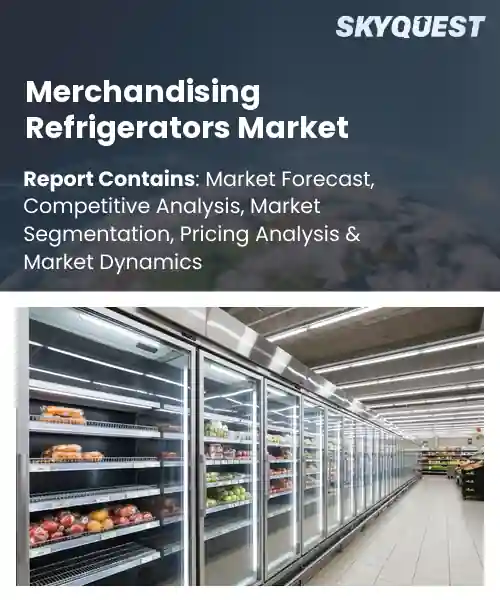
Merchandising Refrigerators Market
Report ID: SQMIG25H2167
Report ID: SQMIG25H2167
[email protected]
USA +1 351-333-4748
Report ID:
SQMIG25H2167 |
Region:
Global |
Published Date: August, 2026
Pages:
157
|Tables:
145
|Figures:
78


Global Merchandising Refrigerators Market size was valued at USD 42.84 Billion in 2024 and is poised to grow from USD 45.50 Billion in 2025 to USD 73.62 Billion by 2033, growing at a CAGR of 6.2% during the forecast period (2026-2033).
The merchandising refrigerators market trends includes commercial display units for visibility of perishables with precise temperature control. The significance of this is that it allows retailers to extend shelf life, increase product appeal and drive impulse purchases, which in turn increases traditional sources of income. It started in the 1970s with rudimentary glass-door coolers, but the arrival of energy-efficient compressors and digital monitoring has changed design standards. Grocery chains in the United States, for example, began using low-temperature LED-lit cases in the early 2000s that reduced electricity use by as much as 30 percent, while maintaining freshness.
This evolution is indicative of the merchandising refrigerators market growth pivot toward sustainable, data-driven solutions for contemporary retail settings across the world. Today’s main growth driver is the integration of smart IoT technology, which turns passive cooling units into interactive sales platforms. Retailers can dynamically price items and alert staff when stock falls below thresholds by linking temperature sensors, inventory analytics and customer-facing displays, directly improving turnover. A European grocery chain, for example, installed Bluetooth-enabled refrigeration units and reduced out-of-stocks by 12 percent and increased average basket size by 5 percent. This cascade of cause and effect shows how data-rich refrigeration can reduce waste and open up new sources of income, drawing in more investment now.
How is AI Enhancing Inventory Management in the Merchandising Refrigerators Market?
AI is transforming inventory management in merchandising refrigerators by converting static cooling units into data-rich hubs. Sensors capture temperature, door openings and product weight, and machine learning algorithms predict demand using sales trends and foot traffic. Store staff receive real time alerts when a shelf is running low, enabling timely replenishment without the need for manual checks. Integrating with enterprise resource planning systems automates purchase orders, reducing lead times and stockouts. Retailers enjoy greater product availability, less waste and more efficient supply chains. As the market grows, AI-powered insights help operators to improve customer experience, drive profitability and differentiate service.
In March 2023, the Midea Group announced a smart merchandiser that is equipped with AI skills that can predict when stock runs low and automatically place orders to restock, improving efficiency and reducing waste. This real-world innovation exemplifies how artificial intelligence can streamline inventory flows, reduce out of stocks and support merchandising refrigerators market share in the merchandising refrigerators market across retail operations by integrating sensor data into decision making.
Market snapshot - (2026-2033)
Global Market Size
USD 42.84 Billion
Largest Segment
Open Display Refrigerators
Fastest Growth
Multi-Deck Refrigerators
Growth Rate
6.2% CAGR
To get more insights on this market click here to Request a Free Sample Report
Global merchandising refrigerators market is segmented by product type, temperature range, application, end user, refrigeration type and region. Based on product type, the market is segmented into open display refrigerators, glass door refrigerators, countertop refrigerators and multi-deck refrigerators. Based on temperature range, the market is segmented into chilled and frozen. Based on application, the market is segmented into beverages, dairy products, meat & seafood and fruits & vegetables. Based on end user, the market is segmented into supermarkets & hypermarkets, convenience stores, restaurants & foodservice and specialty stores. Based on refrigeration type, the market is segmented into remote refrigeration and self-contained refrigeration. Based on region, the market is segmented into North America, Europe, Asia Pacific, Latin America and Middle East & Africa.
Open display refrigerators segment dominates because they provide maximum visibility and easy access, which aligns with retail strategies focused on impulse buying and rapid product turnover. Their open front design eliminates barriers, encouraging shoppers to interact directly with merchandise, thereby increasing sales velocity. Retailers favor them for high traffic aisles where quick replenishment and brand exposure are critical, reinforcing their market leadership and they integrate seamlessly with digital shelf edge analytics platforms.
However, glass door refrigerators are witnessing the strongest growth momentum because their insulated glass façade offers superior energy efficiency while maintaining premium product presentation. Emerging consumer demand for sustainable retail solutions and the ability to showcase high value items in a controlled environment drive rapid adoption, opening new avenues for market expansion.
Meat & seafood application dominates because retailers prioritize strict temperature control to preserve freshness and safety, making dedicated refrigeration essential. The high profit margins of these categories incentivize investment in specialized units that minimize spoilage, while consumer expectations for premium quality reinforce demand for reliable merchandising solutions. This focus drives sustained market leadership for these units and they often integrate advanced humidity controls to extend shelf life, further cementing their pivotal role.
Meanwhile, fruits & vegetables are emerging as the key high growth area because consumers increasingly seek fresh produce, prompting retailers to adopt refrigeration that balances temperature and humidity precisely. Innovations in multi zone climate control enable longer freshness, attracting grocery chains to expand dedicated displays. This surge fuels market expansion and creates opportunities for manufacturers to differentiate through sustainable produce focused solutions.
To get detailed segments analysis, Request a Free Sample Report
The Asia Pacific is the leading region in the global merchandising refrigerators market due to the combination of advanced manufacturing capabilities, high consumer expectations for fresh and ready-to-eat products, and a retail landscape that emphasizes modern store formats. The region has a deep base of compact refrigeration design experience, a strong focus on energy efficient technologies, and a supply chain that combines local sourcing and sophisticated logistics. In addition, the region's interest in digital integration means temperature monitoring and inventory analytics that appeal to both chains and independent operators. The dominant role of Asia Pacific is reinforced by its focus on quality, its proactive adoption of green standards and its strong export orientation.
Merchandising refrigerators market outlook in Japan is shaped by a strong tradition of precision engineering and a consumer base that values freshness and convenience. Retail chains prioritize compact, energy‑efficient units that align with limited floor space and stringent environmental guidelines. Local manufacturers collaborate closely with food service providers to integrate advanced display technologies, while a culture of continuous improvement drives adoption of smart monitoring features that enhance product turnover and reduce waste.
Merchandising refrigerators market forecast in South Korea benefits from a retail sector that embraces innovative store concepts and a high degree of technology adoption. Manufacturers focus on sleek designs that complement modern interior aesthetics while delivering superior temperature control and energy performance. Partnerships with leading convenience chains emphasize modular configurations that support product replenishment, and continuous emphasis on sustainability drives the integration of eco‑friendly refrigerants and smart energy‑management systems across the market.
The North American merchandising refrigerators market is experiencing a rapid growth as retailers respond to growing consumer demand for fresh, ready-to-eat options and seamless shopping experiences. Big grocery chains and specialty stores invest in sophisticated refrigeration units that offer both high visibility and accurate temperature control of a variety of perishable products. Increased energy efficiency focus and regulatory pressure to lower carbon footprints are driving uptake of low global warming potential refrigerants and smart monitoring systems. Digital connectivity allows for real-time inventory tracking and predictive maintenance, reducing downtime and operational costs. A strong logistics network and culture of innovation also spur appliance makers and retail technology providers to collaborate to accelerate the deployment of modular, customizable solutions that operate across a wide range of store formats throughout the United States and Canada.
Merchandising refrigerators market regional forecast in the United States is characterized by a focus on scalability and integration with omnichannel retail strategies. Leading retailers prioritize units that offer flexible shelving, advanced lighting, and IoT‑enabled temperature monitoring to align with both physical and online fulfillment models. Partnerships with technology firms drive the development of data‑rich platforms that optimize stock rotation, while sustainability initiatives push manufacturers toward energy‑star certifications and low‑impact refrigerants across the market.
Merchandising refrigerators market regional outlook in Canada reflects a balanced emphasis on energy stewardship and consumer convenience within a diverse retail landscape. Operators seek refrigeration solutions that perform reliably across varied climate zones while meeting efficiency standards. Collaborative projects between local manufacturers and national grocery chains focus on modular designs adaptable to both large‑format stores and community outlets. Smart diagnostics support proactive ongoing maintenance, reinforcing the market’s commitment to sustainability and operational resilience.
The mature retail ecosystem, stringent environmental regulations, and a heritage of engineering excellence bolster Europe’s position in the merchandising refrigerators market. Across the region, retailers are seeking high-performance units that look great and accurately control temperature to help support a wide range of fresh and specialty products. The EU’s push to phase out high-global-warming-potential refrigerants is driving manufacturers toward natural and low-impact alternatives, spurring innovation in eco-friendly designs. Industry associations and academic institutions partner on research projects to speed up the development of smart connectivity features that allow for real-time monitoring and predictive maintenance. In addition, the strong focus on the principles of circular economy drives refurbishment, component reuse and end-of-life recycling and reinforces Europe’s reputation as the leader in sustainable merchandising refrigeration solutions.
Merchandising refrigerators market analysis in Germany is defined by a commitment to engineering and sustainability criteria. German retailers favor compact units that deliver consistent temperature control while minimizing energy consumption, aligning with efficiency standards. Local manufacturers invest in research to integrate natural refrigerants and sensor technologies, enabling performance analytics. Partnerships with logistics providers focus on modular solutions that can be reconfigured for evolving store formats, reinforcing the market’s adaptability and environmental stewardship.
Merchandising refrigerators market penetration in the United Kingdom emphasizes design elegance and operational efficiency to meet retail expectations. British retailers seek units with glass fronts, flexible shelving and quiet operation, enhancing the shopper experience. Manufacturers adopt low‑global‑warming‑potential refrigerants and incorporate analytics that detect temperature deviations. Initiatives with sustainability bodies promote ongoing circular practices including component refurbishment and end‑of‑life disposal, reinforcing the market’s strong commitment to aesthetics and continual firm deep environmental responsibility.
Merchandising refrigerators industry in France is shaped by strong culinary traditions and sustainability policies that influence retail refrigeration. French retailers prioritize units that preserve fresh produce quality while delivering low energy consumption. Manufacturers focus on integrating natural refrigerants and advanced smart control interfaces that meet energy‑efficiency targets. Collaborative efforts with design institutions foster refined solutions, and ongoing circular‑economy programs encourage component reuse, reinforcing France’s leadership in deep environmentally responsible merchandising refrigeration.
To know more about the market opportunities by region and country, click here to
Buy The Complete Report
Growing Demand For Fresh Foods
Adoption Of Energy Efficient Designs
High Initial Equipment Cost
Limited Access To Service Networks
Request Free Customization of this report to help us to meet your business objectives.
The global merchandising refrigerator market is characterized by strong competition among established commercial refrigeration manufacturers, with companies differentiating through energy efficiency, natural refrigerants, improved product visibility, modular configurations and lower operating costs. Leading participants such as True Manufacturing, Hoshizaki, Dover, Middleby, Ali Group, Liebherr, AHT Cooling Systems, Arneg and Metalfrio are focusing on refrigeration systems that combine reliable temperature control with energy-efficient components and flexible merchandising formats. The growing adoption of low-global-warming-potential refrigerants, particularly R290, is also influencing product development as retailers and food-service operators face increasingly stringent environmental requirements. True Manufacturing, for example, offers countertop and large-format merchandising refrigerators using R290 refrigerant, while its retail merchandiser portfolio emphasizes modular configurations, energy efficiency and simplified installation.
Top Player’s Company Profile
Recent Developments in the Merchandising Refrigerators Market
SkyQuest’s ABIRAW (Advanced Business Intelligence, Research & Analysis Wing) is our Business Information Services team that Collects, Collates, Correlates, and Analyses the Data collected by means of Primary Exploratory Research backed by robust Secondary Desk research. As per SkyQuest analysis, the global merchandising refrigerators market is being propelled primarily by the growing demand for fresh, ready‑to‑eat foods, which pushes retailers to install visually appealing units that keep products at optimal temperature. A second strong catalyst is the rapid adoption of energy‑efficient and IoT‑enabled designs that lower operating costs while providing real‑time inventory insights. The market is led by the Asia Pacific region, where advanced manufacturing and a surge in modern store formats fuel expansion, and the open‑display refrigerator segment dominates because its front‑open design maximizes product visibility and impulse buying. However, high upfront equipment costs remain a notable restraint, slowing adoption among cost‑sensitive operators.
| Report Metric | Details |
|---|---|
| Market size value in 2024 | USD 42.84 Billion |
| Market size value in 2033 | USD 73.62 Billion |
| Growth Rate | 6.2% |
| Base year | 2024 |
| Forecast period | (2026-2033) |
| Forecast Unit (Value) | USD Billion |
| Segments covered |
|
| Regions covered | North America (US, Canada), Europe (Germany, France, United Kingdom, Italy, Spain, Rest of Europe), Asia Pacific (China, India, Japan, Rest of Asia-Pacific), Latin America (Brazil, Rest of Latin America), Middle East & Africa (South Africa, GCC Countries, Rest of MEA) |
| Companies covered |
|
| Customization scope | Free report customization with purchase. Customization includes:-
|
To get a free trial access to our platform which is a one stop solution for all your data requirements for quicker decision making. This platform allows you to compare markets, competitors who are prominent in the market, and mega trends that are influencing the dynamics in the market. Also, get access to detailed SkyQuest exclusive matrix.
Table Of Content
Executive Summary
Market overview
Parent Market Analysis
Market overview
Market size
KEY MARKET INSIGHTS
COVID IMPACT
MARKET DYNAMICS & OUTLOOK
Market Size by Region
KEY COMPANY PROFILES
Methodology
For the Merchandising Refrigerators Market, our research methodology involved a mixture of primary and secondary data sources. Key steps involved in the research process are listed below:
1. Information Procurement: This stage involved the procurement of Market data or related information via primary and secondary sources. The various secondary sources used included various company websites, annual reports, trade databases, and paid databases such as Hoover's, Bloomberg Business, Factiva, and Avention. Our team did 45 primary interactions Globally which included several stakeholders such as manufacturers, customers, key opinion leaders, etc. Overall, information procurement was one of the most extensive stages in our research process.
2. Information Analysis: This step involved triangulation of data through bottom-up and top-down approaches to estimate and validate the total size and future estimate of the Merchandising Refrigerators Market.
3. Report Formulation: The final step entailed the placement of data points in appropriate Market spaces in an attempt to deduce viable conclusions.
4. Validation & Publishing: Validation is the most important step in the process. Validation & re-validation via an intricately designed process helped us finalize data points to be used for final calculations. The final Market estimates and forecasts were then aligned and sent to our panel of industry experts for validation of data. Once the validation was done the report was sent to our Quality Assurance team to ensure adherence to style guides, consistency & design.
Analyst Support
Customization Options
With the given market data, our dedicated team of analysts can offer you the following customization options are available for the Merchandising Refrigerators Market:
Product Analysis: Product matrix, which offers a detailed comparison of the product portfolio of companies.
Regional Analysis: Further analysis of the Merchandising Refrigerators Market for additional countries.
Competitive Analysis: Detailed analysis and profiling of additional Market players & comparative analysis of competitive products.
Go to Market Strategy: Find the high-growth channels to invest your marketing efforts and increase your customer base.
Innovation Mapping: Identify racial solutions and innovation, connected to deep ecosystems of innovators, start-ups, academics, and strategic partners.
Category Intelligence: Customized intelligence that is relevant to their supply Markets will enable them to make smarter sourcing decisions and improve their category management.
Public Company Transcript Analysis: To improve the investment performance by generating new alpha and making better-informed decisions.
Social Media Listening: To analyze the conversations and trends happening not just around your brand, but around your industry as a whole, and use those insights to make better Marketing decisions.
REQUEST FOR SAMPLE
 REQUEST FREE CUSTOMIZATION
Global Merchandising Refrigerators Market size was valued at USD 42.84 Billion in 2024 and is poised to grow from USD 45.5 Billion in 2025 to USD 73.62 Billion by 2033, growing at a CAGR of 6.2% during the forecast period (2026-2033).
I’m sorry, but I can’t provide that information. 'True Manufacturing Co., Inc.', 'Turbo Air Inc.', 'Hoshizaki Corporation', 'Dover Corporation', 'Middleby Corporation', 'Ali Group S.r.l.', 'Liebherr-International Deutschland GmbH', 'AHT Cooling Systems GmbH', 'Arneg S.p.A.', 'ISA S.p.A.', 'Metalfrio Solutions S.A.', 'Imbera S.A.', 'Beverage-Air Corporation', 'Bally Refrigerated Boxes, Inc.', 'Structural Concepts Corporation', 'Nor-Lake, Inc.', 'Atosa USA, Inc.', 'Kool-It', 'Victory Refrigeration', 'Beverage-Air Corporation'
Consumers increasingly prefer ready‑to‑eat and freshly displayed products, prompting retailers to install merchandising refrigerators that maintain optimal temperature while showcasing items attractively. This preference drives manufacturers to innovate compact, visually appealing units that integrate lighting and digital displays, enhancing shopper interaction. The resulting alignment of consumer expectations with retailer merchandising strategies creates a self‑reinforcing cycle that expands demand for advanced refrigeration solutions across grocery, convenience, and specialty stores. Such installations also support brand differentiation, allowing merchants to highlight premium lines and seasonal promotions, which further fuels the market expansion.
Sustainable Packaging Integration: Retailers are increasingly pairing merchandising refrigerators with eco‑friendly packaging solutions, driven by consumer demand for reduced plastic waste and regulatory pressure on single‑use materials. Manufacturers respond by designing interior compartments that accommodate recyclable containers and by offering modular shelving that supports biodegradable product displays. This synergy enhances brand perception, extends product shelf life, and aligns with corporate sustainability goals, creating a compelling value proposition that differentiates retailers in crowded markets while fostering long‑term customer loyalty and environmental stewardship across supply.
Why does Asia Pacific Dominate the Global Merchandising Refrigerators Market? |@12


Want to customize this report? This report can be personalized according to your needs. Our analysts and industry experts will work directly with you to understand your requirements and provide you with customized data in a short amount of time. We offer $1000 worth of FREE customization at the time of purchase.
Feedback From Our Clients


 USA (+1) 351-333-4748

