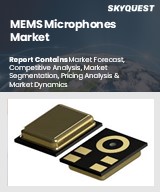
MEMS Microphones Market
Report ID: SQMIG45K2156
Report ID: SQMIG45K2156
[email protected]
USA +1 351-333-4748
Report ID:
SQMIG45K2156 |
Region:
Global |
Published Date: July, 2025
Pages:
175
|Tables:
88
|Figures:
71


Global MEMS Microphones Market size was valued at USD 2.16 Billion in 2024 and is poised to grow from USD 2.34 Billion in 2025 to USD 4.4 Billion by 2033, growing at a CAGR of 8.2% during the forecast period (2026–2033).
One of the key drivers for the MEMS microphones market is the increasing demand for consumer electronics such as smartphones, earbuds, smartwatches, and smart speakers. Voice-based controls and hands-free operation are becoming increasingly dependent on these devices, and they demand small-sized and efficient audio input solutions. MEMS microphones are suitable for integration into handheld and space-limited products due to their compact sizes, low energy consumption, and high-fidelity sound detection. As consumer demand grows for richer sound experiences and better interaction with virtual assistants, electronic manufacturers focus more on MEMS microphones. This is a reinforcing cycle—increased demand stimulates innovation and manufacture, which in turn increases market penetration further.
A key factor shaping the MEMS microphones market is the rapid advancement in MEMS technology. Ongoing R&D has significantly improved microphone performance, with enhancements in sensitivity, signal-to-noise ratio, directionality, and resistance to environmental conditions like dust and moisture. These advances allow MEMS microphones to meet the rigorous requirements of such applications as voice assistants, in-car systems, and industrial Internet of Things devices. Further, AI and machine learning system integration has boosted their application in voice recognition and surroundings awareness. As technology evolves, MEMS microphones become more adaptable and reliable, encouraging widespread adoption across new industries and innovative product categories.
Which AI Applications are Driving Demand for High-Performance Microphones?
Artificial intelligence (AI) is significantly influencing the global MEMS microphones market by driving demand for high-performance audio capture in AI-powered devices. With AI-enabled features such as voice assistants and real-time language processing gaining prominence, there's a greater requirement for MEMS microphones with better signal-to-noise ratios (SNR) to achieve good speech recognition. This necessitates MEMS vendors to advance further, giving rise to solutions such as Infineon's Sealed Dual Membrane (SDM) technology, providing ultra-high SNR and minimal distortion. In this way, AI's evolution supports the expansion and technological advancements of the MEMS microphones market directly.
In January 2024, sensiBel unveiled its SBM100 series MEMS microphones at CES 2024, boasting an industry-leading 80 dBA signal-to-noise ratio (SNR) and 146 dB SPL acoustic overload point (AOP). These patented optical-based microphones provide authentic studio-quality performance in a small form factor, making it possible for such high-performance microphone arrays to be used for far-field sound acquisition.
How are MEMS Microphone Startups Addressing Traditional Capacitive Technology Limitations?
The global MEMS microphones market is experiencing vibrant startup activity, driven by the need for advanced audio solutions in compact, power-efficient devices. Startups are venturing into new materials such as piezoelectric and optical sensing to address the shortcomings of conventional capacitive MEMS. As applications widen to voice interfaces, smart devices, and IoT, startups are developing disruptive innovations that improve sensitivity, robustness, and power efficiency, hastening the transformation of next-gen MEMS microphone technology.
Founded in 2016 in Norway, sensiBel designs high-performance optical MEMS microphones. Born out of SINTEF's research, sensiBel's optical sensing technology employs a tiny laser and interferometer to sense membrane motion with uncanny accuracy. Its SBM100 series delivers 80 dBA SNR and 146 dB SPL AOP, making studio-quality audio available in ultra-compact sizes. Its innovative optical technique replaces legacy capacitive detection, making it possible to use in applications such as advanced audio arrays and far-field voice pickup.
Established in the year 2018, headquartered in Santa Clara, California, xMEMS Labs specializes in solid-state MEMS speakers and microphones. Their innovative design substitutes conventional coil-based solutions with silicon-based ones, improving performance and miniaturization. One of their flagship products, Montara, is the first genuine MEMS speaker in the world, providing higher sound quality and reliability. xMEMS's innovation is the integration of piezoelectric actuators into silicon, leading to devices with improved response time and lower power requirements, hence transforming audio components of consumer electronics.
Market snapshot - 2026-2033
Global Market Size
USD 2.0 billion
Largest Segment
Digital
Fastest Growth
Analog
Growth Rate
8.2% CAGR
To get more insights on this market click here to Request a Free Sample Report
Global MEMS Microphones Market is segmented by Application, Microphone Type, Form Factor, Performance Features, End User and region. Based on Application, the market is segmented into Consumer Electronics, Automotive, Medical and Industrial. Based on Microphone Type, the market is segmented into Digital MEMS Microphones and Analog MEMS Microphones. Based on Form Factor, the market is segmented into Surface Mount and Through-Hole Mount. Based on Performance Features, the market is segmented into Frequency Response, Signal-to-Noise Ratio (SNR) and Total Harmonic Distortion (THD). Based on End User, the market is segmented into Device Manufacturers and System Integrators. Based on region, the market is segmented into North America, Europe, Asia Pacific, Latin America and Middle East & Africa.
Digital MEMS are dominating in the global MEMS microphones market due to their plug-and-play integration with contemporary digital signal processors and lower electromagnetic interference. They are best suited for smartphones, wearables, and smart speakers as they provide consistent audio quality with less noise. Dominance by digital types is due to their uncomplicated system design, compact architecture, and higher compatibility with AI-powered voice interfaces, making them the choice in small, connected electronic devices.
Analog MEMS are projected to experience rapid growth in the global MEMS microphones market due to their cost-effectiveness, smaller package sizes, and lower power consumption compared to digital counterparts. These qualities render them perfect for energy-hungry devices such as smartphones and wearables, where energy efficiency is paramount. Moreover, their compatibility with current analog audio infrastructures and easy integration into a wide range of consumer electronics further fuels their growth.
Capacitive technology remains the market leader in the global MEMS microphone market owing to its established performance, high sensitivity, and superior signal-to-noise ratio. Wafer-level packaging and advancements in miniaturization have compressed capacitive designs into smaller sizes and made them cost-effective, suitable for mobile phones, hearing aids, and smart speakers. Its popularity is a result of well-established manufacturing processes, scalability for high-volume production, and compatibility with established audio processing systems in a wide variety of consumer and industrial applications.
Piezoelectric technology is poised for rapid growth in the global MEMS microphones market due to their inherent durability, low power consumption, and resistance to environmental factors like dust and moisture. These traits make them suitable for outdoor and industrial uses where reliability is essential. Also, developments in piezoelectric materials have improved their sensitivity and performance, further propelling their use across various industries.
To get detailed segments analysis, Request a Free Sample Report
As per the global MEMS microphones market analysis, North America dominates the industry, due to the high growth of the consumer electronics sector and the early traction of smart technologies in the region. Dominance of key tech players and increasing demand for voice-enabled products, IoT applications, and wearables are also contributing factors to the growth of the market. Furthermore, consistent R&D spends and improvements in AI-based audio processing aid the swift adoption of MEMS microphones in regions' healthcare, automotive, and industrial applications.
The United States significantly contributes to North America's MEMS microphones market, driven by its robust consumer electronics industry and high smartphone penetration. Large tech firms like Apple incorporate MEMS microphones into products like iPhones, driving demand. Moreover, the increasing usage of voice-enabled smart home devices and wearables also drives market expansion. The U.S. also dominates technological innovation and R&D spend, driving MEMS microphone functionality and use.
Canada's MEMS microphones market is growing at a high rate, with an estimated CAGR of 23.3% during the period from 2021 to 2027. This growth is driven by rising adoption of sophisticated consumer electronics and IoT devices. The focus of the country on technological advancement and encouraging policies creates a favorable environment for the development of MEMS technology. Moreover, Canada's expanding healthcare industry applies MEMS microphones in hearing aids and medical equipment, which further accelerates market growth.
Europe is fastest growing in the global MEMS microphones market due to high demand for smart consumer electronics, automotive voice control systems, and hearing aids. Germany, France, and the UK are at the front of innovation with cutting-edge R&D infrastructures and automation industries. The emphasis on sustainable and miniaturized technologies and an aging population driving the adoption of medical devices in the region is a major contributor to the integration of MEMS microphones in various applications.
Germany significantly contributes to the Europe’s MEMS microphones market through its robust automotive and industrial sectors. The focus of the country on precision engineering and Industry 4.0 projects pushes the use of MEMS microphones into smart manufacturing systems and car infotainment. German industries and institutions lead in creating new MEMS technologies that improve audio performance and reliability in many applications.
United Kingdom is a contributing factor to Europe‘s MEMS microphones market with its vibrant consumer electronics industry and powerful focus on R&D. Universities and firms located in the United Kingdom are doing pioneering work with MEMS to improve microphone sensitivity and energy consumption. This innovation supports the growing demand for MEMS microphones in applications like mobile devices, hearing aids, and smart home systems.
Asia Pacific is steadily growing in the global MEMS microphones market, driven by the presence of major consumer electronics manufacturing hubs in China, South Korea, and Japan. The region enjoys fast urbanization, rising smartphone penetration, and growing IoT ecosystems. Technological innovations, low costs of production, and robust R&D activities lead to high-volume adoption. Further, growth in demand for wearable devices, voice-based systems, and automotive usage drives long-term market growth through Asia Pacific's diversified industrial base.
Japan is central to the Asia Pacific MEMS microphones market, backed by its strong electronics industry and high focus on miniaturization and precision technology. Japanese organizations are leading in the production of high-quality MEMS microphones, which feature prominently in consumer electronics, vehicle applications, as well as in hearing aids. The nation's high focus on innovation and quality has made it a major destination in the worldwide market.
South Korea plays an important role in the Asia Pacific’s MEMS microphones market with its solid consumer electronics industry, dominated by conglomerates Samsung and LG. The government effort, including grants and tax exemptions for the development of MEMS technology, helps to support the industry. The emphasis of South Korea on making MEMS microphones a part of smart devices improves user experience and fuels the growth of the market.
To know more about the market opportunities by region and country, click here to
Buy The Complete Report
Surge in Voice-Enabled Consumer Electronics
Expansion of IoT and Smart Home Ecosystems
Complex Integration with Multicomponent Systems
Limited Consumer Awareness in Emerging Markets
Request Free Customization of this report to help us to meet your business objectives.
The global MEMS microphones market is globally competitive, featuring players such as Knowles Corporation, STMicroelectronics, Infineon Technologies, Goertek Inc., and AAC Technologies. Miniaturization, multi-microphone arrays, and low-power designs are focused on by companies. Knowles is focused on voice AI and audio processing innovation; STMicroelectronics is focused on advanced packaging and MEMS integration; Infineon is focused on automotive and industrial applications with high-SNR, robust microphones. Competitiveness and technological leadership are driven by product diversification and strategic partnerships.
SkyQuest’s ABIRAW (Advanced Business Intelligence, Research & Analysis Wing) is our Business Information Services team that Collects, Collates, Correlates, and Analyses the Data collected by means of Primary Exploratory Research backed by robust Secondary Desk research.
As per SkyQuest analysis, the global MEMS microphones industry is undergoing rapid transformation, driven by consumer demand for smarter, voice-enabled devices and the integration of cutting-edge AI applications. Advancements in MEMS technology—spanning capacitive, piezoelectric, and optical sensing are enhancing audio fidelity, energy efficiency, and durability across diverse environments.
With industry leaders and startups both driving innovation frontiers, MEMS microphones are now indispensable parts of smartphones, wearables, automotive systems, and industrial IoT devices. Regional giants like North America, Europe, and Asia-Pacific are driving this development through dynamic R&D hubs, high-intensity electronics production, and increased adoption of smart tech. With AI, IoT, and digital interfaces continuing their advance, MEMS microphones will be leading the charge on next-generation audio recording and intelligent device interaction.
| Report Metric | Details |
|---|---|
| Market size value in 2024 | USD 2.16 Billion |
| Market size value in 2033 | USD 4.4 Billion |
| Growth Rate | 8.2% |
| Base year | 2024 |
| Forecast period | 2026-2033 |
| Forecast Unit (Value) | USD Billion |
| Segments covered |
|
| Regions covered | North America (US, Canada), Europe (Germany, France, United Kingdom, Italy, Spain, Rest of Europe), Asia Pacific (China, India, Japan, Rest of Asia-Pacific), Latin America (Brazil, Rest of Latin America), Middle East & Africa (South Africa, GCC Countries, Rest of MEA) |
| Companies covered |
|
| Customization scope | Free report customization with purchase. Customization includes:-
|
To get a free trial access to our platform which is a one stop solution for all your data requirements for quicker decision making. This platform allows you to compare markets, competitors who are prominent in the market, and mega trends that are influencing the dynamics in the market. Also, get access to detailed SkyQuest exclusive matrix.
Table Of Content
Executive Summary
Market overview
Parent Market Analysis
Market overview
Market size
KEY MARKET INSIGHTS
COVID IMPACT
MARKET DYNAMICS & OUTLOOK
Market Size by Region
KEY COMPANY PROFILES
Methodology
For the MEMS Microphones Market, our research methodology involved a mixture of primary and secondary data sources. Key steps involved in the research process are listed below:
1. Information Procurement: This stage involved the procurement of Market data or related information via primary and secondary sources. The various secondary sources used included various company websites, annual reports, trade databases, and paid databases such as Hoover's, Bloomberg Business, Factiva, and Avention. Our team did 45 primary interactions Globally which included several stakeholders such as manufacturers, customers, key opinion leaders, etc. Overall, information procurement was one of the most extensive stages in our research process.
2. Information Analysis: This step involved triangulation of data through bottom-up and top-down approaches to estimate and validate the total size and future estimate of the MEMS Microphones Market.
3. Report Formulation: The final step entailed the placement of data points in appropriate Market spaces in an attempt to deduce viable conclusions.
4. Validation & Publishing: Validation is the most important step in the process. Validation & re-validation via an intricately designed process helped us finalize data points to be used for final calculations. The final Market estimates and forecasts were then aligned and sent to our panel of industry experts for validation of data. Once the validation was done the report was sent to our Quality Assurance team to ensure adherence to style guides, consistency & design.
Analyst Support
Customization Options
With the given market data, our dedicated team of analysts can offer you the following customization options are available for the MEMS Microphones Market:
Product Analysis: Product matrix, which offers a detailed comparison of the product portfolio of companies.
Regional Analysis: Further analysis of the MEMS Microphones Market for additional countries.
Competitive Analysis: Detailed analysis and profiling of additional Market players & comparative analysis of competitive products.
Go to Market Strategy: Find the high-growth channels to invest your marketing efforts and increase your customer base.
Innovation Mapping: Identify racial solutions and innovation, connected to deep ecosystems of innovators, start-ups, academics, and strategic partners.
Category Intelligence: Customized intelligence that is relevant to their supply Markets will enable them to make smarter sourcing decisions and improve their category management.
Public Company Transcript Analysis: To improve the investment performance by generating new alpha and making better-informed decisions.
Social Media Listening: To analyze the conversations and trends happening not just around your brand, but around your industry as a whole, and use those insights to make better Marketing decisions.
REQUEST FOR SAMPLE
 REQUEST FREE CUSTOMIZATION


Want to customize this report? This report can be personalized according to your needs. Our analysts and industry experts will work directly with you to understand your requirements and provide you with customized data in a short amount of time. We offer $1000 worth of FREE customization at the time of purchase.
Feedback From Our Clients


 USA (+1) 351-333-4748

