Membrane Air Spring Market
Report ID: SQMIG20I3408
Report ID: SQMIG20I3408
[email protected]
USA +1 351-333-4748
Report ID:
SQMIG20I3408 |
Region:
Global |
Published Date: July, 2026
Pages:
157
|Tables:
144
|Figures:
78


Global Membrane Air Spring Market size was valued at USD 100.61 Million in 2024 and is poised to grow from USD 105.89 Million in 2025 to USD 159.46 Million by 2033, growing at a CAGR of 5.25% during the forecast period (2026-2033).
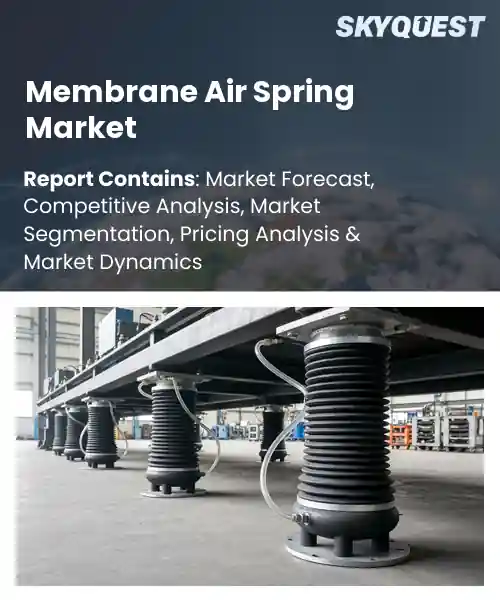
The global membrane air spring market comprises flexible rubber or elastomeric bladders that replace conventional steel coil springs in automotive, rail, and heavy‑equipment suspensions. The significance of this technology is that it enables a more comfortable ride at lower vehicle weights and maintenance costs. The shift to lightweight and fuel-efficient cars is due to the changes in the automotive industry that have also intensified due to the implementation of more stringent emission regulations in Europe and China. In the past, steel springs were used by auto makers, but in the 2010s, there was an emergence of membrane springs introduced by ZF and Tenneco particularly for vehicles that will use electricity and requiring improvements in the field of transportation.
The key trend driving the global membrane air spring sector expansion is the rising demand for active suspension systems that integrate membrane air springs with electronic control units to adapt ride characteristics in time. This synergy produces a chain reaction whereby the more level of autonomy the transport means attain, the better the damping systems function, enhancing the performance of sensors and provoking producers to implement spring-based solutions. The example of railways in Japan where membrane air springs are installed in high-speed trains to minimize the wear of the railway infrastructure confirms this connection. In the USA, the utilization of air spring seats has become a common occurrence in luxury buses, reflecting another aspect of the synergy between spring-based technologies and possibilities of the market related to the supply of retrofits to the previously installed systems.
How is AI Influencing the Design and Performance of Membrane Air Spring Systems?
The global membrane air spring market is being transformed indirectly by artificial intelligence since it optimizes the product development activities and the performance of suspension systems. AI-based simulation tools help manufacturers to analyze the distribution of stress, the fatigue of rubber, and the load behavior of the product before the physical prototyping begins. AI-based suspension control systems in electric vehicles and commercial vehicles allow the continuous monitoring of road conditions, vehicle weight, and driving dynamics in order to adjust the air suspension operation, improving the overall ride comfort and stability and extending the service life of the vehicle components.
In April 2025, The firm Continental AG presented AI-powered software-based vehicle innovations at the Auto Shanghai 2025 automotive exhibition. They highlight intelligent chassis and suspension control systems based on actual data from the vehicle to improve the driving experience. These AI-driven capabilities enhance the performance of air suspension systems, indirectly increasing demand for advanced membrane air springs in commercial and electric vehicles.
Market snapshot - (2026-2033)
Global Market Size
USD 100.61 Million
Largest Segment
Single Convolution
Fastest Growth
Triple Convolution
Growth Rate
5.25% CAGR
To get more insights on this market click here to Request a Free Sample Report
Global membrane air spring market is segmented by product type, material, vehicle type, application, end user and region. Based on product type, the market is segmented into single convolution, double convolution and triple convolution. Based on material, the market is segmented into rubber, elastomer composites and others. Based on vehicle type, the market is segmented into commercial vehicles, railways, industrial equipment and others. Based on application, the market is segmented into suspension systems, vibration isolation and lift & actuation. Based on end user, the market is segmented into oems and aftermarket. Based on region, the market is segmented into North America, Europe, Asia Pacific, Latin America and Middle East & Africa.
Based on global membrane air spring market growth, single convolution segment dominates because its simple architecture aligns with cost sensitive manufacturers, delivering reliable load management while minimizing component count. The design has an inbuilt flexibility which allows for easy adjustment according to various vehicle weights which drives the widespread usage in varying commercial fleets. Engineers like the design because it is dependable, while manufacturers enjoy the efficiency achieved during production processes due to simple supply chain processes.
Meanwhile, triple convolution emerges as the most rapidly expanding area within the product type space. Its multilayered membrane provides superior energy absorption, attracting advanced suspension designs in high performance and off road applications. Emerging demand for superior ride comfort and payload optimization fuels its accelerated adoption, opening new growth avenues.
Rubber segment dominates because it offers proven durability and easy manufacturability that align with legacy production lines. The natural ability of this material to bounce back makes it the number one choice for suspension and vibration isolation. Both suppliers and manufacturers profit from a great variety of available raw material sources and traditional ways of processing that allow them to keep the price under control, as well as to guarantee their high output in terms of production and supply of goods around the entire world.
Conversely, elastomer composites are witnessing the strongest growth momentum in the material category. Innovative filler technologies improve fatigue resistance and temperature stability, drawing manufacturers toward lighter yet robust solutions for performance rail and industrial equipment. Growing demand for longer service intervals and tighter vibration standards fuels adoption, making it a driver of market expansion.
To get detailed segments analysis, Request a Free Sample Report
As per the global membrane air spring market share, North America leads the industry through a combination of deep engineering expertise, extensive automotive and heavy‑equipment manufacturing activity, and a highly integrated supply chain that accelerates product development. A variety of strong research facilities and corporations in this area help to generate innovation in materials and designs. Regulatory standards that require both performance and security assure that new vehicles and updateexisting ones are adopted. An established aftermarket infrastructure allows the quick distribution and servicing of such technologies, therefore increasing the process of entering the market. Combined together they form a sustainable ecosystem of leadership. Manufacturer collaboration helps in developing new technologies and introducing them into practice, which is made further easy by the customer need for comfortable rides. The convergence of policy incentives for emission reduction and the strategic focus on vehicle weight management reinforces the region’s dominant position.
Membrane air spring market in the United States benefits from a broad base of original equipment manufacturers that prioritize advanced suspension technologies for passenger and commercial vehicles. The robust network of suppliers and research laboratories enables the fast improvement of materials while tight safety regulations contribute to the introduction of new platforms. The aftermarket is thriving, providing numerous services that support product life cycles. The collaboration between automotive and heavy machinery industries ensures high demand for high-quality air spring products.
Membrane air spring market in Canada is supported by a strong manufacturing sector that serves both domestic and cross‑border automotive supply chains. The focus placed on sustainable engineering leads to the quest for developing lighter and more durable membrane structures in accordance with national programs for energy efficiency. Use of an efficient system of distribution and the proper focus on after-market services help achieve quick adaptation of these innovations across various types of vehicles.
Based on global membrane air spring regional forecast, Europe experiences rapid expansion of the industry through a blend of high‑tech automotive engineering, stringent environmental mandates, and strong cross‑border collaboration among manufacturers. The ongoing investments in the field of materials science and design optimization lead to lighter and more advanced suspension parts, which can comply with strict safety and emission regulations. The harmonized regulatory frameworks across the bloc support common implementation, while the already existing extensive network of specialized suppliers makes it easier to create and release the product to the market. The rising consumer expectations in terms of comfort and fuel efficiency are responsible for the increasing demand, while the presence of leading research institutions helps continued innovations that make European products some of the best in the world. Besides, incentives for vehicle weight reduction support the transition to air spring solutions, while cooperation between automotive manufacturers and component producers simplifies the incorporation of the new solutions in both new vehicles and upgrades for the existing ones.
Membrane air spring market in Germany is anchored by a robust automotive manufacturing ecosystem that prioritizes precision engineering and lightweight solutions. The collaboration between leading vehicle manufacturers and manufacturers of special materials makes it possible to quickly prototype and test new air spring designs. Stringent safety regulations make high-performance parts a common practice, while the solid base of suppliers guarantees a high-quality component. Continuous joint research work with technical universities contributes to improved durability and performance of structural materials.
Membrane air spring market in the United Kingdom benefits from a vibrant engineering talent pool and a strong tradition of automotive innovation. The partnership of OEMs, research institutions, and specialized suppliers contributes to the advancement of light suspension technologies as per the requirement of the market. The initiatives endorsed by the government that encourages carbon reduction and improving efficiency of the vehicle promote the adoption of membrane-based solutions very well. The presence of efficient aftermarket network helps carry out quick conversions and effective life cycle support in the vehicles of various types.
Membrane air spring market in France is emerging through focused investment in green mobility and a growing network of component manufacturers. Partnerships between automotive groups and research laboratories encourage the exploration of novel polymer membranes that combine lightness with resilience. With an increasing focus on controlling emissions and ensuring passenger comfort, air spring technology becomes relevant for new vehicle development and fleet upgrades efforts. A growing service structure also contributes to the successful implementation and service of air springs in the market.
As per global membrane air spring regional outlook, Asia Pacific is strengthening its position in the industry by leveraging rapid industrialization, expansive automotive production capacity, and aggressive technology adoption. Countries in the region place great importance on material research and are driving the development of high-performance membranes meant for load-bearing and comfort purposes. Vehicle manufacturers and their component suppliers work closely together which enables shorter development time and growing consumer demand for smoother rides and fuel-efficient solutions facilitates the market growth. Government-supported programs, which contribute to lightweight vehicle initiatives and emission reduction, speed up the process even more. Wide aftermarket presence of the membranes has also played its part as there are already numerous players from different transportation sectors. Moreover, partnership with global OEMs allows transfer of technology and boosts local manufacturing potential, while emerging e-vehicles provide new possibilities for introduction of membranes as part of optimisation of vehicle weight management system.
Membrane air spring market in Japan is driven by a sophisticated automotive sector that prioritizes precision, reliability, and advanced vibration control. Cooperative research among top manufacturers and specialized polymer companies has produced membranes with improved durability and weight. Government support of the promotion of vehicle efficiency and emissions reductions contributed to the introduction of air spring technology on the markets of new models. Profoundly organized network of aftermarket assures professional support that allows a quick joining of operation of different vehicles.
Membrane air spring market in South Korea benefits from a rapidly expanding automotive export base and a focused push toward lightweight chassis solutions. The partnership between companies producing chassis and those supplying advanced materials enhances the evolution of high-performing membranes that fulfill stringent requirements of durability. The national government provides incentives for efficient fuel consumption and lower emissions, thus facilitating air spring adoption in commercial and private transport. An efficient distribution system and active aftersales services create favorable conditions for successful business development.
To know more about the market opportunities by region and country, click here to
Buy The Complete Report
Rising Demand For Lightweight Vehicles
Increasing Adoption Of Sustainable Suspension Systems
High Initial Cost Of Membrane Technology
Limited Awareness And Technical Expertise
Request Free Customization of this report to help us to meet your business objectives.
The competitive landscape in the global membrane air spring market outlook, is shaped by firms leveraging advanced membrane technologies to improve air spring performance, with recent M&A activity such as a leading suspension supplier acquiring a niche membrane specialist to broaden its product portfolio, while strategic partnerships between automotive OEMs and membrane innovators accelerate co‑development of lightweight, high‑efficiency air spring systems, and continuous tech innovation focuses on integrating smart sensors and adaptive control algorithms.
Top Player’s Company Profile
Recent Developments
SkyQuest’s ABIRAW (Advanced Business Intelligence, Research & Analysis Wing) is our Business Information Services team that Collects, Collates, Correlates, and Analyses the Data collected by means of Primary Exploratory Research backed by robust Secondary Desk research.
As per SkyQuest analysis, the global membrane air spring industry is being propelled primarily by the rising demand for lightweight vehicles, with manufacturers seeking compact suspension solutions that reduce weight and improve fuel efficiency. A secondary boost comes from the growing adoption of sustainable suspension systems that lower environmental impact. The market’s main restraint is the high initial cost of membrane technology, which can deter cost‑sensitive players. North America remains the dominant region, benefitting from strong engineering expertise and a mature aftermarket. Within product types, the single convolution segment leads the market thanks to its cost‑effective, simple architecture that appeals to a broad range of OEMs.
| Report Metric | Details |
|---|---|
| Market size value in 2024 | USD 100.61 Million |
| Market size value in 2033 | USD 159.46 Million |
| Growth Rate | 5.25% |
| Base year | 2024 |
| Forecast period | (2026-2033) |
| Forecast Unit (Value) | USD Million |
| Segments covered |
|
| Regions covered | North America (US, Canada), Europe (Germany, France, United Kingdom, Italy, Spain, Rest of Europe), Asia Pacific (China, India, Japan, Rest of Asia-Pacific), Latin America (Brazil, Rest of Latin America), Middle East & Africa (South Africa, GCC Countries, Rest of MEA) |
| Companies covered |
|
| Customization scope | Free report customization with purchase. Customization includes:-
|
To get a free trial access to our platform which is a one stop solution for all your data requirements for quicker decision making. This platform allows you to compare markets, competitors who are prominent in the market, and mega trends that are influencing the dynamics in the market. Also, get access to detailed SkyQuest exclusive matrix.
Table Of Content
Executive Summary
Market overview
Parent Market Analysis
Market overview
Market size
KEY MARKET INSIGHTS
COVID IMPACT
MARKET DYNAMICS & OUTLOOK
Market Size by Region
KEY COMPANY PROFILES
Methodology
For the Membrane Air Spring Market, our research methodology involved a mixture of primary and secondary data sources. Key steps involved in the research process are listed below:
1. Information Procurement: This stage involved the procurement of Market data or related information via primary and secondary sources. The various secondary sources used included various company websites, annual reports, trade databases, and paid databases such as Hoover's, Bloomberg Business, Factiva, and Avention. Our team did 45 primary interactions Globally which included several stakeholders such as manufacturers, customers, key opinion leaders, etc. Overall, information procurement was one of the most extensive stages in our research process.
2. Information Analysis: This step involved triangulation of data through bottom-up and top-down approaches to estimate and validate the total size and future estimate of the Membrane Air Spring Market.
3. Report Formulation: The final step entailed the placement of data points in appropriate Market spaces in an attempt to deduce viable conclusions.
4. Validation & Publishing: Validation is the most important step in the process. Validation & re-validation via an intricately designed process helped us finalize data points to be used for final calculations. The final Market estimates and forecasts were then aligned and sent to our panel of industry experts for validation of data. Once the validation was done the report was sent to our Quality Assurance team to ensure adherence to style guides, consistency & design.
Analyst Support
Customization Options
With the given market data, our dedicated team of analysts can offer you the following customization options are available for the Membrane Air Spring Market:
Product Analysis: Product matrix, which offers a detailed comparison of the product portfolio of companies.
Regional Analysis: Further analysis of the Membrane Air Spring Market for additional countries.
Competitive Analysis: Detailed analysis and profiling of additional Market players & comparative analysis of competitive products.
Go to Market Strategy: Find the high-growth channels to invest your marketing efforts and increase your customer base.
Innovation Mapping: Identify racial solutions and innovation, connected to deep ecosystems of innovators, start-ups, academics, and strategic partners.
Category Intelligence: Customized intelligence that is relevant to their supply Markets will enable them to make smarter sourcing decisions and improve their category management.
Public Company Transcript Analysis: To improve the investment performance by generating new alpha and making better-informed decisions.
Social Media Listening: To analyze the conversations and trends happening not just around your brand, but around your industry as a whole, and use those insights to make better Marketing decisions.
REQUEST FOR SAMPLE
 REQUEST FREE CUSTOMIZATION
Global Membrane Air Spring Market size was valued at USD 100.61 Million in 2024 and is poised to grow from USD 105.89 Million in 2025 to USD 159.46 Million by 2033, growing at a CAGR of 5.25% during the forecast period (2026-2033).
The competitive landscape is shaped by firms leveraging advanced membrane technologies to improve air spring performance, with recent M&A activity such as a leading suspension supplier acquiring a niche membrane specialist to broaden its product portfolio, while strategic partnerships between automotive OEMs and membrane innovators accelerate co‑development of lightweight, high‑efficiency air spring systems, and continuous tech innovation focuses on integrating smart sensors and adaptive control algorithms. 'Bridgestone Corporation', 'Continental AG', 'Vibracoustic SE', 'Trelleborg AB', 'Hendrickson Holdings, L.L.C.', 'Firestone Industrial Products Company, LLC', 'Phoenix Mecano AG', 'Sumitomo Riko Company Limited', 'ZF Friedrichshafen AG', 'Stemco Products Inc.', 'Mubea Group', 'Dunlop Systems and Components Ltd', 'BWI Group', 'Hitachi Astemo, Ltd.', 'ITT Inc.', 'Meiji Rubber & Chemical Co., Ltd.', 'Yitao Qianchao Vibration Control Technology Co., Ltd.', 'Guangzhou Guomat Air Spring Co., Ltd.', 'Aktas Holding A.S.', 'Air Lift Company'
The automotive sector is shifting toward lighter vehicle architectures to improve fuel efficiency and reduce emissions, prompting manufacturers to seek suspension components that add minimal weight while delivering reliable performance. Membrane air springs provide a flexible, compact solution that aligns with these design objectives, encouraging OEMs to integrate them across passenger car and commercial vehicle platforms. This design focus fuels demand for advanced spring technologies, thereby supporting market expansion. Such integration also enhances ride comfort and durability, reinforcing supplier interest and accelerating product development cycles.
Advanced Composite Membranes: Manufacturers are increasingly integrating advanced composite membranes into air spring designs to achieve higher durability and lighter weight. These materials combine reinforced fibers with elastomeric layers, delivering superior resistance to fatigue and temperature extremes while reducing overall system mass. The shift supports automotive OEMs seeking to improve fuel efficiency and ride comfort, and aligns with broader industry moves toward lightweighting across vehicle platforms. As supply chains mature, cost pressures are expected to ease, encouraging broader adoption in passenger and commercial vehicles worldwide markets.
Why does North America Dominate the Global Membrane Air Spring Market? |@12


Want to customize this report? This report can be personalized according to your needs. Our analysts and industry experts will work directly with you to understand your requirements and provide you with customized data in a short amount of time. We offer $1000 worth of FREE customization at the time of purchase.
Feedback From Our Clients


 USA (+1) 351-333-4748

