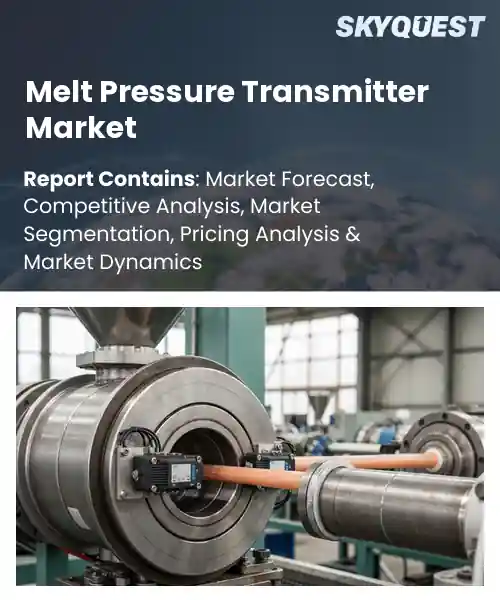
Melt Pressure Transmitter Market
Report ID: SQMIG45J2808
Report ID: SQMIG45J2808
[email protected]
USA +1 351-333-4748
Report ID:
SQMIG45J2808 |
Region:
Global |
Published Date: August, 2026
Pages:
157
|Tables:
143
|Figures:
78


Global Melt Pressure Transmitter Market size was valued at USD 486.2 Million in 2024 and is poised to grow from USD 517.32 Million in 2025 to USD 849.75 Million by 2033, growing at a CAGR of 6.4% during the forecast period (2026-2033).
The global melt pressure transmitter market is supplying sensors that take the pressure being exerted on molten polymer streams and turn it into electrical signals, so manufacturers can dial in extrusion , injection molding and blow-film processes. People say its importance comes from the need for stable product dimensions , less scrap, and better energy efficiency during plastics production.
Regulatory pressure to cut material waste and carbon emissions is now pushing the melt pressure transmitter market growth, mainly because tight pressure control reduces off-spec output and also lowers energy use. When a transmitter notices a deviation, the control loop responds right away by changing pump speed or adjusting barrel temperature. That prevents a lot of scrap that would otherwise need re-processing, and it adds up fast over time. Because of this, performance food packaging firms have been retrofitting older extruders, and they report savings up to 15% each year , more or less. Also the expansion of additive-manufacturing lines , which rely on consistent melt flow, increases demand for transmitters that can handle higher temperatures plus wireless diagnostics, that part is opening new revenue streams for OEMs and related partners.
AI and IoT are making these melt pressure transmitters feel more like connected intelligence hubs, not just standalone sensing devices. AI models can analyze pressure waveforms in real time, catching irregularities that suggest wear or process drift before defects show up. Meanwhile IoT links each transmitter to cloud platforms, letting operators observe melt pressure from any device and change set points without being physically near the machine. This continuous data stream also supports machine learning models that improve calibration over time and boost repeatability across extrusion lines. Manufacturers are leaning into these smart transmitters to trim scrap, reduce changeovers, and stretch equipment life , so the tech is becoming a core efficiency driver.
Market snapshot - (2026-2033)
Global Market Size
USD 486.2 Million
Largest Segment
Rigid Stem
Fastest Growth
Flexible Capillary
Growth Rate
6.4% CAGR
To get more insights on this market click here to Request a Free Sample Report
The global melt pressure transmitter market is segmented by product type, technology, application, end user, output signal and region. Based on product type, the market is segmented into Rigid Stem, Flexible Capillary and Flush Diaphragm. Based on technology, the market is segmented into Strain Gauge, Piezoresistive and Capacitive. Based on application, the market is segmented into Plastic Extrusion, Polymer Processing and Chemical Processing. Based on end user, the market is segmented into Plastic Manufacturers, Chemical Companies and Industrial Process Plants. Based on output signal, the market is segmented into Analog and Digital. Based on region, the market is segmented into North America, Europe, Asia Pacific, Latin America and Middle East & Africa.
As per the melt pressure transmitter market analysis, the rigid stem segment dominates because it gives strong mechanical integrity, it keeps working even under high temperatures and that abrasive melt flow, so pressure measurement stays reliable in demanding extrusion lines. And with that solid construction, it offers less signal drift and fewer maintenance hassles. That’s why it is the go to option for manufacturers looking at long-term stability; the inherent durability matches the main requirement: continuous operation, without interruption. So, it reinforces its market leadership across many processes and uses, globally recognized.
However, the flexible capillary segment shows up as the fastest mover, because its slim profile lets it fit into tight process spaces, making direct pressure sensing possible without intrusive setups. Also, the retrofit angle matters, it’s easier to add to older equipment, and there is growing demand for that flexible instrumentation, so the adoption climbs. This opens up new pathways for melt pressure transmitter market penetration and some innovation, which is why people keep paying attention.
According to the melt pressure transmitter market forecast, the strain gauge segment leads because it has proven reliability, and the construction is straightforward, so it offers consistent pressure readings even when thermal conditions are all over the place, which is typical during polymer processing. It basically does a direct conversion of mechanical deformation into electrical signals, which lowers overall complexity and keeps calibration and maintenance simple. Plus, it plays well with existing control systems, and the cost-effectiveness aspect is strong too. That’s what keeps it preferred among manufacturers who need dependable performance across different extrusion environments during the whole production cycle, so quality control remains continuous and process stability stays steady.
Meanwhile, the capacitive segment is gaining the most momentum, mainly because high sensitivity helps detect tiny pressure variations, which supports accurate melt flow monitoring. And since the industry wants tighter process control, that matters. Improvements in material science also reduce temperature drift, so capacitive devices become more attractive for next-generation extrusion lines and this helps wider adoption in advanced polymer manufacturing.
To get detailed segments analysis, Request a Free Sample Report
As per the melt pressure transmitter market regional forecast, North America keeps a leading stance in the market, mostly because the industrial environment is already mature, plus there is a solid layer of engineering know-how , and the region took precision measurement tech early enough. It is ended up seeing a tight web of original equipment manufacturers and system integrators who care a lot about dependability and how things perform in real lines. There are also these back-and-forth research efforts between universities and companies that speed up new product ideas. At the same time, regulatory structures nudge everyone toward consistent quality, which matters. For end users, areas like polymer processing, automotive plastics , and advanced composites lean on accurate pressure monitoring, so demand stays firm. On top of that, big spending on automation and digital twins helps push melt pressure transmitters into “smart” manufacturing setups. And since energy efficiency and less waste are becoming non-negotiable , buyers tend to choose higher-precision instruments that stabilize the process and help lengthen equipment life.
United States Melt Pressure Transmitter Market
In the United States, the Melt Pressure Transmitter Market outlook is shaped by a strong network of polymer producers and a very clear push toward advanced manufacturing. Major tech vendors often work closely with end users to tune their solutions for high‑speed extrusion along with injection molding cycles . The focus on operational strength, and meeting strict quality requirements, keeps fueling ongoing upgrades. Meanwhile there is this culture of experimentation , so adoption of next‑generation sensor platforms happens rather quickly.
Canada Melt Pressure Transmitter Market
In Canada, the Melt Pressure Transmitter sector benefits from a diversified industrial footprint , including specialty plastics, aerospace composites, and renewable material processing. There’s a lot of collaboration between research organizations and producers which supports rugged devices ,that can handle lower temperatures, and match the local climate realities. Environmental responsibility programs also push for better pressure regulation so waste is reduced. Plus, government incentives that back technology adoption help broaden the market. And the rising requirement for high-performance packaging keeps lifting demand for advanced monitoring approaches across multiple sub-sectors.
Asia Pacific is seeing fast growth in the melt pressure transmitter industry because manufacturers are doubling down on efficient polymer processing and leaning into smart factory concepts. More spending on consumer products, automotive parts ,and packaging is pushing investments in extrusion and injection molding lines, where pressure monitoring has to be precise for quality assurance. Government directions around advanced manufacturing and sustainability encourage energy‑saving sensor rollouts, while the competitive supplier scene keeps pushing improvements in accuracy, and durability of the devices. Strong engineering talent ,and teamwork between universities plus industry partners, also helps speed up new transmitter designs that fit local process needs. So overall, it offers a lively situation where melt pressure measurement becomes a key factor for productivity ,and for staying cost competitive.
Japan Melt Pressure Transmitter Market
The Japanese Melt Pressure Transmitter Market is driven by a very automated production landscape ,and a strong preference for precision engineering. Big electronics companies collaborate with polymer producers to place advanced sensing technologies inside high‑speed extrusion systems. Continuous refinement programs aim to cut cycle times and reduce material losses, so transmitters with better stability and quicker response get chosen more often. Also ,government backing for Industry 4.0 speeds up digital monitoring integration across the supply chain.
South Korea Melt Pressure Transmitter Market
The South Korean Melt Pressure Transmitter Market is supported by an energetic electronics ecosystem, and heavy investment in high‑value polymer applications. Local manufacturers emphasize compact , high‑accuracy sensors, to support rapid scaling for automotive parts and consumer‑electronics components. University and technology firm collaborations help produce transmitters tuned for low power use and tougher processing conditions. National programs pushing digital transformation further boost demand for real‑time pressure information, so manufacturers can improve process efficiency and keep product quality more consistent.
Europe is strengthening its stance in the melt pressure transmitter market by mixing top notch engineering ability with strict quality rules, plus a deliberate push toward more sustainable manufacturing. In general, the region has long history and deep know how in precision instrumentation, so it keeps delivering sensors that feel dependable and also hit tough performance requirements across a bunch of different process situations. There are also cooperative setups, where research bodies , equipment makers and end user industries link up, and that helps fast prototyping , and adoption of digital twins, which then supports real time pressure analytics so energy use can be tuned in a better way. On top of that, environmental directives nudge manufacturers to cut down waste and emissions , so advanced monitoring solutions get added in, helping the process control become more stable. Also, a mature supply chain and a solid after sales service network help keep products available and tech help easy to reach. All in all, Europe keeps reinforcing its image as a dependable provider for high performance melt pressure measurement tech.
Germany Melt Pressure Transmitter Market
In Germany, the melt pressure transmitter market shows a clear preference for precision engineering, and there’s a noticeable blending with both the automotive and chemical sectors. German producers tap advanced sensor methods to land on tight process limits, which supports high volume manufacturing of polymers used in light weight components. Research partnerships with technical universities also keep pushing innovation, especially around sensor miniaturization and improved diagnostic functions. The focus on energy efficiency keeps pulling adoption toward transmitters that can help optimize melt flow in real time, without too much delay.
United Kingdom Melt Pressure Transmitter Market
The United Kingdom melt pressure transmitter market is helped by a lively ecosystem of specialist sensor companies, plus ongoing research cooperation with the plastics processing sphere. There’s strong momentum around digital transformation, and that leads to melt pressure data being fed into analytics ecosystems for better predictive maintenance and steadier product quality. Government support for low carbon manufacturing adds fuel to the trend, encouraging adoption of high precision transmitters that reduce energy draw. And because major academic hubs are close by, development keeps moving with new measurement approaches for tricky processing conditions.
France Melt Pressure Transmitter Market
In France, the melt pressure transmitter market leans on an established tradition of precision instrumentation, while also seeing increasing attention on sustainable production approaches. French manufacturers commonly fold melt pressure sensors into advanced extrusion lines for aerospace and automotive composites, with extra emphasis on reliability, and less maintenance hassle. Collaborative efforts between research organizations and industry help speed up sensor creation, including better temperature stability and wireless communication abilities. Meanwhile, national policies tied to circular economy ideas keep stimulating demand for accurate pressure supervision, so material usage improves and waste goes down, in a more measurable way.
To know more about the market opportunities by region and country, click here to
Buy The Complete Report
Industrial Automation Driving Adoption
Energy Efficiency Emerging Requirement
High Initial Capital Expenditure
Limited Technical Expertise Available
Request Free Customization of this report to help us to meet your business objectives.
In the global melt pressure transmitter market, things get crowded, with long-standing sensor manufacturers go head to head with newer innovators, and lately M&A is moving fast like ABB buying a smaller pressure-sensor company, plus partnerships where Endress+Hauser teamed up with a prominent plastics processor to co-develop advanced melt-pressure solutions. All of that pushes differentiation in technology and it also speeds up product rollout, like everyone wants to be first.
Top Player’s Company Profile
Recent Developments in the Melt Pressure Transmitter Market
SkyQuest’s ABIRAW (Advanced Business Intelligence, Research & Analysis Wing) is our Business Information Services team that Collects, Collates, Correlates, and Analyses the Data collected by means of Primary Exploratory Research backed by robust Secondary Desk research.
As per SkyQuest analysis, the market is being propelled mainly by energy efficiency regulations , which pressure manufacturers to cut waste and lower fuel use. A second strong driver is the rise of AI and IoT , and together they turn older transmitters into connected intelligence hubs . This supports real time diagnostics and predictive control . The main restraint still looks like the high upfront capital outlay needed for purchase, installation and integration, and that can deter smaller players. North America keeps dominating due to its mature industrial base and early adoption of precision measurement technology, and within the product mix the rigid stem segment holds the largest share, mainly due to robust mechanical integrity and long term stability.
| Report Metric | Details |
|---|---|
| Market size value in 2024 | USD 486.2 Million |
| Market size value in 2033 | USD 849.75 Million |
| Growth Rate | 6.4% |
| Base year | 2024 |
| Forecast period | (2026-2033) |
| Forecast Unit (Value) | USD Million |
| Segments covered |
|
| Regions covered | North America (US, Canada), Europe (Germany, France, United Kingdom, Italy, Spain, Rest of Europe), Asia Pacific (China, India, Japan, Rest of Asia-Pacific), Latin America (Brazil, Rest of Latin America), Middle East & Africa (South Africa, GCC Countries, Rest of MEA) |
| Companies covered |
|
| Customization scope | Free report customization with purchase. Customization includes:-
|
To get a free trial access to our platform which is a one stop solution for all your data requirements for quicker decision making. This platform allows you to compare markets, competitors who are prominent in the market, and mega trends that are influencing the dynamics in the market. Also, get access to detailed SkyQuest exclusive matrix.
Table Of Content
Executive Summary
Market overview
Parent Market Analysis
Market overview
Market size
KEY MARKET INSIGHTS
COVID IMPACT
MARKET DYNAMICS & OUTLOOK
Market Size by Region
KEY COMPANY PROFILES
Methodology
For the Melt Pressure Transmitter Market, our research methodology involved a mixture of primary and secondary data sources. Key steps involved in the research process are listed below:
1. Information Procurement: This stage involved the procurement of Market data or related information via primary and secondary sources. The various secondary sources used included various company websites, annual reports, trade databases, and paid databases such as Hoover's, Bloomberg Business, Factiva, and Avention. Our team did 45 primary interactions Globally which included several stakeholders such as manufacturers, customers, key opinion leaders, etc. Overall, information procurement was one of the most extensive stages in our research process.
2. Information Analysis: This step involved triangulation of data through bottom-up and top-down approaches to estimate and validate the total size and future estimate of the Melt Pressure Transmitter Market.
3. Report Formulation: The final step entailed the placement of data points in appropriate Market spaces in an attempt to deduce viable conclusions.
4. Validation & Publishing: Validation is the most important step in the process. Validation & re-validation via an intricately designed process helped us finalize data points to be used for final calculations. The final Market estimates and forecasts were then aligned and sent to our panel of industry experts for validation of data. Once the validation was done the report was sent to our Quality Assurance team to ensure adherence to style guides, consistency & design.
Analyst Support
Customization Options
With the given market data, our dedicated team of analysts can offer you the following customization options are available for the Melt Pressure Transmitter Market:
Product Analysis: Product matrix, which offers a detailed comparison of the product portfolio of companies.
Regional Analysis: Further analysis of the Melt Pressure Transmitter Market for additional countries.
Competitive Analysis: Detailed analysis and profiling of additional Market players & comparative analysis of competitive products.
Go to Market Strategy: Find the high-growth channels to invest your marketing efforts and increase your customer base.
Innovation Mapping: Identify racial solutions and innovation, connected to deep ecosystems of innovators, start-ups, academics, and strategic partners.
Category Intelligence: Customized intelligence that is relevant to their supply Markets will enable them to make smarter sourcing decisions and improve their category management.
Public Company Transcript Analysis: To improve the investment performance by generating new alpha and making better-informed decisions.
Social Media Listening: To analyze the conversations and trends happening not just around your brand, but around your industry as a whole, and use those insights to make better Marketing decisions.
REQUEST FOR SAMPLE
 REQUEST FREE CUSTOMIZATION
Global Melt Pressure Transmitter Market size was valued at USD 486.2 Million in 2024 and is poised to grow from USD 517.32 Million in 2025 to USD 849.75 Million by 2033, growing at a CAGR of 6.4% during the forecast period (2026-2033).
The global melt pressure transmitter market is shaped by intense competition among established sensor manufacturers and emerging innovators, with recent M&A activity such as ABB’s acquisition of a niche pressure‑sensor firm and strategic partnerships like Endress+Hauser collaborating with a leading plastics processor to co‑develop advanced melt‑pressure solutions, driving technology differentiation and accelerating product rollout. 'Dynisco', 'Gefran S.p.A.', 'HBM (Hottinger Brüel & Kjær)', 'WIKA Alexander Wiegand SE & Co. KG', 'OMEGA Engineering, Inc.', 'MTS Sensors', 'Melt Pressure Systems', 'Viatran Corporation', 'Kistler Group', 'BD|SENSORS GmbH', 'Baumer Holding AG', 'Sensata Technologies Holding plc', 'Reotemp Instruments Corporation', 'Noshok, Inc.', 'ZHYQ Sensors', 'Aplisens S.A.', 'Kobold Messring GmbH', 'Shanghai Zhaohui Pressure Apparatus Co., Ltd.', 'Tecsis GmbH', 'FUTEK Advanced Sensor Technology, Inc.'
The upfront cost of melt pressure transmitters, combined with associated installation and integration expenses, can deter organizations with constrained budgets from immediate adoption. Procurement decisions often prioritize short‑term financial considerations over long‑term operational benefits, leading to extended reliance on existing, less accurate instrumentation. This cost sensitivity is particularly pronounced in smaller manufacturers and emerging markets where capital allocation demands careful justification. Consequently, high initial investment requirements act as a barrier, decelerating market expansion despite recognized performance advantages for future production scalability.
Advanced Digital Integration: The migration of melt pressure transmitters toward fully digital architectures is reshaping plant-level data ecosystems. Manufacturers are embedding Ethernet-based protocols and edge‑computing capabilities directly into the sensor housing, enabling real‑time diagnostics, predictive maintenance, and seamless integration with enterprise asset management platforms. This shift reduces reliance on legacy wiring, shortens response times, and supports higher‑resolution process control, fostering greater operational transparency and strategic decision‑making across petrochemical, refining, and specialty chemical facilities while also enhancing compliance with evolving safety and environmental standards.
Why does North America Dominate the Global Melt Pressure Transmitter Market? |@12


Want to customize this report? This report can be personalized according to your needs. Our analysts and industry experts will work directly with you to understand your requirements and provide you with customized data in a short amount of time. We offer $1000 worth of FREE customization at the time of purchase.
Feedback From Our Clients


 USA (+1) 351-333-4748

