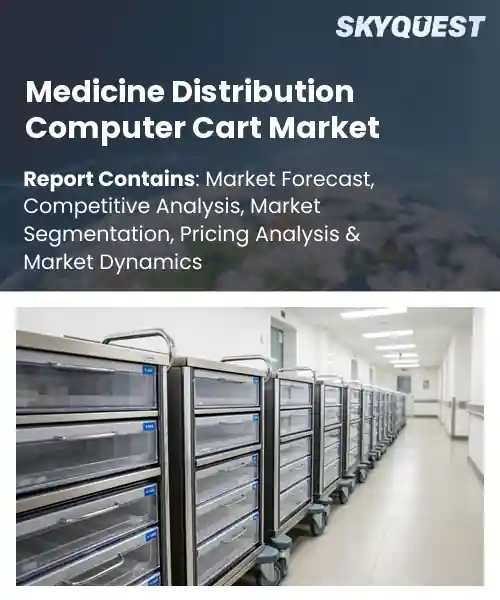
Medicine Distribution Computer Cart Market
Report ID: SQMIG35G2381
Report ID: SQMIG35G2381
[email protected]
USA +1 351-333-4748
Report ID:
SQMIG35G2381 |
Region:
Global |
Published Date: March, 2026
Pages:
157
|Tables:
117
|Figures:
77


Global Medicine Distribution Computer Cart Market size was valued at USD 0.9 Billion in 2024 and is poised to grow from USD 0.97 Billion in 2025 to USD 1.8 Billion by 2033, growing at a CAGR of 8.0% during the forecast period (2026-2033).
The medicine distribution computer cart market centers on mobile, electronically controlled workstations that store, track and dispense pharmaceuticals at the point of care. Its primary driver is the imperative to reduce medication errors and improve nursing productivity, a need amplified by aging populations and complex drug regimens. Hospitals, ambulatory clinics and long-term care facilities adopted these carts alongside barcode medication administration and electronic health record integration, evolving from simple locking trolleys to intelligent, networked devices. Investment has accelerated after high-profile patient-safety initiatives and pandemic-related workflow stresses, with examples including oncology suites adopting locking compartments and emergency departments deploying rapid-response carts.A central growth factor is systems interoperability combined with analytics, because when carts connect seamlessly to EHRs and inventory platforms hospitals can automate medication verification, reconcile stocks and generate usage reports that reduce waste. This connectivity causes faster clinical decisions and lower labor costs, which incentivizes broader deployment during staffing shortages. Manufacturers respond by offering modular IoT sensors, enabling use cases such as oncology dosing cabinets, anesthesia carts that sync dose records and controlled-substance traceability to prevent diversion. These benefits create a feedback loop of adoption, improving safety metrics while opening opportunities for contracts and data-driven supply chain optimization worldwide.
How does AI-enabled automation improve medication accuracy in medicine distribution computer carts?
AI enabled automation improves medication accuracy in medicine distribution computer carts by combining verification sensors, clinical decision support, and system integration to prevent errors at the point of care. Key aspects include automated barcode and camera checks, guided workflows that match patient orders to dispensed items, and inventory intelligence that alerts staff to discrepancies. The current market favors solutions that connect carts to electronic health records and pharmacy systems to enable closed loop medication administration. Hospitals are adopting mobile and cabinet linked carts to reduce manual steps and support staff under pressure. Real world examples include modern automated dispensing and mobile medication systems that emphasize safety and workflow fit.BD October 2025, introduced an AI enabled connected care platform that layers analytics and device interoperability onto its Pyxis ecosystem. This advancement strengthens point of care verification and inventory prediction, which improves medication accuracy and makes distribution carts more efficient and attractive to health systems.
Market snapshot - (2026-2033)
Global Market Size
USD 0.9 Billion
Largest Segment
Powered/Battery-Integrated Carts
Fastest Growth
Powered/Battery-Integrated Carts
Growth Rate
8.0% CAGR
To get more insights on this market click here to Request a Free Sample Report
Global medicine distribution computer cart market is segmented by cart configuration, access control & security, functional feature, end-user and region. Based on cart configuration, the market is segmented into Powered/Battery-Integrated Carts, Non-powered Carts and Wall-mount/Compact Hybrid Carts. Based on access control & security, the market is segmented into Electronic Keypad/PIN Access, Biometric Locking and RFID/Proximity Card Access. Based on functional feature, the market is segmented into Integrated Medication Drawers, Worksurface with Monitor Mounts and Antimicrobial Coating/Surface. Based on end-user, the market is segmented into In-patient Wards & ICUs, Emergency Departments and Long-term Care Facilities. Based on region, the market is segmented into North America, Europe, Asia Pacific, Latin America and Middle East & Africa.
Powered/Battery-Integrated Carts segment dominates because these platforms provide uninterrupted power and onboard device support that enable continuous point of care medication dispensing and computerized documentation. Their integrated power architecture reduces workflow interruptions and supports larger active electronics loads such as monitors and scanners, which drives clinician adoption and vendor preference. As a result, hospitals favor these robust units for reliability, staff efficiency, and meeting stringent medication safety and automation requirements.
However, Wall-mount/Compact Hybrid Carts are rapidly expanding as facilities prioritize space efficient, flexible medication stations that fit crowded care zones. Demand for modular deployment, simpler corridor access, and lower installation footprint accelerates adoption, driving new compact designs and service offerings that expand applications and open fresh market opportunities.
Biometric Locking segment dominates because it delivers a strong authentication layer tailored to medication control workflows, linking unique physiological identifiers to access logs and audits. This reduces unauthorized dispensing and simplifies compliance documentation while minimizing credential sharing risks. High perceived security and integration into electronic health records and pharmacy systems drive procurement preferences, as hospitals prioritize tamper proof access solutions that directly address diversion, controlled substance oversight, and regulatory scrutiny.
Conversely, RFID/Proximity Card Access is witnessing the strongest growth as facilities leverage existing badge ecosystems for rapid, low friction authentication and streamlined workflows. The technology supports contactless, scalable deployments and easier staff onboarding, enabling faster installation and interoperability with asset tracking, which spurs broader adoption and creates incremental opportunities for integrated services and analytics.
To get detailed segments analysis, Request a Free Sample Report
North America dominates due to a confluence of advanced healthcare infrastructure, high technology adoption, and a dense concentration of leading manufacturers and service providers. Healthcare institutions prioritize medication safety, inventory control, and workflow optimization, which aligns with the capabilities of sophisticated medicine distribution computer carts. Strong clinical informatics ecosystems and interoperability expectations encourage integration with electronic records and pharmacy systems. Established procurement channels, pilot programs in academic centers, and robust post sale support networks enable rapid validation and scaled deployments. Collaborative relationships among vendors, healthcare providers, and technology partners further reinforce innovation, localized customization, and reliable service delivery across diverse care settings, sustaining the region's leadership.
Medicine Distribution Computer Cart Market in the United States is driven by mature hospital networks, strong vendor presence, and clinical focus on medication safety. Integration with electronic health records and pharmacy systems is prioritized, with academic medical centers leading pilot deployments. Centralized procurement and clinical engineering teams streamline adoption across care settings. Close collaboration among providers, technology vendors, and institutional purchasers supports tailored solutions and sustained maintenance and training programs.
Medicine Distribution Computer Cart Market in Canada reflects a coordinated approach led by provincial health authorities and integrated hospital systems. Focus on patient safety, medication accuracy, and interoperability with provincial electronic health records shapes procurement decisions. Regional distributors and service networks support installations across urban and remote facilities. Emphasis on clinician training, bilingual support, and value drives interest in scalable solutions that accommodate varying care models and regulatory requirements effectively.
Rapid expansion in Europe is driven by healthcare modernization, a strong regulatory focus on medication safety, and growing investment in digital health infrastructure. National and regional health systems prioritize reduction of medication errors and efficient pharmacy workflows, prompting hospitals and care groups to adopt automated distribution carts integrated with clinical information systems. Local and international vendors offer configurable solutions to meet diverse language and regulatory requirements, while cross border collaborations and standardization initiatives provide validation through leading pilot programs. Procurement strategies increasingly favor scalable, interoperable platforms that align with hospital information systems, and cost containment pressures coupled with the need for efficient resource utilization further encourage adoption and expanded deployments.
Medicine Distribution Computer Cart Market in Germany is characterized by a strong industrial base, rigorous regulatory standards, and established hospital procurement processes. Emphasis on product quality, lifecycle support, and clinical evidence drives vendor selection. Integration with complex hospital IT landscapes and regional interoperability standards encourages robust, configurable solutions. Close collaboration between manufacturers, clinical stakeholders, and service providers supports term implementations and continuous innovation catering to specialist hospital requirements and workflows.
Medicine Distribution Computer Cart Market in the United Kingdom is propelled by modernization programs within healthcare institutions and a receptive procurement environment for innovative solutions. Focus on medication safety, nurse workflow efficiency, and integration with national electronic records shapes adoption choices. Presence of system integrators and clinical technology incubators accelerates pilots and scaling. Emphasis on interoperability, training, and local support networks enables assimilation across diverse hospital and community care settings.
Medicine Distribution Computer Cart Market in France is emerging through targeted modernization efforts within hospitals and health networks, supported by focused pilot projects. Priorities include medication safety, integration with hospital information systems, and adaptation to national procurement processes. Local manufacturers and service providers tailor solutions to language and regulatory expectations. Emphasis on clinician engagement and interoperability enables scaling from pilot sites to broader deployments across acute and outpatient care environments.
Asia Pacific is strengthening its position through accelerated modernization of hospital infrastructure, rising investments in clinical automation, and expanding capabilities among local manufacturers and system integrators. Markets in the region adopt solutions that balance cost effectiveness with essential features such as medication safety, inventory control, and electronic record integration. Collaborations between global vendors and regional partners facilitate technology transfer, localization, and service networks that support installations across urban and rural facilities. Government programs and health system reforms encourage adoption of digital health tools, while pilot projects in leading hospitals demonstrate operational benefits. Focus on adaptable designs, training, capacity building, and responsive maintenance services enables scalable rollouts that align with varied care delivery models and procurement practices across the region.
Medicine Distribution Computer Cart Market in Japan is driven by focus on advanced healthcare technologies and quality expectations. Hospitals prioritize integration with electronic medical records and pharmacy systems, features that enhance medication safety and workflow efficiency. Local manufacturers produce compact, durable designs tailored to facility constraints. Close collaboration between clinical teams and vendors facilitates customized implementations, training, and service models that sustain operational continuity across acute care environments with reliability.
Medicine Distribution Computer Cart Market in South Korea benefits from integration of electronics and IT capabilities across healthcare institutions. Hospitals focus on automation to improve medication safety and streamline pharmacy workflows, with demand for compact, connected solutions. Collaboration between domestic technology firms and global vendors enables localization and service networks. Emphasis on clinician training, interoperability with hospital systems, and maintenance supports reliable deployments across national hospitals and community care facilities.
To know more about the market opportunities by region and country, click here to
Buy The Complete Report
Rising Demand For Automated Workflows
Automated medicine distribution systems reduce manual tasks and streamline nursing workflows, enabling care teams to focus on patient care activities and clinical decision making. This efficiency lowers the burden on staff, shortens medication delivery cycles, and enhances coordination across departments, which in turn encourages healthcare providers to invest in computerized carts. The perceived improvement in operational productivity and potential to standardize medication handling processes fosters broader adoption, as institutions prioritize technologies that demonstrably support safer, more reliable medication management and better resource utilization.
Integration With Electronic Records
Seamless integration with electronic health record systems enables computerized medication carts to access current patient profiles, medication orders, and allergy information, reducing the likelihood of dispensing errors and facilitating reconciliation workflows. When carts are interoperable with other hospital IT systems, clinicians can rely on consistent data across platforms, which improves trust and usability. This interoperability encourages procurement decisions favoring solutions that connect to existing infrastructure, as administrators view integrated systems as critical for improving clinical communication, maintaining audit trails, and supporting coordinated medication management across the care continuum.
High Initial Capital Investment
Significant upfront capital required for purchasing computerized medicine carts and associated infrastructure, together with costs for installation and customization, creates a financial barrier for many healthcare facilities. Smaller hospitals and clinics with limited budgets may defer or forgo adoption despite recognizing operational benefits, as competing priorities such as staffing and basic facility maintenance absorb available funds. The perception of steep initial investment leads to prolonged procurement cycles and cautious decision making, which restrains market expansion by slowing uptake and favoring incremental upgrades over comprehensive system deployments.
Complex Regulatory Compliance Requirements
Compliance with varied regulatory standards and strict medication safety protocols imposes complex requirements on manufacturers and healthcare purchasers, complicating product development and deployment. Meeting diverse certification processes across jurisdictions necessitates extensive documentation, validation, and often iterative design adjustments, which increases time to market and operational complexity. Hospitals may be hesitant to adopt new cart solutions until regulatory clarity is achieved, preferring proven systems that already satisfy local regulations. This cautious stance slows adoption rates and creates additional burdens that constrain market momentum and vendor innovation.
Request Free Customization of this report to help us to meet your business objectives.
The competitive landscape for global medicine distribution computer carts is consolidation driven and innovation led, with hospitals demanding tighter EMR integration and closed loop medication workflows that push vendors toward acquisitions, strategic distributor partnerships, and targeted tech upgrades such as IoT enabled carts and inventory analytics; notable examples include Capsa Healthcare acquisitions and BD’s purchase of Parata and distributor and product partnerships expanding global reach.
Top Player’s Company Profile
Recent Developments
SkyQuest’s ABIRAW (Advanced Business Intelligence, Research & Analysis Wing) is our Business Information Services team that Collects, Collates, Correlates, and Analyses the Data collected by means of Primary Exploratory Research backed by robust Secondary Desk research. As per SkyQuest analysis, the global medicine distribution computer cart market is being driven primarily by the imperative to reduce medication errors and improve nursing productivity, with a second driver being systems interoperability and analytics that enable closed loop medication administration and inventory optimization. A notable restraint remains the high initial capital investment required for carts and integration, which slows adoption among smaller facilities. North America continues to dominate due to advanced healthcare infrastructure and strong vendor ecosystems, while Powered/Battery-Integrated Carts lead the product mix because they support continuous power, onboard electronics and robust point-of-care workflows and offer measurable gains in safety and staff efficiency.
| Report Metric | Details |
|---|---|
| Market size value in 2024 | USD 0.9 Billion |
| Market size value in 2033 | USD 1.8 Billion |
| Growth Rate | 8.0% |
| Base year | 2024 |
| Forecast period | (2026-2033) |
| Forecast Unit (Value) | USD Billion |
| Segments covered |
|
| Regions covered | North America (US, Canada), Europe (Germany, France, United Kingdom, Italy, Spain, Rest of Europe), Asia Pacific (China, India, Japan, Rest of Asia-Pacific), Latin America (Brazil, Rest of Latin America), Middle East & Africa (South Africa, GCC Countries, Rest of MEA) |
| Companies covered |
|
| Customization scope | Free report customization with purchase. Customization includes:-
|
To get a free trial access to our platform which is a one stop solution for all your data requirements for quicker decision making. This platform allows you to compare markets, competitors who are prominent in the market, and mega trends that are influencing the dynamics in the market. Also, get access to detailed SkyQuest exclusive matrix.
Table Of Content
Executive Summary
Market overview
Parent Market Analysis
Market overview
Market size
KEY MARKET INSIGHTS
COVID IMPACT
MARKET DYNAMICS & OUTLOOK
Market Size by Region
KEY COMPANY PROFILES
Methodology
For the Medicine Distribution Computer Cart Market, our research methodology involved a mixture of primary and secondary data sources. Key steps involved in the research process are listed below:
1. Information Procurement: This stage involved the procurement of Market data or related information via primary and secondary sources. The various secondary sources used included various company websites, annual reports, trade databases, and paid databases such as Hoover's, Bloomberg Business, Factiva, and Avention. Our team did 45 primary interactions Globally which included several stakeholders such as manufacturers, customers, key opinion leaders, etc. Overall, information procurement was one of the most extensive stages in our research process.
2. Information Analysis: This step involved triangulation of data through bottom-up and top-down approaches to estimate and validate the total size and future estimate of the Medicine Distribution Computer Cart Market.
3. Report Formulation: The final step entailed the placement of data points in appropriate Market spaces in an attempt to deduce viable conclusions.
4. Validation & Publishing: Validation is the most important step in the process. Validation & re-validation via an intricately designed process helped us finalize data points to be used for final calculations. The final Market estimates and forecasts were then aligned and sent to our panel of industry experts for validation of data. Once the validation was done the report was sent to our Quality Assurance team to ensure adherence to style guides, consistency & design.
Analyst Support
Customization Options
With the given market data, our dedicated team of analysts can offer you the following customization options are available for the Medicine Distribution Computer Cart Market:
Product Analysis: Product matrix, which offers a detailed comparison of the product portfolio of companies.
Regional Analysis: Further analysis of the Medicine Distribution Computer Cart Market for additional countries.
Competitive Analysis: Detailed analysis and profiling of additional Market players & comparative analysis of competitive products.
Go to Market Strategy: Find the high-growth channels to invest your marketing efforts and increase your customer base.
Innovation Mapping: Identify racial solutions and innovation, connected to deep ecosystems of innovators, start-ups, academics, and strategic partners.
Category Intelligence: Customized intelligence that is relevant to their supply Markets will enable them to make smarter sourcing decisions and improve their category management.
Public Company Transcript Analysis: To improve the investment performance by generating new alpha and making better-informed decisions.
Social Media Listening: To analyze the conversations and trends happening not just around your brand, but around your industry as a whole, and use those insights to make better Marketing decisions.
REQUEST FOR SAMPLE
 REQUEST FREE CUSTOMIZATION


Want to customize this report? This report can be personalized according to your needs. Our analysts and industry experts will work directly with you to understand your requirements and provide you with customized data in a short amount of time. We offer $1000 worth of FREE customization at the time of purchase.
Feedback From Our Clients


 USA (+1) 351-333-4748

