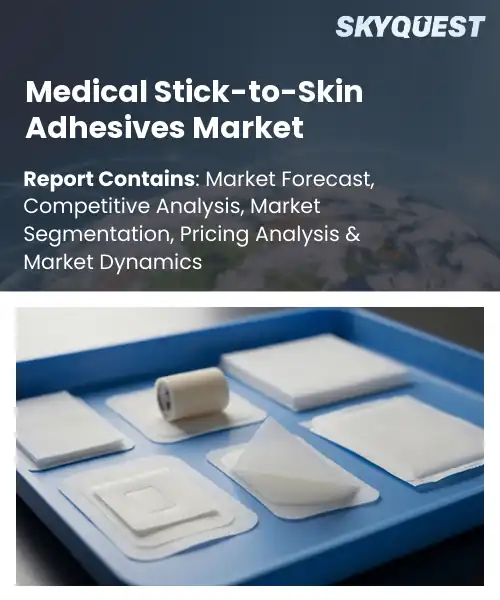
Medical Stick-to-Skin Adhesives Market
Report ID: SQMIG35A3897
Report ID: SQMIG35A3897
[email protected]
USA +1 351-333-4748
Report ID:
SQMIG35A3897 |
Region:
Global |
Published Date: June, 2026
Pages:
157
|Tables:
147
|Figures:
78


Global Medical Stick-To-Skin Adhesives Market size was valued at USD 2.8 Billion in 2024 and is poised to grow from USD 3.01 Billion in 2025 to USD 5.37 Billion by 2033, growing at a CAGR of 7.5% during the forecast period (2026-2033).
The medical stick-to-skin adhesives market is made up of adhesive products, including hydrocolloid formulations, adhesives, and pressure-sensitive tapes, which aid in the fixation of dressing, tubing, and devices onto a patient’s skin. This market segment is critical to ensuring patient safety, improving wound healing and ensuring device adherence and has matured as hospitals have requested enhanced fixation for long-term monitoring as well as minimally invasive therapy (ie: Increasingly adopting chronic care, home healthcare and ambulatory surgeries) has driven increased innovation in the adhesives segment with the introduction of new catheter securement systems and sensor patches for continuous glucose monitoring. Growth of adhesive demand for applications with improved comfort, endurance, and biocompatibility are the leading drivers of demand. An additional market driver for innovation and market growth is the increased regulatory emphasis on patient safety. The development of wearable diagnostics has driven the call for better adhesive products, while stronger testing requirements for adhesives that are "skin friendly," as well as longer and/or more complex reimbursement pathways for patients experiencing injuries from adhesives, incentivize the adhesive manufacturers to invest in silicone-based and hydrocolloid hybrid adhesive products, thus leading to fewer skin injuries and lower rates of re-admission associated with complications related to adhesives.
The growing deployment of continuous glucose monitors (CGM's) and remote cardiac patches has driven hospitals to actively procure adhesive products that deliver both strong fixation and gentle removal. This trend provides additional opportunities for adhesive manufacturers providing backed adhesive solutions. Consequently partnerships between adhesive specialists and device makers accelerate product integration, unlocking opportunities in home care, sports medicine and telehealth monitoring.
How is AI Improving Adhesion Performance And Patient Outcomes In The Medical Stick-to-skin Adhesives Market?
Artificial Intelligence (AI), through it’s use in automating formulation and predictive analysis, is advancing the performance of adhesives used in stick to skin medical applications and improving outcomes for patients. Machine Learning (ML) models allow developers to analyze the properties of materials (adhesives) and the surface of patient’s skin (patient’s skin is the surface of people’s body we put an adhesive on to stick an attachment) to provide predictions about adhesion strength, how long the adhesive will hold the attachments in place without needing to be changed, how long until irritation occurs to the patient, among others. This technology allows manufacturers to create devices that will hold in place longer with less likelihood of causing skin damage, reducing the number of times the device needs to be changed.
In addition, the increasing trend for wearables and remote patient care will create greater demand for adhesives that provide both a balance between comfort and reliability. By using AI technology to create materials based on real world monitoring data of adhesion to a caregiver’s skin, companies can decrease their time to develop and expand their potential audience for use of their products.
Sibel Health December 2025, has received a grant from the FDA for an AI enabled wearable monitor sensor device that uses stick to skin technology. This project is an example of the potential that exists by pairing AI based algorithms and technology with adhesion Engineering to enhance the accuracy, reduce the amount of skin damage and increase device retention, which will ultimately enhance the speed with which these devices can be utilized as well as enhance the efficiencies in deployment methods for customers across the industry.
Market snapshot - (2026-2033)
Global Market Size
USD 2.8 Billion
Largest Segment
Acrylic Adhesives
Fastest Growth
Silicone Adhesives
Growth Rate
7.5% CAGR
To get more insights on this market click here to Request a Free Sample Report
Global medical stick-to-skin adhesives market is segmented by product type, backing material, application, form, end user and region. Based on product type, the market is segmented into Acrylic Adhesives, Silicone Adhesives and Rubber-Based Adhesives. Based on backing material, the market is segmented into Paper, Fabric, Plastic / Film and Foam. Based on application, the market is segmented into Wound Care, Surgical Applications, Ostomy Seals and Device Fixation (Wearables, Sensors). Based on form, the market is segmented into Medical Tapes, Dressing Adhesives and Liquid / Spray Adhesives. Based on end user, the market is segmented into Hospitals, Clinics and Home Care Settings. Based on region, the market is segmented into North America, Europe, Asia Pacific, Latin America and Middle East & Africa.
As acrylic adhesives offer reliable adhesion for the skin, combined with optimal breathability and hypoallergenic properties, acrylic chemistries dominate the market for use in a wide range of clinical applications. Additionally, their formulary flexibility allows for customized tack and cohesive strength suitable for long wear and secure placement of a device. The greater familiarity with regulatory approvals and scalability of manufacturing for acrylics among manufacturers and providers of care helps create stable corridors to support product development as well as supplier investment in acrylic-based products.
The growth in silicone adhesives is stronger than any other category of adhesive due to the gentle removal and excellent skin compatibility characteristics of silicone adhesives, which meet the sensitivity concerns associated with extended-wear applications. Developments in silicone "tack" modulation and decreased adhesive transfer to the skin (e.g., uses for fragile skin populations and pediatric populations) have introduced new clinical applications to support the future growth of silicone as an adhesive category, which has prompted manufacturers to prioritize growing their silicone formulation offerings through product portfolio expansion.
The Device Fixation (Wearables, Sensors) segment is growing rapidly as there is a high demand for adhesives that will hold securely while a patient is in motion and exposed to moisture and will cause minimal trauma to the skin. There is a growing need for predictable peel and shear performance across different types of anatomies. R&D departments are focusing on developing pressure-stable chemistries and engineered backings that can provide consistent and reliable performance. As there is increased acceptance of wearable technologies both clinically and by the general public, there are increased opportunities for suppliers to partner with manufacturers to optimize adhesive-backing combinations that provide reliable sensor performance and user comfort.
While the Device Fixation (Wearables, Sensors) segment has been growing rapidly, there has also been significant growth in the use of Ostomy Seals, as there is an increased focus on peristomal adhesive security and skin barrier protection. Innovations in hydrocolloid interfaces and stretchable foams have enabled longer wear durations while providing gentle edges, which has created clinical demand and provided incentive for developers to design customized geometries for Ostomy Seals as well as to develop skin-friendly formulations. These innovations should lead to improved quality of life.
To get detailed segments analysis, Request a Free Sample Report
The medical stick-to-skin adhesives market is primarily dominated by North America's advances in clinical use and the presence of established healthcare facilities and concentrated innovative manufacturer bases. The procurement process in hospitals or out-patients is driven by clinical considerations such as patient comfort and the applicant's ability to provide quality wound care. Regulating bodies have created pathways for the introduction of new products and evaluation guidelines for institutions that help facilitate the introduction of iteratively produced products. A sophisticated distribution infrastructure plus partnerships between device companies and academic institutions have increased the speed of product development and the evaluation of new products in real-world settings. Manufacturers emphasise the creation of high-performance, hypoallergenic adhesive formulations and differentiated technology in adhesives. The reimbursement and purchasing practices implemented by hospitals multiply each manufacturer's success at all care settings, therefore making North America the leader of this sector while having significant influence on the product priority of manufacturers worldwide. We have built significant relationships with Clinical Opinion Leaders and continuously invest in our-materials' formulation science, which is helping create ongoing refinements/increase the durability of the healthcare adhesive market.
The Medical Stick-to-Skin Adhesives Market is influenced by the concentrated demand within clinical settings as well as widespread use in both acute care and home health; facilitated by a large supply chain that includes manufacturers and specialized distributors. Collaboration between product development teams and clinical centers is critical in supporting innovation through a focus on comfort, skin compatibility, and secure adherence of medical adhesives. Procurement practices and payer considerations of health systems dictate the product portfolio for medical adhesives. Additionally, they drive differentiation from other products based on the characteristics of the patient and/or performance.
The Medical Stick-to-Skin Adhesives Market in Canada is influenced by the federal and provincial procurement frameworks and the prioritization of patient comfort for each of the care settings, including hospitals and community clinics. As a result, Canadian manufacturers are developing adhesives using hypoallergenic materials and flexible adhesion profiles that differ relative to the patient's skin type. Collaborative pilot projects between suppliers and health care providers test the real-world effect of adhesive performance; while collaborative distribution agreements increase the ability to access these medically adhesive products. Product improvements as well as regulatory compliance and clinical feedback provide encouragement to the end-users to adopt adhesive-based solutions.
Europe is experiencing rapid expansion driven by centralized procurement initiatives, heightened focus on patient centric care, and active innovation ecosystems across multiple healthcare markets. Clinical demand for skin friendly, long lasting adhesion aligns with hospital and outpatient priorities to reduce skin trauma and improve dressing retention. Cross border regulatory harmonization and collaborative research programs facilitate product testing and adoption, while specialized distributors enable targeted market penetration. Local manufacturers and multinational companies adapt formulations to regional preferences and clinical guidelines, and payer and tendering mechanisms encourage comparative evaluation, accelerating adoption of differentiated adhesive technologies across key Western European markets. Investment in clinician education and evidence generation, alongside increasing attention to comfort and allergy profiles, supports uptake in both hospital and community care, reinforcing regional momentum and diversity of product offerings.
Medical Stick-to-Skin Adhesives Market in Germany is characterized by strong hospital procurement frameworks and high clinical standards that favor quality adhesive solutions. Local manufacturing and emphasis on rigorous clinical evaluation support the introduction of advanced formulations. Institutional tenders and preference for products with demonstrated skin compatibility influence supplier strategies. Collaboration between research institutions and industry fosters improvements and purchasing practices help establish market leaders based on performance and regulatory compliance.
Medical Stick-to-Skin Adhesives Market in United Kingdom is characterized by adoption driven by clinician advocacy, interest in outcome based procurement, and active engagement with innovative suppliers. Evaluation cycles and pilot programs enable validation of formulations emphasizing comfort and skin friendliness and incorporate clinical feedback. Health service procurement reform and focus on patient experience encourage diversification of product portfolios, while established distribution networks support access across hospital and community care channels.
Medical Stick-to-Skin Adhesives Market in France is taking an visible role driven by interest in patient centric solutions and localized product adaptation. Manufacturers prioritize skin friendly formulations and modular adhesive designs suited to varying clinical applications. Early adopter hospitals and specialty clinics run targeted evaluations to assess comfort and adhesion profiles. Growing dialogue between clinicians, suppliers, and regulatory stakeholders supports gradual integration into standard care pathways and encourages tailored innovation.
Asia Pacific is strengthening its position through expanding manufacturing capabilities, targeted research initiatives, and growing clinical engagement across mature and developing healthcare systems. Local suppliers increasingly tailor adhesive chemistries and backing materials to regional skin profiles and clinical practices, while partnerships with international firms facilitate technology transfer and quality alignment. Improved regulatory clarity in key markets and investment in clinical studies support broader acceptance by hospitals and outpatient providers. Distribution networks and cost sensitive product positioning enable penetration into diverse care settings, and rising attention to patient comfort and allergy considerations is driving adoption of advanced, skin friendly adhesive options. Regional centers of excellence and academic collaborations are generating locally relevant evidence and application protocols, while focused marketing and clinician training programs accelerate clinical uptake across surgical and wound care specialties.
Medical Stick-to-Skin Adhesives Market in Japan is driven by strong emphasis on high quality engineering, with manufacturers focusing on advanced formulations and materials compatibility. Clinical institutions and research organizations collaborate to validate adhesion and skin safety profiles, shaping product design. Demand emphasizes hypoallergenic properties, long term wear and considerations for patient comfort. Distribution through integrated medical channels and partnerships with global suppliers supports product introductions and ongoing clinician education programs.
Medical Stick-to-Skin Adhesives Market in South Korea is advancing through strong manufacturing capabilities and a focus on innovative material science. Domestic firms work with clinical partners to refine adhesive formulations for secure adhesion and skin compatibility across care settings. Emphasis on breathable backings and hypoallergenic adhesives responds to clinician and patient preferences. Collaborations with global technology providers and distribution channels support availability of differentiated products to hospitals and specialty clinics.
To know more about the market opportunities by region and country, click here to
Buy The Complete Report
Rising Demand For Minimally Invasive Procedures
Advances In Adhesive Formulation
Regulatory Approval Complexity and Variability
Limited Reimbursement and Clinical Adoption
Request Free Customization of this report to help us to meet your business objectives.
Competitive dynamics in the global stick to skin medical adhesives market are driven by targeted M&A to secure bioadhesive technologies, strategic partnerships with wearable sensor developers, and rapid materials innovation that extends wear time while reducing skin trauma. Recent industry actions include acquisitions to bolster adhesive pipelines and collaborations that produced FDA cleared wearable sensor platforms such as those from Sibel Health and PyrAmes, accelerating clinical adoption and product differentiation.
SkyQuest’s ABIRAW (Advanced Business Intelligence, Research & Analysis Wing) is our Business Information Services team that Collects, Collates, Correlates, and Analyses the Data collected by means of Primary Exploratory Research backed by robust Secondary Desk research.
As per SkyQuest analysis, the global medical stick-to-skin adhesives market is propelled by rising demand for minimally invasive procedures with one key driver being the need for comfortable, durable fixation, and a second driver being advances in adhesive formulation that improve biocompatibility and wear time. One restraint is regulatory approval complexity and variable regional requirements that slow product rollout. North America remains the dominating region due to advanced clinical adoption and strong industry collaboration. Acrylic adhesives are the dominating segment, favored for reliable adhesion, breathability and manufacturing scalability. Overall, innovation, wearable device integration and partnerships between adhesive specialists and device makers will shape near-term growth.
| Report Metric | Details |
|---|---|
| Market size value in 2024 | USD 2.8 Billion |
| Market size value in 2033 | USD 5.37 Billion |
| Growth Rate | 7.5% |
| Base year | 2024 |
| Forecast period | (2026-2033) |
| Forecast Unit (Value) | USD Billion |
| Segments covered |
|
| Regions covered | North America (US, Canada), Europe (Germany, France, United Kingdom, Italy, Spain, Rest of Europe), Asia Pacific (China, India, Japan, Rest of Asia-Pacific), Latin America (Brazil, Rest of Latin America), Middle East & Africa (South Africa, GCC Countries, Rest of MEA) |
| Companies covered |
|
| Customization scope | Free report customization with purchase. Customization includes:-
|
To get a free trial access to our platform which is a one stop solution for all your data requirements for quicker decision making. This platform allows you to compare markets, competitors who are prominent in the market, and mega trends that are influencing the dynamics in the market. Also, get access to detailed SkyQuest exclusive matrix.
Table Of Content
Executive Summary
Market overview
Parent Market Analysis
Market overview
Market size
KEY MARKET INSIGHTS
COVID IMPACT
MARKET DYNAMICS & OUTLOOK
Market Size by Region
KEY COMPANY PROFILES
Methodology
For the Medical Stick-to-Skin Adhesives Market, our research methodology involved a mixture of primary and secondary data sources. Key steps involved in the research process are listed below:
1. Information Procurement: This stage involved the procurement of Market data or related information via primary and secondary sources. The various secondary sources used included various company websites, annual reports, trade databases, and paid databases such as Hoover's, Bloomberg Business, Factiva, and Avention. Our team did 45 primary interactions Globally which included several stakeholders such as manufacturers, customers, key opinion leaders, etc. Overall, information procurement was one of the most extensive stages in our research process.
2. Information Analysis: This step involved triangulation of data through bottom-up and top-down approaches to estimate and validate the total size and future estimate of the Medical Stick-to-Skin Adhesives Market.
3. Report Formulation: The final step entailed the placement of data points in appropriate Market spaces in an attempt to deduce viable conclusions.
4. Validation & Publishing: Validation is the most important step in the process. Validation & re-validation via an intricately designed process helped us finalize data points to be used for final calculations. The final Market estimates and forecasts were then aligned and sent to our panel of industry experts for validation of data. Once the validation was done the report was sent to our Quality Assurance team to ensure adherence to style guides, consistency & design.
Analyst Support
Customization Options
With the given market data, our dedicated team of analysts can offer you the following customization options are available for the Medical Stick-to-Skin Adhesives Market:
Product Analysis: Product matrix, which offers a detailed comparison of the product portfolio of companies.
Regional Analysis: Further analysis of the Medical Stick-to-Skin Adhesives Market for additional countries.
Competitive Analysis: Detailed analysis and profiling of additional Market players & comparative analysis of competitive products.
Go to Market Strategy: Find the high-growth channels to invest your marketing efforts and increase your customer base.
Innovation Mapping: Identify racial solutions and innovation, connected to deep ecosystems of innovators, start-ups, academics, and strategic partners.
Category Intelligence: Customized intelligence that is relevant to their supply Markets will enable them to make smarter sourcing decisions and improve their category management.
Public Company Transcript Analysis: To improve the investment performance by generating new alpha and making better-informed decisions.
Social Media Listening: To analyze the conversations and trends happening not just around your brand, but around your industry as a whole, and use those insights to make better Marketing decisions.
REQUEST FOR SAMPLE
 REQUEST FREE CUSTOMIZATION
Global Medical Stick-To-Skin Adhesives Market size was valued at USD 2.8 Billion in 2024 and is poised to grow from USD 3.01 Billion in 2025 to USD 5.37 Billion by 2033, growing at a CAGR of 7.5% during the forecast period (2026-2033).
Competitive dynamics in the global stick to skin medical adhesives market are driven by targeted M&A to secure bioadhesive technologies, strategic partnerships with wearable sensor developers, and rapid materials innovation that extends wear time while reducing skin trauma. Recent industry actions include acquisitions to bolster adhesive pipelines and collaborations that produced FDA cleared wearable sensor platforms such as those from Sibel Health and PyrAmes, accelerating clinical adoption and product differentiation. 'Solventum', 'Coloplast Group', 'Johnson & Johnson', 'Avery Dennison Corporation', 'Smith & Nephew plc', 'Nitto Denko Corporation', 'Henkel AG & Co. KGaA', 'DuPont', 'Mölnlycke Health Care AB', 'Advanced Medical Solutions Group plc', 'Nichiban Co., Ltd.', 'B. Braun Melsungen AG', 'H.B. Fuller Company', '3M Company', 'Medtronic plc', 'Medline Industries LP', 'Paul Hartmann AG', 'Scapa Group plc', 'Lohmann GmbH & Co. KG', 'Vancive Medical Technologies'
The increasing preference for minimally invasive procedures has elevated the use of stick to skin adhesives because these adhesives simplify securement of devices and dressings, reduce procedural time, and improve patient comfort, which encourages wider adoption across clinical settings. Clinicians favor solutions that minimize suturing and dressings, while hospitals appreciate reduced procedure complexity. As a result, procurement and clinical pathways increasingly incorporate versatile adhesives, reinforcing demand growth as care delivery shifts toward less invasive techniques and streamlined device management protocols in diverse care environments.
Sustainable Formulation Demand: Manufacturers and healthcare purchasers are increasingly prioritizing adhesives with lower environmental impact, driving development of bio-based polymers, recyclable packaging, and solvent-free processes. Demand is shaped by institutional sustainability goals and consumer preference for greener products, encouraging suppliers to redesign formulations without compromising adhesion, skin compatibility, or shelf life. This trend fosters cross-industry collaboration with scientists and packaging innovators, creating opportunities for differentiated products and lifecycle-focused value propositions that appeal to procurement officers focused on total environmental footprint rather than price.
Why does North America Dominate the Global Medical Stick-to-Skin Adhesives Market? |@12


Want to customize this report? This report can be personalized according to your needs. Our analysts and industry experts will work directly with you to understand your requirements and provide you with customized data in a short amount of time. We offer $1000 worth of FREE customization at the time of purchase.
Feedback From Our Clients


 USA (+1) 351-333-4748

