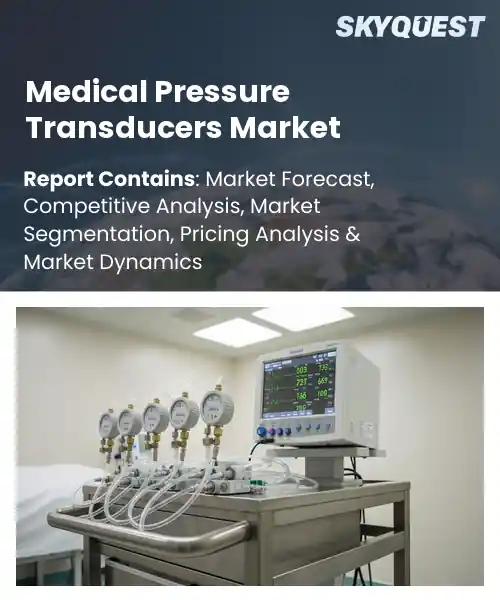
Medical Pressure Transducers Market
Report ID: SQMIG35A3769
Report ID: SQMIG35A3769
[email protected]
USA +1 351-333-4748
Report ID:
SQMIG35A3769 |
Region:
Global |
Published Date: June, 2026
Pages:
157
|Tables:
116
|Figures:
77


Global Medical Pressure Transducers Market size was valued at USD 412.5 Million in 2024 and is poised to grow from USD 438.9 Million in 2025 to USD 720.94 Million by 2033, growing at a CAGR of 6.4% during the forecast period (2026-2033).
Medical pressure transducers convert physiological pressure signals into electrical outputs for monitoring blood pressure, intracranial pressure, intra abdominal pressure and ventilator circuits, and, with rising demand for continuous patient monitoring, this primary driver has reshaped the market landscape. The market's significance stems from the fact that accurate, real-time pressure readings will help to significantly reduce the rates of diagnostic error and will ultimately, therefore, result in better outcomes for critical care patients; thus, hospitals and manufacturers of devices are looking to enhance the performance and reliability of pressure sensors for this very reason. The pressure measurement systems have developed over time from being large mechanical manometers to now being very small microelectromechanical systems with digital outputs.
Building on procurement pressures and innovation trends, a key trend driving the global medical pressure transducers sector is technological integration, specifically MEMS sensors, wireless telemetry and analytics, which lowers unit costs, increases functionality and expands adoption across clinical settings. As an illustration, increased precise MEMS transducers have significantly minimised the requirement for calibrations within intensive care units (ICUs) thus reducing the burden on clinicians and motivating healthcare systems to upgrade from legacy devices. Likewise, the use of wireless modules has facilitated increased speed of placement for field hospitals as well as expanded tele-ICU services at hospitals during the COVID-19 pandemic to show that the demand is capable of scaling greatly. Consequently manufacturers find opportunities in disposable lines, patient monitoring solutions and emerging markets where lower cost connected devices meet rising chronic disease burdens.
How is AI Enhancing Diagnostic Accuracy in the Medical Pressure Transducers Market?
By combining advanced signal processing with machine learning to reduce noise, eliminate artifacts, and extract clinically meaningful waveform features, AI can significantly enhance the accuracy of pressure transducers used for diagnostic purposes. Embedded AI applications, along with cloud-based analytics, help clinicians to distinguish between real physiological changes and sensor drift, thereby providing them with continuous trusted readings. Additionally, the market is moving towards sensor + analytics platform integration for intensive care and remote monitoring. For suppliers of high-fidelity sensors and analog front-end devices, cleaner training data will be available for AI models to use.
In April 2025, BD launched a next generation hemodynamic monitoring solution that applies AI to pressure transducer data to detect instability earlier and deliver clinical decision support. This innovation pairs proven sensors with AI driven analytics to improve workflow efficiency and bolster market growth by increasing diagnostic accuracy and reducing unnecessary interventions.
Market snapshot - (2026-2033)
Global Market Size
USD 412.5 Million
Largest Segment
Single-Port Pressure Transducers
Fastest Growth
Multi-Port Pressure Transducers
Growth Rate
6.4% CAGR
To get more insights on this market click here to Request a Free Sample Report
Global medical pressure transducers market is segmented by product port type, application clinical area, end-user, distribution channel and region. Based on product port type, the market is segmented into single-port pressure transducers and multi-port pressure transducers. Based on application clinical area, the market is segmented into blood pressure monitoring, respiratory & ventilation pressure controls, infusion & dialysis fluid flow safety and intracranial pressure monitoring. Based on end-user, the market is segmented into hospitals & intensive care units, ambulatory surgical centers and cardiac specialty centers. Based on distribution channel, the market is segmented into direct and indirect. Based on region, the market is segmented into North America, Europe, Asia Pacific, Latin America and Middle East & Africa.
Based on the global medical pressure transducers market growth, single-port pressure transducers segment dominates because their simplified design enables straightforward connection to standard catheters and bedside monitors, reducing setup time and clinician training needs. Their robust performance and lower maintenance complexity make them the preferred choice for routine hemodynamic and infusion monitoring, and strong compatibility with existing clinical workflows drives institutional purchasing and long term deployment across care settings.
However, multi-port pressure transducers are witnessing the strongest growth momentum as multi-channel monitoring becomes critical for complex hemodynamic management and advanced respiratory support. Increased clinical opportunities have resulted from advances in miniaturized and multiplexed interfaces and system architecture, while the increasing use of consolidated monitoring solutions drives investment and product development by vendors and provides additional opportunities for reimbursement.
Respiratory & ventilation pressure controls segment dominates because continuous, highly responsive airway pressure measurement is essential for safe mechanical ventilation and respiratory therapy management. Because of strict criteria for safety and alarm performance, manufacturers prioritize sensors that provide fast response time, minimal drift, and seamless integration with ventilators. Clinical priorities guide purchasing towards utilizing transducers specifically designed for use in ventilators.
Meanwhile, intracranial pressure monitoring is emerging as the most rapidly expanding area due to growing emphasis on neurocritical care and the development of less invasive continuous monitoring technologies. Advances in signal processing and analytics increase clinical utility, prompting new buying priorities and supplier innovation that expand applications and create further market opportunities.
To get detailed segments analysis, Request a Free Sample Report
Based on global medical pressure transducers market outlook, North America dominates the industry because its healthcare ecosystem combines advanced clinical infrastructure, concentrated device manufacturing, and mature distribution and service networks that accelerate product adoption and lifecycle support. Long-standing relationships amongst the hospital community, university-based research institutions, and manufacturers fuel ongoing product development and clinical validation while regulations provide clear pathways to obtain product clearance and complete post market surveillance. Long-standing reimbursement methodologies and procurement methodologies of health services establish the foundation for investing in quality monitoring devices. Development of low-cost, reliable pressure transducers across multiple clinical settings is made possible by the availability of specialized critical care and surgical facilities, high patient safety standards, and large amounts of expertise related to medical electronic devices/instrumentation.
Medical pressure transducers market in the United States is characterized by technology leadership, close collaboration between clinicians and device manufacturers, and a sophisticated hospital network that drives adoption of advanced pressure monitoring solutions. There is a significant amount of clinical research happening as well as an array of medical device clusters and the ability to offer extensive service and maintenance capabilities to assist with product refinement and product deployment. In addition to encouraging innovation through the reimbursement structure and the approach to promoting early adoption.
Medical pressure transducers market in Canada benefits from an integrated healthcare system, strong institutional purchasing, and a collaborative environment for implementations. The procurement framework set forth by provinces is focused on standardizing everything, from product selection to supplier relationships. Service networks and partnerships with international manufacturers provide mechanisms for creating tailored solutions, training, maintenance, and coordinated national approaches to stable usage of equipment in acute/critical care clinical services.
Based on global medical pressure transducers regional forecast, Europe is experiencing rapid expansion driven by coordinated healthcare priorities, progressive clinical adoption of integrated monitoring systems, and a robust medical technology industry anchored by leading manufacturing and research hubs. Manufacturers have been encouraged to ensure that their products comply with regional certification and interoperability standards by harmonizing regulatory standards and putting a strong emphasis on patient safety. Both public and private health care providers have made quality of care and operational efficiency top priorities, thereby creating an environment that encourages the purchase of reliable pressure sensing solutions. Cross-border collaboration among clinical networks, academic institutions and industry is providing localized validation of products through customizations. Investments in digital health infrastructure and focus on training and serviceability for products have positioned the region for future growth and more widespread clinical deployment through active participation in specialized medtech clusters.
Medical pressure transducers market in Germany is led by a strong medical technology industry, established manufacturing clusters, and close collaboration between engineering firms and clinical institutions. To develop robust and high-performance transducers for clinical applications, an emphasis on precision engineering and quality standards is necessary. The use of robust hospital procurement processes, targeted technical training, and a culture of clinical evaluation aid in making product development iterative; integrating transducers with patient monitoring systems in acute care settings.
Medical pressure transducers market in the United Kingdom is characterized by dynamic adoption of digital monitoring platforms, agility in clinical procurement, and an innovation ecosystem that fosters collaboration with hospitals. Health Technology Assessment Agencies have also collaborated with healthcare providers and suppliers to facilitate market entry and growth throughout the continuum of care and to help create a commercially successful scale adequate level of usage in both the acute care setting and community-based settings.
Medical pressure transducers market in France is emerging through a focus on quality of care, investment in hospital infrastructure, and a growing appetite for technology that enhances patient monitoring. The partnership between clinical research centres with device manufacturers improves local evaluation and adaptation of devices to fit into their healthcare system’s overall care pathways. Clear education/training, assurance of device reliability, and potential integration with electronic health records, promote the use of consistently monitored devices at large or tertiary care hospitals and across multiple health facilities.
As per global medical pressure transducers regionla outlook, Asia Pacific is strengthening its position through a combination of technological capability, growing domestic manufacturing scale, and targeted investments in healthcare modernization. The combination of precision electronic and sensor fabrication capabilities located within the area provides an opportunity to develop compact, high performance pressure transducers to meet both local and export market needs. National and global government initiatives, together with healthcare system investments, are fostering the creation of better clinical infrastructure through increased adoption of integrated monitoring platforms and evolving regulatory processes aimed at improving access to the market. Collaboration among regional manufacturers and worldwide device manufacturers has accelerated the transfer of knowledge and clinical validation between the two groups. Focusing on lower production costs, increased scalability of supply chain, and improved after sale support are all factors that are allowing greater penetration into the hospital network and specialty care settings of the region.
Medical pressure transducers market in Japan benefits from a strong culture of precision engineering, close ties between semiconductor and medical device sectors, and a focus on miniaturized high performance sensor solutions. The established and research and development agencies work together to improve devices so that they can meet expected quality standards through testing. Both companies have an integrated advanced oversight platform with a long-term commitment to serviceability, which will help create more opportunities for utilization in acute care and clinical applications that require a high level of dependability from their devices.
Medical pressure transducers market in South Korea is advancing through strengths in electronics manufacturing, adoption of health platforms, and close cooperation between manufacturers and medical device developers. The compactness and high precision of our sensors, combined with the ability to increase production based upon regional healthcare requirements, allows us to offer affordable solutions that can be customized for each region. Strategic partnerships with global suppliers, clinical validation, and responsive after sales support encourage uptake across hospitals and private care networks seeking integrated monitoring technologies.
To know more about the market opportunities by region and country, click here to
Buy The Complete Report
Integration With Patient Monitoring
Growing Emphasis on Patient Safety
High Cost Of Advanced Devices
Regulatory Approval Complexity
Request Free Customization of this report to help us to meet your business objectives.
Competition in the medical pressure transducers market outlook centers on technology leadership and OEM channel control, with firms pursuing selective M&A and licensing to secure sensor IP, strategic partnerships to embed sensors into clinical platforms, and rapid device innovation to outpace rivals. Examples include Stryker licensing next generation pressure monitoring technology, Fluke Biomedical integration partnerships, and niche developers winning breakthrough device pathways.
Top Player’s Company Profile
Recent Developments
SkyQuest’s ABIRAW (Advanced Business Intelligence, Research & Analysis Wing) is our Business Information Services team that Collects, Collates, Correlates, and Analyses the Data collected by means of Primary Exploratory Research backed by robust Secondary Desk research.
As per SkyQuest analysis, the global medical pressure transducers industry is being driven primarily by rapid technological integration such as MEMS sensors, wireless telemetry and analytics that improve accuracy and reduce clinician workload, and is further supported by a growing emphasis on patient safety that encourages adoption of reliable monitoring solutions. However, expansion is restrained by the high cost of advanced devices which limits procurement in resource constrained settings. North America remains the dominating region due to its mature healthcare infrastructure and concentrated device manufacturing, while the Single-Port Pressure Transducers segment dominates clinical use because its simple, compatible design and lower maintenance needs suit routine hemodynamic and infusion monitoring.
| Report Metric | Details |
|---|---|
| Market size value in 2024 | USD 412.5 Million |
| Market size value in 2033 | USD 720.94 Million |
| Growth Rate | 6.4% |
| Base year | 2024 |
| Forecast period | (2026-2033) |
| Forecast Unit (Value) | USD Million |
| Segments covered |
|
| Regions covered | North America (US, Canada), Europe (Germany, France, United Kingdom, Italy, Spain, Rest of Europe), Asia Pacific (China, India, Japan, Rest of Asia-Pacific), Latin America (Brazil, Rest of Latin America), Middle East & Africa (South Africa, GCC Countries, Rest of MEA) |
| Companies covered |
|
| Customization scope | Free report customization with purchase. Customization includes:-
|
To get a free trial access to our platform which is a one stop solution for all your data requirements for quicker decision making. This platform allows you to compare markets, competitors who are prominent in the market, and mega trends that are influencing the dynamics in the market. Also, get access to detailed SkyQuest exclusive matrix.
Table Of Content
Executive Summary
Market overview
Parent Market Analysis
Market overview
Market size
KEY MARKET INSIGHTS
COVID IMPACT
MARKET DYNAMICS & OUTLOOK
Market Size by Region
KEY COMPANY PROFILES
Methodology
For the Medical Pressure Transducers Market, our research methodology involved a mixture of primary and secondary data sources. Key steps involved in the research process are listed below:
1. Information Procurement: This stage involved the procurement of Market data or related information via primary and secondary sources. The various secondary sources used included various company websites, annual reports, trade databases, and paid databases such as Hoover's, Bloomberg Business, Factiva, and Avention. Our team did 45 primary interactions Globally which included several stakeholders such as manufacturers, customers, key opinion leaders, etc. Overall, information procurement was one of the most extensive stages in our research process.
2. Information Analysis: This step involved triangulation of data through bottom-up and top-down approaches to estimate and validate the total size and future estimate of the Medical Pressure Transducers Market.
3. Report Formulation: The final step entailed the placement of data points in appropriate Market spaces in an attempt to deduce viable conclusions.
4. Validation & Publishing: Validation is the most important step in the process. Validation & re-validation via an intricately designed process helped us finalize data points to be used for final calculations. The final Market estimates and forecasts were then aligned and sent to our panel of industry experts for validation of data. Once the validation was done the report was sent to our Quality Assurance team to ensure adherence to style guides, consistency & design.
Analyst Support
Customization Options
With the given market data, our dedicated team of analysts can offer you the following customization options are available for the Medical Pressure Transducers Market:
Product Analysis: Product matrix, which offers a detailed comparison of the product portfolio of companies.
Regional Analysis: Further analysis of the Medical Pressure Transducers Market for additional countries.
Competitive Analysis: Detailed analysis and profiling of additional Market players & comparative analysis of competitive products.
Go to Market Strategy: Find the high-growth channels to invest your marketing efforts and increase your customer base.
Innovation Mapping: Identify racial solutions and innovation, connected to deep ecosystems of innovators, start-ups, academics, and strategic partners.
Category Intelligence: Customized intelligence that is relevant to their supply Markets will enable them to make smarter sourcing decisions and improve their category management.
Public Company Transcript Analysis: To improve the investment performance by generating new alpha and making better-informed decisions.
Social Media Listening: To analyze the conversations and trends happening not just around your brand, but around your industry as a whole, and use those insights to make better Marketing decisions.
REQUEST FOR SAMPLE
 REQUEST FREE CUSTOMIZATION
Global Medical Pressure Transducers Market size was valued at USD 412.5 Million in 2024 and is poised to grow from USD 438.9 Million in 2025 to USD 720.94 Million by 2033, growing at a CAGR of 6.4% during the forecast period (2026-2033).
Competition in the medical pressure transducers market centers on technology leadership and OEM channel control, with firms pursuing selective M&A and licensing to secure sensor IP, strategic partnerships to embed sensors into clinical platforms, and rapid device innovation to outpace rivals. Examples include Stryker licensing next generation pressure monitoring technology, Fluke Biomedical integration partnerships, and niche developers winning breakthrough device pathways. 'Edwards Lifesciences', 'Smiths Group', 'Argon Medical Devices', 'Utah Medical Products', 'Merit Medical Systems', 'Becton Dickinson', 'Cardinal Health', 'Medline Industries', 'Terumo Corporation', 'B. Braun SE', 'Nipro Corporation', 'Asahi Intecc', 'Fresenius SE', 'Baxter International', 'Teleflex', 'Abbott Laboratories', 'Boston Scientific Corporation', 'Stryker Corporation', 'Zimmer Biomet Holdings', 'Johnson & Johnson'
Integration of pressure transducers with electronic patient monitoring platforms enhances clinical workflow efficiency and data continuity, encouraging healthcare facilities to adopt these devices more widely. Seamless connectivity reduces manual entry, supports real-time alarms, and enables clinicians to track trends within unified dashboards, which improves responsiveness and perceived value. This interoperability also facilitates device standardization across care settings, simplifies staff training, and supports procurement decisions, making pressure transducers a preferred component of comprehensive monitoring solutions and thereby driving sustained market uptake across hospitals and specialty clinics.
Connectivity Enabled Integration: Medical pressure transducers are increasingly integrated with digital platforms and patient monitoring ecosystems, enabling seamless data flow into clinical workflows and electronic health records. This trend supports remote monitoring and care coordination by providing continuous, contextual pressure information that clinicians can access outside traditional settings. Vendors are focusing on interoperability, standardized communication protocols, and secure data transmission to facilitate device integration. The result is improved workflow efficiency, better clinical decision support, and expanded deployment in decentralized care environments and scalability.
Why does North America Dominate the Global Medical Pressure Transducers Market? |@12


Want to customize this report? This report can be personalized according to your needs. Our analysts and industry experts will work directly with you to understand your requirements and provide you with customized data in a short amount of time. We offer $1000 worth of FREE customization at the time of purchase.
Feedback From Our Clients


 USA (+1) 351-333-4748

