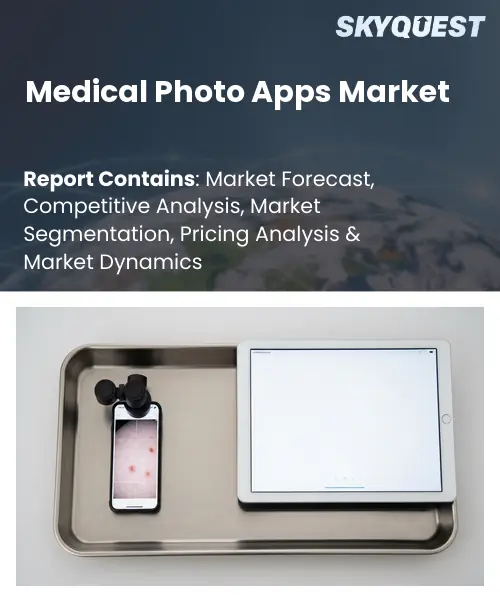
Medical Photo Apps Market
Report ID: SQMIG35G2555
Report ID: SQMIG35G2555
[email protected]
USA +1 351-333-4748
Report ID:
SQMIG35G2555 |
Region:
Global |
Published Date: August, 2026
Pages:
157
|Tables:
171
|Figures:
79


Global Medical Photo Apps Market size was valued at USD 1.16 Billion in 2024 and is poised to grow from USD 1.32 Billion in 2025 to USD 3.84 Billion by 2033, growing at a CAGR of 14.2% during the forecast period (2026-2033).
Interoperable data becomes the driving force behind the next evolution of the market for apps taking photos of patients because repositories of images linked to EHRs will help physicians diagnose accurately, looking at visual images along with other patient data. The integration contributes to the popularity of such applications within dermatology, when a certain app linked to an EHR decreased referral times. Cloud-based data storage decreases expenses, allowing any clinic to use modern diagnostic equipment rather than huge hospitals. Development of APIs and cloud-based storage solutions provides a powerful feedback loop in which better functionality attracts more users who pay, thus funding more development.
How is AI Enhancing Diagnostic Accuracy in the Medical Photo Apps Market?
AI technology has been improving the accuracy of diagnosis in medical photo apps by incorporating deep learning algorithms that are able to identify small visual differences in skin lesions, retinal scans, and wounds. Algorithms are trained on large, varied image databases and are therefore able to distinguish between benign and malignant images. Real-time feedback allows for a more accurate diagnosis by reducing subjectivity and speeding up the process. By integrating the apps with electronic health records, it is possible to make use of context provided by patient history and improve the diagnostic process. With smartphones and tablets becoming increasingly common in the healthcare environment, demand for cost-effective, mobile and highly accurate diagnostic tools continues to drive the growth in the market space.Recent advancement in the industry demonstrates the role of AI-powered image analysis in the growth of the market, with one of the major providers of medical photo apps releasing a new diagnostic tool.
Market snapshot - (2026-2033)
Global Market Size
USD 1.16 Billion
Largest Segment
Clinical Documentation
Fastest Growth
Wound Care Imaging
Growth Rate
14.2% CAGR
To get more insights on this market click here to Request a Free Sample Report
Global medical photo apps market is segmented by application type, deployment, platform, end user, pricing model, organization size and region. Based on application type, the market is segmented into Clinical Documentation, Wound Care Imaging, Telemedicine Imaging and Others. Based on deployment, the market is segmented into Cloud-Based and On-Premises. Based on platform, the market is segmented into Android, iOS and Cross-Platform. Based on end user, the market is segmented into Hospitals, Clinics, Medical Practices and Others. Based on pricing model, the market is segmented into Subscription, One-Time License and Freemium. Based on organization size, the market is segmented into Small Healthcare Providers and Large Healthcare Providers. Based on region, the market is segmented into North America, Europe, Asia Pacific, Latin America and Middle East & Africa.
Clinical Documentation segment dominates because it directly supports regulatory compliance and accurate patient records, which are core priorities for healthcare providers. By enabling seamless capture, annotation, and integration of images into electronic health records, it reduces manual errors and accelerates clinical workflows. The trust placed in these capabilities drives widespread adoption across facilities, reinforcing its central position in the Medical Photo Apps Market and long term strategic planning for providers.
However, Wound Care Imaging segment emerges as the most rapidly expanding area because clinicians seek precise visual monitoring to improve healing outcomes. Advanced analytics and AI driven assessment tools are being integrated, attracting providers focused on chronic wound management. This momentum fuels broader market growth and creates new opportunities for specialized app development.
Cloud based segment leads because it offers elastic resources that match fluctuating imaging workloads without heavy capital investment. Providers can quickly scale storage and processing power as image volumes increase, ensuring uninterrupted access and rapid updates. This flexibility aligns with the demand for real time collaboration and remote specialist input, cementing its pivotal role in the Medical Photo Apps Market by reducing IT overhead and enabling seamless integration with existing health information systems across institutions.
Meanwhile, On Premises segment experiences the strongest growth momentum because organizations with strict data sovereignty requirements prefer local control over sensitive images. Investments in secure on site infrastructure and compliance focused solutions are rising, encouraging adoption among entities wary of external hosting. This trend expands market depth and drives innovation in privacy centric app features.
To get detailed segments analysis, Request a Free Sample Report
North America leads the market through a combination of sophisticated health‑care delivery systems and a culture of rapid technology adoption. The region benefits from extensive integration of digital tools within clinical workflows, strong support from insurers that encourage efficient documentation, and a regulatory environment that balances innovation with patient safety. Leading technology firms and research institutions collaborate closely with health providers, fostering continuous improvement of imaging solutions. High clinician awareness and demand for streamlined patient communication further reinforce the market’s strength, while robust data‑security standards build confidence among users and stakeholders.
Medical Photo Apps Market in the United States thrives on a mature ecosystem where health providers actively seek tools that enhance diagnostic accuracy and patient engagement. The presence of major technology innovators accelerates feature development, while reimbursement frameworks reward efficient documentation practices. Collaborative networks between hospitals, clinics, and software developers drive rapid iteration, ensuring solutions remain aligned with clinical needs. Strong emphasis on data privacy and interoperability supports widespread adoption across diverse care settings.
Medical Photo Apps Market in Canada is propelled by a health system that values coordinated care and digital integration. Government initiatives encourage the use of secure imaging platforms to improve patient outcomes, and health professionals appreciate tools that simplify record‑keeping and communication. Partnerships between academic research centers and technology providers foster tailored solutions that address local practice patterns. Emphasis on privacy compliance and cross‑province data sharing further enhances confidence in adopting these applications.
Europe’s expansion is driven by a convergence of strong privacy standards, supportive public funding, and a growing emphasis on telehealth services. Health systems across the continent prioritize patient‑centered care, encouraging the use of visual documentation to improve diagnostic precision and treatment monitoring. Collaborative research initiatives and a vibrant network of startups contribute to continuous innovation, while integration with existing electronic health records ensures seamless workflow adoption. The region’s commitment to cross‑border data interoperability also facilitates broader market reach and shared best practices.
Medical Photo Apps Market in Germany benefits from a robust health‑care infrastructure that emphasizes precision and efficiency. Leading medical institutions partner with technology firms to develop high‑quality imaging solutions that align with stringent regulatory expectations. Strong emphasis on data protection and standardized protocols encourages trust among clinicians, while funding mechanisms support the integration of digital tools into routine practice. This environment positions Germany as a central hub for advanced medical imaging applications.
Medical Photo Apps Market in the United Kingdom experiences accelerated growth through active adoption of digital health initiatives and a proactive regulatory framework. Health providers seek tools that streamline patient communication and enhance remote consultation capabilities. Collaborative ecosystems involving universities, startups, and established firms drive rapid innovation, delivering solutions that meet the evolving needs of clinicians. Emphasis on interoperability with national health records further propels widespread implementation across the health system.
Medical Photo Apps Market in France is emerging as health organizations explore new ways to improve patient engagement and clinical documentation. Government programs encourage digital transformation, fostering partnerships between hospitals and technology developers. Clinicians value applications that simplify image capture and secure sharing, aligning with national priorities for data protection. Ongoing research collaborations support the refinement of features tailored to French practice patterns, gradually expanding market presence.
Asia Pacific advances its position through rapid mobile adoption, supportive government policies, and a growing focus on telemedicine. Health providers increasingly rely on portable imaging tools to extend care to remote and underserved populations, driving demand for user‑friendly applications. Regional technology hubs foster innovation, delivering culturally adapted solutions that address local clinical workflows. Collaborative efforts between public health agencies and private developers enhance data security standards, while integration with emerging electronic health platforms ensures seamless adoption across diverse health systems.
Medical Photo Apps Market in Japan leverages a technologically sophisticated health environment that values precision and patient safety. Health institutions adopt imaging solutions that complement existing electronic records, improving diagnostic confidence. Collaborative initiatives between medical societies and tech companies promote the development of applications tailored to Japanese clinical practices. Strong regulatory guidance on data handling reinforces trust, encouraging broader utilization across hospitals and clinics.
Medical Photo Apps Market in South Korea benefits from a highly connected population and a health system eager to incorporate digital innovations. Providers prioritize tools that enhance real‑time visual communication with patients, supporting efficient care delivery. Partnerships between leading technology firms and medical centers drive rapid feature enhancements, while government incentives promote the integration of secure imaging platforms. Emphasis on interoperability and data protection underpins growing confidence among health professionals.
To know more about the market opportunities by region and country, click here to
Buy The Complete Report
Telemedicine Integration Boosts Adoption
AI‑Enhanced Imaging Improves Diagnosis
Regulatory Compliance Increases Complexity
Data Privacy Concerns Limit Expansion
Request Free Customization of this report to help us to meet your business objectives.
Competitive dynamics in the Global Medical Photo Apps market are driven by the race to provide secure, interoperable imaging solutions that accelerate telehealth and clinical workflows. Established vendors such as DermEngine have pursued strategic M&A to acquire AI analytics firms, while partnerships between cloud providers and EHR platforms enable seamless data exchange. Recent tech innovation includes AI‑powered annotation tools and real‑time image quality assurance, intensifying competition for clinician adoption.
SkyQuest’s ABIRAW (Advanced Business Intelligence, Research & Analysis Wing) is our Business Information Services team that Collects, Collates, Correlates, and Analyses the Data collected by means of Primary Exploratory Research backed by robust Secondary Desk research.
As per SkyQuest analysis, the growth of the global medical photo apps market is mainly driven by the fact that these apps can be combined with telemedicine apps, making it easier to share images and eliminating face-to-face visits. Another catalyst for the growth of the market is the addition of imaging with the use of AI algorithms that will make it easier to detect certain patterns. The dominant region is North America due to its developed health care systems and high rates of adoption of technology, while the dominant segment is the clinical documentation segment.
| Report Metric | Details |
|---|---|
| Market size value in 2024 | USD 1.16 Billion |
| Market size value in 2033 | USD 3.84 Billion |
| Growth Rate | 14.2% |
| Base year | 2024 |
| Forecast period | (2026-2033) |
| Forecast Unit (Value) | USD Billion |
| Segments covered |
|
| Regions covered | North America (US, Canada), Europe (Germany, France, United Kingdom, Italy, Spain, Rest of Europe), Asia Pacific (China, India, Japan, Rest of Asia-Pacific), Latin America (Brazil, Rest of Latin America), Middle East & Africa (South Africa, GCC Countries, Rest of MEA) |
| Companies covered |
|
| Customization scope | Free report customization with purchase. Customization includes:-
|
To get a free trial access to our platform which is a one stop solution for all your data requirements for quicker decision making. This platform allows you to compare markets, competitors who are prominent in the market, and mega trends that are influencing the dynamics in the market. Also, get access to detailed SkyQuest exclusive matrix.
Table Of Content
Executive Summary
Market overview
Parent Market Analysis
Market overview
Market size
KEY MARKET INSIGHTS
COVID IMPACT
MARKET DYNAMICS & OUTLOOK
Market Size by Region
KEY COMPANY PROFILES
Methodology
For the Medical Photo Apps Market, our research methodology involved a mixture of primary and secondary data sources. Key steps involved in the research process are listed below:
1. Information Procurement: This stage involved the procurement of Market data or related information via primary and secondary sources. The various secondary sources used included various company websites, annual reports, trade databases, and paid databases such as Hoover's, Bloomberg Business, Factiva, and Avention. Our team did 45 primary interactions Globally which included several stakeholders such as manufacturers, customers, key opinion leaders, etc. Overall, information procurement was one of the most extensive stages in our research process.
2. Information Analysis: This step involved triangulation of data through bottom-up and top-down approaches to estimate and validate the total size and future estimate of the Medical Photo Apps Market.
3. Report Formulation: The final step entailed the placement of data points in appropriate Market spaces in an attempt to deduce viable conclusions.
4. Validation & Publishing: Validation is the most important step in the process. Validation & re-validation via an intricately designed process helped us finalize data points to be used for final calculations. The final Market estimates and forecasts were then aligned and sent to our panel of industry experts for validation of data. Once the validation was done the report was sent to our Quality Assurance team to ensure adherence to style guides, consistency & design.
Analyst Support
Customization Options
With the given market data, our dedicated team of analysts can offer you the following customization options are available for the Medical Photo Apps Market:
Product Analysis: Product matrix, which offers a detailed comparison of the product portfolio of companies.
Regional Analysis: Further analysis of the Medical Photo Apps Market for additional countries.
Competitive Analysis: Detailed analysis and profiling of additional Market players & comparative analysis of competitive products.
Go to Market Strategy: Find the high-growth channels to invest your marketing efforts and increase your customer base.
Innovation Mapping: Identify racial solutions and innovation, connected to deep ecosystems of innovators, start-ups, academics, and strategic partners.
Category Intelligence: Customized intelligence that is relevant to their supply Markets will enable them to make smarter sourcing decisions and improve their category management.
Public Company Transcript Analysis: To improve the investment performance by generating new alpha and making better-informed decisions.
Social Media Listening: To analyze the conversations and trends happening not just around your brand, but around your industry as a whole, and use those insights to make better Marketing decisions.
REQUEST FOR SAMPLE
 REQUEST FREE CUSTOMIZATION
Global Medical Photo Apps Market size was valued at USD 1.16 Billion in 2024 and is poised to grow from USD 1.32 Billion in 2025 to USD 3.84 Billion by 2033, growing at a CAGR of 14.2% during the forecast period (2026-2033).
Competitive dynamics in the Global Medical Photo Apps market are driven by the race to provide secure, interoperable imaging solutions that accelerate telehealth and clinical workflows. Established vendors such as DermEngine have pursued strategic M&A to acquire AI analytics firms, while partnerships between cloud providers and EHR platforms enable seamless data exchange. Recent tech innovation includes AI‑powered annotation tools and real‑time image quality assurance, intensifying competition for clinician adoption. '3Shape A/S', 'Canfield Scientific, Inc.', 'TouchMD', 'SkinVision B.V.', 'Miiskin ApS', 'Pixacare', 'Imagia Cybernetics Inc.', 'CureSkin', 'VisualDx', 'Figure 1 Inc.', 'CaptureProof Inc.', 'MedShr Ltd.', 'DermEngine', 'MediRecords', 'Siemens Healthineers AG', 'Epic Systems Corporation', 'Intelerad Medical Systems', 'GE HealthCare Technologies Inc.', 'Oracle Health', 'Aidoc Medical Ltd.'
Integration of medical photo apps with telemedicine platforms enables clinicians to capture, share, and annotate patient images in real time, reducing the need for in‑person visits and accelerating diagnostic workflows; this seamless exchange of visual data fosters greater confidence in remote assessments, encourages broader adoption among healthcare providers, and supports continuous patient monitoring, thereby expanding the functional relevance of these apps across diverse clinical specialties and driving sustained market growth, and improves overall care coordination between primary and specialty services.
Ai‑Driven Diagnostic Imaging Integration: Healthcare providers are rapidly adopting AI‑enhanced photo applications that automatically analyze clinical images for early disease detection, triage, and treatment monitoring. By embedding machine‑learning models directly into mobile platforms, clinicians gain instant insights without needing separate radiology workflows. This seamless integration accelerates decision‑making, reduces referral delays, and supports telemedicine expansion in underserved regions. Vendors focus on intuitive user interfaces and continuous model training, fostering clinician trust and driving broader acceptance across hospitals, clinics, and specialty practices through collaborative innovation initiatives.
Why does North America Dominate the Global Medical Photo Apps Market? |@12


Want to customize this report? This report can be personalized according to your needs. Our analysts and industry experts will work directly with you to understand your requirements and provide you with customized data in a short amount of time. We offer $1000 worth of FREE customization at the time of purchase.
Feedback From Our Clients


 USA (+1) 351-333-4748

