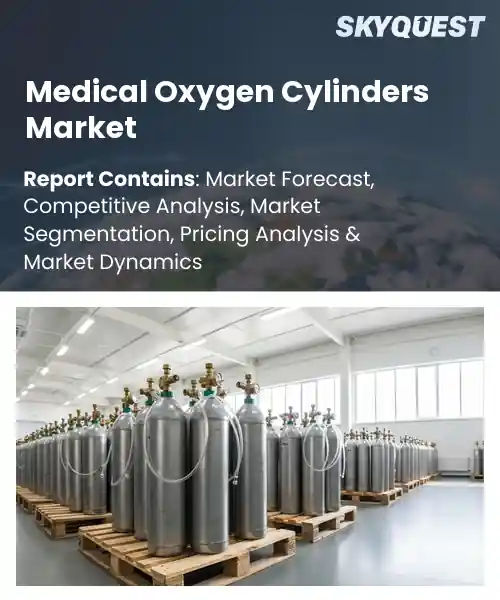
Medical Oxygen Cylinders Market
Report ID: SQMIG35A3449
Report ID: SQMIG35A3449
[email protected]
USA +1 351-333-4748
Report ID:
SQMIG35A3449 |
Region:
Global |
Published Date: May, 2026
Pages:
157
|Tables:
118
|Figures:
72


Global Medical Oxygen Cylinders Market size was valued at USD 3.82 Billion in 2024 and is poised to grow from USD 4.05 Billion in 2025 to USD 6.52 Billion by 2033, growing at a CAGR of 6.12% during the forecast period (2026-2033).
The medical oxygen cylinders market as the network of manufacturers, suppliers, hospitals and home care providers producing and deploying compressed oxygen for clinical and emergency use. The market matters because oxygen is a life saving therapy for respiratory illness, surgical procedures and emergency response, and shortages directly increase morbidity and mortality; the primary driver over recent years has been the COVID 19 pandemic, which revealed supply chain fragility and prompted rapid capacity expansion. Historically the sector shifted from hospital centered cylinder pools to broader supply chains with portable cylinders and private procurement in India.
Building on the surge, the key trend driving the global medical oxygen cylinders sector is decentralization of supply which drives manufacturers and service providers to prioritize portability, local refilling and services. When hospitals and households demand on demand oxygen, manufacturers respond by developing lighter cylinders, systems and pay per use rental models, which lowers upfront cost and enables wider distribution to ambulances, rural clinics and home oxygen therapy for COPD patients. These choices cause distributors to invest in micro refilling and PSA plants, reducing transport times and stockouts; governments and insurers are more willing to reimburse home oxygen, creating a reinforcing cycle of adoption and opportunity.
How is Iot Improving Tracking of Medical Oxygen Cylinders?
Oxygen cylinder tracking is being enhanced and transformed through the deployment of smart sensors, location services, and cloud analytics in the Internet of Things (IoT). Some primary uses include pressure sensors to gauge how much oxygen is left in an oxygen cylinder, wireless identification of where the oxygen cylinder is located, and connected dashboards which alert staff that an oxygen cylinder needs service. As of now, both hospitals and homecare providers are utilizing the real-time tracking of oxygen cylinders through IoT technology in order to increase efficiency of delivery, reduce time that oxygen cylinders are offline, and ensure safety. Practical examples range from BLE tags on cylinders to satellite enabled trackers for rural clinics, making logistics more predictable and patient care more reliable.
In April 2026, Air Liquide rolled out Intelli-OX digital gauges that give caregivers a direct reading of remaining oxygen consumption time and transmit telemetric data to cloud platforms, improving refill scheduling and reducing emergency shortages by enabling predictive logistics and automated alerts, which supports market efficiency and wider adoption of connected cylinder management.
Market snapshot - (2026-2033)
Global Market Size
USD 3.82 Billion
Largest Segment
Steel Cylinders
Fastest Growth
Composite/Carbon Fiber Cylinders
Growth Rate
6.12% CAGR
To get more insights on this market click here to Request a Free Sample Report
Global medical oxygen cylinders market is segmented by cylinder type, size, end-user, distribution and region. Based on cylinder type, the market is segmented into Aluminum Cylinders, Steel Cylinders and Composite/Carbon Fiber Cylinders. Based on size, the market is segmented into Small (Below 5L), Medium (5-20L) and Large (Above 20L). Based on end-user, the market is segmented into Hospitals, Home Healthcare, Emergency Services and Military. Based on distribution, the market is segmented into Medical Gas Distributors, Online and Direct to Hospitals. Based on region, the market is segmented into North America, Europe, Asia Pacific, Latin America and Middle East & Africa.
Based on the global medical oxygen cylinders market growth, composite/carbon fiber cylinders segment stands out because its lightweight, high-pressure construction enables greater portability and extended run times, which directly address clinician and patient needs for mobile oxygen therapy and emergency response. Manufacturing advances and material innovation reduce perceived safety barriers while premium positioning attracts investment in production capacity and supply chain upgrades, collectively driving adoption across home healthcare, emergency services, and hospital specialty applications.
However, aluminum cylinders are emerging as the most rapidly expanding area due to their cost effective balance of weight and durability, broad manufacturing base, and ease of refurbishment. Increasing demand for affordable portable solutions in outpatient and home care settings, combined with streamlined supply chains, is accelerating adoption and opening channels for volume driven market expansion.
Home healthcare segment dominates because increasing preferences for outpatient management and long term oxygen therapy drive sustained demand for portable and refillable cylinders tailored to domestic use. The reimbursement structure and the willingness of caregivers to accept a device provides the manufacturer with an incentive to develop better ergonomics, safety features and maintenance programs. In addition, suppliers are encouraged to make investments in distribution networks and develop service models that will support both ongoing cylinder refills and ongoing lifecycle management of the device.
On the other hand, emergency services are witnessing the strongest growth momentum as demand for rapid response oxygen solutions rises with expanded prehospital care capabilities and disaster preparedness initiatives. Adoption of lightweight cylinders and quick connect regulators in ambulances and field kits, together with procurement focus on reliability and uptime, is accelerating innovation and creating new aftermarket service opportunities.
To get detailed segments analysis, Request a Free Sample Report
As per the global medical oxygen cylinders market share, Asia Pacific dominates the industry due to a convergence of robust healthcare infrastructure development, concentrated industrial capacity, and proactive public health initiatives. Cylinder production is scalable where strong manufacturing systems exist in primary target markets, and supply chain efficiencies are present. Regional suppliers focus on product quality and international standards compliance, while urbanization is creating exponential demand for acute/chronic respiratory care, leading to more and more usage of different health care settings. There are a number of strategic partnerships between equipment manufacturers and health care providers; along with continued investments into logistics and last-mile distribution, these will enhance both the resilience and responsiveness of the market to temporary spikes in demand.
Medical oxygen cylinders market in Japan emphasizes product safety, strict regulatory adherence, and integration with advanced clinical protocols. Local manufacturers focus on reliability and long term service agreements that support hospital and home care adoption. Industry collaboration with medical institutions drives incremental design and handling improvements. Across all urban centers and regional healthcare providers throughout the nation, distribution systems are focused on providing a constant supply of goods as well as fast restoration of service for those with diverse respiratory care needs.
Medical oxygen cylinders market in South Korea blends advanced manufacturing capabilities with strong emphasis on quality control and rigorous testing to ensure cylinder integrity and compliance with international norms. By having a strong relationship between suppliers and healthcare providers, both types of places can work together to improve their services whether they provide services to an inpatient or community setting. Logistics networks are optimized for replenishment and technical support, supporting resilience across dense urban centers and regional medical facilities and strong after sales support across regions.
Based on global medical oxygen cylinders regional forecast, rapid expansion of the industry in North America is driven by a combination of advanced healthcare delivery systems, strong clinical adoption, and efficient logistics capabilities. To fulfill the demand for oxygen supplies from hospitals and other health care providers, close collaboration is needed with those who manufacture and provide service for cylinders. Also, as both patient safety and the ability to provide quality products are important, all of these factors combined create a strong marketplace incentive for the utilization of reliable products and service contracts. Suppliers that compete in this marketplace will invest in superior operations, distribution processes, and the integration of their services to provide continuity in both large urban and small rural care environments. In addition, as new materials and techniques for filling cylinders develop, suppliers will also enhance their plans for coordinated emergency responses to support regional response capabilities for short-term spikes in demand.
Medical oxygen cylinders market in United States reflects a mature healthcare ecosystem that emphasizes patient safety, stringent procurement, and integrated supply chains. Healthcare providers typically prefer long-term service contracts along with full maintenance contracts. Suppliers can be clearly distinguished from each other by their reliability, level of responsiveness, and ability to manage the lifecycles of cylinders. Advanced logistical support, along with emergency planning for cylinder distribution, is essential to successfully support distribution over large geographical areas.
Medical oxygen cylinders market in Canada combines national healthcare priorities with emphasis on supply continuity and regional accessibility. Many times when providers and suppliers work together to develop customized distribution methods, there is an emphasis on assisting multi-facility organization in urban and rural areas. Additionally, the provider/supplier partnership focuses on providing maintenance, training, and technical assistance to ensure reliable delivery of oxygen cylinders throughout hospitals, clinics, and homecare settings.
As per global medical oxygen cylinders regional outlook, Europe is strengthening its position in the industry through coordinated regulatory frameworks, emphasis on product quality, and investments in integrated supply chain solutions. Healthcare systems require dependable delivery and on-going support from suppliers in the form of added services, an emphasis on maintenance, and technician training. Collaborating across borders and establishing harmonized standards increases accessibility for manufacturers who manufacture healthcare products, improves interoperability, and provides ease of use for medical equipment across country borders. Improved logistics efficiencies and sustainability will lead to the use of new material for cylinders, as well as new types of cylinders in distribution. With the improvement in digital monitoring, remote cylinder tracking and service analytics, manufacturing companies can more quickly implement predictive maintenance and better utilise assets.
Medical oxygen cylinders market in Germany is shaped by rigorous regulatory standards, strong reliability expectations, and an industrial base supporting precision manufacturing. Hospital suppliers care about safety certifications, quality assurance, and customized maintenance services. Manufacturers integrate into their supply chains by working closely with health systems to improve cylinder handling and logistic processes. Suppliers also provide distribution strategies that include resilience and technical support to ensure that health systems have a continuous supply of oxygen to serve all types of acute and chronic care.
Medical oxygen cylinders market in United Kingdom benefits from centralized procurement practices, clinical safety focus, and active collaboration between manufacturers and care providers. Suppliers provide maintenance programs to ensure hospitals' and community oxygen therapy needs are met, while also providing timely responses when needed. Joint initiatives and standardization efforts help to create better handling processes for cylinders, thus helping to reduce risk, while supplier partnerships with academia result in innovation of products and services.
Medical oxygen cylinders market in France reflects a healthcare system that emphasizes clinical safety and regional supply coordination. Suppliers focus on certified products, maintenance services, and efficient logistics to serve hospitals, clinics, and home care. Both industry and healthcare networks are collaborating together on cylinder handling procedures, and also provide training for same. Collaboration between industries and healthcare owners will enhance uniformity in working towards uniform technical standards across providers to improve the interoperability and the stability of Oxygen supply systems across all geographic regions of provider networks.
To know more about the market opportunities by region and country, click here to
Buy The Complete Report
Increased Hospital Oxygen Demand
Technological Advancements In Cylinders
High Regulatory Compliance Requirements
Supply Chain Raw Material Shortages
Request Free Customization of this report to help us to meet your business objectives.
Competitive dynamics in the global medical oxygen cylinders market outlook are shaped by major industrial gas firms securing supply through asset acquisitions and long term supply contracts, regional players expanding on site generation, and cylinder manufacturers introducing lighter composite designs to cut logistics cost; examples include Linde’s ASU de-capture agreements and recent lightweight cylinder launches by established manufacturers.
Top Player’s Company Profile
Recent Developments
SkyQuest’s ABIRAW (Advanced Business Intelligence, Research & Analysis Wing) is our Business Information Services team that Collects, Collates, Correlates, and Analyses the Data collected by means of Primary Exploratory Research backed by robust Secondary Desk research.
As per SkyQuest analysis, the global medical oxygen cylinders industry is poised for steady growth, with increased hospital oxygen demand emerging as a key driver and technological advancements in cylinder materials and digital tracking serving as a second driver. A major restraint is stringent regulatory compliance requirements that slow product introductions and add costs. Asia Pacific is the dominating region due to strong manufacturing capacity and expanding healthcare infrastructure, while home healthcare is the dominating segment driven by outpatient management and long term oxygen therapy. The current market dynamics are conducive to lighter, more portable cylinders, decentralised refill solutions and services that are focused on both last mile delivery and on providing repeated refills of your LPG or gases with ease.
| Report Metric | Details |
|---|---|
| Market size value in 2024 | USD 3.82 Billion |
| Market size value in 2033 | USD 6.52 Billion |
| Growth Rate | 6.12% |
| Base year | 2024 |
| Forecast period | (2026-2033) |
| Forecast Unit (Value) | USD Billion |
| Segments covered |
|
| Regions covered | North America (US, Canada), Europe (Germany, France, United Kingdom, Italy, Spain, Rest of Europe), Asia Pacific (China, India, Japan, Rest of Asia-Pacific), Latin America (Brazil, Rest of Latin America), Middle East & Africa (South Africa, GCC Countries, Rest of MEA) |
| Companies covered |
|
| Customization scope | Free report customization with purchase. Customization includes:-
|
To get a free trial access to our platform which is a one stop solution for all your data requirements for quicker decision making. This platform allows you to compare markets, competitors who are prominent in the market, and mega trends that are influencing the dynamics in the market. Also, get access to detailed SkyQuest exclusive matrix.
Table Of Content
Executive Summary
Market overview
Parent Market Analysis
Market overview
Market size
KEY MARKET INSIGHTS
COVID IMPACT
MARKET DYNAMICS & OUTLOOK
Market Size by Region
KEY COMPANY PROFILES
Methodology
For the Medical Oxygen Cylinders Market, our research methodology involved a mixture of primary and secondary data sources. Key steps involved in the research process are listed below:
1. Information Procurement: This stage involved the procurement of Market data or related information via primary and secondary sources. The various secondary sources used included various company websites, annual reports, trade databases, and paid databases such as Hoover's, Bloomberg Business, Factiva, and Avention. Our team did 45 primary interactions Globally which included several stakeholders such as manufacturers, customers, key opinion leaders, etc. Overall, information procurement was one of the most extensive stages in our research process.
2. Information Analysis: This step involved triangulation of data through bottom-up and top-down approaches to estimate and validate the total size and future estimate of the Medical Oxygen Cylinders Market.
3. Report Formulation: The final step entailed the placement of data points in appropriate Market spaces in an attempt to deduce viable conclusions.
4. Validation & Publishing: Validation is the most important step in the process. Validation & re-validation via an intricately designed process helped us finalize data points to be used for final calculations. The final Market estimates and forecasts were then aligned and sent to our panel of industry experts for validation of data. Once the validation was done the report was sent to our Quality Assurance team to ensure adherence to style guides, consistency & design.
Analyst Support
Customization Options
With the given market data, our dedicated team of analysts can offer you the following customization options are available for the Medical Oxygen Cylinders Market:
Product Analysis: Product matrix, which offers a detailed comparison of the product portfolio of companies.
Regional Analysis: Further analysis of the Medical Oxygen Cylinders Market for additional countries.
Competitive Analysis: Detailed analysis and profiling of additional Market players & comparative analysis of competitive products.
Go to Market Strategy: Find the high-growth channels to invest your marketing efforts and increase your customer base.
Innovation Mapping: Identify racial solutions and innovation, connected to deep ecosystems of innovators, start-ups, academics, and strategic partners.
Category Intelligence: Customized intelligence that is relevant to their supply Markets will enable them to make smarter sourcing decisions and improve their category management.
Public Company Transcript Analysis: To improve the investment performance by generating new alpha and making better-informed decisions.
Social Media Listening: To analyze the conversations and trends happening not just around your brand, but around your industry as a whole, and use those insights to make better Marketing decisions.
REQUEST FOR SAMPLE
 REQUEST FREE CUSTOMIZATION
Global Medical Oxygen Cylinders Market size was valued at USD 3.82 Billion in 2024 and is poised to grow from USD 4.05 Billion in 2025 to USD 6.52 Billion by 2033, growing at a CAGR of 6.12% during the forecast period (2026-2033).
Competitive dynamics in the global medical oxygen cylinders market are shaped by major industrial gas firms securing supply through asset acquisitions and long term supply contracts, regional players expanding on site generation, and cylinder manufacturers introducing lighter composite designs to cut logistics cost; examples include Linde’s ASU de-capture agreements and recent lightweight cylinder launches by established manufacturers. 'Linde plc', 'Air Products', 'Air Liquide', 'Messer Group', 'Luxfer Holdings', 'Worthington Industries', 'Chart Industries', 'Beijing Tianhai Industry', 'Faber Industrie', 'Catalina Cylinders', 'Everest Kanto Cylinders', 'Sinoma Science & Technology', 'Hexagon Composites', 'Alugas Deutschland', 'Norris Cylinder Company'
The sustained rise in inpatient and outpatient respiratory cases has led healthcare facilities to expand oxygen supply infrastructure, directly increasing demand for medical oxygen cylinders. Hospitals and clinics are investing in reliable cylinder fleets to ensure continuous oxygen availability for emergency, surgical, and chronic care needs, prompting procurement and replacement cycles. This procurement focus supports manufacturers and distributors, incentivizes production scaling, and encourages supply chain investments, thereby reinforcing market expansion through steady institutional purchasing and long-term planning for oxygen delivery resilience.
Decentralized Oxygen Distribution: Healthcare providers are shifting toward decentralized oxygen distribution models that emphasize on-site generation, localized storage and scalable cylinder fleets to improve resilience and responsiveness. This trend drives manufacturers and service providers to develop modular systems, flexible leasing and maintenance contracts, and integrated training programs for facility staff. Emphasis on last mile logistics and point-of-care availability supports broader adoption in care settings, fosters strategic partnerships with regional suppliers, and creates opportunities for differentiated service offerings focused on reliability and operational continuity.
Why does Asia Pacific Dominate the Global Medical Oxygen Cylinders Market? |@12


Want to customize this report? This report can be personalized according to your needs. Our analysts and industry experts will work directly with you to understand your requirements and provide you with customized data in a short amount of time. We offer $1000 worth of FREE customization at the time of purchase.
Feedback From Our Clients


 USA (+1) 351-333-4748

