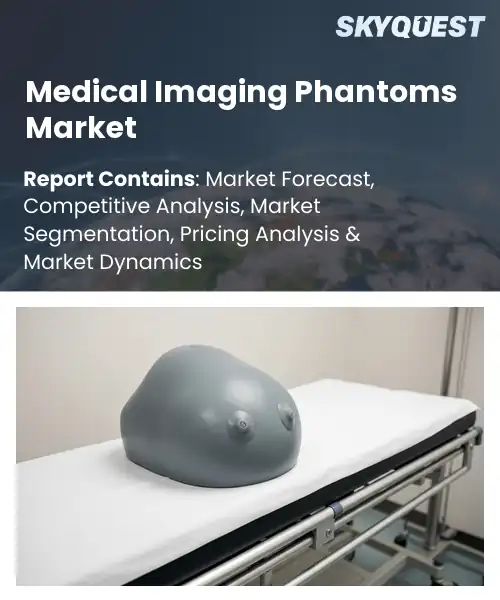
Medical Imaging Phantoms Market
Report ID: SQMIG35A3794
Report ID: SQMIG35A3794
[email protected]
USA +1 351-333-4748
Report ID:
SQMIG35A3794 |
Region:
Global |
Published Date: June, 2026
Pages:
157
|Tables:
128
|Figures:
77


Global Medical Imaging Phantoms Market size was valued at USD 198.7 Million in 2024 and is poised to grow from USD 208.44 Million in 2025 to USD 305.62 Million by 2033, growing at a CAGR of 4.9% during the forecast period (2026-2033).
The main driver behind the global medical imaging phantoms market growth seems to be this nonstop need for accurate imaging calibration and sturdy solutions that really support patient safety and diagnostic confidence. medical imaging phantoms are like physical models that mimic human tissues, and they help standardize equipment behavior while also checking protocols, even as their importance keeps growing alongside new imaging modalities. Before, the field mostly started with plain tissue equivalent blocks for X ray and ultrasound, then it basically evolved toward anatomically detailed multi material phantoms for CT , MRI and PET, all to assist dose optimization and quantitative imaging. regulatory pressure plus clinical uptake has been pushing faster investment, and at this point the phantoms are more sophisticated and more demanding to build.
In addition, building on all that earlier progress, the adoption of advanced hybrid designs and patient specific phantoms keeps fueling market growth, because clinicians and manufacturers want realistic platforms to check complicated imaging workflows, and even the algorithms that ride on them. when hospitals bring in AI assisted diagnostic tools, vendors often supply phantoms that replicate lesions and motion, too, so software performance can be benchmarked, which can lower clinical risk ,and also help speed up regulatory approval. likewise, research centers use anthropomorphic phantoms to tune low dose CT protocols, so patient exposure goes down while diagnostic quality stays about the same, and that ends up creating demand for upgraded materials plus better manufacturing techniques. so overall, investment keeps climbing in 3D printing capabilities, along with customizable phantom services, and that widens the market openings.
AI boosts validation accuracy in the medical imaging phantoms market by layering automated, data driven discipline onto both physical and digital test objects. Key parts are AI enabled image analysis that supports consistent segmentation, motion correction , and artifact removal, plus synthetic data generation to cover the clinical blind spots. The current picture is basically a mix of classic anthropomorphic phantoms and machine learning pipelines, so validation can be repeated more reliably and it better reflects clinical variety. This helps cut down observer dependence and shortens test cycles , while also enabling multi modality checks across CT, MRI, PET , and ultrasound. recent work shows deep learning workflows validated with conventional phantoms and federated approaches, which helps keep models strong across sites.
Market snapshot - (2026-2033)
Global Market Size
USD 198.7 Million
Largest Segment
X-ray Phantoms
Fastest Growth
Ultrasound Phantoms
Growth Rate
4.9% CAGR
To get more insights on this market click here to Request a Free Sample Report
The global medical imaging phantoms market is segmented by product type, material type, application, end user and region. Based on product type, the market is segmented into X-ray Phantoms, Ultrasound Phantoms, CT Phantoms, MRI Phantoms, Nuclear Imaging Phantoms, Mammography Phantoms and Others. Based on material type, the market is segmented into Water-Based Phantoms, Gel-Based Phantoms, Solid Phantoms, Anthropomorphic Phantoms and Others. Based on application, the market is segmented into Equipment Calibration, Quality Assurance Testing, Radiation Dose Measurement, Training & Education, Research & Development and Others. Based on end user, the market is segmented into Hospitals, Diagnostic Imaging Centers, Academic & Research Institutes, Medical Device Manufacturers and Others. Based on region, the market is segmented into North America, Europe, Asia Pacific, Latin America and Middle East & Africa.
As per the medical imaging phantoms market analysis, the CT Phantoms segment dominates because they give critical three dimensional density and attenuation references that are essential for system calibration, and dose optimization. Plus, their compatibility with complex geometries, and multimaterial inserts, really pushes adoption from manufacturers and clinical centers that want reproducible benchmarking. And since people still need to validate reconstruction algorithms, iterative processing, and cross system consistency, the demand stays steady, plus established standards and procurement preferences further entrench CT phantom utilization across imaging workflows .
However, Ultrasound Phantoms are emerging as the fastest-growing area, mainly because point of care ultrasound adoption keeps expanding, and the market wants acoustic realism for training and device tuning. Innovations in tissue mimicking gels and modular designs lower production costs, while also improving customization, which speeds up adoption in education, portable device validation, and ultrasound guided therapies that are still coming up.
According to the medical imaging phantoms market forecast, the Anthropomorphic Phantoms segment dominates because they basically replicate human anatomy and tissue heterogeneity, allowing realistic evaluation of imaging chains and real clinical style workflows. Their anatomical fidelity helps with protocol optimization, training programs and even regulatory validation, so manufacturers and clinical researchers tend to prefer them. Also, since these phantoms let teams do end to end system testing with clinical like targets, demand continues for device approvals, multidisciplinary training, and complex modality benchmarking. And they’re compatible with multimodality imaging, plus digital modeling, so they keep getting used across validation pipelines.
However, gel-based phantoms are the fastest-growing category, due to tunable acoustic and electromagnetic properties ,and the relative ease of customization for specific research needs. Improvements in polymer chemistries, and three dimensional molding, make it possible to prototype faster, which supports expanding use in newer ultrasound, MRI sequence development, and preclinical studies. So overall, it opens new product opportunities, for sure .
To get detailed segments analysis, Request a Free Sample Report
As per the medical imaging phantoms market regional forecast, North America dominance comes from a mix of advanced clinical infrastructure, research in one place concentrated, and a regulatory setup that pushes rigorous device testing validation, plus standardizing things a lot. There’s also this ecosystem of top phantom producers and specialized service providers that keeps product upgrades moving, and makes supply chains more dependable. At the same time, lots of imaging modalities being used out there, basically keeps demand alive for training tools that are realistic, and also modality specific calibration items. Hospitals, imaging centers, academic groups, and industry working together closely helps stuff move from lab to clinic faster and get accepted. Then there is accreditation, quality assurance, and structured operator training, which just makes institutions more comfortable adopting these solutions, and steady investment streams let companies tailor products and build high fidelity anthropomorphic phantom solutions for different clinical and learning requirements.
United States Medical Imaging Phantoms Market
The Medical Imaging Phantoms sector in the United States tends to gain momentum because there are concentrated clinical research hubs, a dense academic hospital landscape, and tight collaboration between manufacturers and real end users. Demand is pushed by fast modality adoption, strong attention to accreditation and quality assurance, and training programs that keep expanding. A big footprint of specialist suppliers and customization strengths also supports many diagnostic and interventional uses, so the market keeps leaning toward leadership, innovation, and better clinical results.
Canada Medical Imaging Phantoms Market
The Medical Imaging Phantoms industry in Canada is shaped by public healthcare systems that are strong, with a clear focus on standardization and quality control. Clinical institutions also stay active with research labs, and that engagement matters. The whole approach leans into training, remote imaging services, and centers of excellence so people keep buying versatile, portable phantom solutions. Domestic suppliers often work with international manufacturers to align products with local clinical pathways, which helps make specialized phantoms available for education and equipment calibration, even when requirements shift.
The rapid medical imaging phantoms market penetration in Europe is mostly linked to integrated healthcare systems, regulatory harmonization, and a network of academic hospitals plus imaging research centers that care a lot about reproducibility and standardization. Big device manufacturers, together with specialized providers, supply modality specific and anthropomorphic phantoms designed for clinical validation, training, and quality control. And then cross border cooperation, among research institutes, clinical networks and industry, speeds up product refinement, and adoption too. When harmonized accreditation is emphasized, along with multicenter trials and hands on simulation training, institutions stay motivated to keep buying advanced phantom solutions. Public private partnerships, and active industry clusters in key markets help translational development, while established procurement channels with specialized distributors support wide clinical availability, along with technical support.
Germany Medical Imaging Phantoms Market
The Medical Imaging Phantoms Market in Germany is supported by a dense net of hospitals and medical research institutions that pull demand toward high fidelity, application specific phantoms. Strong industry research partnerships and a clear emphasis on precision imaging, device testing, and meeting regulatory requirements encourage even more advanced phantom development. Local manufacturers and specialized service providers deliver tailored solutions for clinical trials and equipment calibration, which helps Germany maintain its role as a regional innovation center.
United Kingdom Medical Imaging Phantoms Market
The Medical Imaging Phantoms Market in the United Kingdom is seeing swift uptake, largely because imaging infrastructure is getting more investment. Also, more clinical trial sites are forming, and specialist suppliers are more present. With an emphasis on medical education, simulation training centers, and multicenter research, demand stays steady for adaptable phantom solutions that match curricula. Academic groups and commercial vendors collaborate, which tends to speed up product development, and procurement networks keep improving access to modality specific and anthropomorphic phantoms, commonly across different settings.
France Medical Imaging Phantoms Market
The Medical Imaging Phantoms Market in France is picking up pace via stronger academic research, targeted industry collaborations, and rising needs from specialized imaging centers. The focus on translational research, plus niche clinical use cases, encourages development of bespoke phantom solutions for advanced imaging tasks. National efforts to strengthen training and standardization open windows for domestic manufacturers and international suppliers to introduce compact, user friendly phantoms that fit evolving clinical workflows, and support specialized educational needs.
Asia Pacific is really tightening its presence by pouring money into imaging capability, the domestic build quality is getting more sophisticated, and clinical centers are working in a close harmony with tech providers, not just “buying stuff”. Places like Japan and South Korea are pushing harder on materials science , precision engineering, and even modality centered phantom designs, so the end result is that can make high fidelity solutions that actually match specific uses. Regional manufacturers are also starting to line up with international quality benchmarks and they form partnerships that help them tune products to fit local clinical routines. At the same time, more and more attention is being placed on professional training, simulation rooms , and multicenter research activities, which helps uptake a lot. And because the production landscape is becoming more competitive, plus companies can respond quickly with custom builds, the region is emerging as a major, cost friendly and scalable supply base for phantom offerings that work both at home and for export. Meanwhile, active research institutes and regional conferences keep the knowledge moving, and improvements in distribution routes plus tech support approaches raise trust for new phantom technologies across both city and remote healthcare settings.
Japan Medical Imaging Phantoms Market
The Medical Imaging Phantoms Market in Japan , benefits from advanced materials engineering, precision manufacturing, and strong connections between academic research and industry teams. Companies tend to focus on high fidelity and modality specific phantoms, which fits with more sophisticated diagnostic and interventional processes. Local firms put a heavy spotlight on strict quality assurance and creative anthropomorphic designs , and partnerships with clinical centers support real validation.
South Korea Medical Imaging Phantoms Market
The Medical Imaging Phantoms Market in South Korea is being driven by a strong electronics culture and a medical device ecosystem, which makes it easier to blend sensor technologies with careful fabrication inside phantom design. Hospitals, technology firms, and research institutes collaborate , so tailored phantoms can be created for advanced imaging modalities. Manufacturers in the region also emphasize scalable production and quick customization, while quality assurance plus clinical training efforts make it more likely that adoption will stick across tertiary centers and specialized diagnostic environments.
To know more about the market opportunities by region and country, click here to
Buy The Complete Report
Rising Clinical Demand For Realistic Phantoms
Advancements In Multimodality Phantom Technology
High Cost Of Custom Phantoms
Regulatory Complexity And Compliance
Request Free Customization of this report to help us to meet your business objectives.
The competitive landscape is marked by focused M&A plus product specialization as firms try to keep up and supply standardized AI ready phantoms, for quantitative imaging validation and all that. This can be seen in examples like IBA picking up PhantomX, to add more realistic anthropomorphic phantoms, and QUEL Imaging commercializing those NIH supported tissue equivalent optical phantoms. Overall, the pressure seems to come from the need for repeatable validation tools, research collaborations , and just faster commercialisation of newer materials AND workflows.
Top Player’s Company Profile
Recent Developments in the Medical Imaging Phantoms Market
SkyQuest’s ABIRAW (Advanced Business Intelligence, Research & Analysis Wing) is our Business Information Services team that Collects, Collates, Correlates, and Analyses the Data collected by means of Primary Exploratory Research backed by robust Secondary Desk research.
As per SkyQuest analysis, the global medical imaging phantoms market is driven mainly by the constant need for precise imaging calibration, plus solutions that support patient safety and diagnostic confidence, and it’s also further strengthened by ai integration in phantom design and synthetic data generation, which helps validation repeatability and speeds things up. Growth is strongest in North America, where advanced clinical infrastructure and strong industry academic collaboration support adoption, and CT phantoms lead the product mix because they play a crucial role in three dimensional density referencing and algorithm validation. Still, uptake is somewhat slowed down by the high cost of custom, high fidelity phantoms, which limits procurement by smaller institutions that have tighter budgets.
| Report Metric | Details |
|---|---|
| Market size value in 2024 | USD 198.7 Million |
| Market size value in 2033 | USD 305.62 Million |
| Growth Rate | 4.9% |
| Base year | 2024 |
| Forecast period | (2026-2033) |
| Forecast Unit (Value) | USD Million |
| Segments covered |
|
| Regions covered | North America (US, Canada), Europe (Germany, France, United Kingdom, Italy, Spain, Rest of Europe), Asia Pacific (China, India, Japan, Rest of Asia-Pacific), Latin America (Brazil, Rest of Latin America), Middle East & Africa (South Africa, GCC Countries, Rest of MEA) |
| Companies covered |
|
| Customization scope | Free report customization with purchase. Customization includes:-
|
To get a free trial access to our platform which is a one stop solution for all your data requirements for quicker decision making. This platform allows you to compare markets, competitors who are prominent in the market, and mega trends that are influencing the dynamics in the market. Also, get access to detailed SkyQuest exclusive matrix.
Table Of Content
Executive Summary
Market overview
Parent Market Analysis
Market overview
Market size
KEY MARKET INSIGHTS
COVID IMPACT
MARKET DYNAMICS & OUTLOOK
Market Size by Region
KEY COMPANY PROFILES
Methodology
For the Medical Imaging Phantoms Market, our research methodology involved a mixture of primary and secondary data sources. Key steps involved in the research process are listed below:
1. Information Procurement: This stage involved the procurement of Market data or related information via primary and secondary sources. The various secondary sources used included various company websites, annual reports, trade databases, and paid databases such as Hoover's, Bloomberg Business, Factiva, and Avention. Our team did 45 primary interactions Globally which included several stakeholders such as manufacturers, customers, key opinion leaders, etc. Overall, information procurement was one of the most extensive stages in our research process.
2. Information Analysis: This step involved triangulation of data through bottom-up and top-down approaches to estimate and validate the total size and future estimate of the Medical Imaging Phantoms Market.
3. Report Formulation: The final step entailed the placement of data points in appropriate Market spaces in an attempt to deduce viable conclusions.
4. Validation & Publishing: Validation is the most important step in the process. Validation & re-validation via an intricately designed process helped us finalize data points to be used for final calculations. The final Market estimates and forecasts were then aligned and sent to our panel of industry experts for validation of data. Once the validation was done the report was sent to our Quality Assurance team to ensure adherence to style guides, consistency & design.
Analyst Support
Customization Options
With the given market data, our dedicated team of analysts can offer you the following customization options are available for the Medical Imaging Phantoms Market:
Product Analysis: Product matrix, which offers a detailed comparison of the product portfolio of companies.
Regional Analysis: Further analysis of the Medical Imaging Phantoms Market for additional countries.
Competitive Analysis: Detailed analysis and profiling of additional Market players & comparative analysis of competitive products.
Go to Market Strategy: Find the high-growth channels to invest your marketing efforts and increase your customer base.
Innovation Mapping: Identify racial solutions and innovation, connected to deep ecosystems of innovators, start-ups, academics, and strategic partners.
Category Intelligence: Customized intelligence that is relevant to their supply Markets will enable them to make smarter sourcing decisions and improve their category management.
Public Company Transcript Analysis: To improve the investment performance by generating new alpha and making better-informed decisions.
Social Media Listening: To analyze the conversations and trends happening not just around your brand, but around your industry as a whole, and use those insights to make better Marketing decisions.
REQUEST FOR SAMPLE
 REQUEST FREE CUSTOMIZATION
Global Medical Imaging Phantoms Market size was valued at USD 198.7 Million in 2024 and is poised to grow from USD 208.44 Million in 2025 to USD 305.62 Million by 2033, growing at a CAGR of 4.9% during the forecast period (2026-2033).
The competitive landscape is marked by targeted M&A and product specialization as companies race to supply standardized AI ready phantoms for quantitative imaging validation. Examples include IBA acquiring PhantomX to add realistic anthropomorphic phantoms and QUEL Imaging commercializing NIH supported tissue equivalent optical phantoms. Competition is driven by demand for reproducible validation tools, research partnerships, and rapid commercialisation of new materials and workflows. 'Computerized Imaging Reference Systems, Inc. (CIRS)', 'Sun Nuclear Corporation', 'IBA Dosimetry GmbH', 'Modus Medical Devices Inc.', 'Kyoto Kagaku Co., Ltd.', 'The Phantom Laboratory, Inc.', 'Leeds Test Objects Ltd.', 'QUART GmbH', 'Gold Standard Phantoms Ltd.', 'True Phantom Solutions Inc.', 'Radiology Support Devices, Inc.', 'PTW Freiburg GmbH', 'Fluke Biomedical Corporation', 'Standard Imaging, Inc.', 'Pure Imaging Phantoms', 'Anatomical Geometry', 'PhantomX GmbH', 'Biodex Medical Systems, Inc.', 'QRM GmbH', 'Mirion Technologies, Inc.'
Clinical demand for realistic and customizable phantoms drives adoption by enabling imaging departments to validate protocols, train personnel, and optimize device performance in conditions that closely mimic patient anatomy and pathology. Healthcare providers prioritize tools that reduce diagnostic uncertainty and support reproducible workflows, prompting procurement of high fidelity phantoms. Manufacturers respond with product enhancements and tailored solutions, fueling market expansion through broader clinical acceptance, increased institutional purchases, and integration into routine quality assurance practices across imaging modalities. This sustained clinical validation strengthens vendor credibility and encourages long term investment.
Ai Integration In Design: The integration of artificial intelligence and simulation into phantom design is reshaping development by enabling higher fidelity, tailored models and automated optimization across imaging modalities. Developers employ machine learning to predict tissue responses, refine geometry and select materials, shortening development cycles and improving reproducibility. The shift promotes collaboration between software and hardware teams, encourages digital twin validation workflows and expands phantom utility into training, protocol development and comparative technology assessment, creating service models around data driven customization and performance improvement.
Why does North America Dominate the Global Medical Imaging Phantoms Market? |@12


Want to customize this report? This report can be personalized according to your needs. Our analysts and industry experts will work directly with you to understand your requirements and provide you with customized data in a short amount of time. We offer $1000 worth of FREE customization at the time of purchase.
Feedback From Our Clients


 USA (+1) 351-333-4748

