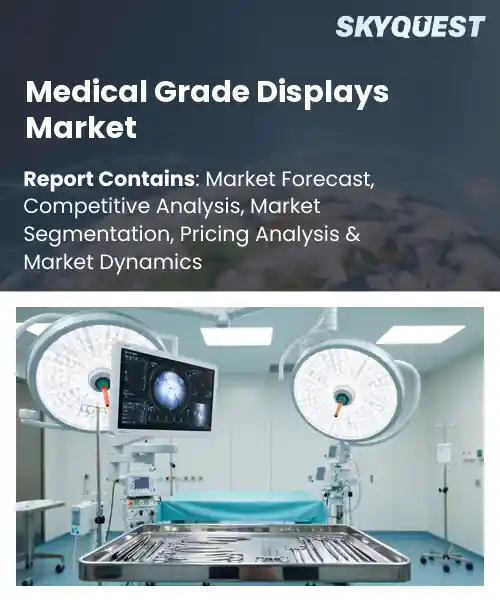
Medical Grade Displays Market
Report ID: SQMIG35A3273
Report ID: SQMIG35A3273
[email protected]
USA +1 351-333-4748
Report ID:
SQMIG35A3273 |
Region:
Global |
Published Date: February, 2026
Pages:
157
|Tables:
203
|Figures:
80


Global Medical Grade Displays Market size was valued at USD 2.9 Billion in 2024 and is poised to grow from USD 3.06 Billion in 2025 to USD 4.66 Billion by 2033, growing at a CAGR of 5.4% during the forecast period (2026-2033).
Growing demand for accurate medical imaging, increasing adoption of minimally invasive procedures, rising investments in healthcare infrastructure, technological advancements in display technologies, and emphasis on patient safety are driving sales of medical grade displays. Surge in demand for accurate image representation to improve diagnostic outcomes and patient safety, which has encouraged adoption across radiology, cardiology, and surgical specialties. Over time, the industry has shifted from cathode ray tube systems to LCD and LED panels and more recently to ultra-high-definition displays and specialized surgical monitors used in operating rooms.
Examples include DICOM-calibrated radiology workstations and 4K laparoscopic displays commonly deployed in tertiary care hospitals. Higher imaging workloads and distributed clinical workflows require more calibrated visualization endpoints. Growing reliance on advanced medical imaging for diagnosis and treatment planning, coupled with the increasing need for precise image visualization in healthcare facilities, is expected to primarily drive medical grade displays market growth. As imaging caseloads increase, hospitals are upgrading to high-resolution displays to maintain diagnostic accuracy. This encourages manufacturers to develop advanced solutions such as 4K, HDR, and DICOM-compliant displays integrated with picture archiving and communication systems (PACS) and AI-assisted imaging tools.
On the contrary, high costs associated with advanced medical grade displays, strict regulatory compliance requirements, integration challenges with existing hospital IT infrastructure, and frequent calibration and maintenance needs are anticipated to slow down medical grade displays market penetration through 2033 and beyond.
How is AI Improving Diagnostic Accuracy in the Medical Grade Displays Market?
AI is improving diagnostic accuracy in the medical grade displays market by enhancing image clarity, supporting clinical decision-making, and integrating smoothly into healthcare workflows. AI-based image optimization improves contrast and texture so clinicians can detect subtle abnormalities more easily. Today, manufacturers are combining high-precision calibrated displays with edge and cloud-based AI systems so clinicians receive consistent images along with helpful analytical insights during interpretation.
Market snapshot - 2026-2033
Global Market Size
USD 2.9 Billion
Largest Segment
Laparoscopic Instruments
Fastest Growth
Tissue Products
Growth Rate
5.4% CAGR
To get more insights on this market click here to Request a Free Sample Report
The medical grade displays market is segmented by product, device, panel size, resolution, multi-modality, application, end user, and region. Based on product, the market is segmented into tissue products, laparoscopic instruments, and other products. Based on device, the market is segmented into desktop, mobile, and all-in-one. Based on panel size, the market is segmented into up to 22.9 inch, 23.0 to 26.9 inch, 27.0 to 41.9 inch, and above 42 inch. Based on resolution, the market is segmented into up to 2MP, 2 to 4MP, 4 to 8MP, and above 8MP.
Based on multi-modality, the market is segmented into digital pathology, radiology, surgical, mammography, and others. Based on application, the market is segmented into hernia repair, skin repair, orthopedic repair, and other applications. Based on end user, the market is segmented into hospitals & clinics, ambulatory surgical centers, and other end users. Based on region, the market is segmented into North America, Europe, Asia Pacific, Latin America, and Middle East & Africa.
The tissue products segment is slated to lead the global medical grade displays market revenue generation in the long run. The high share can be attributed to clinical demand curated tissue visualization places premium requirements on color fidelity, contrast stability, and calibration workflows. Close collaboration between display manufacturers and diagnostic device vendors, along with certification pathways and clinician preference for reproducible imaging, creates a virtuous cycle where validated displays become standard in diagnostic suites and influence broader procurement decisions.
However, laparoscopic instruments segment is rising at a rapid pace as per this medical grade displays industry analysis. Surge in demand for minimally invasive procedures and their need for compact displays paired with endoscopic cameras is creating new business scope. Advances in sterilizable interfaces and interoperability with surgical imaging systems boost OR adoption, enabling display providers to deliver procedure tailored visualization solutions and open new revenue channels in surgical imaging.
The 4 to 8MP segment is slated to account for the highest global medical grade displays market share in the future. Its ability to balances high diagnostic fidelity with practical workstation integration, meeting radiology and surgical visualization needs without imposing extreme data helps this segment hold sway over others. Its image clarity supports nuanced grayscale and color rendering required for cross modality reading, encouraging adoption by PACS integrators and clinical IT teams, while established calibration and certification practices make it a dependable choice for routine diagnostic workflows.
Meanwhile, above 8mp segment is the fastest growing area because digital pathology and whole slide imaging require ultra high resolution for confident diagnosis. Improvements in sensor technology and graphics pipelines, along with growing regulatory clarity for high resolution workflows, are driving adoption and creating demand for premium displays in advanced diagnostic environments.
To get detailed segments analysis, Request a Free Sample Report
Presence of mature healthcare systems, strong clinical demand for high fidelity imaging, and a dense concentration of established display manufacturers help North America maintain its dominant stance. The current medical field uses advanced diagnostic tools because both the extensive clinical research conducted and the complete digital imaging system of the hospital allow for their implementation. Regulatory requirements and accreditation standards create specific quality requirements which lead to hospitals purchasing certified medical equipment. Hospitals with multiple facilities and specialized imaging centers choose to work with vendors who provide complete service and equipment testing and system connection solutions.
The existing financial systems for equipment purchasing and reimbursement in hospitals enable regular replacement of outdated medical devices. Technology vendors and clinical end users and academic institutions work together to test new display technologies which helps hospitals maintain their top position in display technology specifications and deployment and support for complex healthcare systems.
United States Medical Grade Displays Market
Presence of leading display manufacturers and medical imaging solution providers is primarily influencing the sales of medical grade displays in the United States. Clinical hubs, specialized imaging centers, and enterprise imaging system integration are forecasted to govern the sales of medical grade displays across the study period. Hospitals experience fast system upgrades because their extensive clinical networks and strong vendor support enable them to implement high-end diagnostic monitors and associated services.
Canada Medical Grade Displays Market
High emphasis on integrated diagnostic networks are prompting investments in reliable clinical grade displays and remote reading solutions across Canada. Provincial procurement practices encourage standardized equipment selection and service relationships across the country. Academic medical centers and specialized clinics drive demand for color critical features, while partnerships between vendors and health authorities are also creating new business scope.
Presence of harmonized clinical standards, growing digitization of radiology and operating environments, and a strong base of regional manufacturers help govern sales of medical grade displays in Europe. The push towards interoperability between imaging networks as well as electronic health records has created a demand for certified display screens that comply with the same set of requirements from a quality perspective across borders.
Many of the larger hospital networks as well as private clinic chains are upgrading the display inventory used for diagnostic imaging and performing surgery, ultimately allowing for more sophisticated imaging techniques, especially those that require minimally invasive surgical procedures. Supplier purchasing power will increase through the use of public procurement frameworks and consortia to create buying mass, and the focused innovation centres located in central Europe will accelerate the adoption of next generation display technologies.
Germany Medical Grade Displays Market
Presence of a strong industrial ecosystem and concentration of specialist medical technology firms are promoting innovation of medical grade displays in Germany. German procurement focuses on three main areas which include service delivery, calibration services and system integration with enterprise imaging systems. This procurement approach enables healthcare providers to establish partnerships with vendors who help them build local service capabilities while developing products that meet clinician requirements.
United Kingdom Medical Grade Displays Market
Increasing modernization of healthcare infrastructure and a strong emphasis on digital imaging workflows and teleradiology are governing medical grade displays sales in the United Kingdom. Centralized procurement and clinical guidelines are expected to prioritize the adoption of medical grade displays that offer interoperability and performance validation. The combination of innovation clusters with academic centers enables medical professionals to validate new technologies which will lead to their acceptance in healthcare settings.
France Medical Grade Displays Market
Coordinated investments in diagnostic imaging across hospitals, with growing attention to display performance and interoperability are shaping medical grade displays demand in France going forward. Offering localized service, training and compliance with national guidelines is also a top priority for medical grade displays companies in the long run. Academic hospitals together with specialty centers serve as early technology adopters who validate new technologies while they help drive acceptance of those technologies in clinical practice.
High investments in targeted healthcare modernization and growing clinical demand for advanced imaging solutions are driving sustained sales of medical grade displays going forward. Investments in upgrading hospitals and increasing the number of specialist imaging centers are increasing the adoption of diagnostic and surgical displays with additional support from the local service ecosystem and local calibration capabilities. The credibility of the medical displays is enhanced through cross-border collaboration, export-oriented organizations, and validation through national academic institutions. An increased focus on interoperability with enterprise imaging systems along with a remote reading infrastructure is allowing for further integration of displays into medicine and the Asia Pacific is emerging as both a manufacturing hub & growing market for premium medical grade display solutions.
Japan Medical Grade Displays Market
Presence of a mature electronics industry and precision manufacturing emphasis are shaping medical grade display adoption in Japan. Hospitals and regional specialty centers adopt the system because its clinical design delivers accurate results and comfortable user experience while its permanent service contracts and strong local support systems ensure system maintenance. Collaborations between academic hospitals and imaging centers are also creating a new business scope.
South Korea Medical Grade Displays Market
Rise in collaboration between manufacturers and healthcare institutions to deliver advanced diagnostic displays are creating new opportunities in South Korea. Hospitals focus on three main needs which include precise imaging results and system compatibility with health IT systems and dependable post-purchase support. Local vendors create small yet powerful products while developing their rating and servicing abilities. The clinical validation process at tertiary centers establishes trustworthiness which enables broader implementation throughout healthcare systems.
To know more about the market opportunities by region and country, click here to
Buy The Complete Report
Rising Demand For Diagnostic Precision
Integration With Advanced Imaging Modalities
High Acquisition and Maintenance Costs
Regulatory and Compliance Complexity
Request Free Customization of this report to help us to meet your business objectives.
Competitive intensity in the global medical grade displays market is rising as OEMs pursue acquisitions, OEM partnerships and display technology differentiation; examples include Innolux’s 2019 InnoCare spin off, Barco’s collaboration with startups for smart OR displays, and Kopin’s production partnership with HMDmd for wearable surgical monitors. These moves drive faster product integration, scale up and clinical OEM deals that shape vendor positioning and procurement strategies.
AI-Enabled Imaging Workflows
Telehealth and Remote Diagnostics
SkyQuest’s ABIRAW (Advanced Business Intelligence, Research & Analysis Wing) is our Business Information Services team that Collects, Collates, Correlates, and Analyses the Data collected by means of Primary Exploratory Research backed by robust Secondary Desk research.
As per SkyQuest analysis, rising demand for accurate medical imaging and increasing adoption of minimally invasive surgical procedures are anticipated to drive the demand for medical grade displays going forward. However, high costs of advanced display systems and strict regulatory compliance requirements are slated to slow down the adoption of medical grade displays in the future. North America is slated to spearhead the demand for medical grade displays owing to the presence of advanced healthcare infrastructure, high imaging volumes, and strong adoption of digital diagnostic technologies. Development of ultra-high-definition displays and integration with PACS platforms and AI-assisted imaging systems are anticipated to be key trends driving the medical grade displays industry across the forecast period.
| Report Metric | Details |
|---|---|
| Market size value in 2024 | USD 2.9 Billion |
| Market size value in 2033 | USD 4.66 Billion |
| Growth Rate | 5.4% |
| Base year | 2024 |
| Forecast period | 2026-2033 |
| Forecast Unit (Value) | USD Billion |
| Segments covered |
|
| Regions covered | North America (US, Canada), Europe (Germany, France, United Kingdom, Italy, Spain, Rest of Europe), Asia Pacific (China, India, Japan, Rest of Asia-Pacific), Latin America (Brazil, Rest of Latin America), Middle East & Africa (South Africa, GCC Countries, Rest of MEA) |
| Companies covered |
|
| Customization scope | Free report customization with purchase. Customization includes:-
|
To get a free trial access to our platform which is a one stop solution for all your data requirements for quicker decision making. This platform allows you to compare markets, competitors who are prominent in the market, and mega trends that are influencing the dynamics in the market. Also, get access to detailed SkyQuest exclusive matrix.
Table Of Content
Executive Summary
Market overview
Parent Market Analysis
Market overview
Market size
KEY MARKET INSIGHTS
COVID IMPACT
MARKET DYNAMICS & OUTLOOK
Market Size by Region
KEY COMPANY PROFILES
Methodology
For the Medical Grade Displays Market, our research methodology involved a mixture of primary and secondary data sources. Key steps involved in the research process are listed below:
1. Information Procurement: This stage involved the procurement of Market data or related information via primary and secondary sources. The various secondary sources used included various company websites, annual reports, trade databases, and paid databases such as Hoover's, Bloomberg Business, Factiva, and Avention. Our team did 45 primary interactions Globally which included several stakeholders such as manufacturers, customers, key opinion leaders, etc. Overall, information procurement was one of the most extensive stages in our research process.
2. Information Analysis: This step involved triangulation of data through bottom-up and top-down approaches to estimate and validate the total size and future estimate of the Medical Grade Displays Market.
3. Report Formulation: The final step entailed the placement of data points in appropriate Market spaces in an attempt to deduce viable conclusions.
4. Validation & Publishing: Validation is the most important step in the process. Validation & re-validation via an intricately designed process helped us finalize data points to be used for final calculations. The final Market estimates and forecasts were then aligned and sent to our panel of industry experts for validation of data. Once the validation was done the report was sent to our Quality Assurance team to ensure adherence to style guides, consistency & design.
Analyst Support
Customization Options
With the given market data, our dedicated team of analysts can offer you the following customization options are available for the Medical Grade Displays Market:
Product Analysis: Product matrix, which offers a detailed comparison of the product portfolio of companies.
Regional Analysis: Further analysis of the Medical Grade Displays Market for additional countries.
Competitive Analysis: Detailed analysis and profiling of additional Market players & comparative analysis of competitive products.
Go to Market Strategy: Find the high-growth channels to invest your marketing efforts and increase your customer base.
Innovation Mapping: Identify racial solutions and innovation, connected to deep ecosystems of innovators, start-ups, academics, and strategic partners.
Category Intelligence: Customized intelligence that is relevant to their supply Markets will enable them to make smarter sourcing decisions and improve their category management.
Public Company Transcript Analysis: To improve the investment performance by generating new alpha and making better-informed decisions.
Social Media Listening: To analyze the conversations and trends happening not just around your brand, but around your industry as a whole, and use those insights to make better Marketing decisions.
REQUEST FOR SAMPLE
 REQUEST FREE CUSTOMIZATION
Global Medical Grade Displays Market size was valued at USD 2.9 Billion in 2024 and is poised to grow from USD 3.06 Billion in 2025 to USD 4.66 Billion by 2033, growing at a CAGR of 5.4% during the forecast period (2026-2033).
ARTHREX, INC., SMITH & NEPHEW PLC, JOHNSON & JOHNSON SERVICES, INC., BECTON, DICKINSON AND COMPANY (BD), STRYKER, MEDTRONIC, ZIMMER BIOMET, INTEGRA LIFESCIENCES CORPORATION, LG Display, EIZO, BenQ Corporation, Siemens Healthineers AG, Dell Technologies Inc., Sony Electronics Inc., Advantech Co., Ltd., Barco, JVC Kenwood Corporation, FSN Medical Technologies, ViewSonic Corporation, NEC Display Solutions
The key driver of the Medical Grade Displays Market is the growing adoption of high-resolution displays in hospitals and diagnostic imaging, along with increasing demand for surgical displays, patient monitoring systems, and advanced visualization technologies in clinical and research settings.
A key market trend in the Medical Grade Displays Market is the shift toward high-definition, 4K/8K displays and touchscreen-enabled solutions. Integration with AI-assisted imaging, telemedicine, and advanced surgical visualization systems is also driving innovation and adoption in healthcare facilities.
North America accounted for the largest share in the Medical Grade Displays Market, driven by advanced healthcare infrastructure, early adoption of high-resolution and surgical display technologies, strong R&D activities, and high demand from hospitals and diagnostic imaging centers.


Want to customize this report? This report can be personalized according to your needs. Our analysts and industry experts will work directly with you to understand your requirements and provide you with customized data in a short amount of time. We offer $1000 worth of FREE customization at the time of purchase.
Feedback From Our Clients


 USA (+1) 351-333-4748

