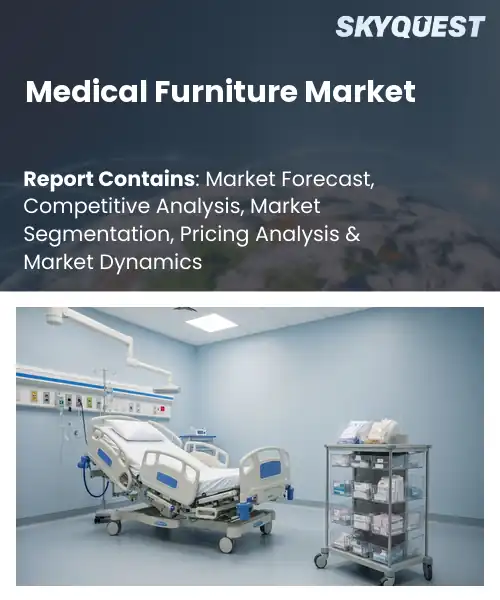
Medical Furniture Market
Report ID: SQMIG35A3380
Report ID: SQMIG35A3380
[email protected]
USA +1 351-333-4748
Report ID:
SQMIG35A3380 |
Region:
Global |
Published Date: May, 2026
Pages:
157
|Tables:
182
|Figures:
79


Global Medical Furniture Market size was valued at USD 12.9 Billion in 2024 and is poised to grow from USD 13.44 Billion in 2025 to USD 18.68 Billion by 2033, growing at a CAGR of 4.2% during the forecast period (2026-2033).
Global medical furniture market growth is driven by rising aging population that is placing greater demands on healthcare systems and forcing providers to focus, as a priority, on providing safer and more efficient patient-care fixtures. This includes many types of medical furniture such as hospital beds, examination tables, bedside cabinets, procedure chairs, and sterile storage components that are used to develop clinical workflows that impact both clinical and patient outcomes. Over the years, the medical furniture sector has evolved from the original metal and wood medical furnishings (i.e., hospital beds, exam tables) through the transition to: electrically adjustable beds; antimicrobial surfaces; and integrated monitoring technologies, as manufacturers adapted their designs to comply with more stringent regulatory standards and to support the needs of clinicians. For example: the increased demand for ICU capacity and infection control due to COVID-19 has driven the rapid adoption of modular ICU beds and mobile isolation carts, which have changed how health care facilities procure those types of medical furniture.
Through the realignment of procurement priorities, a key driver of growth has been the ability of differentiated products to provide measurable clinical results through improvements in the design of furniture and services. As hospitals have started using more connected, antimicrobial, and ergonomically optimized products, they report quicker patient turnover rates, fewer negative incidents, and lower rates of caregiver injury. These results help to justify the higher initial capital and ongoing service costs associated with using connected products. For example, smart ICU beds with sensors help reduce the incidence of pressure ulcers and alerts help minimize the risk of falls, and telemedicine-enabled examination carts allow specialists to see patients in remote locations. As a result, manufacturers will continue to develop modular retrofits for existing products, provide maintenance on a subscription basis, and bundle software analytics with products to create new revenue streams and/or access to emerging markets.
How is IoT enabling smart medical furniture for real-time patient monitoring?
The Internet of Things (IoT) is changing the way we look at medical equipment by adding technology to slide mattresses, stretchers and chairs so they can monitor heart rate, respiration, movement and pressure in real time. There are three key components involved in this transformation: onsite sensing of these changes, processing the information locally and sending that information securely to a cloud-based system that links with electronic medical record (EMR) systems and hospital alarms. Hospital and long-term care providers are currently testing programs and rolling out new solutions that allow for improved remote monitoring and increased efficiency in workflows. For example, using sensors to determine the pressure on a mattress to prevent development of pressure ulcers, determine when a patient gets out of bed and has a potential chance of falling, or determine a patient's vitals while the patient is being transported in a chair will give caregivers the tools they need to provide better, more proactive patient-centered care.
In January 2026, Baxter introduced the new Dynamo Series smart stretcher, which has IoT-based sensors and connectivity built into it that allow for continuous monitoring of the bedside environment and help nurses to streamline their workflow processes. The introduction of this new innovation will allow hospitals to increase their market share by improving patient safety, increasing operational efficiency, and providing real-time vitals/alarm data to all members of the care team in order to improve the speed of responding to events and decrease the number of patient transfers.
Market snapshot - (2026-2033)
Global Market Size
USD 12.9 Billion
Largest Segment
Hospital Beds
Fastest Growth
Hospital Beds
Growth Rate
4.2% CAGR
To get more insights on this market click here to Request a Free Sample Report
Global medical furniture market is segmented by product type, material type, application, end user, mobility type, distribution channel and region. Based on product type, the market is segmented into Hospital Beds, Examination Tables & Chairs, Operating Room Furniture, Patient Transport Furniture, Storage & Utility Furniture, Medical Cabinets & Lockers, Overbed Tables & Bedside Furniture and Others. Based on material type, the market is segmented into Metal-Based Furniture, Wood-Based Furniture, Plastic & Polymer-Based Furniture and Composite & Hybrid Materials. Based on application, the market is segmented into Patient Care, Examination & Diagnostics, Surgical & Operating Rooms, Patient Transportation and Storage & Administrative Use. Based on end user, the market is segmented into Hospitals, Ambulatory Surgical Centers, Clinics & Physician Offices, Diagnostic Laboratories, Long-Term Care Centers & Nursing Homes, Home Healthcare Settings and Rehabilitation Centers. Based on mobility type, the market is segmented into Fixed Furniture and Mobile Furniture. Based on distribution channel, the market is segmented into Direct Sales, Distributors & Dealers and E-commerce & Online Procurement. Based on region, the market is segmented into North America, Europe, Asia Pacific, Latin America and Middle East & Africa.
As per medical furniture market analysis, the Hospital Beds category has traditionally been the largest segment of the market. The hospital bed is essential to the patient recovery journey and capital planning cycle, influencing procurement priorities throughout the entire healthcare system and across all care settings. The adaptability of the hospital bed to accommodate clinical acuity levels and integrate with monitoring technology will continue to motivate hospital systems to invest in new bed designs that are innovative, advanced, and support improvements in infection control. Multifunctionality in hospital beds is on the rise, as demand for beds with improved ergonomic design for caregivers has driven the specification of higher functionality beds, which, in turn, has prompted manufacturers to focus on innovation in bed designs, as well as warranty and support models in order to secure consistent long-term contracts with hospitals and healthcare organizations.
Conversely, the Overbed Tables & Bedside Furniture category is currently the fastest-growing segment of the healthcare furniture market due to increased demand for bedside care customization, as well as the ongoing evolution of patient-focused conveniences that support ambulation and therapy. Innovations in modular design, antimicrobial surfaces, and integrated device mounts have greatly accelerated the adoption of new technologies; creating new accessory markets and cross-selling opportunities for manufacturers.
As per medical furniture market share, the Mobile Furniture segment remains the leading segment of the healthcare furniture market because of its inherent portability. Mobile furniture is enabling rapid reconfiguration of treatment areas, and supporting point-of-care procedures, thereby improving the total care experience for patients. The ability to increase the number of patients treated while simultaneously decreasing the amount of time required to transfer patients reduces patient transfers, increases overall process flow, and enables clinicians to deploy equipment to where it is most required, ultimately resulting in improved response times. Innovative designs that utilize locking casters, lightweight materials, and integrated power sources are motivating healthcare providers to introduce new mobile product lines and expand service offerings from manufacturers seeking to build flexible operations within their respective organizations.
As per medical furniture market forecast, Fixed Furniture is having the highest growth rate in clinical defined installation due to their durable construction and meeting of compliance standards as a result of long-term facility planning and the existence of a solid infrastructure. Manufacturers are providing products with durable finishes, combined cabinetry/storage systems and antimicrobial coatings, resulting in extended life cycles of assets and providing additional opportunities in refurbishment and upgrading of institutional facilities.
To get detailed segments analysis, Request a Free Sample Report
As per global medical furniture market regional analysis, using an advanced healthcare infrastructure, high levels of clinical technology adoption, and the presence of manufacturers that prioritize quality and compliance creates North America’s continued dominance in the global market. Uniquely, this is achieved through three major factors: demand from large hospital systems (that lead the way in modernizing their outpatient care environments), the overall culture of changing toward furnishings designed ergonomically and for infection control; as well as regulatory frameworks & procurement standards that create baseline standards for all use. With suppliers having to provide integrated/customized products, there is ample incentive for them to create a highly-competitive environment. This creates strong supply chain competencies, concentrates R&D spending, and promotes collaborative efforts between healthcare providers/manufacturers, which continues to support North America’s leadership position in the market; while also continually changing demand for innovative products based on patient experience and staff efficiency. Lastly, because of extensive aftermarket support (maintenance) services and easy-to-access/customization options from various sources, the total cost of ownership issues are diminished; making purchasing more desirable for customers purchasing medical furniture in North America. The presence of specialized trade show/distribution channels provides manufacturers with access to a large customer base, and retailers in turn, have access to the latest medical furniture innovations. Overall, North America serves as the leading market for the introduction of new and high-quality medical furniture products.
The medical furniture market in the U.S. is marked by a high degree of innovation, as well as strong hospital networks that require durable and standardized furniture solutions. The strong focus on infection control, ergonomics, and comfort of patients fosters a need for customized, integrated solutions through technology and/or advanced design options. Purchasers will choose vendors who offer robust aftercare and service agreements, while design and compliance trends encourage ongoing development of products, as well as close strategic collaboration between manufacturers and clinical partners.
The medical furniture market in Canada is affected by provincial regulations, & by the fact that there are multiple styles of care providers who are looking for long-lasting, adaptable furniture solutions in dispersed sites across the country. In addition to these factors, suppliers must also be able to provide services and aftercare for customers on a regional basis. Sustainability and product lifecycle considerations play a role in overall purchasing decisions. Collaborative efforts between healthcare providers and manufacturers can produce tailored solutions that include cost effectiveness, ease of maintenance, and ergonomic design across the broad spectrum of clinical specialties.
The continuous growth in Europe is due to a combination of improvements to clinical facilities and increased regulations around them, as well as an increasing focus on patients being at the center of care. All of this has resulted in a larger demand for specialty medical furniture as hospitals and clinics upgrade their space to have improved workflows, less risk of infection and greater comfort for patients. In response to these new trends, manufacturers are producing modular, ergonomic and sustainable products that can help support the new ways of working in clinical environments. The continued establishment of strong manufacturing bases in Europe helps promote innovation and customization, while the growing trend of cross-border purchasing combined with interoperability among manufacturers products enables rapid adoption of new products and technologies. There is also an increase in collaboration between those who use the products and the designers of the products with respect to developing products that can be easily adapted for use across all types of care settings such as outpatient and specialty care centers. Therefore, Europe has become a highly advanced and high-quality market for medical furniture. As sustainability has become a priority for all the health care systems, manufacturers are requiring their new product lines to include sustainable materials and a plan for their end-of-life recycling. In addition, providing service models that include maintenance, training and long-term support of the products installed at customer locations allow buyers to more effectively support the ongoing operation of their clinical facility and differentiates the vendor throughout the region.
Medical furniture sector in Germany experiences growth due to a concentration of industries and stringent clinical standards that drive demand for compliant, high-quality furnishings that are manufactured with precision engineering and modularity in design, along with a commitment to sustainability, supporting hospital and specialty clinic requirements. There is ongoing collaboration between research institutions and suppliers creating a culture of iterative innovation through the procurement practices favoured by procurers, focusing on suppliers providing an aftersales service and customization. Germany’s position as a buyer and exporter supports continued excellence in the design of medical furniture.
Medical Furniture industry in the UK features accelerated adoption and deployment of furnishings by both private and public providers, with a significant amount of activity occurring in specialty and outpatient settings, which desire to incorporate flexible and patient-focused furnishings into their facilities. The trend toward accelerated refurbishment of facilities creates opportunities to deliver modular and technology-compatible furniture products to health care facilities. Manufacturers who provide service-based business models, refined designs, and demonstrate sustainable credibility are the types of suppliers who are well positioned to meet the changing needs of their health care customers. Through collaborative relationships between manufacturers, clinicians and facility managers, customized solutions can be developed and delivered throughout the UK health care system in an accelerated timeframe.
In France, changes to hospital and outpatient facility renovation cycles led to increased demand for flexible and space-efficient furniture. As a result, vendors domestically have begun focusing on furniture design that integrates well from an aesthetic viewpoint, and uses ergonomically-designed furniture and environmentally friendly materials. In addition to integrating design features, vendors focused on providing flexible suppliers that can deliver custom made furniture and support and/or maintain their furnishings. Home healthcare and specialty clinics provide additional opportunities for patient-friendly and modular furnishings that can support multiple paths through the continuum of care.
As a result of the growing demand for medical furniture, the Asia Pacific region continues to increase its presence in this market as it builds up its healthcare infrastructure, increases its clinical standards and develops its domestic manufacturing capabilities to meet the expectations of international quality standards. In addition, the regional supplier is modifying their product mixes to fit the needs of large urban hospitals and expanding ambulatory networks, providing them with modular, space-saving and cost-effective solutions. The region's current manufacturers are forging strategic alliances with global manufacturers and investing in quality control and service networks to strengthen their market credibility. As the region emphasizes localization, rapid customization and the ability to scale production capacity, they are able to quickly respond to the needs of the buyers in the marketplace. In addition, the growing focus on sustainability and ergonomic design will help to promote the Asia Pacific region not only as a large consumer market, but also as a developing region of competitive products. Furthermore, the improvements made to the service infrastructure as well as the introduction of training programmes for clinical staff and the support provided for participation in regional standardization initiatives, are creating an environment of trust between buyers and the suppliers. Finally, the region's manufacturers can reach out to a larger number of healthcare providers through the expansion of their showroom and distribution networks for the new products being introduced with design and technology integration.
The Medical Furniture Market in Japan is driven by precision engineering, ergonomic design and the integration of high-tech clinical technologies to meet the demanding needs of hospitals and long-term care. Suppliers offer compact, multi-functional products that are responsive to space limitations, while also ensuring long product lifecycles through robust aftersales service and maintenance support. In addition, the collaborative initiatives with healthcare providers and research institutions help facilitate ongoing improvement on an iterative basis and thus, establish Japan's position as a leading country for quality and innovative specialized medical furniture for complex care environments.
The Medical Furniture Market in South Korea has reached a high level of maturity through advanced manufacturing technologies, technological integration, and design-driven solutions which are adapted to the current clinical workflow. Domestic suppliers deliver competitive priced production with a high level of quality assurance to support hospitals and their outpatient networks while also developing strong collaborative partnerships with international suppliers to gain access to new materials and the implementation of smart furniture features faster. The distribution and service network for both product installation and product maintenance is also helping drive the South Korean Medical Furniture Market towards becoming the regional hub of excellence in medical furniture expertise.
To know more about the market opportunities by region and country, click here to
Buy The Complete Report
Growing Demand for Ergonomic Products
Technological Advances in Furniture Design
Initial Procurement Costs
Regulatory Compliance Issues
Request Free Customization of this report to help us to meet your business objectives.
The global market for medical furnishings is evolving both through consolidation driven by acquisitions by strategic mergers and acquisitions, as well as through technology. Companies are acquiring companies or entering into licensing arrangements; they also are utilizing integration with existing sensing platforms to create new offerings. Two examples of this are Baxter's (2021) acquisition of Hillrom to bring together its portfolios of connected beds and Stryker's introduction of its wireless smart beds along with its bedside sensing platforms. Multiple large companies have formed alliances with sensing companies like The EarlySense Company after obtaining critical technology and further developing vendor rationalization and contract management capabilities in order to provide member hospitals with easier sourcing and procurement processes.
SkyQuest’s ABIRAW (Advanced Business Intelligence, Research & Analysis Wing) is our Business Information Services team that Collects, Collates, Correlates, and Analyses the Data collected by means of Primary Exploratory Research backed by robust Secondary Desk research.
As per SkyQuest analysis, global demand for medical furniture is strongly influenced by an aging population and modernization of healthcare systems; however, the high initial cost of purchasing medical furniture continues to be a significant obstacle to the growth of the market. The North American region is the largest market for medical furniture, with Hospital Beds being the most significant segment due to their key position in both patient recovery and capital planning. Technology is also a significant driver of medical furniture sales; therefore, differentiation through the use of technology has created several effective opportunities for manufacturers in this industry. Examples of such technology could be IoT enabled Hospital Beds, Hospital Beds made with Antibacterial Surface Materials, or designs that maximize hospital operations and the effective use of hospital resources. Providers often have long term value, ease of integration, and availability of Aftermarket Support as their primary criteria when selecting medical furniture manufacturers, thus providing continued opportunities for manufacturers to supply providers with connected solutions and service-led solutions that provide some degree of balance between upfront costs vs. long term benefits throughout the use phase of the product such as medical furniture.
| Report Metric | Details |
|---|---|
| Market size value in 2024 | USD 12.9 Billion |
| Market size value in 2033 | USD 18.68 Billion |
| Growth Rate | 4.2% |
| Base year | 2024 |
| Forecast period | (2026-2033) |
| Forecast Unit (Value) | USD Billion |
| Segments covered |
|
| Regions covered | North America (US, Canada), Europe (Germany, France, United Kingdom, Italy, Spain, Rest of Europe), Asia Pacific (China, India, Japan, Rest of Asia-Pacific), Latin America (Brazil, Rest of Latin America), Middle East & Africa (South Africa, GCC Countries, Rest of MEA) |
| Companies covered |
|
| Customization scope | Free report customization with purchase. Customization includes:-
|
To get a free trial access to our platform which is a one stop solution for all your data requirements for quicker decision making. This platform allows you to compare markets, competitors who are prominent in the market, and mega trends that are influencing the dynamics in the market. Also, get access to detailed SkyQuest exclusive matrix.
Table Of Content
Executive Summary
Market overview
Parent Market Analysis
Market overview
Market size
KEY MARKET INSIGHTS
COVID IMPACT
MARKET DYNAMICS & OUTLOOK
Market Size by Region
KEY COMPANY PROFILES
Methodology
For the Medical Furniture Market, our research methodology involved a mixture of primary and secondary data sources. Key steps involved in the research process are listed below:
1. Information Procurement: This stage involved the procurement of Market data or related information via primary and secondary sources. The various secondary sources used included various company websites, annual reports, trade databases, and paid databases such as Hoover's, Bloomberg Business, Factiva, and Avention. Our team did 45 primary interactions Globally which included several stakeholders such as manufacturers, customers, key opinion leaders, etc. Overall, information procurement was one of the most extensive stages in our research process.
2. Information Analysis: This step involved triangulation of data through bottom-up and top-down approaches to estimate and validate the total size and future estimate of the Medical Furniture Market.
3. Report Formulation: The final step entailed the placement of data points in appropriate Market spaces in an attempt to deduce viable conclusions.
4. Validation & Publishing: Validation is the most important step in the process. Validation & re-validation via an intricately designed process helped us finalize data points to be used for final calculations. The final Market estimates and forecasts were then aligned and sent to our panel of industry experts for validation of data. Once the validation was done the report was sent to our Quality Assurance team to ensure adherence to style guides, consistency & design.
Analyst Support
Customization Options
With the given market data, our dedicated team of analysts can offer you the following customization options are available for the Medical Furniture Market:
Product Analysis: Product matrix, which offers a detailed comparison of the product portfolio of companies.
Regional Analysis: Further analysis of the Medical Furniture Market for additional countries.
Competitive Analysis: Detailed analysis and profiling of additional Market players & comparative analysis of competitive products.
Go to Market Strategy: Find the high-growth channels to invest your marketing efforts and increase your customer base.
Innovation Mapping: Identify racial solutions and innovation, connected to deep ecosystems of innovators, start-ups, academics, and strategic partners.
Category Intelligence: Customized intelligence that is relevant to their supply Markets will enable them to make smarter sourcing decisions and improve their category management.
Public Company Transcript Analysis: To improve the investment performance by generating new alpha and making better-informed decisions.
Social Media Listening: To analyze the conversations and trends happening not just around your brand, but around your industry as a whole, and use those insights to make better Marketing decisions.
REQUEST FOR SAMPLE
 REQUEST FREE CUSTOMIZATION
Global Medical Furniture Market size was valued at USD 12.9 Billion in 2024 and is poised to grow from USD 13.44 Billion in 2025 to USD 18.68 Billion by 2033, growing at a CAGR of 4.2% during the forecast period (2026-2033).
Competitive landscape in the global medical furniture market is consolidation driven and technology led, with strategic M&A, licensing and integration of sensing platforms reshaping offers. Examples include Baxter's 2021 acquisition of Hillrom to consolidate connected bed portfolios and Stryker's launches of wireless smart beds and bedside platforms. Partnerships with sensing firms such as EarlySense and regional tie ups like Dozee and Midmark show incumbents buy or partner for rapid capability gains. 'Stryker Corporation', 'Getinge AB', 'Baxter International Inc.', 'Arjo AB', 'LINET Group SE', 'Paramount Bed Holdings Co., Ltd.', 'Invacare Corporation', 'Drive DeVilbiss Healthcare', 'GF Health Products, Inc.', 'Joerns Healthcare LLC', 'Midmark Corporation', 'Medifa GmbH & Co. KG', 'Merivaara Corporation', 'Malvestio S.p.A.', 'Stiegelmeyer GmbH & Co. KG', 'Capsa Healthcare', 'Amico Corporation', 'GPC Medical Ltd.', 'Narang Medical Limited', 'Wieland Healthcare'
The increasing prevalence of chronic illnesses and an aging population is prompting healthcare providers to prioritize patient comfort, safety, and long term care needs, which in turn drives demand for specialized medical furniture. Hospitals and long term care facilities are focusing on ergonomic designs that support clinical workflows, reduce caregiver strain, and accommodate diverse patient mobility requirements, motivating procurement of adaptable, durable, and easy to clean furniture that aligns with care protocols and infection control practices, thereby fostering market growth through focused institutional investments and specification driven purchases.
Digital Integration Across Facilities: Healthcare providers increasingly prioritize connected furniture that enhances workflow continuity, asset visibility, and system interoperability across care areas. Manufacturers focus on modular platforms with embedded sensors, electronic controls, and cloud enabled service models to support clinician productivity and patient comfort. Emphasis on remote diagnostics, software updates, and lifecycle services fosters closer partnerships between suppliers and IT teams. Procurement weighs long term operational impact and integration simplicity, encouraging collaborative specification processes that align clinical needs with technology roadmaps and service agreements.
Why does North America Dominate the Global Medical Furniture Market? |@12


Want to customize this report? This report can be personalized according to your needs. Our analysts and industry experts will work directly with you to understand your requirements and provide you with customized data in a short amount of time. We offer $1000 worth of FREE customization at the time of purchase.
Feedback From Our Clients


 USA (+1) 351-333-4748

