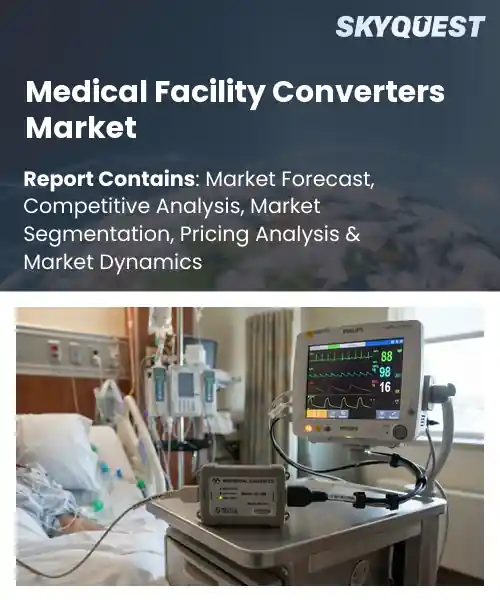
Medical Facility Converters Market
Report ID: SQMIG35D2670
Report ID: SQMIG35D2670
[email protected]
USA +1 351-333-4748
Report ID:
SQMIG35D2670 |
Region:
Global |
Published Date: August, 2026
Pages:
157
|Tables:
121
|Figures:
77


Global Medical Facility Converters Market size was valued at USD 4.18 Billion in 2024 and is poised to grow from USD 4.48 Billion in 2025 to USD 7.75 Billion by 2033, growing at a CAGR of 7.1% during the forecast period (2026-2033).
Global Medical Facility Converters market refers to the sector that supplies power‑conversion equipment such as AC‑DC, DC‑AC and DC‑DC converters specifically engineered for hospitals, diagnostic centers, and care institutions. Demand for these devices has risen because healthcare increasingly relies on energy‑intensive imaging, robotics and telemedicine platforms that require stable, high‑efficiency power. Historically, converters were simple, bulky units; the 2000s saw a shift toward modular, controlled systems that support redundant backup and remote monitoring. For example, a leading U.S. hospital upgraded its cardiac‑catheterization suite in 2018 using converters that reduced outage by 40%, illustrating how reliability and regulatory compliance have become market imperatives.
The accelerating adoption of energy and micro‑grid architectures is becoming the pivotal factor for the Global Medical Facility Converters market because hospitals aim to combine solar generation with battery storage while preserving power. These converters let facilities draw electricity from solar during daylight and feed surplus back to the grid, cutting operating costs and carbon footprints. A university hospital recently installed a converter linked to a 2 MW rooftop solar array, reducing diesel‑generator use by 70 percent and earning Green‑Deal incentives. This dynamic pushes manufacturers toward silicon‑carbide and gallium‑nitide designs that offer efficiency, creating retrofit opportunities in older facilities and new builds focused on sustainability.
How is AI-driven automation reshaping the medical facility converters market?
AI-driven automation is streamlining the design, planning and execution phases of medical facility conversions. Machine‑learning models predict space utilization, optimize equipment layout and reduce downtime, while robotic process automation handles documentation and regulatory compliance. These tools enable providers to repurpose hospitals, outpatient centers and specialty clinics faster and with fewer errors. The market, valued at over a trillion dollars in recent years, is responding to pressure for cost‑effective upgrades and the need to adapt to evolving care models. As hospitals seek to modernize infrastructure, AI offers a scalable way to meet demand while preserving clinical quality.
Fresenius Medical Care announced a new strategy in January 2026, highlighting AI‑driven automation to accelerate conversion projects, thereby enhancing efficiency and supporting market growth.
Market snapshot - (2026-2033)
Global Market Size
USD 4.18 Billion
Largest Segment
Medical Power Converters
Fastest Growth
Data & Communication Converters
Growth Rate
7.1% CAGR
To get more insights on this market click here to Request a Free Sample Report
Global medical facility converters market is segmented by converter type, facility type, application, end user and region. Based on converter type, the market is segmented into Medical Power Converters, Medical Signal Converters, Medical Gas Converters and Data & Communication Converters. Based on facility type, the market is segmented into Hospitals, Ambulatory Surgical Centers, Diagnostic & Imaging Centers, Clinics and Long-Term Care Facilities. Based on application, the market is segmented into Patient Monitoring Systems, Diagnostic & Imaging Equipment, Surgical Equipment, Laboratory Equipment and Healthcare Facility Infrastructure. Based on end user, the market is segmented into Healthcare Providers and Medical Device Manufacturers. Based on region, the market is segmented into North America, Europe, Asia Pacific, Latin America and Middle East & Africa.
Medical Power Converters segment dominates because they provide essential voltage regulation and reliability required by critical care devices, ensuring uninterrupted operation in high intensity environments. Their ability to meet stringent safety standards and integrate seamlessly with existing equipment makes them indispensable, driving widespread adoption across facilities that prioritize patient safety and equipment uptime. Because they can adapt to diverse power profiles, hospitals rely on them for legacy devices, reinforcing their central role in infrastructure planning and upgrade cycles.
Meanwhile, Medical Signal Converters are witnessing the strongest growth momentum because increasing integration of digital health monitoring and real time data analytics demands seamless conversion of physiological signals into actionable information. Their expanding role in wearable diagnostics and telehealth platforms accelerates market expansion by unlocking new service models and enhancing patient engagement.
Hospitals segment dominates because they require comprehensive power and data conversion solutions to support a broad array of critical medical equipment, ensuring operational continuity and compliance with health regulations. Their scale drives procurement of robust converters that can handle high load volumes, while institutional policies prioritize reliability, making hospitals the primary driver of market volume. This emphasis on uninterrupted service and stringent safety standards pushes hospitals to adopt advanced conversion technologies that integrate monitoring, imaging and therapeutic devices under a unified infrastructure, reinforcing their leading position in the market.
On the other hand, Ambulatory Surgical Centers are emerging as the key high growth area because the shift toward outpatient procedures fuels demand for compact efficient converters that fit smaller footprints while maintaining clinical performance. Their rapid adoption of modular equipment and focus on cost effective solutions accelerates market expansion and creates new opportunities for specialized converter designs.
To get detailed segments analysis, Request a Free Sample Report
North America leads the global Medical Facility Converters market due to a mature healthcare infrastructure, strong demand for advanced conversion technologies, and robust investment in research and development. The United States benefits from a large network of hospitals and a culture of early adoption of innovative equipment, while Canada offers a supportive regulatory environment and collaborative public‑private initiatives. Both countries host leading manufacturers and service providers, ensuring a reliable supply chain and rapid deployment of conversion solutions. In addition, the presence of major academic medical centers drives continuous refinement of conversion processes, while strong financing mechanisms enable hospitals to upgrade legacy systems without disrupting service delivery. The combined effect of technological expertise, regulatory clarity, and market readiness creates a self‑reinforcing ecosystem that sustains North America’s leadership in the sector.
Medical Facility Converters Market in the United States is shaped by a concentration of tertiary care centers that prioritize rapid equipment turnover and compliance with stringent safety standards. Leading manufacturers collaborate closely with hospital engineering teams to customize conversion solutions that align with clinical workflows. The ecosystem benefits from a strong intellectual property framework, training programs, and an approach to integrating digital monitoring, which together enhance reliability and operational continuity.
Medical Facility Converters Market in Canada benefits from a health system that emphasizes cost‑effectiveness and care. Provincial authorities work closely with equipment suppliers to ensure that conversion technologies meet performance criteria while supporting sustainability goals. The market is reinforced by a skilled workforce and research institutions that focus on adapting conversion processes to clinical needs. This alignment of policy, expertise, and operational priorities drives adoption across acute and community facilities.
Europe experiences rapid expansion of the Medical Facility Converters market driven by a strong regulatory focus on patient safety, increasing demand for flexible healthcare infrastructure, and a concerted push toward sustainability. The region’s mature hospital networks are upgrading legacy equipment to meet evolving clinical standards, while government incentives encourage adoption of conversion technologies that reduce waste and improve energy efficiency. Collaborative research initiatives across Germany, the United Kingdom, and France foster innovation in modular conversion designs, enabling faster deployment and customization. Additionally, the emphasis on cross‑border standardization simplifies procurement and supports a unified market environment, accelerating growth across the continent. Healthcare providers are also prioritizing digital integration, which aligns with converter solutions that incorporate smart monitoring and data analytics, further enhancing operational efficiency. The combined effect of policy support, technological advancement, and a collaborative ecosystem positions Europe as a leading arena for converter adoption and continuous improvement.
Medical Facility Converters Market in Germany is anchored by an engineering sector and a healthcare system that values precision and reliability. Leading manufacturers collaborate with hospitals to develop conversion solutions tailored to environments, ensuring minimal downtime during equipment upgrades. The market benefits from strong funding for medical technology research and a regulatory framework that promotes standardization. This combination of technical expertise and support drives widespread adoption across acute care facilities.
Medical Facility Converters Market in the United Kingdom is driven by policy that encourages modernization of hospital infrastructure. Trusts collaborate with conversion specialists to replace aging equipment with solutions that can be reconfigured as clinical needs evolve. The market benefits from a network that drives research into conversion technologies, integrating IoT capabilities for performance monitoring. This environment accelerates adoption and positions the United Kingdom as a hub for converter innovation.
Medical Facility Converters Market in France is emerging as hospitals seek pathways to upgrade legacy systems while adhering to regulatory standards. French healthcare providers partner with conversion firms to implement upgrades that minimize service disruption and extend equipment lifespan. The market is supported by programs that incentivize sustainable technology adoption and by clusters focusing on conversion processes. This combination of policy encouragement and practical solutions fuels steady market expansion ongoing.
Asia Pacific is strengthening its position in the Medical Facility Converters market through a blend of rapid healthcare infrastructure development, increasing adoption of advanced medical technologies, and a focus on cost‑efficient solutions. Nations such as Japan and South Korea are investing heavily in modernizing hospital equipment to meet rising patient expectations and to support aging populations. Local manufacturers are leveraging strong engineering capabilities to produce high‑quality conversion systems that align with regional standards and sustainability goals. Collaborative initiatives between government agencies, research institutions, and industry players accelerate technology transfer and foster innovation in modular conversion designs. This dynamic environment, coupled with growing demand for flexible and scalable medical equipment, propels the region toward greater market relevance and competitive advantage. These trends collectively reinforce the region’s emerging leadership.
Medical Facility Converters Market in Japan is driven by a healthcare system that prioritizes precision and reliability. Japanese hospitals collaborate with conversion experts to upgrade legacy devices, ensuring minimal downtime and adherence to strict quality standards. The market benefits from domestic manufacturing capabilities and a culture of improvement, which supports the development of conversion technologies. Government initiatives that promote sustainable medical equipment further encourage adoption across public and private facilities.
Medical Facility Converters Market in South Korea is propelled by a medical sector that seeks integration of equipment. Korean hospitals partner with conversion specialists to replace aging infrastructure with solutions that can be reconfigured for clinical demands. The market leverages R&D capabilities and government support for digital health initiatives, fostering the creation of conversion systems with monitoring. This synergy of policy, expertise, and demand accelerates widespread adoption across healthcare facilities.
To know more about the market opportunities by region and country, click here to
Buy The Complete Report
Increasing Demand for Portable Imaging
Regulatory Support for Interoperability
High Initial Capital Expenditure
Complex Integration with Legacy Systems
Request Free Customization of this report to help us to meet your business objectives.
The market is shaped by aggressive funding and partnership moves, with emerging device innovators accelerating product pipelines to challenge incumbents; NanoSyrinx’s recent $21.5 million round fuels rapid scale‑up, while Convergence Medical Robotics leverages a $3.1 million seed raise and a university alliance to introduce AI‑driven surgical tools, illustrating how capital‑driven tech innovation and strategic collaborations intensify competition.
Top Player’s Company Profile
SkyQuest’s ABIRAW (Advanced Business Intelligence, Research & Analysis Wing) is our Business Information Services team that Collects, Collates, Correlates, and Analyses the Data collected by means of Primary Exploratory Research backed by robust Secondary Desk research.
As per SkyQuest analysis, the global medical facility converters market is driven primarily by the rising demand for portable imaging that pushes hospitals to adopt flexible conversion solutions, while regulatory support for interoperability is a second catalyst encouraging investments in devices that bridge legacy and smart equipment. High upfront capital costs act as a restraint, limiting uptake in smaller facilities. North America remains the dominant region due to mature infrastructure and strong R&D, and within the market medical power converters lead as the prevailing segment, offering essential voltage regulation for critical care devices.
| Report Metric | Details |
|---|---|
| Market size value in 2024 | USD 4.18 Billion |
| Market size value in 2033 | USD 7.75 Billion |
| Growth Rate | 7.1% |
| Base year | 2024 |
| Forecast period | (2026-2033) |
| Forecast Unit (Value) | USD Billion |
| Segments covered |
|
| Regions covered | North America (US, Canada), Europe (Germany, France, United Kingdom, Italy, Spain, Rest of Europe), Asia Pacific (China, India, Japan, Rest of Asia-Pacific), Latin America (Brazil, Rest of Latin America), Middle East & Africa (South Africa, GCC Countries, Rest of MEA) |
| Companies covered |
|
| Customization scope | Free report customization with purchase. Customization includes:-
|
To get a free trial access to our platform which is a one stop solution for all your data requirements for quicker decision making. This platform allows you to compare markets, competitors who are prominent in the market, and mega trends that are influencing the dynamics in the market. Also, get access to detailed SkyQuest exclusive matrix.
Table Of Content
Executive Summary
Market overview
Parent Market Analysis
Market overview
Market size
KEY MARKET INSIGHTS
COVID IMPACT
MARKET DYNAMICS & OUTLOOK
Market Size by Region
KEY COMPANY PROFILES
Methodology
For the Medical Facility Converters Market, our research methodology involved a mixture of primary and secondary data sources. Key steps involved in the research process are listed below:
1. Information Procurement: This stage involved the procurement of Market data or related information via primary and secondary sources. The various secondary sources used included various company websites, annual reports, trade databases, and paid databases such as Hoover's, Bloomberg Business, Factiva, and Avention. Our team did 45 primary interactions Globally which included several stakeholders such as manufacturers, customers, key opinion leaders, etc. Overall, information procurement was one of the most extensive stages in our research process.
2. Information Analysis: This step involved triangulation of data through bottom-up and top-down approaches to estimate and validate the total size and future estimate of the Medical Facility Converters Market.
3. Report Formulation: The final step entailed the placement of data points in appropriate Market spaces in an attempt to deduce viable conclusions.
4. Validation & Publishing: Validation is the most important step in the process. Validation & re-validation via an intricately designed process helped us finalize data points to be used for final calculations. The final Market estimates and forecasts were then aligned and sent to our panel of industry experts for validation of data. Once the validation was done the report was sent to our Quality Assurance team to ensure adherence to style guides, consistency & design.
Analyst Support
Customization Options
With the given market data, our dedicated team of analysts can offer you the following customization options are available for the Medical Facility Converters Market:
Product Analysis: Product matrix, which offers a detailed comparison of the product portfolio of companies.
Regional Analysis: Further analysis of the Medical Facility Converters Market for additional countries.
Competitive Analysis: Detailed analysis and profiling of additional Market players & comparative analysis of competitive products.
Go to Market Strategy: Find the high-growth channels to invest your marketing efforts and increase your customer base.
Innovation Mapping: Identify racial solutions and innovation, connected to deep ecosystems of innovators, start-ups, academics, and strategic partners.
Category Intelligence: Customized intelligence that is relevant to their supply Markets will enable them to make smarter sourcing decisions and improve their category management.
Public Company Transcript Analysis: To improve the investment performance by generating new alpha and making better-informed decisions.
Social Media Listening: To analyze the conversations and trends happening not just around your brand, but around your industry as a whole, and use those insights to make better Marketing decisions.
REQUEST FOR SAMPLE
 REQUEST FREE CUSTOMIZATION
Global Medical Facility Converters Market size was valued at USD 4.18 Billion in 2024 and is poised to grow from USD 4.48 Billion in 2025 to USD 7.75 Billion by 2033, growing at a CAGR of 7.1% during the forecast period (2026-2033).
The market is shaped by aggressive funding and partnership moves, with emerging device innovators accelerating product pipelines to challenge incumbents; NanoSyrinx’s recent $21.5 million round fuels rapid scale‑up, while Convergence Medical Robotics leverages a $3.1 million seed raise and a university alliance to introduce AI‑driven surgical tools, illustrating how capital‑driven tech innovation and strategic collaborations intensify competition. 'GE HealthCare Technologies Inc.', 'Siemens Healthineers AG', 'Koninklijke Philips N.V.', 'Stryker Corporation', 'Hill-Rom Holdings, Inc.', 'Getinge AB', 'Drägerwerk AG & Co. KGaA', 'STERIS plc', 'Midmark Corporation', 'Skytron, LLC', 'Alvo Medical Sp. z o.o.', 'Brandon Medical Company Ltd.', 'Amico Group of Companies', 'BeaconMedaes LLC', 'Modular Devices, Inc.', 'Mobile Healthcare Facilities LLC', 'Vanguard Healthcare Solutions Ltd.', 'Cadolto Modultechnik GmbH', 'Karmod Prefabricated Technologies', 'Portakabin Limited'
The growing need for portable imaging solutions in remote and emergency care settings drives adoption of medical facility converters, as clinicians require flexible equipment that can be quickly reconfigured for various diagnostic procedures. This demand encourages manufacturers to develop versatile converter technologies that support multiple modalities, thereby expanding market reach and fostering continuous product innovation. Additionally, the ease of upgrading existing devices extends equipment lifespan, further incentivizing adoption across facilities.
Ai‑Driven Predictive Maintenance: Hospitals are increasingly adopting AI‑driven predictive maintenance platforms for medical facility converters, enabling continuous monitoring of performance parameters and early fault detection. These intelligent systems analyze sensor data to forecast degradation patterns, allowing proactive interventions that minimize downtime and extend equipment lifespan. By shifting from reactive to condition‑based servicing, institutions improve operational reliability, reduce unscheduled service costs, and bolster patient safety, while vendors differentiate themselves through advanced analytics capabilities and integrated service models and strengthen overall hospital resilience across regions.
Why does North America Dominate the Global Medical Facility Converters Market? |@12


Want to customize this report? This report can be personalized according to your needs. Our analysts and industry experts will work directly with you to understand your requirements and provide you with customized data in a short amount of time. We offer $1000 worth of FREE customization at the time of purchase.
Feedback From Our Clients


 USA (+1) 351-333-4748

