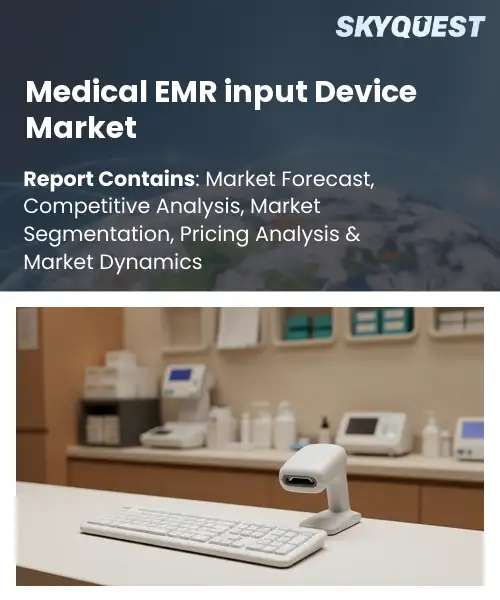
Medical EMR input Device Market
Report ID: SQMIG35A3262
Report ID: SQMIG35A3262
[email protected]
USA +1 351-333-4748
Report ID:
SQMIG35A3262 |
Region:
Global |
Published Date: March, 2026
Pages:
157
|Tables:
115
|Figures:
77


Global Medical Emr Input Device Market size was valued at USD 869.32 Million in 2024 and is poised to grow from USD 900.62 Million in 2025 to USD 1195.14 Million by 2033, growing at a CAGR of 3.6% during the forecast period (2026-2033).
Primary driver of the medical EMR input device market is the digital transformation of clinical documentation and workflow automation. This market comprises hardware and software tools such as clinical keyboards, barcode scanners, touch-screen tablets, voice-recognition microphones and stylus-enabled tablets that capture structured patient data directly into electronic medical records. It matters because accurate and efficient data entry reduces errors, improves billing and enables analytics for population health. Over the past decade adoption grew after policy incentives and interoperability standards pushed hospitals to replace paper charts, exemplified by the HITECH Act in United States and deployment of speech‑recognition in emergency departments.A principal factor shaping global EMR input device market growth is interoperability and seamless workflow integration, which compels device makers to align their products with clinical systems and standards such as HL7 and FHIR. Because vendors deliver plug-and-play keyboards, speech modules, and barcode solutions that integrate without disrupting EHR workflows, hospitals realize measurable efficiency gains and lower documentation burden, prompting further investment. For example, deploying speech-recognition reduced charting time in busy emergency departments, while integrated barcode scanners cut medication administration errors, causing procurement teams to prioritize certified input devices and creating recurring opportunities for vendors offering validated interoperability and support.
How is AI enhancing data accuracy in medical EMR input devices?
AI is improving data accuracy in medical EMR input devices by combining advanced speech recognition with clinical context and clinician validation. Key aspects include voice to text models trained on medical language, ambient capture that records encounters, structured templates that map notes into discrete EMR fields, and in line error detection that flags ambiguous entries. The current state shows rapid adoption of ambient AI and integrated voice assistants that reduce transcription errors and raise documentation quality. The market is moving from basic dictation tools toward integrated AI scribe platforms offered by major vendors which makes deployment more practical in hospitals and clinics.Suki February 2026, released iOS SDK updates and a headless web SDK that add visit metadata to improve note accuracy and EMR field mapping. This update eases integration and supports faster rollouts which helps market growth by improving clinician trust and documentation efficiency. Hospitals can deploy with less custom work and clinicians see more accurate discrete data entry.
Market snapshot - (2026-2033)
Global Market Size
USD 869.32 Million
Largest Segment
Touchscreen Devices
Fastest Growth
Stylus and Pen Devices
Growth Rate
3.6% CAGR
To get more insights on this market click here to Request a Free Sample Report
Global medical emr input device market is segmented by input device type, technology, application, end-user and region. Based on input device type, the market is segmented into Keyboard Devices, Stylus and Pen Devices and Touchscreen Devices. Based on technology, the market is segmented into Wireless Technology and Wired Technology. Based on application, the market is segmented into Hospital Use and Clinic Use. Based on end-user, the market is segmented into Hospitals, Ambulatory Care Centers and Others. Based on region, the market is segmented into North America, Europe, Asia Pacific, Latin America and Middle East & Africa.
Keyboard devices segment dominates because clinical staff rely on tactile familiarity and rapid alphanumeric entry for detailed recordkeeping, making keyboards the default interface in many care settings. Their compatibility with legacy EMR systems, ease of integration with clinical workflows, and predictable performance under continuous use drive procurement preference, while training resources and established vendor support reinforce adoption and maintain their central role in routine documentation and administrative tasks.
However, stylus and pen devices are rapidly expanding due to natural handwriting capture, improved digital ink accuracy, and clinician preference for quick notes on mobile interfaces. Advances in pressure sensitivity, palm rejection, and EMR handwriting recognition accelerate workflow personalization and open opportunities for point of care capture and clinician centric applications.
wired technology segment leads because many healthcare facilities prioritize consistent connectivity and predictable device performance for continuous charting and monitoring tasks. Hardwired connections offer low latency and stable power, reducing interruptions during critical documentation, and ease integration with established network infrastructures and medical grade peripherals. Procurement and compliance preferences favor wired deployments for controlled environments, reinforcing their prevalence in settings that demand dependability and simplified technical maintenance.
However, wireless technology is rapidly expanding as mobility and demand for untethered point of care access drive adoption. Advances in secure protocols, battery efficiency, and wireless management enable reliable clinical workflows and integration with mobile EMR clients. This momentum creates new use cases, clinician mobility, and scalable deployment of connected input devices.
To get detailed segments analysis, Request a Free Sample Report
North America leads the global Medical EMR input Device market due to a confluence of advanced healthcare infrastructure, mature health information technology ecosystems, and concentrated vendor presence. Large hospital systems and integrated delivery networks demand sophisticated input devices that integrate with complex electronic medical record platforms, driving product innovation and scale. Supportive regulatory and reimbursement frameworks encourage interoperability and clinical workflow optimization, while strong private investment fuels research and development. Proximity to major technology and semiconductor companies enables rapid prototyping and supply chain resilience. Skilled clinical and IT workforces facilitate adoption and customization. Emphasis on usability and clinician ergonomics, combined with active collaboration between vendors and academic medical centers, accelerates translation of innovations into clinical practice and reinforces leadership.
Medical EMR input Device Market in United States reflects concentration of leading technology firms and large academic medical centers that demand cutting edge input solutions. Strong private investment and established procurement channels enable rapid adoption of advanced interfaces and interoperability features. Clinical workforce expectations and intensive clinical validation requirements drive emphasis on usability, reliability, and integration with enterprise electronic medical record platforms across inpatient and ambulatory settings and device durability.
Medical EMR input Device Market in Canada is shaped by publicly funded healthcare delivery and coordinated provincial procurement that emphasize interoperability and long term value. Health authorities favor standardized input solutions to support clinical workflows across urban and rural providers. Language and regional integration requirements encourage vendors to provide localized interfaces and robust support. Focus on patient safety and vendor collaboration drives adoption of dependable input devices across care settings.
Rapid expansion in Europe stems from coordinated policy emphasis on digital health modernization, strong regulatory focus on interoperability and data protection, and active investment in clinical IT modernization by public and private healthcare organizations. National and regional procurement strategies encourage standardized input devices that can integrate with varied electronic medical record infrastructures, while certification frameworks promote device quality and patient safety. Local vendor development and partnerships with global suppliers accelerate product adaptation to language and clinical workflow requirements. Growing clinician acceptance of digitized workflows and an increasing focus on remote and ambulatory care further drive demand. Cross border research collaboration and shared standards development reinforce a coherent market environment that supports both established providers and innovative entrants. Mature reimbursement and long term care priorities also motivate institutional modernization and procurement.
Medical EMR input Device Market in Germany benefits from a strong medical technology manufacturing base and large hospital network demanding precision engineered input solutions. Manufacturers focus on rigorous quality and certification standards, creating devices that integrate with complex clinical IT environments. Procurement practices favor dependable equipment and collaboration with academic hospitals accelerates clinical validation. Local engineering strengths and export focus reinforce Germany role as leader in specialized input device offerings.
Medical EMR input Device Market in United Kingdom is shaped by national digital health programs and centralized procurement that can accelerate scale adoption. Integration with primary care systems and emphasis on clinician usability promote rapid uptake of intuitive input devices. Active collaboration between NHS organisations and technology vendors supports piloting and wider deployment across hospital and community settings. Focus on interoperability encourages solutions that meet national standards and clinician needs.
Medical EMR input Device Market in France is influenced by national digital health initiatives and regional hospital procurement emphasizing secure, certified input solutions. Vendors tailor interfaces to language and clinical practice variations and work with regional health agencies on deployment. Growing interest in ambulatory care integration and cloud enabled platforms increases demand for adaptable, secure input devices. Certification requirements and hospital validation ensure devices meet clinical and data protection expectations.
Asia Pacific is strengthening its role through a blend of manufacturing depth, technology innovation, and targeted healthcare modernization efforts across key markets. Domestic medical device manufacturers leverage precision engineering and advanced electronics expertise to produce competitive input solutions, while robust information and communications infrastructures support rapid integration with electronic medical record platforms. Governments and private healthcare providers promote pilots and deployments that favor mobile and touch enabled interfaces, localization for language and workflow, and tight integration with telehealth and remote monitoring services. Strategic partnerships between regional firms and global suppliers accelerate knowledge transfer and market access, and attention to certification and clinical validation builds trust with institutional buyers across diverse care environments. Cost competitive manufacturing combined with expanding research and development hubs enables scalable production and continuous product refinement.
Medical EMR input Device Market in Japan benefits from a high technology manufacturing base and a strong culture of precision engineering that yields reliable, sophisticated input devices. Hospitals demand seamless integration with complex hospital information systems and emphasize device quality and clinical validation. Collaboration between manufacturers and academic medical centers supports iterative innovation, while attention to ergonomic design and care use cases shapes product development and adoption in clinical practice.
Medical EMR input Device Market in South Korea is propelled by advanced information and communications infrastructure and strong integration between electronics firms and healthcare providers. Innovative, mobile oriented interfaces and rapid prototyping capabilities allow domestic suppliers to adapt devices to clinician workflows and consumer health trends. Government support for digital health pilots and emphasis on interoperability encourage collaboration with global technology partners for validation and market access. Export focus aids.
To know more about the market opportunities by region and country, click here to
Buy The Complete Report
Increasing Adoption Of EMR Input Devices
Advancements In Device Interface Design
High Implementation And Training Costs
Interoperability And Compatibility Concerns
Request Free Customization of this report to help us to meet your business objectives.
The competitive landscape for the global medical EMR input device market is now defined by fierce rivalry between legacy vendors and well funded ambient scribe startups, with competition driven by enterprise EHR integrations, large scale contracts, and strategic M&A. Notable moves include Microsoft’s acquisition of Nuance, Ambience’s health system partnerships and Epic integrations, and Knowtex’s VA deployments, showing real examples of M&A, partnerships, and product innovation. Startups:
Top Player’s Company Profile
Recent Developments
SkyQuest’s ABIRAW (Advanced Business Intelligence, Research & Analysis Wing) is our Business Information Services team that Collects, Collates, Correlates, and Analyses the Data collected by means of Primary Exploratory Research backed by robust Secondary Desk research. As per SkyQuest analysis, the global medical EMR input device market is being driven primarily by digital transformation of clinical documentation and workflow automation, with a secondary acceleration from AI-enabled voice recognition and ambient scribe technologies that improve data accuracy and reduce charting time. Adoption is strongest in North America, where advanced health IT ecosystems and large hospital systems dominate demand, and keyboard devices remain the leading segment due to clinician preference for tactile, high-volume entry. Growth is tempered by high implementation and training costs that deter smaller providers and slow scale deployments. Vendors focused on interoperable, user-centered solutions stand to capture steady institutional investment.
| Report Metric | Details |
|---|---|
| Market size value in 2024 | USD 869.32 Million |
| Market size value in 2033 | USD 1195.14 Million |
| Growth Rate | 3.6% |
| Base year | 2024 |
| Forecast period | (2026-2033) |
| Forecast Unit (Value) | USD Million |
| Segments covered |
|
| Regions covered | North America (US, Canada), Europe (Germany, France, United Kingdom, Italy, Spain, Rest of Europe), Asia Pacific (China, India, Japan, Rest of Asia-Pacific), Latin America (Brazil, Rest of Latin America), Middle East & Africa (South Africa, GCC Countries, Rest of MEA) |
| Companies covered |
|
| Customization scope | Free report customization with purchase. Customization includes:-
|
To get a free trial access to our platform which is a one stop solution for all your data requirements for quicker decision making. This platform allows you to compare markets, competitors who are prominent in the market, and mega trends that are influencing the dynamics in the market. Also, get access to detailed SkyQuest exclusive matrix.
Table Of Content
Executive Summary
Market overview
Parent Market Analysis
Market overview
Market size
KEY MARKET INSIGHTS
COVID IMPACT
MARKET DYNAMICS & OUTLOOK
Market Size by Region
KEY COMPANY PROFILES
Methodology
For the Medical EMR input Device Market, our research methodology involved a mixture of primary and secondary data sources. Key steps involved in the research process are listed below:
1. Information Procurement: This stage involved the procurement of Market data or related information via primary and secondary sources. The various secondary sources used included various company websites, annual reports, trade databases, and paid databases such as Hoover's, Bloomberg Business, Factiva, and Avention. Our team did 45 primary interactions Globally which included several stakeholders such as manufacturers, customers, key opinion leaders, etc. Overall, information procurement was one of the most extensive stages in our research process.
2. Information Analysis: This step involved triangulation of data through bottom-up and top-down approaches to estimate and validate the total size and future estimate of the Medical EMR input Device Market.
3. Report Formulation: The final step entailed the placement of data points in appropriate Market spaces in an attempt to deduce viable conclusions.
4. Validation & Publishing: Validation is the most important step in the process. Validation & re-validation via an intricately designed process helped us finalize data points to be used for final calculations. The final Market estimates and forecasts were then aligned and sent to our panel of industry experts for validation of data. Once the validation was done the report was sent to our Quality Assurance team to ensure adherence to style guides, consistency & design.
Analyst Support
Customization Options
With the given market data, our dedicated team of analysts can offer you the following customization options are available for the Medical EMR input Device Market:
Product Analysis: Product matrix, which offers a detailed comparison of the product portfolio of companies.
Regional Analysis: Further analysis of the Medical EMR input Device Market for additional countries.
Competitive Analysis: Detailed analysis and profiling of additional Market players & comparative analysis of competitive products.
Go to Market Strategy: Find the high-growth channels to invest your marketing efforts and increase your customer base.
Innovation Mapping: Identify racial solutions and innovation, connected to deep ecosystems of innovators, start-ups, academics, and strategic partners.
Category Intelligence: Customized intelligence that is relevant to their supply Markets will enable them to make smarter sourcing decisions and improve their category management.
Public Company Transcript Analysis: To improve the investment performance by generating new alpha and making better-informed decisions.
Social Media Listening: To analyze the conversations and trends happening not just around your brand, but around your industry as a whole, and use those insights to make better Marketing decisions.
REQUEST FOR SAMPLE
 REQUEST FREE CUSTOMIZATION


Want to customize this report? This report can be personalized according to your needs. Our analysts and industry experts will work directly with you to understand your requirements and provide you with customized data in a short amount of time. We offer $1000 worth of FREE customization at the time of purchase.
Feedback From Our Clients


 USA (+1) 351-333-4748

