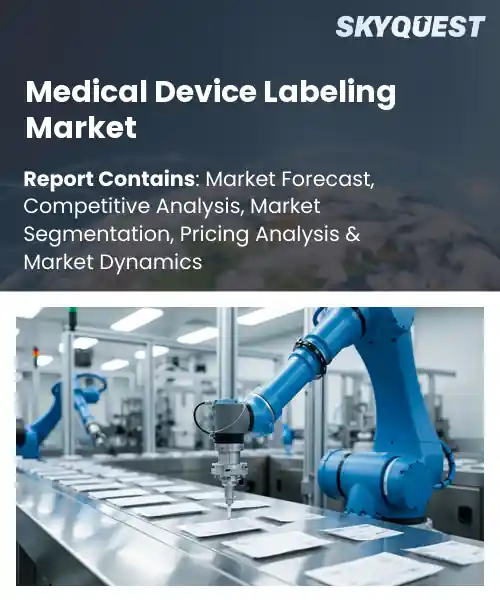
Medical Device Labeling Market
Report ID: SQMIG35G2498
Report ID: SQMIG35G2498
[email protected]
USA +1 351-333-4748
Report ID:
SQMIG35G2498 |
Region:
Global |
Published Date: July, 2026
Pages:
157
|Tables:
118
|Figures:
77


Global Medical Device Labeling Market size was valued at USD 3.52 Billion in 2024 and is poised to grow from USD 3.75 Billion in 2025 to USD 6.22 Billion by 2033, growing at a CAGR of 6.52% during the forecast period (2026-2033).
The main driver for the medical device labeling market growth is the rising tighter regulatory climate, which insists on traceability and patient safety. It covers physical and electronic information that’s tied to the devices and also the packaging, and, it matters because the right labels lower bad outcomes, make recalls easier to run, and help trade move along smoothly. In the past, the market started with handwritten notes and rigid fixed print labels, then it shifted toward standardized barcodes and Unique Device Identification systems, mostly after the FDA UDI rule and various EU device requirements. Once regulators pushed harder for serialization and postmarket monitoring, manufacturers started investing in label printers, software, and compliant content services, so they could get visibility across complicated supply chains and keep interoperability.
In addition, a major factor that is shaping the medical device labeling market outlook is accelerating digital integration, plus tougher traceability rules; both of those create a ripple effect growth. When regulators require Unique Device Identification and hospitals want instant scanability, manufacturers typically put money into label management platforms and serialized printers, and that helps them meet compliance obligations while also cutting recall expenses. In actual practice, implant makers apply GS1 barcodes on surgical trays, so clinicians can verify at the point of care, and diagnostic firms use tamper-evident QR codes to guard cold chain integrity. As a result, specialized labeling providers can win repeat contracts and keep expanding their market footprint.
AI improves regulatory compliance in medical device labeling by speeding up core workflows and making them more repeatable, less chaotic. Some of the key parts are automated label authoring that keeps regulatory phrasing and formatting in line, plus natural language processing that flags inconsistencies between device claims and the accompanying instructions. There is also AI driven translation that aims to retain regulatory nuance across different markets, not just literal wording, and unified data management that keeps unique device identifiers and packaging details synced with the labeling itself. Right now the market deals with complex rules across countries and frequent post market updates. AI tools reduce the manual slip ups and help speed up reviews, while still preserving traceability and audit trails. This is helpful for manufacturers as they answer regulatory requests and keep labeling aligned with design controls.
Market snapshot - (2026-2033)
Global Market Size
USD 3.52 Billion
Largest Segment
Pressure-Sensitive Labels
Fastest Growth
RFID Labels
Growth Rate
6.52% CAGR
To get more insights on this market click here to Request a Free Sample Report
The global medical device labeling market is segmented by labeling type, material, technology, end-use and region. Based on labeling type, the market is segmented into Pressure-Sensitive Labels, In-Mold Labels, RFID Labels and Direct Part Marking (DPM). Based on material, the market is segmented into Polyester, Polypropylene and Paper. Based on technology, the market is segmented into Thermal Transfer Printing, Inkjet Printing and Laser Etching. Based on end-use, the market is segmented into Sterile Packaging, Device Tracking (UDI) and Diagnostic Equipment. Based on region, the market is segmented into North America, Europe, Asia Pacific, Latin America and Middle East & Africa.
As per the medical device labeling market analysis, the Pressure-Sensitive Labels segment dominates, mainly because they’re easy to put on and they work across lots of different substrates, so they fit right into the complicated device manufacturing lines. Also, their compatibility with sterilization steps, the solid sticking power across various device surfaces, and the steady barcode readability help cut down on handling mistakes, while still meeting regulatory traceability needs. In practice, suppliers and manufacturers tend to lean on what they already know: predictable results, established supply chains, and lower implementation friction, so they keep choosing these over less familiar labeling approaches.
However, RFID Labels are starting to grow fast, largely because the appetite for device-level electronic tracking and automated inventory control keeps rising. When RFID can embed unique identifiers and allow wireless scanning, it speeds up adoption across clinical and supply chain workflows. That ends up improving asset management and supports more data-driven regulatory compliance too.
According to the medical device labeling market forecast, the Thermal Transfer Printing category leads because it makes high-contrast barcodes and human-readable text, and it holds up through harsh sterilization plus the rough handling that shows up across device lifecycles. Since it’s been proven to maintain data integrity during packaging and scanning, it lowers recall risk and backs the unique device identification requirements. It also scales well with a range of label materials, and it slots into automated production lines without much drama, which is why manufacturers keep preferring it, and why it keeps getting entrenched in quality and traceability workflows.
Whereas Laser Etching is seeing the strongest growth momentum, because more manufacturers want permanent, consumable-free markings on metal and polymer components, for traceability. It can create tamper-resistant and sterilization-resistant DPM and UDI markings, and importantly, it does this without relying on label materials. That helps adoption for implantable and reusable devices, supports validated marking workflows, and basically opens up new use cases as well.
To get detailed segments analysis, Request a Free Sample Report
As per the medical device labeling market regional forecast, North America is leading mostly because of long-standing, fairly mature regulatory rules and this solid cluster of device manufacturing plus the take-up of more advanced labeling tech. The regulatory oversight is so “watchful” that manufacturers and suppliers end up putting money into labeling that’s compliant, traceable and easier to prove later on. So demand builds for printing that is more sophisticated, with serialization and data handling that doesn’t fall apart when volume ramps. There are several large contract manufacturers and label solution providers around , which turns into this innovation loop where integrated hardware and software keeps improving. And because labeling systems work better with the larger health IT world, electronic labeling initiatives get a little easier to push forward. Quality control, supply chain visibility, and post-market surveillance are high expectations , so companies keep investing. Plus there are standards organizations that stay active and a professional services layer that helps people adopt best practices fast and tailor things for complicated product portfolios, which makes the market feel deeper and not as fragile.
United States Medical Device Labeling Market
The Medical Device Labeling sector in the United States is shaped by strict regulatory expectations, a big device manufacturing ecosystem, and a set of specialist labeling vendors. The demand tends to be on traceability, regulatory alignment, and integration with health IT systems. Service providers often highlight labeling platforms, software-based compliance, and printing methods that can scale. Continuous improvements show up as manufacturers work closely with contract packagers and technology firms, refining labeling workflows so they can handle complicated products and real market constraints.
Canada Medical Device Labeling Market
The Medical Device Labeling industry in Canada shows strong alignment with international regulatory norms, and it also has bilingual labeling requirements, which drives demand for translation and localization. Manufacturers focus on clarity, quality assurance, and supply chain traceability, and they commonly coordinate with partners from the United States to support distribution. Suppliers, meanwhile, want labeling solutions that are flexible enough for English and French content, while still keeping high-quality checks in place. The push for regulatory harmonization and quick supplier response helps grow specialized labeling capabilities.
Europe is seeing rapid medical device labeling market penetration, supported by stronger regulatory structures, more patient safety emphasis, and increased trade inside the region. As technical requirements are more harmonized now, labeling complexity rises too, so manufacturers and suppliers invest more in multilingual content management, translation support and advanced serialization setups. There’s also this fairly dense network of contract manufacturers and packaging specialists that makes flexible production and localization for different markets possible. Digital labeling and lifecycle management tools are getting more demand, since firms want a smoother way to manage frequent updates, and the same time, market-to-market differences. Sustainability considerations matter more as well, and there’s pressure to reduce packaging complexity which leads to material experimentation and newer materials. Overall, industry collaboration and regulatory engagement create an environment that tends to favor suppliers who can deliver compliant, scalable, and localized labeling outcomes.
Germany Medical Device Labeling Market
The Medical Device Labeling Market in Germany is tied to a strong medical manufacturing base and precision engineering expectations, and that pushes advanced labeling solutions. Companies lean hard on regulatory compliance, reliable traceability, and tighter integration with production automation. Local suppliers bring specialized printing, specific materials, and software that helps with complex product lines and export requirements. When manufacturers partner with labeling specialists, the result is tailored workflows that try to balance quality, speed, and adherence to European and international labeling expectations.
United Kingdom Medical Device Labeling Market
The Medical Device Labeling Market outlook in the United Kingdom is influenced by regulatory change and a growing interest in innovation, which boosts demand for flexible labeling approaches and digital options. Medtech clusters and service providers tend to prioritize agile content governance, electronic labeling, and multilingual options so they can support both domestic use and export routes. Contract manufacturers and labeling technology firms team up to deliver responsive workflows, so product updates can happen while staying compliant with regional standards, even when timing gets tight.
France Medical Device Labeling Market
The Medical Device Labeling Market in France is starting to accelerate, with attention on labeling quality, patient safety, and regulatory alignment. Manufacturers and packaging specialists are investing in better materials, localization efforts for Francophone markets, and compliance workflows designed to match regional expectations. Collaboration with certification bodies also supports market maturation. Suppliers who blend material know-how with digital content management and translation services are becoming more relevant, especially as product portfolios expand, exports increase, and documentation practices become more disciplined.
Asia Pacific is strengthening its footing using a blend of manufacturing scale, tech know how and regulatory modernization across key markets. In several regional device production hubs people are adding advanced labeling methods, like high resolution printing, automation, and smart labeling, to satisfy both home requirements and export responsibilities. Regulatory bodies are working on smoother compliance routes and pushing a closer match to international norms, so global suppliers tend to localize what they sell and also build regional service networks. Strategic partnerships between international vendors and local contract manufacturers speed up the transfer of knowhow and bring more sophisticated labeling workflows into day to day operations. There is also a clear rise in attention to electronic labeling, serialization , and supply chain visibility, along with interest in greener or sustainable materials. Finally investment in local research-and-development, plus workforce training, helps keep capability building on track.
Japan Medical Device Labeling Market
The Medical Device Labeling Market in Japan benefits from a precision manufacturing culture, plus strict quality expectations that move adoption of advanced labeling technologies forward. Domestic suppliers and technology companies stress high-quality materials and tight integration with automation. The demand leans toward labels that help with export compliance and also provide clear user information. When device manufacturers cooperate with labeling specialists, the result is very controlled labeling workflows that align with domestic regulatory expectations, as well as with the international market requirements stakeholders care about.
South Korea Medical Device Labeling Market
The Medical Device Labeling Market in South Korea moves ahead via electronics competence, agile manufacturing, and a sustained push for digital labeling innovation. Suppliers roll out smart labels and supporting software to enable serialization, track and trace, and stronger supply chain visibility. Collaboration between tech firms and contract manufacturers supports fast uptake of advanced labeling workflows. There’s an emphasis on time to market and on quality control as well, which helps suppliers meet changing domestic and export needs more broadly, not just in one segment.
To know more about the market opportunities by region and country, click here to
Buy The Complete Report
Stricter Regulatory Requirements Encourage Adoption
Rising Adoption Of Automated Solutions
High Implementation and Maintenance Costs
Fragmented Global Regulatory Landscape
Request Free Customization of this report to help us to meet your business objectives.
Competition in the global medical device labeling market is set by regulation-led demand for UDI and eIFU, so rivals keep pushing acquisitions, teaming up, and moving toward more productized labeling options. Lately the chatter includes RLDatix buying oneSOURCE in order to gather up IFU assets, device makers rolling in point-of-care UDI scanning through companies like Xcelrate UDI, and newer entrants shipping AI-enabled GxP labeling modules such as INGENEUS.
Top Player’s Company Profile
Recent Developments in the Medical Device Labeling Market
SkyQuest’s ABIRAW (Advanced Business Intelligence, Research & Analysis Wing) is our Business Information Services team that Collects, Collates, Correlates, and Analyses the Data collected by means of Primary Exploratory Research backed by robust Secondary Desk research.
As per SkyQuest analysis, the key drivers are basically twofold, first the tightening regulatory landscape that requires traceability and patient safety, and second the accelerating digital integration and automation that boosts labeling accuracy and lifecycle management. The main restraint is the high implementation and maintenance costs tied to advanced labeling equipment, software and validation services, which can slow adoption for smaller manufacturers. North America still leads the market, partly due to mature regulation, a concentrated device manufacturing base, and faster uptake of advanced labeling tech. Within the market, pressure sensitive labels stay the dominant segment, because they’re easier to apply, they keep good adhesion performance through sterilization processes, and there are established supply chains that reduce the “friction” of getting started.
| Report Metric | Details |
|---|---|
| Market size value in 2024 | USD 3.52 Billion |
| Market size value in 2033 | USD 6.22 Billion |
| Growth Rate | 6.52% |
| Base year | 2024 |
| Forecast period | (2026-2033) |
| Forecast Unit (Value) | USD Billion |
| Segments covered |
|
| Regions covered | North America (US, Canada), Europe (Germany, France, United Kingdom, Italy, Spain, Rest of Europe), Asia Pacific (China, India, Japan, Rest of Asia-Pacific), Latin America (Brazil, Rest of Latin America), Middle East & Africa (South Africa, GCC Countries, Rest of MEA) |
| Companies covered |
|
| Customization scope | Free report customization with purchase. Customization includes:-
|
To get a free trial access to our platform which is a one stop solution for all your data requirements for quicker decision making. This platform allows you to compare markets, competitors who are prominent in the market, and mega trends that are influencing the dynamics in the market. Also, get access to detailed SkyQuest exclusive matrix.
Table Of Content
Executive Summary
Market overview
Parent Market Analysis
Market overview
Market size
KEY MARKET INSIGHTS
COVID IMPACT
MARKET DYNAMICS & OUTLOOK
Market Size by Region
KEY COMPANY PROFILES
Methodology
For the Medical Device Labeling Market, our research methodology involved a mixture of primary and secondary data sources. Key steps involved in the research process are listed below:
1. Information Procurement: This stage involved the procurement of Market data or related information via primary and secondary sources. The various secondary sources used included various company websites, annual reports, trade databases, and paid databases such as Hoover's, Bloomberg Business, Factiva, and Avention. Our team did 45 primary interactions Globally which included several stakeholders such as manufacturers, customers, key opinion leaders, etc. Overall, information procurement was one of the most extensive stages in our research process.
2. Information Analysis: This step involved triangulation of data through bottom-up and top-down approaches to estimate and validate the total size and future estimate of the Medical Device Labeling Market.
3. Report Formulation: The final step entailed the placement of data points in appropriate Market spaces in an attempt to deduce viable conclusions.
4. Validation & Publishing: Validation is the most important step in the process. Validation & re-validation via an intricately designed process helped us finalize data points to be used for final calculations. The final Market estimates and forecasts were then aligned and sent to our panel of industry experts for validation of data. Once the validation was done the report was sent to our Quality Assurance team to ensure adherence to style guides, consistency & design.
Analyst Support
Customization Options
With the given market data, our dedicated team of analysts can offer you the following customization options are available for the Medical Device Labeling Market:
Product Analysis: Product matrix, which offers a detailed comparison of the product portfolio of companies.
Regional Analysis: Further analysis of the Medical Device Labeling Market for additional countries.
Competitive Analysis: Detailed analysis and profiling of additional Market players & comparative analysis of competitive products.
Go to Market Strategy: Find the high-growth channels to invest your marketing efforts and increase your customer base.
Innovation Mapping: Identify racial solutions and innovation, connected to deep ecosystems of innovators, start-ups, academics, and strategic partners.
Category Intelligence: Customized intelligence that is relevant to their supply Markets will enable them to make smarter sourcing decisions and improve their category management.
Public Company Transcript Analysis: To improve the investment performance by generating new alpha and making better-informed decisions.
Social Media Listening: To analyze the conversations and trends happening not just around your brand, but around your industry as a whole, and use those insights to make better Marketing decisions.
REQUEST FOR SAMPLE
 REQUEST FREE CUSTOMIZATION
Global Medical Device Labeling Market size was valued at USD 3.52 Billion in 2024 and is poised to grow from USD 3.75 Billion in 2025 to USD 6.22 Billion by 2033, growing at a CAGR of 6.52% during the forecast period (2026-2033).
Competition in the global medical device labeling market is shaped by regulation driven demand for UDI and eIFU, prompting rivals to pursue acquisitions, partnerships and productized labeling solutions. Recent moves include RLDatix acquiring oneSOURCE to consolidate IFU assets, device makers integrating point of care UDI scanning via firms like Xcelrate UDI, and entrants delivering AI enabled GxP labeling modules such as INGENEUS. 'Avery Dennison', 'Brady Corporation', 'CCL Industries', 'PolyArt (now part of CCL)', 'Schreiner Group', 'UPM Raflatac', 'Paxar Corporation (Avery Dennison)', 'Mabbett Label', 'Williams Data Management', 'Consolidated Label', 'Resource Label Group', 'Fort Dearborn Company', 'Multi-Color Corporation', 'All4Labels Group', 'Flexcon Company', 'Zebra Technologies', 'Honeywell Intelligrated', 'Videojet (Danaher)', 'Domino Printing Sciences', 'Markem-Imaje (Dover)'
Regulatory bodies increasingly emphasize accurate, standardized labeling to ensure patient safety and postmarket traceability, prompting manufacturers to prioritize compliant labeling solutions. As requirements tighten, medical device companies seek robust labeling systems and services to meet conformity obligations and to simplify documentation workflows, which encourages investment in labeling technologies. This regulatory pressure incentivizes suppliers to expand capabilities, integrate validation and audit features, and offer consultancy, thereby expanding market demand for products and services that help manufacturers achieve and maintain compliance across jurisdictions.
Smart Labeling Integration: Adoption of digital and wireless labeling technologies is accelerating integration of product data with clinical workflows, enabling dynamic content updates, enhanced traceability and improved inventory management. Labels that communicate with hospital systems and connected devices support better asset utilization and facilitate user guidance at point of care. This trend drives closer collaboration between device manufacturers and IT vendors to ensure interoperability, secure data exchange and seamless lifecycle updates, ultimately improving patient safety, clinical outcomes and operational efficiency across healthcare providers.
Why does North America Dominate the Global Medical Device Labeling Market? |@12


Want to customize this report? This report can be personalized according to your needs. Our analysts and industry experts will work directly with you to understand your requirements and provide you with customized data in a short amount of time. We offer $1000 worth of FREE customization at the time of purchase.
Feedback From Our Clients


 USA (+1) 351-333-4748

