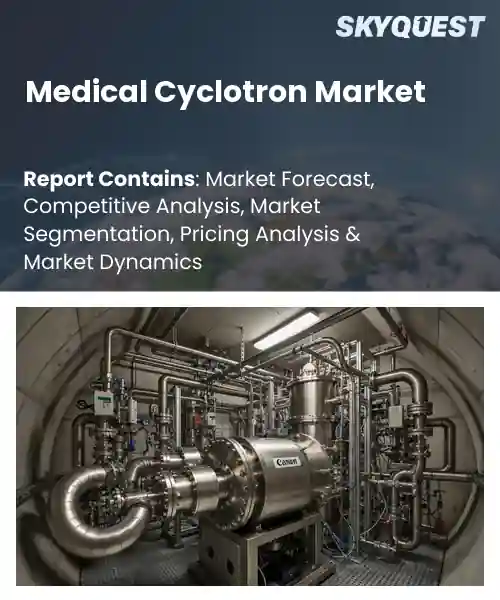
Medical Cyclotron Market
Report ID: SQMIG35A3900
Report ID: SQMIG35A3900
[email protected]
USA +1 351-333-4748
Report ID:
SQMIG35A3900 |
Region:
Global |
Published Date: June, 2026
Pages:
157
|Tables:
119
|Figures:
77


Global Medical Cyclotron Market size was valued at USD 265.0 Million in 2024 and is poised to grow from USD 286.2 Million in 2025 to USD 529.74 Million by 2033, growing at a CAGR of 8.0% during the forecast period (2026-2033).
The primary driver of the medical cyclotron market is the rising clinical demand for positron emission tomography radiotracers, which has pushed healthcare providers to secure local and reliable isotope supply. Medical cyclotrons are particle accelerators that produce short-lived radioisotopes such as fluorine-18 for FDG and carbon-11 for research; their role matters because timely isotope availability directly affects diagnostic accuracy and therapy planning. Over the past three decades the industry moved from large university-based accelerators toward compact, hospital-installed systems, enabling same-day imaging and expanding PET center access.
For example, decentralized cyclotron deployment reduced logistical losses and improved patient throughput, reinforcing investment.Building on local isotope needs, the influential growth factor is regulatory acceptance and reimbursement for novel radiopharmaceuticals, which transforms clinical demand into capital investment decisions. When health systems receive coverage for PET diagnostics and radioligand therapies, hospitals justify procuring cyclotrons to ensure timely isotope supply for uses such as FDG imaging, PSMA PET in prostate cancer, and lutetium-177 theranostics, thereby increasing unit sales and service contracts. Simultaneously improvements in cyclotron automation and smaller footprints reduce operational complexity, causing manufacturers to enter emerging markets where oncology incidence is rising. These dynamics create opportunities for isotope-as-a-service networks and contract radiopharmacy partnerships.
How is AI improving operational efficiency in the medical cyclotron market?
AI is driving operational efficiency in the medical cyclotron sector with predictive maintenance, process optimization, digital twin technology and automated quality control. Predictive models, using sensor and maintenance data, help avoid unplanned downtime and extend the life of components. Machine learning leads to more stable beam settings and improves radiochemical yields. Digital twins accelerate commissioning and enable virtual testing of production runs. These capabilities are important as demand for diagnostic and therapeutic isotopes develops, and facilities need reliable continuous output. Vendors and service providers within the industry are progressively integrating AI into operations to increase uptime and consistency at sites.
Cyclone launched iKure for industrial Astatine 211 production in June 2026, IBA. Combined with AI enabled scheduling and predictive maintenance this results in improved uptime, more consistent isotope batches, while decreasing unplanned outages and enabling more predictable supply chains for clinics and research facilities.
Market snapshot - (2026-2033)
Global Market Size
USD 265.0 Million
Largest Segment
16–18 MeV
Fastest Growth
Above 24 MeV
Growth Rate
8.0% CAGR
To get more insights on this market click here to Request a Free Sample Report
Global medical cyclotron market is segmented by energy range, application, product type, end-user and region. Based on energy range, the market is segmented into 10–12 MeV, 16–18 MeV, 19–24 MeV and Above 24 MeV. Based on application, the market is segmented into Diagnostic Imaging (PET, SPECT), Therapeutic Isotope Production and Research & Development. Based on product type, the market is segmented into Fixed Energy Cyclotrons and Variable Energy Cyclotrons. Based on end-user, the market is segmented into Hospitals, Diagnostic Imaging Centers, Pharmaceutical & Radiopharma Companies and Research Institutes. Based on region, the market is segmented into North America, Europe, Asia Pacific, Latin America and Middle East & Africa.
16–18 MeV segment leads with large medical cyclotron market share because clinical demand for widely used PET isotopes aligns with this energy window, allowing reliable production of common tracers with established cyclotron designs and predictable operational characteristics. Proven supply chains, mature service ecosystems, and compatibility with existing radiochemistry modules reduce integration friction and operating risk, driving buyer preference and steady procurement toward these systems.
As per medical cyclotron market outlook, 19–24 MeV segment is witnessing the strongest growth momentum as higher energy capability supports production of emerging therapeutic isotopes and novel PET tracers, attracting investment in advanced radiopharmaceutical pipelines. Innovation in targetry and automation lowers operational barriers, unlocking new applications and prompting manufacturers to prioritize this range for future pipeline support.
As per medical cyclotron market forecast, therapeutic isotope production segment dominates because rising clinical adoption of targeted radiotherapies directs capital toward cyclotrons optimized for producing therapeutic nuclides, prompting vendors to tailor equipment and services to supply consistent, high-purity outputs. Collaboration between radiopharma developers and equipment manufacturers accelerates scale-up, while reimbursement recognition and clinical trial activity justify long lead investments in dedicated production infrastructure.
As per medical cyclotron market analysis, diagnostic imaging (PET, SPECT) segment is emerging as the most rapidly expanding area as demand for advanced diagnostics and personalized medicine fuels investments in on-site tracer production. Improvements in compact cyclotron designs, streamlined radiochemistry kits, and expanding clinical indications accelerate adoption at imaging centers and hospitals, creating new service models and market opportunities.
To get detailed segments analysis, Request a Free Sample Report
North America dominates the market due to the presence of modern clinical facilities and a robust ecosystem that drives the manufacture of radiopharmaceuticals and deployment of cyclotrons. Close cooperation between academic research centers, specialist hospitals and experienced manufacturers provides effective avenues for technological uptake and product commercialization. Clear regulatory processes, well established supply chains and favorable reimbursement environments all lower barriers to scale-up. Facility growth and service innovation are driven by strong private investment and open capital markets. Experienced engineering and maintenance networks combined with focused workforce development activities provide operational reliability and continual technical assistance in clinical and research environments. Regional leadership is aided by established contract manufacturing and distribution models that provide timely supply, redundancy of operations and close alignment of clinical demand with production capability.
The medical cyclotron market is supported by a network of university medical institutes and specialized imaging facilities that generate demand for radionuclides and related services. The technological uptake and service availability are supported by strong industry collaboration, mature contract manufacturing ecosystems and a qualified engineering staff. Collaborative innovation projects promote clear regulatory paths and well built infrastructure for scale up of manufacturing and timely distribution to clinical and research sites across various geographies.
Canada is characterized by a focus on regional access to radiopharmaceuticals and collaboration between healthcare systems and research institutes. Investment in local production capabilities and service networks enhances reliability of supply for diagnostic and therapeutic applications. Policy engagement and skilled workforce development support industry maturation and regional integration. Partnerships with clinical centers and engineering firms drive technology transfer and program expansion across varied provincial healthcare environments.
The growth in Europe is fueled by the increased integration of clinical research, manufacturing capabilities, and collaborative networks supporting cross-border distribution of radiopharmaceuticals. National health systems and regional partnerships are bolstering procurement processes and backing local production hubs to broaden access to diagnostic and therapeutic isotopes. Close collaboration between equipment vendors, research institutes and hospital networks speeds up clinical translation and drives investment in production capacity. Regulatory harmonization and common quality standards provide an incentive for scalability and cross border clinical trial activity. Technology vendors and service providers are tailoring their offerings to regional needs and targeted initiatives in the public and private sectors are supporting workforce training and infrastructure upgrades, positioning Europe as a vibrant market with distinct national strengths and opportunities for collaborative growth.
Germany medical cyclotron market is powered by a dynamic industrial ecosystem combining precision engineering with improved clinical applications. Consistent technology uptake and localized production are made possible by strong manufacturing capabilities and close synergy between institutions and hospital networks. Industry alliances, quality assurance focus improve supply security, incorporation into clinical research. Collaboration allows new isotope solutions to be deployed rapidly and effectively to key healthcare institutions and regional service networks.
As per medical cyclotron market regional outlook, United Kingdom is emerging with growing clinical interest and expanding research capabilities. Academic centers and specialist hospitals are forming collaborations with technology providers to scale local production and service support. Policy initiatives and investment in workforce training help create an environment conducive to clinical translation and commercial activity across regional centers. Focus on regulatory alignment and cross sector partnerships strengthens supply resilience and innovation pathways locally.
As per medical cyclotron market regional forecast, France is noted for rapid momentum across clinical and manufacturing domains. Public and private stakeholders are aligning to expand production capacity and distribution networks, while research institutes advance novel radiopharmaceutical applications. Emphasis on operational efficiency and quality control supports rapid deployment of new services into clinical practice. Strategic collaborations with equipment manufacturers and clinical research groups drive scale up and broaden access regionally and nationally swiftly.
Asia Pacific is bolstering its position with strategic investments in infrastructure, technological adaption and regional collaboration to fulfill the rising clinical need for sophisticated diagnostic and treatment solutions. Capacity building and workforce development to enable local production and reliable delivery of radionuclides are being addressed by governments and corporate parties. Technology providers are working on compact cyclotron designs and service models to address a range of market needs and partnerships between global corporations and domestic manufacturers are speeding up the transfer of information. Cross-border partnerships and regional supply agreements build resilience, while increasing clinical research activity promotes the use of new radiopharmaceuticals. Further emphasis on regulatory capacity building and quality systems further facilitates integration of Asia Pacific into global supply chains and increases chances of sustained regional contribution to innovation.
Japan is characterized by advanced technical capabilities and an experienced industrial base. High levels of collaboration between industry and academic centers support adaptation of equipment to specific clinical requirements. Focus on quality control and system integration enables stable local production and effective distribution to specialist hospitals. Ongoing training and service networks strengthen operational resilience and technology transfer. Strategic partnerships accelerate clinical adoption and innovation pipelines broadly.
South Korea is marked by rapid industry modernization and strong linkages between technology firms and hospital networks. Local manufacturers and service providers focus on scalable solutions and aftermarket support to enable consistent radionuclide supply for diagnostic and therapeutic applications. Government engagement and training programs enhance workforce capabilities and facilitate technology adoption, while regional collaboration extends market reach. Partnerships refine operational models and quality assurance and scalability.
To know more about the market opportunities by region and country, click here to
Buy The Complete Report
Increased Demand For PET Imaging
Rising Adoption of Theranostic Applications
High Capital And Operational Costs
Regulatory And Licensing Complexity
Request Free Customization of this report to help us to meet your business objectives.
Competitive pressure in the global medical cyclotron industry is driven by rising radiopharmaceutical demand and supply security, prompting vertical integration, M&A and strategic partnerships that secure isotope supply and downstream radiochemistry. Examples include Telix Pharmaceuticals completing acquisitions to internalize isotope production and contract manufacturing, while TRIUMF linked initiatives and technology licensing expand cyclotron deployment and commercial production capacity.
SkyQuest’s ABIRAW (Advanced Business Intelligence, Research & Analysis Wing) is our Business Information Services team that Collects, Collates, Correlates, and Analyses the Data collected by means of Primary Exploratory Research backed by robust Secondary Desk research.
As per SkyQuest analysis, one key driver is rising clinical demand for PET radiotracers and a second driver is growing regulatory acceptance and reimbursement for novel radiopharmaceuticals, while a major restraint is high capital and operational costs. North America remains the dominant region due to mature clinical, manufacturing and reimbursement ecosystems, and therapeutic isotope production is the dominating segment as demand for targeted radiotherapies spurs investment in dedicated production capacity. Continued decentralization, compact cyclotron design improvements and AI-enabled efficiencies create pathways for wider adoption, though financing and regulatory complexity will shape deployment pace, making service partnerships and flexible financing increasingly important across regions.
| Report Metric | Details |
|---|---|
| Market size value in 2024 | USD 265.0 Million |
| Market size value in 2033 | USD 529.74 Million |
| Growth Rate | 8.0% |
| Base year | 2024 |
| Forecast period | (2026-2033) |
| Forecast Unit (Value) | USD Million |
| Segments covered |
|
| Regions covered | North America (US, Canada), Europe (Germany, France, United Kingdom, Italy, Spain, Rest of Europe), Asia Pacific (China, India, Japan, Rest of Asia-Pacific), Latin America (Brazil, Rest of Latin America), Middle East & Africa (South Africa, GCC Countries, Rest of MEA) |
| Companies covered |
|
| Customization scope | Free report customization with purchase. Customization includes:-
|
To get a free trial access to our platform which is a one stop solution for all your data requirements for quicker decision making. This platform allows you to compare markets, competitors who are prominent in the market, and mega trends that are influencing the dynamics in the market. Also, get access to detailed SkyQuest exclusive matrix.
Table Of Content
Executive Summary
Market overview
Parent Market Analysis
Market overview
Market size
KEY MARKET INSIGHTS
COVID IMPACT
MARKET DYNAMICS & OUTLOOK
Market Size by Region
KEY COMPANY PROFILES
Methodology
For the Medical Cyclotron Market, our research methodology involved a mixture of primary and secondary data sources. Key steps involved in the research process are listed below:
1. Information Procurement: This stage involved the procurement of Market data or related information via primary and secondary sources. The various secondary sources used included various company websites, annual reports, trade databases, and paid databases such as Hoover's, Bloomberg Business, Factiva, and Avention. Our team did 45 primary interactions Globally which included several stakeholders such as manufacturers, customers, key opinion leaders, etc. Overall, information procurement was one of the most extensive stages in our research process.
2. Information Analysis: This step involved triangulation of data through bottom-up and top-down approaches to estimate and validate the total size and future estimate of the Medical Cyclotron Market.
3. Report Formulation: The final step entailed the placement of data points in appropriate Market spaces in an attempt to deduce viable conclusions.
4. Validation & Publishing: Validation is the most important step in the process. Validation & re-validation via an intricately designed process helped us finalize data points to be used for final calculations. The final Market estimates and forecasts were then aligned and sent to our panel of industry experts for validation of data. Once the validation was done the report was sent to our Quality Assurance team to ensure adherence to style guides, consistency & design.
Analyst Support
Customization Options
With the given market data, our dedicated team of analysts can offer you the following customization options are available for the Medical Cyclotron Market:
Product Analysis: Product matrix, which offers a detailed comparison of the product portfolio of companies.
Regional Analysis: Further analysis of the Medical Cyclotron Market for additional countries.
Competitive Analysis: Detailed analysis and profiling of additional Market players & comparative analysis of competitive products.
Go to Market Strategy: Find the high-growth channels to invest your marketing efforts and increase your customer base.
Innovation Mapping: Identify racial solutions and innovation, connected to deep ecosystems of innovators, start-ups, academics, and strategic partners.
Category Intelligence: Customized intelligence that is relevant to their supply Markets will enable them to make smarter sourcing decisions and improve their category management.
Public Company Transcript Analysis: To improve the investment performance by generating new alpha and making better-informed decisions.
Social Media Listening: To analyze the conversations and trends happening not just around your brand, but around your industry as a whole, and use those insights to make better Marketing decisions.
REQUEST FOR SAMPLE
 REQUEST FREE CUSTOMIZATION
Global Medical Cyclotron Market size was valued at USD 265.0 Million in 2024 and is poised to grow from USD 286.2 Million in 2025 to USD 529.74 Million by 2033, growing at a CAGR of 8.0% during the forecast period (2026-2033).
Competitive pressure in the global medical cyclotron market is driven by rising radiopharmaceutical demand and supply security, prompting vertical integration, M&A and strategic partnerships that secure isotope supply and downstream radiochemistry. Examples include Telix Pharmaceuticals completing acquisitions to internalize isotope production and contract manufacturing, while TRIUMF linked initiatives and technology licensing expand cyclotron deployment and commercial production capacity. 'IBA Radiopharma Solutions', 'Siemens Healthineers', 'GE HealthCare', 'Sumitomo Heavy Industries Ltd.', 'Advanced Cyclotron Systems Inc.', 'Best Cyclotron Systems Inc.', 'Ionetix Corporation', 'PMB-ALCEN', 'Best ABT Molecular Imaging', 'The Japan Steel Works Ltd.', 'Varian Medical Systems', 'General Electric Company', 'IsoSolution Inc.', 'TeamBest', 'Cyclotron Corp', 'Eckert & Ziegler Group', 'ACSI Pharma Solutions', 'Shinva Medical Instrument', 'Nucline Technologies', 'Comecer S.p.A.'
Growing utilization of PET imaging procedures has elevated the need for reliable isotope supply, prompting adoption of medical cyclotrons in diagnostic centers and hospitals. Cyclotrons enable on-site production of commonly used radiopharmaceuticals, reducing dependence on distant suppliers and improving scheduling flexibility for clinicians. This proximity supports routine imaging workflows and enhances access to advanced diagnostic services, encouraging healthcare providers to invest in cyclotron infrastructure and integrate production capabilities with existing nuclear medicine operations, thereby expanding market demand for compact and midrange cyclotron systems across diverse clinical environments.
Theranostics Driving Demand: Growth in theranostics is prompting healthcare providers to adopt cyclotron-produced radionuclides for integrated diagnosis and targeted therapy workflows, stimulating demand for localized isotope production. This trend fosters collaboration between hospitals and radiopharmacies, encourages investments in compact systems, and accelerates protocol development to support personalized treatment pathways. The emphasis on patient-centric care and efficient supply chains is reshaping procurement priorities, privileging reliability, flexible production capacity, and service partnerships that can support rapid translation of novel radiotracers into clinical practice at scale.
Why does North America Dominate the Global Medical Cyclotron Market? |@12


Want to customize this report? This report can be personalized according to your needs. Our analysts and industry experts will work directly with you to understand your requirements and provide you with customized data in a short amount of time. We offer $1000 worth of FREE customization at the time of purchase.
Feedback From Our Clients


 USA (+1) 351-333-4748

