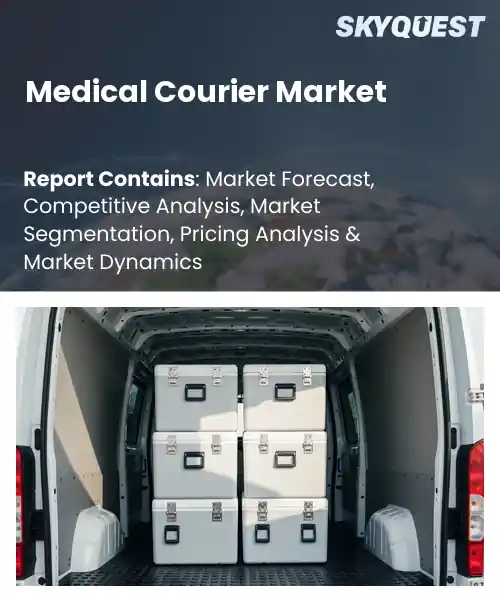
Medical Courier Market
Report ID: SQMIG35E2088
Report ID: SQMIG35E2088
[email protected]
USA +1 351-333-4748
Report ID:
SQMIG35E2088 |
Region:
Global |
Published Date: July, 2026
Pages:
157
|Tables:
178
|Figures:
79


Global Medical Courier Market size was valued at USD 7.2 Billion in 2024 and is poised to grow from USD 7.62 Billion in 2025 to USD 11.96 Billion by 2033, growing at a CAGR of 5.8% during the forecast period (2026-2033).
The medical courier market refers to the logistics service that provides delivery transportation of pharmaceuticals, biologics, diagnostic specimen, and medical devices that takes care of transportation under the control of the temperature and the time. The medical courier market is based on the growing necessity of temperature-controlled delivery of biologics and other medicines, since it has a direct effect on the treatment of patients, and also on compliance with regulations.
Over the years the medical courier market has turned from a small niche in terms of the delivery of vaccines to a big network supporting telemedicine, outpatient infusion centers, and clinical research. Since the appearance of COVID-19, the medical courier market began to develop as it became necessary to supply mRNA vaccines and other kits with the help of couriers who could preserve the temperature of such medicines. This resilience fuels demand throughout emerging markets where decentralized clinical trials and home‑infusion therapies are expanding, creating a critical feedback loop that encourages further strategic investment in advanced logistics ecosystems, which continues globally today.
How are IoT and AI Enhancing Temperature Monitoring In The Medical Courier Market?
IoT sensors set in temperature-controlled containers enable continuous monitoring of temperature, humidity and shocks and provide data transmission through cellular or LPWAN channels for processing by Cloud systems for anomaly detection, risk assessment and notification to the drivers and dispatchers. The availability of real-time platforms provides shippers opportunity to confirm compliance with temperature requirements and machine learning helps to use previous experience for optimizations of routes and packages.
The technology significantly reduces manual checks, minimizes risks of temperature excursions and enhances confidence in transportation of vaccines and other biological materials. As the demand expands for medical courier services, such technologies prove useful in the process of observing regulatory requirements.
Market snapshot - (2026-2033)
Global Market Size
USD 7.2 Billion
Largest Segment
Specimen Transport Services
Fastest Growth
Blood & Organ Transport Services
Growth Rate
5.8% CAGR
To get more insights on this market click here to Request a Free Sample Report
Global medical courier market is segmented by service type, transportation mode, delivery type, application, end user, temperature requirement and region. Based on service type, the market is segmented into Specimen Transport Services, Pharmaceutical Courier Services, Medical Equipment Courier Services, Blood & Organ Transport Services and Others. Based on transportation mode, the market is segmented into Road Transportation, Air Transportation, Rail Transportation and Others. Based on delivery type, the market is segmented into Same-Day Delivery, Scheduled Delivery and On-Demand/Emergency Delivery. Based on application, the market is segmented into Laboratory Specimen Transport, Pharmaceutical Distribution, Hospital Supply Logistics, Clinical Trial Logistics and Others. Based on end user, the market is segmented into Hospitals & Clinics, Diagnostic Laboratories, Pharmaceutical & Biotechnology Companies, Blood Banks & Organ Transplant Centers and Others. Based on temperature requirement, the market is segmented into Ambient Transport, Refrigerated Transport and Frozen Transport. Based on region, the market is segmented into North America, Europe, Asia Pacific, Latin America and Middle East & Africa.
The specimen transport services segment is the largest contributor because this is the backbone of the diagnostic process, providing transportation of biological specimens from the point of collection to laboratories while maintaining high standards concerning time and safety. The fact of the matter is supported by the huge amount of tests done on a daily basis, legally demanded chain-of-custody, and strong temperature management practices. Companies that have great routing and timely transfer practices account for a big part of the market share in this segment which ensures profits for all parties involved in the blood management process.
But now the segment of blood and organ transportation is experiencing the fastest growth in terms of development due to the fact that the processes of organ transplantation become more and more demanded and the logistics of transporting blood and organs should be faster than ever. The industry comes up with new solutions for the problem of transporting such important biological materials, including new tracking practices, special containers, and new regulations in the sphere.
The refrigerated transport segment is in the forefront because the majority of biologics, vaccines, and diagnostic agents require preservation under cold chain from two to eight degrees Celsius. The leadership results from the growing vaccination campaigns, increasing intricacies in vaccine distribution process, along with necessity to uphold strict temperature monitoring. The companies that have installed insulated containers and IOT devices are fulfilling the regulatory requirements and are able to deliver effective products with minimum failures, thereby increasing the market confidence and enabling them to advance their partnerships along the value chain.
At the same time, Frozen transportation segment subsequently becomes a major high‑growth segment as cell‑therapies, genetic products and cryopreserve forms of bio-products start becoming mainstream. The use of ultra-low temperature devices, regulatory advantages and greater interest by investors allows the sector to attain greater penetration and create new sources of revenues.
To get detailed segments analysis, Request a Free Sample Report
North America is considered to be the largest market for medical courier services worldwide because of its well-developed healthcare infrastructure, strict regulatory system and a high adoption of cutting-edge logistics technologies. The U.S. and Canada have a highly developed network of hospitals, research centers and specialized laboratories that require timely and safe deliveries of biological samples, medicines and temperature-sensitive supplies. Substantial investments in cold-chain logistics, use of integrated information management systems and experienced carriers ensure service reliability. The region also boasts reasonable reimbursement policies and compliance objectives for big multi-national companies as well as smaller companies. North America enjoys high funding for research that translates into increasing demand for fast deliveries of clinical trial materials and customized drugs. Continuous cooperation between logistics companies and important healthcare systems raises the standards of services.
The Medical courier Market in United States benefits from having a multitude of medical institutions and research facilities that generate large amounts of urgent specimens. Through value-based care programs, the healthcare industry is driven to optimize logistics and enhance response times. The use of digital tracking technology ensures that the shipments are monitored during transport, and specialized logistics service providers facilitate compliance with stringent regulations through effective temperature-controlled transportation.
The Medical Courier Market in Canada takes its advantage from having underlined the added value of safety and rapid diagnosis offered by their health system. Provinces of Canada emphasize integrated logistics solutions in healthcare resulting in collaboration of hospitals with the couriers. In turn, having invested in the cold chain technology ensures the high reliability of the shipments containing different kinds of biologics or materials related to clinical trials.
The rapid expansion of the medical courier market across Europe is fueled by a combination of regulatory convergence, increasing demand for cross‑border clinical trials, and heightened emphasis on patient‑centric care. Harmonized standards for the transport of temperature‑sensitive drugs streamline operations for carriers serving multiple jurisdictions. A vibrant biotech ecosystem in key economies generates steady volumes of biologics, vaccines, and personalized medicines that require reliable, time‑critical delivery. Health systems are investing in integrated logistics platforms that combine real‑time tracking with advanced cold‑chain technology, while sustainability mandates encourage the adoption of greener transport solutions. Collaborative networks among hospitals, research institutions, and specialized logistics providers further enhance service quality and broaden market reach, positioning Europe as a dynamic hub for innovative medical courier services.
Medical Courier Market in Germany is emerging as a segment driven by increasing adoption of personalized medicine and a growing network of specialty pharmacies. Health policies encourage logistics for biologics, prompting carriers to invest in temperature‑controlled fleets and traceability platforms. Collaboration between academic hospitals and biotech firms generates demand for shipment of clinical trial materials. These factors collectively nurture Germany’s emergence as an important contributor to Europe’s medical courier ecosystem.
Medical Courier Market in the United Kingdom is experiencing accelerated growth due to strong partnerships that prioritize delivery of diagnostic samples and therapies. The NHS focus on integration drives demand for real‑time tracking and reliable cold‑chain services. A dense network of research universities and biotech clusters supplies a flow of time‑sensitive shipments. These dynamics, combined with regulatory support for logistics, position the United Kingdom as the fastest‑growing market in Europe.
Medical Courier Market in France is emerging as a segment driven by increasing adoption of personalized medicine and a growing network of specialty pharmacies. Health policies encourage logistics for biologics, prompting carriers to invest in temperature‑controlled fleets and traceability platforms. Collaboration between academic hospitals and biotech firms generates demand for shipment of clinical trial materials. These factors collectively nurture France’s emergence as an important contributor to Europe’s medical courier ecosystem.
The Asia Pacific region is solidifying its role in the medical courier arena through a blend of technological adoption, expanding healthcare networks, and increasing focus on temperature‑sensitive therapeutics. Countries such as Japan and South Korea are investing heavily in cold‑chain infrastructure to support the rising demand for biologics, cell therapies, and rapid diagnostic services. Digital platforms that enable real‑time monitoring and predictive analytics are being integrated into logistics operations, enhancing reliability and compliance. Government initiatives aimed at streamlining regulatory pathways for medical shipments further accelerate market development. Coupled with a growing emphasis on export of innovative healthcare solutions, these dynamics position Asia Pacific as an emerging hub of sophisticated, high‑value medical courier services. The synergy between advanced logistics and expanding clinical research activity reinforces the region’s capability to meet global demand for fast, secure medical transport.
Medical Courier Market in Japan is driven by a healthcare system and adoption of precision medicine, which creates demand for temperature‑controlled logistics. Regulatory standards mandate handling of biologics and diagnostic samples, prompting carriers to adopt cold‑chain technologies. Integration of tracking enhances visibility and compliance across the supply chain. Initiatives between hospitals, pharmaceutical firms, and logistics providers streamline operations, positioning Japan as a leading market for medical courier services in the region.
Medical Courier Market in South Korea is driven by biotech growth and a focus on rapid diagnostic turnaround, increasing demand for temperature‑controlled transport. Government policies support cold‑chain networks and digital tracking, ensuring compliance with health standards. Partnerships between hospitals, pharmaceutical companies, and logistics firms enable seamless handling of biologics and clinical trial specimens. These efforts position South Korea as an influential global player in the Asia Pacific medical courier landscape.
To know more about the market opportunities by region and country, click here to
Buy The Complete Report
Increasing Demand For Time‑Sensitive Deliveries
Adoption Of Advanced Tracking Technologies
Stringent Regulatory Compliance Requirements
High Cost Of Specialized Infrastructure
Request Free Customization of this report to help us to meet your business objectives.
The market is shaped by intense rivalry among logistics giants and niche couriers, with same‑day delivery demand driving competitive moves; FedEx HealthCare Solutions acquired a regional cold‑chain provider to broaden its network, UPS Healthcare partnered with a biotech firm to integrate temperature‑monitoring IoT, and DHL Supply Chain Healthcare launched an AI‑driven routing platform to cut transit times, illustrating how M&A, strategic alliances and technology upgrades are directly targeting service speed and compliance.
SkyQuest’s ABIRAW (Advanced Business Intelligence, Research & Analysis Wing) is our Business Information Services team that Collects, Collates, Correlates, and Analyses the Data collected by means of Primary Exploratory Research backed by robust Secondary Desk research.
As per SkyQuest analysis the global medical courier market is being propelled primarily by the rising demand for time‑sensitive, temperature‑controlled deliveries of biologics and diagnostic specimens, while a second major catalyst is the rapid adoption of AI‑driven route optimization and IoT‑enabled cold‑chain monitoring that boost reliability and reduce spoilage. The specimen transport services segment remains the clear leader because it underpins daily diagnostic workflows. North America dominates the market due to its mature healthcare infrastructure and strong investment in advanced logistics platforms. However, stringent regulatory compliance requirements act as a restraint, increasing operational complexity and cost for carriers seeking to expand.
| Report Metric | Details |
|---|---|
| Market size value in 2024 | USD 7.2 Billion |
| Market size value in 2033 | USD 11.96 Billion |
| Growth Rate | 5.8% |
| Base year | 2024 |
| Forecast period | (2026-2033) |
| Forecast Unit (Value) | USD Billion |
| Segments covered |
|
| Regions covered | North America (US, Canada), Europe (Germany, France, United Kingdom, Italy, Spain, Rest of Europe), Asia Pacific (China, India, Japan, Rest of Asia-Pacific), Latin America (Brazil, Rest of Latin America), Middle East & Africa (South Africa, GCC Countries, Rest of MEA) |
| Companies covered |
|
| Customization scope | Free report customization with purchase. Customization includes:-
|
To get a free trial access to our platform which is a one stop solution for all your data requirements for quicker decision making. This platform allows you to compare markets, competitors who are prominent in the market, and mega trends that are influencing the dynamics in the market. Also, get access to detailed SkyQuest exclusive matrix.
Table Of Content
Executive Summary
Market overview
Parent Market Analysis
Market overview
Market size
KEY MARKET INSIGHTS
COVID IMPACT
MARKET DYNAMICS & OUTLOOK
Market Size by Region
KEY COMPANY PROFILES
Methodology
For the Medical Courier Market, our research methodology involved a mixture of primary and secondary data sources. Key steps involved in the research process are listed below:
1. Information Procurement: This stage involved the procurement of Market data or related information via primary and secondary sources. The various secondary sources used included various company websites, annual reports, trade databases, and paid databases such as Hoover's, Bloomberg Business, Factiva, and Avention. Our team did 45 primary interactions Globally which included several stakeholders such as manufacturers, customers, key opinion leaders, etc. Overall, information procurement was one of the most extensive stages in our research process.
2. Information Analysis: This step involved triangulation of data through bottom-up and top-down approaches to estimate and validate the total size and future estimate of the Medical Courier Market.
3. Report Formulation: The final step entailed the placement of data points in appropriate Market spaces in an attempt to deduce viable conclusions.
4. Validation & Publishing: Validation is the most important step in the process. Validation & re-validation via an intricately designed process helped us finalize data points to be used for final calculations. The final Market estimates and forecasts were then aligned and sent to our panel of industry experts for validation of data. Once the validation was done the report was sent to our Quality Assurance team to ensure adherence to style guides, consistency & design.
Analyst Support
Customization Options
With the given market data, our dedicated team of analysts can offer you the following customization options are available for the Medical Courier Market:
Product Analysis: Product matrix, which offers a detailed comparison of the product portfolio of companies.
Regional Analysis: Further analysis of the Medical Courier Market for additional countries.
Competitive Analysis: Detailed analysis and profiling of additional Market players & comparative analysis of competitive products.
Go to Market Strategy: Find the high-growth channels to invest your marketing efforts and increase your customer base.
Innovation Mapping: Identify racial solutions and innovation, connected to deep ecosystems of innovators, start-ups, academics, and strategic partners.
Category Intelligence: Customized intelligence that is relevant to their supply Markets will enable them to make smarter sourcing decisions and improve their category management.
Public Company Transcript Analysis: To improve the investment performance by generating new alpha and making better-informed decisions.
Social Media Listening: To analyze the conversations and trends happening not just around your brand, but around your industry as a whole, and use those insights to make better Marketing decisions.
REQUEST FOR SAMPLE
 REQUEST FREE CUSTOMIZATION
Global Medical Courier Market size was valued at USD 7.2 Billion in 2024 and is poised to grow from USD 7.62 Billion in 2025 to USD 11.96 Billion by 2033, growing at a CAGR of 5.8% during the forecast period (2026-2033).
The market is shaped by intense rivalry among logistics giants and niche couriers, with same‑day delivery demand driving competitive moves; FedEx HealthCare Solutions acquired a regional cold‑chain provider to broaden its network, UPS Healthcare partnered with a biotech firm to integrate temperature‑monitoring IoT, and DHL Supply Chain Healthcare launched an AI‑driven routing platform to cut transit times, illustrating how M&A, strategic alliances and technology upgrades are directly targeting service speed and compliance. 'Cencora, Inc.', 'UPS, Inc.', 'FedEx Corporation', 'DHL Group', 'Marken', 'Cryoport, Inc.', 'Kuehne+Nagel International AG', 'CEVA Logistics', 'MNX Global Logistics', 'Biocair International Ltd.', 'Medical Couriers Inc.', 'Dropoff, Inc.', 'American Expediting Company', 'Lab Logistics Group GmbH', 'Medical Messenger Service', 'MedSpeed LLC', 'Quick International Courier', 'Air Charter Service Ltd.', 'Zipline International Inc.', 'Quick Specialized Healthcare Logistics'
The rise in demand for rapid, temperature‑controlled transport of biologics, vaccines, and diagnostic specimens drives market expansion. Healthcare providers and pharmaceutical firms require reliable courier services to maintain product integrity and meet clinical timelines. This necessity encourages service providers to enhance logistics networks, invest in specialized vehicles, and develop cold‑chain expertise. Consequently, the heightened expectation for swift, dependable delivery strengthens client relationships and prompts broader adoption of dedicated medical courier solutions across hospitals, research institutions, and patient care global settings.
Ai‑Driven Route Optimization: Healthcare providers and pharmaceutical firms are increasingly relying on AI‑driven platforms to orchestrate same‑day and time‑critical deliveries. These systems analyze traffic patterns, weather forecasts, and patient appointment schedules to generate optimal routes that minimize transit time while preserving specimen integrity. By continuously learning from historical performance, the technology reduces driver idle time, improves fuel efficiency, and enhances predictability for end‑users. As a result, logistics partners that embed advanced analytics into their operations gain a competitive edge and attract higher‑value contracts.
Why does North America Dominate the Global Medical Courier Market? |@12


Want to customize this report? This report can be personalized according to your needs. Our analysts and industry experts will work directly with you to understand your requirements and provide you with customized data in a short amount of time. We offer $1000 worth of FREE customization at the time of purchase.
Feedback From Our Clients


 USA (+1) 351-333-4748

