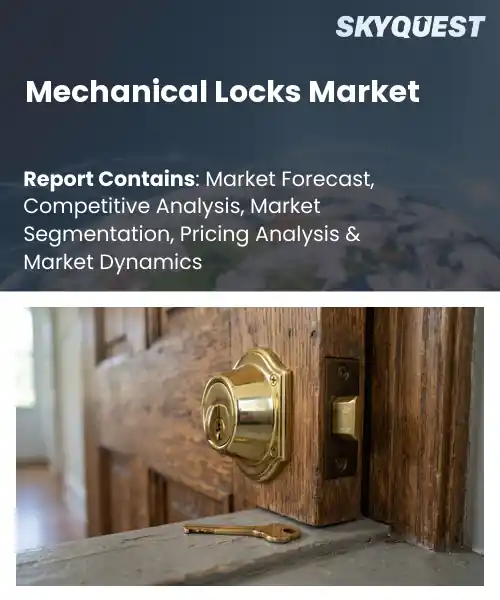
Mechanical Locks Market
Report ID: SQMIG20B2317
Report ID: SQMIG20B2317
[email protected]
USA +1 351-333-4748
Report ID:
SQMIG20B2317 |
Region:
Global |
Published Date: August, 2026
Pages:
157
|Tables:
147
|Figures:
78


Global Mechanical Locks Market size was valued at USD 12.46 Billion in 2024 and is poised to grow from USD 13.2 Billion in 2025 to USD 20.88 Billion by 2033, growing at a CAGR of 5.9% during the forecast period (2026-2033).
The global mechanical locks market comprises devices such as deadbolts, padlocks, cam locks and cylinders that protect residential, commercial and automotive assets without relying on electricity. Its significance stems from the enduring need for barriers in regions where power infrastructure is unreliable or cyber‑threats undermine electronic solutions. Historically, the sector evolved from rudimentary warded mechanisms of the 19th century to pin‑tumbler and disc‑detainer designs that meet ISO‑standard resistance levels. For instance, European manufacturers introduced anti‑pick cylinders in the early 2000s, prompting adoption across office buildings. This progression illustrates how escalating safety expectations have continuously reshaped product complexity and market size. Building on the heightened safety expectations described earlier, the principal growth catalyst for the mechanical locks market is the expanding demand for security solutions that combine robustness with integration. As enterprises adopt platforms, they require mechanical locks that can be monitored yet remain functional during power outages, prompting manufacturers to embed RFID readers and Bluetooth modules into lock bodies. This convergence has opened lucrative contracts in data‑center facilities, where compliance standards mandate mechanical devices alongside access control. Consequently, suppliers that invest in modular designs and certification for standards capture a share of a market projected to exceed $12 billion by 2028.
How is AI-driven automation impacting the mechanical locks market?
AI‑driven automation is reshaping the mechanical locks market by embedding intelligence into design, manufacturing and after‑sales processes. Smart sensors now monitor wear and signal when components need replacement, reducing downtime and extending product life. Production lines use machine‑learning algorithms to optimise assembly sequences, cutting waste and accelerating time‑to‑market. Vendors are pairing traditional metal hardware with connected software, creating hybrid solutions that retain the reliability of mechanical locks while offering remote access and data analytics. This blend of physical durability and digital insight is attracting new customers in commercial and residential sectors, reinforcing demand for advanced lock systems that can adapt to evolving security needs.In February 2022, a leading lock manufacturer introduced an AI‑enabled production line, streamlining assembly and boosting overall efficiency, which supports continued market growth.
Market snapshot - (2026-2033)
Global Market Size
USD 12.46 Billion
Largest Segment
Cylinder Locks
Fastest Growth
Padlocks
Growth Rate
5.9% CAGR
To get more insights on this market click here to Request a Free Sample Report
Global mechanical locks market is segmented by lock type, material, application, security level, distribution channel and region. Based on lock type, the market is segmented into Padlocks, Deadbolts, Mortise Locks, Cylinder Locks and Lever Locks. Based on material, the market is segmented into Stainless Steel, Brass, Zinc Alloy and Aluminum. Based on application, the market is segmented into Residential, Commercial and Industrial. Based on security level, the market is segmented into Basic Security, Medium Security and High Security. Based on distribution channel, the market is segmented into Hardware Stores, Specialty Stores and Online Retail. Based on region, the market is segmented into North America, Europe, Asia Pacific, Latin America and Middle East & Africa.
Padlocks segment dominates because they offer portable security, ease of installation, and cost‑effectiveness, making them preferred for a wide range of residential and temporary applications. Their straightforward design aligns with DIY trends, and manufacturers can produce them at scale, reinforcing market presence. The combination of convenience and affordability drives sustained demand across user groups. Additionally, the low maintenance requirements and compatibility with a variety of keying systems enhance their appeal to both consumers and small businesses.
However, deadbolts segment is witnessing the strongest growth momentum because rising consumer focus on permanent home security, integration with smart lock technologies, and heightened building code requirements boost adoption. Their robust construction and ability to provide higher resistance to forced entry position them as a key growth engine in the market.
Brass segment leads because its corrosion resistance and aesthetic appeal make it ideal for high traffic lock components especially in commercial environments. The alloy’s inherent malleability facilitates precision machining, allowing manufacturers to achieve tighter tolerances and longer service life. These attributes reinforce its preference among specifiers seeking reliable, long lasting locking solutions. Furthermore, the material’s natural antimicrobial properties contribute to hygiene considerations in settings such as healthcare facilities, broadening its applicability and strengthening market demand.
On the other hand, aluminum segment is emerging as the fastest expanding area because its lightweight nature and adaptability to modern manufacturing processes enable cost effective, high volume production of lock housings. Growing emphasis on sustainable materials and the demand for corrosion free solutions in outdoor installations accelerate its uptake, positioning aluminum as a catalyst for future market growth.
To get detailed segments analysis, Request a Free Sample Report
The region leverages an expansive manufacturing ecosystem that combines deep engineering expertise with cost‑efficient production capabilities. Strong demand from rapidly urbanizing economies fuels continuous upgrades to residential, commercial, and industrial security solutions. Integration of mechanical components with emerging smart technologies is supported by robust research institutions and a culture of innovation that prioritizes reliability and durability. Additionally, well‑established supply chains and strategic trade relationships enable swift distribution across global markets, reinforcing the region’s leadership position.
Mechanical Locks Market in Japan benefits from a longstanding tradition of precision engineering and a regulatory environment that emphasizes safety and quality. Consumer preferences lean toward high‑performance, durable products, driving manufacturers to focus on advanced material usage and meticulous craftsmanship. Collaboration between lock makers and security technology firms enhances product portfolios, while a strong construction sector sustains steady demand for both new installations and retrofits.
Mechanical Locks Market in South Korea is propelled by a dynamic industrial base that prioritizes innovation and rapid product development. Emphasis on integrating mechanical reliability with electronic enhancements creates a unique value proposition for both domestic and export markets. Government incentives for advanced manufacturing and a keen focus on export competitiveness support growth, while rising awareness of security needs across residential and commercial segments sustains robust demand.
Europe’s expansion is anchored in stringent security regulations that encourage the adoption of high‑quality mechanical solutions. A mature construction landscape, coupled with extensive renovation activity, fuels ongoing replacement cycles and upgrades. The region’s reputation for engineering excellence and design sophistication attracts premium‑segment consumers seeking reliable, aesthetically refined locks. Collaborative ecosystems linking lock manufacturers with architects and safety consultants promote continuous product refinement, while sustainability considerations drive the development of environmentally responsible materials and processes.
Mechanical Locks Market in Germany is characterized by a strong focus on engineering precision and durability, reflecting the country’s broader industrial heritage. Demand is driven by a balanced mix of new construction projects and systematic upgrading of existing facilities. Manufacturers emphasize rigorous testing and compliance with European safety standards, positioning German‑made locks as benchmarks for performance and reliability across the continent.
Mechanical Locks Market in the United Kingdom experiences accelerated growth as property developers and homeowners prioritize enhanced security amidst evolving safety expectations. The market benefits from a vibrant network of specialized manufacturers that blend traditional craftsmanship with modern design. Increased emphasis on retrofit solutions for historic buildings and the integration of mechanical locks into smart home ecosystems further stimulate demand across residential and commercial sectors.
Mechanical Locks Market in France is emerging as a notable segment, supported by growing awareness of security benefits in both urban and rural settings. Local manufacturers focus on blending aesthetic appeal with functional robustness, catering to a consumer base that values style alongside protection. Collaborative initiatives with design institutes and adherence to European regulatory frameworks help elevate the market’s credibility and attract new adopters.
North America builds its position through a combination of extensive construction activity and a pervasive culture of security awareness. The market benefits from advanced manufacturing capabilities that prioritize durability and ease of installation, aligning with the preferences of both professional installers and DIY consumers. Strong partnerships between lock producers and technology firms facilitate the seamless integration of mechanical solutions with broader security ecosystems. Additionally, regulatory frameworks that stress building safety and consumer protection encourage continual product enhancements and market penetration.
Mechanical Locks Market in the United States is driven by a large and diversified construction sector that demands reliable, cost‑effective security solutions. Manufacturers focus on delivering a wide array of product options that address varying residential, commercial, and industrial needs. Emphasis on compliance with stringent safety standards and active engagement with distribution networks ensures broad market reach and sustained adoption across multiple building typologies.
Mechanical Locks Market in Canada reflects a balanced approach that values both performance and adaptability to diverse climatic conditions. Industry players concentrate on producing locks that withstand harsh weather while maintaining operational integrity. Collaboration with security service providers and an emphasis on meeting national building codes reinforce confidence among consumers and professionals, supporting steady market growth.
To know more about the market opportunities by region and country, click here to
Buy The Complete Report
Increased Security Awareness
Adoption Of Smart Home Integration
High Manufacturing Cost
Regulatory Compliance Challenges
Request Free Customization of this report to help us to meet your business objectives.
The mechanical locks market is shaped by intense rivalry as legacy manufacturers defend market share while new entrants leverage digital integration. Companies are accelerating M&A to acquire patented lock mechanisms, forming partnerships with security system integrators to broaden solution portfolios, and investing in smart‑compatible hardware to differentiate product lines and meet rising demand for integrated access control.
Top Player’s Company Profile
Recent Developments
SkyQuest’s ABIRAW (Advanced Business Intelligence, Research & Analysis Wing) is our Business Information Services team that Collects, Collates, Correlates, and Analyses the Data collected by means of Primary Exploratory Research backed by robust Secondary Desk research. As per SkyQuest analysis the global mechanical locks market is expected to rise to $20.9 billion by 2033 driven primarily by rising security awareness that pushes consumers and businesses to choose robust, non‑electronic protection, while the integration of mechanical locks into smart‑home ecosystems adds a second catalyst by offering remote access and convenience. High manufacturing cost acts as a restraint limiting price‑sensitive adoption. Asia Pacific leads the market thanks to its large manufacturing base and rapid urbanisation, and padlocks remain the dominant segment because of their portability, ease of installation and cost‑effectiveness. These dynamics together shape a steady growth trajectory for the industry.
| Report Metric | Details |
|---|---|
| Market size value in 2024 | USD 12.46 Billion |
| Market size value in 2033 | USD 20.88 Billion |
| Growth Rate | 5.9% |
| Base year | 2024 |
| Forecast period | (2026-2033) |
| Forecast Unit (Value) | USD Billion |
| Segments covered |
|
| Regions covered | North America (US, Canada), Europe (Germany, France, United Kingdom, Italy, Spain, Rest of Europe), Asia Pacific (China, India, Japan, Rest of Asia-Pacific), Latin America (Brazil, Rest of Latin America), Middle East & Africa (South Africa, GCC Countries, Rest of MEA) |
| Companies covered |
|
| Customization scope | Free report customization with purchase. Customization includes:-
|
To get a free trial access to our platform which is a one stop solution for all your data requirements for quicker decision making. This platform allows you to compare markets, competitors who are prominent in the market, and mega trends that are influencing the dynamics in the market. Also, get access to detailed SkyQuest exclusive matrix.
Table Of Content
Executive Summary
Market overview
Parent Market Analysis
Market overview
Market size
KEY MARKET INSIGHTS
COVID IMPACT
MARKET DYNAMICS & OUTLOOK
Market Size by Region
KEY COMPANY PROFILES
Methodology
For the Mechanical Locks Market, our research methodology involved a mixture of primary and secondary data sources. Key steps involved in the research process are listed below:
1. Information Procurement: This stage involved the procurement of Market data or related information via primary and secondary sources. The various secondary sources used included various company websites, annual reports, trade databases, and paid databases such as Hoover's, Bloomberg Business, Factiva, and Avention. Our team did 45 primary interactions Globally which included several stakeholders such as manufacturers, customers, key opinion leaders, etc. Overall, information procurement was one of the most extensive stages in our research process.
2. Information Analysis: This step involved triangulation of data through bottom-up and top-down approaches to estimate and validate the total size and future estimate of the Mechanical Locks Market.
3. Report Formulation: The final step entailed the placement of data points in appropriate Market spaces in an attempt to deduce viable conclusions.
4. Validation & Publishing: Validation is the most important step in the process. Validation & re-validation via an intricately designed process helped us finalize data points to be used for final calculations. The final Market estimates and forecasts were then aligned and sent to our panel of industry experts for validation of data. Once the validation was done the report was sent to our Quality Assurance team to ensure adherence to style guides, consistency & design.
Analyst Support
Customization Options
With the given market data, our dedicated team of analysts can offer you the following customization options are available for the Mechanical Locks Market:
Product Analysis: Product matrix, which offers a detailed comparison of the product portfolio of companies.
Regional Analysis: Further analysis of the Mechanical Locks Market for additional countries.
Competitive Analysis: Detailed analysis and profiling of additional Market players & comparative analysis of competitive products.
Go to Market Strategy: Find the high-growth channels to invest your marketing efforts and increase your customer base.
Innovation Mapping: Identify racial solutions and innovation, connected to deep ecosystems of innovators, start-ups, academics, and strategic partners.
Category Intelligence: Customized intelligence that is relevant to their supply Markets will enable them to make smarter sourcing decisions and improve their category management.
Public Company Transcript Analysis: To improve the investment performance by generating new alpha and making better-informed decisions.
Social Media Listening: To analyze the conversations and trends happening not just around your brand, but around your industry as a whole, and use those insights to make better Marketing decisions.
REQUEST FOR SAMPLE
 REQUEST FREE CUSTOMIZATION


Want to customize this report? This report can be personalized according to your needs. Our analysts and industry experts will work directly with you to understand your requirements and provide you with customized data in a short amount of time. We offer $1000 worth of FREE customization at the time of purchase.
Feedback From Our Clients


 USA (+1) 351-333-4748

