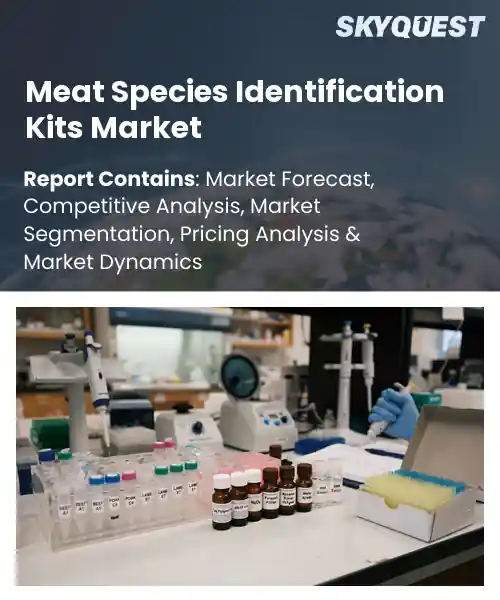
Meat Species Identification Kits Market
Report ID: SQMIG35J2833
Report ID: SQMIG35J2833
[email protected]
USA +1 351-333-4748
Report ID:
SQMIG35J2833 |
Region:
Global |
Published Date: September, 2026
Pages:
157
|Tables:
124
|Figures:
77


Global Meat Species Identification Kits Market size was valued at USD 290.0 Million in 2024 and is poised to grow from USD 310.88 Million in 2025 to USD 542.19 Million by 2033, growing at a CAGR of 7.2% during the forecast period (2026-2033).
Regulatory harmonization across jurisdictions serves as a catalyst propelling market expansion, because standards compel companies to adopt validated identification kits in their sourcing networks. For instance, the European Union’s 2022 amendment to Regulation (EC) No 178/2002 mandates species confirmation for processed meats, prompting poultry processors in Brazil to integrate portable PCR devices to satisfy import requirements. This compliance pressure fuels demand for multiplex kits detecting multiple species simultaneously, thereby opening avenues for suppliers to offer SaaS‑based data management solutions that streamline audit trails. Consequently, investment in preparation and analytics is expected to rise, unlocking revenue streams while enhancing traceability for consumers.
How is AI enhancing accuracy and speed in the meat species identification kits market?
AI is reshaping meat species identification kits by turning raw data into actionable results faster and more reliably. Modern kits combine PCR or isothermal amplification with machine learning models that interpret melt curves, fluorescence patterns or spectral signatures. The algorithms learn from large reference libraries, reducing misidentification and eliminating the need for expert review. As food fraud concerns grow, producers and regulators seek tools that deliver results on site within minutes. AI driven platforms now pair handheld devices with cloud based analytics, allowing real time verification and seamless integration into supply chain workflows.Thermo Fisher Scientific March 2024, introduced an AI enabled DNA barcoding kit that delivers species results in minutes and reduces manual interpretation, boosting laboratory throughput and supporting tighter compliance across the meat supply chain. The system integrates cloud analytics that improve detection models as samples are processed, boosting confidence for producers and regulators.
Market snapshot - (2026-2033)
Global Market Size
USD 290.0 Million
Largest Segment
PCR-Based Kits
Fastest Growth
DNA Barcoding Kits
Growth Rate
7.2% CAGR
To get more insights on this market click here to Request a Free Sample Report
Global meat species identification kits market is segmented by technology, meat species, application, end user and region. Based on technology, the market is segmented into PCR-Based Kits, Real-Time PCR Kits, DNA Barcoding Kits and Other Technologies. Based on meat species, the market is segmented into Beef, Pork, Poultry, Sheep & Goat, Horse and Other Meat Species. Based on application, the market is segmented into Meat Authentication, Adulteration Detection, Food Traceability, Regulatory Testing and Other Applications. Based on end user, the market is segmented into Food Testing Laboratories, Meat Processors, Government & Regulatory Agencies and Research Institutes. Based on region, the market is segmented into North America, Europe, Asia Pacific, Latin America and Middle East & Africa.
PCR‑Based Kits segment dominates because it offers a proven, straightforward workflow that aligns with existing laboratory infrastructure, enabling rapid amplification of target DNA with minimal technical complexity. Its reliability and ease of interpretation have built strong trust among users, driving widespread adoption across routine testing. The low cost of reagents and compatibility with standard thermal cyclers further reinforce its leading position, making it the go‑to solution for most meat species verification needs.
However, DNA Barcoding Kits segment emerges as the fastest growing because it leverages high‑throughput sequencing to differentiate even closely related species, meeting rising demand for precise multi‑species profiling. Continuous improvements in library preparation and decreasing sequencing costs are accelerating adoption, opening new avenues for comprehensive authenticity and traceability programs.
Meat Authentication segment leads because it directly tackles consumer concerns about fraud, offering a tangible method for brands to verify label claims and sustain trust. Ongoing regulatory scrutiny and retailer requirements intensify demand, prompting manufacturers to produce kits that deliver rapid, on‑site results with user‑friendly protocols. This focus on authenticating origin creates recurring revenue streams and fuels continuous product refinement, anchoring the market’s core growth trajectory.
Meanwhile, Food Traceability segment experiences the strongest growth because transparency initiatives push adoption of kits linking species data to provenance records. Integration with digital tracking platforms and heightened stakeholder expectations for end‑to‑end visibility accelerate investment, making traceability solutions essential for risk management and brand protection, thereby widening the market’s addressable space.
To get detailed segments analysis, Request a Free Sample Report
The region benefits from a highly regulated food safety environment that encourages rigorous verification of meat origins. Strong collaboration between government agencies, academic laboratories, and private innovators drives continuous improvement of detection technologies. The presence of leading biotech firms and well‑funded research institutions fuels rapid product development and validation. A mature distribution network and extensive testing infrastructure enable swift deployment across diverse supply chains. Consumer awareness of authenticity and traceability further fuels demand, reinforcing market leadership. Together, these factors create a robust ecosystem that sustains dominance in the global arena.
Meat Species Identification Kits Market in the United States is propelled by sophisticated laboratory capabilities and a proactive regulatory stance that emphasizes authenticity. Industry partnerships with leading research universities accelerate innovation, while a broad base of food processors adopts advanced testing to meet stringent import requirements. The market benefits from an entrenched culture of scientific excellence, ensuring that new kits are quickly validated and integrated into quality assurance programs across the supply chain.
Meat Species Identification Kits Market in Canada thrives on strong governmental commitment to food integrity and a collaborative research community focused on analytical solutions. Provincial agencies work closely with private laboratories to implement cutting‑edge testing protocols, enhancing confidence in domestic and imported products. Emphasis on consumer protection and alignment with international standards drives adoption among meat processors, fostering a resilient market that supports both large‑scale operations and niche producers.
Europe’s expansion is fueled by a stringent regulatory landscape that mandates thorough verification of meat species throughout the supply chain. Harmonized standards across member states create a unified market, encouraging manufacturers to develop interoperable solutions. Growing consumer demand for transparency and ethical sourcing intensifies pressure on retailers to adopt robust testing. Collaborative research initiatives among leading universities and biotech clusters accelerate innovation, while robust funding mechanisms support the translation of scientific breakthroughs into commercial kits. The combination of regulatory pressure, consumer expectations, and strong innovation ecosystems propels rapid growth across the continent.
Meat Species Identification Kits Market in Germany is anchored by a dense network of research institutes that specialize in molecular diagnostics. Close cooperation between regulatory bodies and industry ensures that testing methods align with rigorous national standards. German meat processors prioritize high‑confidence verification to maintain export credibility, driving widespread adoption of sophisticated kits. The market benefits from a culture of precision engineering, which translates into reliable and scalable testing solutions for both large and artisanal producers.
Meat Species Identification Kits Market in the United Kingdom is experiencing swift momentum due to heightened emphasis on food fraud prevention and evolving post‑brexit trade requirements. Academic collaborations with start‑up innovators accelerate the introduction of rapid, user‑friendly detection platforms. Retail chains increasingly demand traceability assurances, prompting widespread integration of kits into quality control routines. The market’s agility is reinforced by a supportive policy environment that encourages investment in advanced analytical capabilities.
Meat Species Identification Kits Market in France is emerging as a dynamic segment supported by a strong tradition of culinary authenticity and rigorous food safety oversight. Collaborative projects between national research agencies and biotech firms focus on developing sensitive assays tailored to diverse product ranges. French producers, especially in the premium and specialty sectors, adopt testing to safeguard brand reputation and meet consumer expectations for provenance. This nurturing environment positions the market for sustained expansion.
Asia Pacific advances its position through a blend of rapid technological adoption and growing awareness of food authenticity across diverse economies. Regional collaborations between governmental food safety agencies and emerging biotech companies foster the development of cost‑effective, high‑throughput testing solutions. Expanding export‑oriented meat industries seek reliable verification tools to meet stringent international requirements, driving demand for sophisticated kits. Additionally, increased consumer concern about mislabeled products spurs retailers to integrate testing into supply chain monitoring. The confluence of supportive policy frameworks, innovative research hubs, and market readiness accelerates the region’s ascent in the global landscape.
Meat Species Identification Kits Market in Japan is shaped by a meticulous approach to food quality and a strong emphasis on scientific precision. Governmental food safety programs collaborate with leading universities to refine molecular identification techniques, ensuring high reliability. Japanese processors, particularly in the premium segment, incorporate advanced kits to uphold stringent brand standards and secure consumer trust. The market benefits from a culture that values detailed analytical validation, supporting widespread implementation across the industry.
Meat Species Identification Kits Market in South Korea is propelled by aggressive investment in biotech research and a proactive regulatory environment that prioritizes traceability. Partnerships between national laboratories and private innovators yield rapid, portable testing platforms suited to diverse supply chain needs. Korean meat manufacturers adopt these solutions to enhance export competitiveness and address rising consumer demand for transparent labeling. The market’s growth is reinforced by a forward‑looking policy climate that encourages continuous improvement in food authentication practices.
To know more about the market opportunities by region and country, click here to
Buy The Complete Report
Increasing Food Safety Regulations
Rising Demand For Authentic Products
High Cost Of Specialized Kits
Limited Technical Expertise In Labs
Request Free Customization of this report to help us to meet your business objectives.
Top Player’s Company Profile
Recent Developments
SkyQuest’s ABIRAW (Advanced Business Intelligence, Research & Analysis Wing) is our Business Information Services team that Collects, Collates, Correlates, and Analyses the Data collected by means of Primary Exploratory Research backed by robust Secondary Desk research. As per SkyQuest analysis, the market is being propelled primarily by tightening food‑safety regulations that compel producers and labs to adopt reliable species‑identification kits, while a growing consumer appetite for authentic meat adds a second boost by driving brands to verify label claims. The PCR‑Based kits segment remains the dominant technology thanks to its simplicity and low‑cost reagents, and North America leads the market thanks to its stringent regulatory framework and advanced testing infrastructure. However, the high cost of specialized kits limits adoption among smaller processors and laboratories, creating a notable restraint on broader market penetration. This dynamic is expected to sustain steady growth through 2033.
| Report Metric | Details |
|---|---|
| Market size value in 2024 | USD 290.0 Million |
| Market size value in 2033 | USD 542.19 Million |
| Growth Rate | 7.2% |
| Base year | 2024 |
| Forecast period | (2026-2033) |
| Forecast Unit (Value) | USD Million |
| Segments covered |
|
| Regions covered | North America (US, Canada), Europe (Germany, France, United Kingdom, Italy, Spain, Rest of Europe), Asia Pacific (China, India, Japan, Rest of Asia-Pacific), Latin America (Brazil, Rest of Latin America), Middle East & Africa (South Africa, GCC Countries, Rest of MEA) |
| Companies covered |
|
| Customization scope | Free report customization with purchase. Customization includes:-
|
To get a free trial access to our platform which is a one stop solution for all your data requirements for quicker decision making. This platform allows you to compare markets, competitors who are prominent in the market, and mega trends that are influencing the dynamics in the market. Also, get access to detailed SkyQuest exclusive matrix.
Table Of Content
Executive Summary
Market overview
Parent Market Analysis
Market overview
Market size
KEY MARKET INSIGHTS
COVID IMPACT
MARKET DYNAMICS & OUTLOOK
Market Size by Region
KEY COMPANY PROFILES
Methodology
For the Meat Species Identification Kits Market, our research methodology involved a mixture of primary and secondary data sources. Key steps involved in the research process are listed below:
1. Information Procurement: This stage involved the procurement of Market data or related information via primary and secondary sources. The various secondary sources used included various company websites, annual reports, trade databases, and paid databases such as Hoover's, Bloomberg Business, Factiva, and Avention. Our team did 45 primary interactions Globally which included several stakeholders such as manufacturers, customers, key opinion leaders, etc. Overall, information procurement was one of the most extensive stages in our research process.
2. Information Analysis: This step involved triangulation of data through bottom-up and top-down approaches to estimate and validate the total size and future estimate of the Meat Species Identification Kits Market.
3. Report Formulation: The final step entailed the placement of data points in appropriate Market spaces in an attempt to deduce viable conclusions.
4. Validation & Publishing: Validation is the most important step in the process. Validation & re-validation via an intricately designed process helped us finalize data points to be used for final calculations. The final Market estimates and forecasts were then aligned and sent to our panel of industry experts for validation of data. Once the validation was done the report was sent to our Quality Assurance team to ensure adherence to style guides, consistency & design.
Analyst Support
Customization Options
With the given market data, our dedicated team of analysts can offer you the following customization options are available for the Meat Species Identification Kits Market:
Product Analysis: Product matrix, which offers a detailed comparison of the product portfolio of companies.
Regional Analysis: Further analysis of the Meat Species Identification Kits Market for additional countries.
Competitive Analysis: Detailed analysis and profiling of additional Market players & comparative analysis of competitive products.
Go to Market Strategy: Find the high-growth channels to invest your marketing efforts and increase your customer base.
Innovation Mapping: Identify racial solutions and innovation, connected to deep ecosystems of innovators, start-ups, academics, and strategic partners.
Category Intelligence: Customized intelligence that is relevant to their supply Markets will enable them to make smarter sourcing decisions and improve their category management.
Public Company Transcript Analysis: To improve the investment performance by generating new alpha and making better-informed decisions.
Social Media Listening: To analyze the conversations and trends happening not just around your brand, but around your industry as a whole, and use those insights to make better Marketing decisions.
REQUEST FOR SAMPLE
 REQUEST FREE CUSTOMIZATION


Want to customize this report? This report can be personalized according to your needs. Our analysts and industry experts will work directly with you to understand your requirements and provide you with customized data in a short amount of time. We offer $1000 worth of FREE customization at the time of purchase.
Feedback From Our Clients


 USA (+1) 351-333-4748

