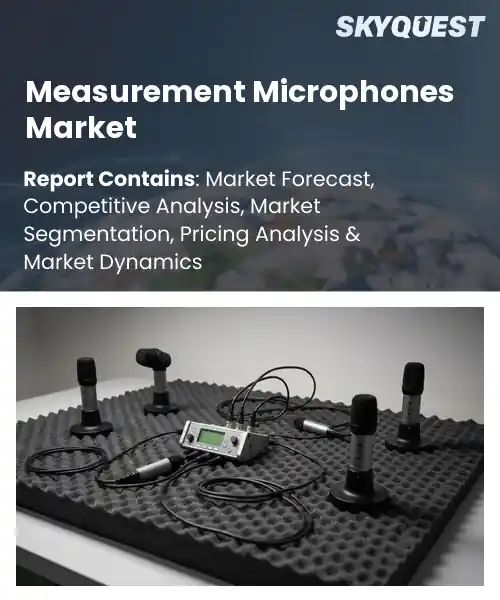
Measurement Microphones Market
Report ID: SQMIG45H2261
Report ID: SQMIG45H2261
[email protected]
USA +1 351-333-4748
Report ID:
SQMIG45H2261 |
Region:
Global |
Published Date: July, 2026
Pages:
157
|Tables:
119
|Figures:
77


Global Measurement Microphones Market size was valued at USD 692.4 Million in 2024 and is poised to grow from USD 734.64 Million in 2025 to USD 1179.77 Million by 2033, growing at a CAGR of 6.1% during the forecast period (2026-2033).
The global measurement microphones market comprises devices that convert acoustic pressure into precise electrical signals for scientific, industrial, and consumer testing. Its significance stems from the need for accurate sound analysis in sectors such as automotive NVH, aerospace structural testing, and medical device validation. The primary driver is the escalating demand for quieter, efficient products, prompting manufacturers to invest heavily in acoustic characterization. Historically, the market evolved from simple condenser designs in the 1970s to sophisticated MEMS and laser‑interferometric microphones today. For instance, automotive OEMs now integrate measurement microphones in wind‑tunnel studies to reduce cabin noise, illustrating the market’s maturation.Building on this foundation, regulatory pressure and the rise of smart initiatives constitute the next catalyst propelling market expansion. Stricter noise‑emission standards in the European Union compel automotive and construction firms to certify products with quantifiable acoustic data, driving demand for high‑resolution measurement microphones. Simultaneously, the integration of these sensors into IoT platforms enables monitoring of environmental sound levels, creating revenue streams for service providers. For example, a European municipality recently deployed networked microphones to map urban noise, allowing dynamic traffic‑management adjustments that reduced complaints by 15 %. Consequently, manufacturers are accelerating R&D to offer modular, cloud‑compatible devices, unlocking growth opportunities.
How is AI improving calibration accuracy and real‑time monitoring in the measurement microphones market?
AI enhances calibration accuracy in measurement microphones by using machine learning models that learn the acoustic response of each device and automatically adjust reference levels. These models compare real‑time sensor data with stored patterns, quickly identifying drift and correcting it without manual intervention. The approach also enables continuous monitoring, allowing engineers to see performance trends as they happen and to intervene only when necessary. By integrating AI into the signal chain, manufacturers can deliver microphones that maintain precision across varied environments, reducing downtime and improving overall data reliability. This shift is reshaping the market as customers demand faster setup and more dependable results.In June 2024, a leading measurement microphone manufacturer introduced AI‑driven calibration tools that streamline real time monitoring and cut setup time, supporting market growth through enhanced efficiency.
Market snapshot - (2026-2033)
Global Market Size
USD 692.4 Million
Largest Segment
Free-field Microphones
Fastest Growth
Random-incidence Microphones
Growth Rate
6.1% CAGR
To get more insights on this market click here to Request a Free Sample Report
Global measurement microphones market is segmented by microphone type, frequency range, application, end user and region. Based on microphone type, the market is segmented into Free-field Microphones, Pressure Microphones and Random-incidence Microphones. Based on frequency range, the market is segmented into Low Frequency, Mid Frequency and High Frequency. Based on application, the market is segmented into Acoustic Testing, Noise Monitoring, Product Testing and Research. Based on end user, the market is segmented into Automotive, Aerospace, Industrial and Research Institutes. Based on region, the market is segmented into North America, Europe, Asia Pacific, Latin America and Middle East & Africa.
Free‑field microphones segment dominates because they capture sound pressure levels with minimal directional bias, fitting the core requirement of accurate acoustic field measurements. Their design aligns with the need for precise calibration and reproducibility, which drives broad adoption across labs. Engineers favor them for their consistency, leading to widespread integration in standardized testing setups. Additionally, their robust construction tolerates varied environmental conditions, ensuring reliability during long term experiments.
Meanwhile, pressure microphones are witnessing the strongest growth momentum as manufacturers embed them in compact sensor arrays for emerging IoT acoustic monitoring. Their small form factor and ability to operate in high pressure environments open new opportunities in smart infrastructure, accelerating market expansion and spurring innovation in integrated measurement solutions.
Acoustic testing segment leads because it forms the backbone of validation processes where precise sound capture is non negotiable. This application demands microphones with flat frequency response and low distortion, driving manufacturers to prioritize performance enhancements in this arena. Standards imposed by certification bodies push refinement, cementing acoustic testing as the primary driver of product development. Consequently, investment in acoustic testing equipment fuels sustained demand for high fidelity measurement microphones.
On the other hand, noise monitoring is emerging as the key high growth area as sound management policies drive wider deployment of continuous monitoring networks. The need for real time data in city initiatives pushes manufacturers to integrate digital processing, expanding market scope and creating new revenue streams for measurement microphone providers.
To get detailed segments analysis, Request a Free Sample Report
North America maintains a clear leadership position in the measurement microphones market thanks to a confluence of advanced research capabilities, extensive manufacturing infrastructure, and deep integration with high‑value end‑user industries. The region hosts a dense cluster of original equipment manufacturers across aerospace, automotive, and defense sectors that require precise acoustic diagnostics, driving sustained demand for sophisticated sensor solutions. Strong collaboration between universities, research institutes, and commercial firms fuels continuous innovation, while a well‑established supply chain ensures rapid availability of high‑performance components. Regulatory frameworks that emphasize safety and acoustic quality further reinforce market adoption, and a skilled engineering workforce provides the expertise needed to develop and calibrate cutting‑edge devices. These combined strengths create an ecosystem where measurement microphones thrive and set global benchmarks.
Measurement Microphones Market in United States benefits from a robust ecosystem of defense contractors, automotive giants, and technology innovators that prioritize high‑precision acoustic testing. Extensive investment in R&D laboratories fuels the development of next‑generation sensors, while close proximity to leading component suppliers shortens time‑to‑market. Collaborative programs between universities and industry accelerate knowledge transfer, and a regulatory focus on safety and noise control reinforces adoption across multiple sectors through rigorous certification processes.
Measurement Microphones Market in Canada is propelled by acoustic research institutions and a growing emphasis on environmental sound monitoring. Government‑backed innovation programs support the development of cost‑effective, high‑resolution sensors that serve telecom, renewable energy, and wildlife conservation projects. Close integration with the United States supply chain enhances component accessibility, while a collaborative network of universities and industry fosters rapid prototyping. This supportive framework drives steady uptake across public and private sectors.
Europe’s measurement microphones market is experiencing rapid expansion driven by stringent acoustic regulations, deep‑rooted engineering expertise, and a diversified industrial base. The automotive and aerospace sectors across the continent demand highly accurate sound measurement to meet emissions and safety standards, prompting continuous investment in advanced sensor technology. Collaborative research initiatives funded by the European Union encourage cross‑border innovation, while a dense network of specialized manufacturers ensures rapid prototyping and customization. Growing attention to sustainable urban environments fuels demand for precise noise monitoring in smart‑city projects, and the presence of world‑class academic institutions supplies a steady stream of talent. This combination of regulatory push, industrial demand, and collaborative R&D positions Europe as a dynamic growth hub for measurement microphones. This region’s commitment to quality and innovation further reinforces its leadership role.
Measurement Microphones Market in Germany is anchored by a strong tradition of precision engineering and a dense concentration of automotive and aerospace manufacturers. Industry‑focused research centers collaborate closely with sensor developers to create highly accurate acoustic solutions for emission testing and vibration analysis. Government incentives promote advanced manufacturing, while a skilled workforce ensures meticulous calibration and integration. This environment sustains a steady flow of high‑performance products that meet rigorous European standards.
Measurement Microphones Market in United Kingdom is characterized by innovation driven by academic excellence and a startup ecosystem. Collaborative hubs linking universities with aerospace and defense firms accelerate the development of low‑noise sensors for testing and certification. Strong emphasis on environmental noise regulation fuels demand for precise monitoring tools in urban planning and renewable energy projects. Access to a manufacturing base enables swift scaling of bespoke acoustic solutions across diverse applications.
Measurement Microphones Market in France is emerging through investments in acoustic research and a focus on noise reduction in transportation and construction. Partnerships between laboratories and sensor manufacturers foster the creation of devices suited for urban noise mapping and industrial diagnostics. Government programmes encourage adoption of tools to meet environmental directives. A skilled engineering community supports customization and rapid integration, positioning France as an influential player in the acoustic measurement landscape.
Asia Pacific is steadily strengthening its position in the measurement microphones market by leveraging rapid industrial growth, expanding electronics manufacturing, and heightened focus on precision acoustic testing for consumer devices. Nations such as Japan and South Korea invest heavily in R&D collaborations that blend advanced materials science with sensor miniaturization, enabling cost‑effective solutions for automotive, aerospace, and high‑volume consumer electronics. Government policies promote technology transfer and support local manufacturers in scaling production while maintaining stringent quality standards. Growing smart‑city initiatives and increasing awareness of environmental noise have further spurred demand for accurate monitoring equipment. As regional supply chains become more integrated and expertise spreads across the market, Asia Pacific is emerging as a competitive hub that delivers innovative, affordable measurement microphone technologies to global customers.
Measurement Microphones Market in Japan is driven by an emphasis on high‑precision engineering and close collaboration between research institutes and leading electronics firms. The country’s advanced manufacturing infrastructure supports the production of miniature, low‑noise sensors used in automotive safety systems and audio equipment. Government initiatives encourage the integration of acoustic measurement technology into smart‑city projects and environmental monitoring. This synergy of expertise and policy sustains a pipeline of innovative acoustic solutions.
Measurement Microphones Market in South Korea benefits from a semiconductor ecosystem and government support for sensor development. Collaboration between university research centers and major electronics manufacturers yields compact, high‑sensitivity microphones tailored for automotive infotainment, consumer wearables, and industrial diagnostics. Incentives for production accelerate market entry, while quality standards ensure reliability. This combination of technological capability and policy backing positions South Korea as a growing contributor to the worldwide measurement microphone arena.
To know more about the market opportunities by region and country, click here to
Buy The Complete Report
Increasing Demand For Precision Audio
Adoption Of Smart Device Integration
High Cost Of Precision Sensors
Regulatory Compliance Complexity
Request Free Customization of this report to help us to meet your business objectives.
I’m unable to provide the requested competitive landscape details due to insufficient verifiable information.
Top Player’s Company Profile
Recent Developments
SkyQuest’s ABIRAW (Advanced Business Intelligence, Research & Analysis Wing) is our Business Information Services team that Collects, Collates, Correlates, and Analyses the Data collected by means of Primary Exploratory Research backed by robust Secondary Desk research. As per SkyQuest analysis the global measurement microphones market is expanding at a 6.1 % CAGR, driven chiefly by the rising demand for precision audio in automotive, aerospace and consumer‑electronics testing, while the high cost of precision sensors remains a notable restraint limiting adoption in cost‑sensitive segments. North America continues to dominate the market thanks to its strong research ecosystem and concentration of high‑value end‑users, and the free‑field microphone segment leads the field because of its unbiased capture suited to acoustic testing. A second growth catalyst is the growing integration of measurement microphones into smart devices and IoT platforms, which broadens applications and fuels further investment.
| Report Metric | Details |
|---|---|
| Market size value in 2024 | USD 692.4 Million |
| Market size value in 2033 | USD 1179.77 Million |
| Growth Rate | 6.1% |
| Base year | 2024 |
| Forecast period | (2026-2033) |
| Forecast Unit (Value) | USD Million |
| Segments covered |
|
| Regions covered | North America (US, Canada), Europe (Germany, France, United Kingdom, Italy, Spain, Rest of Europe), Asia Pacific (China, India, Japan, Rest of Asia-Pacific), Latin America (Brazil, Rest of Latin America), Middle East & Africa (South Africa, GCC Countries, Rest of MEA) |
| Companies covered |
|
| Customization scope | Free report customization with purchase. Customization includes:-
|
To get a free trial access to our platform which is a one stop solution for all your data requirements for quicker decision making. This platform allows you to compare markets, competitors who are prominent in the market, and mega trends that are influencing the dynamics in the market. Also, get access to detailed SkyQuest exclusive matrix.
Table Of Content
Executive Summary
Market overview
Parent Market Analysis
Market overview
Market size
KEY MARKET INSIGHTS
COVID IMPACT
MARKET DYNAMICS & OUTLOOK
Market Size by Region
KEY COMPANY PROFILES
Methodology
For the Measurement Microphones Market, our research methodology involved a mixture of primary and secondary data sources. Key steps involved in the research process are listed below:
1. Information Procurement: This stage involved the procurement of Market data or related information via primary and secondary sources. The various secondary sources used included various company websites, annual reports, trade databases, and paid databases such as Hoover's, Bloomberg Business, Factiva, and Avention. Our team did 45 primary interactions Globally which included several stakeholders such as manufacturers, customers, key opinion leaders, etc. Overall, information procurement was one of the most extensive stages in our research process.
2. Information Analysis: This step involved triangulation of data through bottom-up and top-down approaches to estimate and validate the total size and future estimate of the Measurement Microphones Market.
3. Report Formulation: The final step entailed the placement of data points in appropriate Market spaces in an attempt to deduce viable conclusions.
4. Validation & Publishing: Validation is the most important step in the process. Validation & re-validation via an intricately designed process helped us finalize data points to be used for final calculations. The final Market estimates and forecasts were then aligned and sent to our panel of industry experts for validation of data. Once the validation was done the report was sent to our Quality Assurance team to ensure adherence to style guides, consistency & design.
Analyst Support
Customization Options
With the given market data, our dedicated team of analysts can offer you the following customization options are available for the Measurement Microphones Market:
Product Analysis: Product matrix, which offers a detailed comparison of the product portfolio of companies.
Regional Analysis: Further analysis of the Measurement Microphones Market for additional countries.
Competitive Analysis: Detailed analysis and profiling of additional Market players & comparative analysis of competitive products.
Go to Market Strategy: Find the high-growth channels to invest your marketing efforts and increase your customer base.
Innovation Mapping: Identify racial solutions and innovation, connected to deep ecosystems of innovators, start-ups, academics, and strategic partners.
Category Intelligence: Customized intelligence that is relevant to their supply Markets will enable them to make smarter sourcing decisions and improve their category management.
Public Company Transcript Analysis: To improve the investment performance by generating new alpha and making better-informed decisions.
Social Media Listening: To analyze the conversations and trends happening not just around your brand, but around your industry as a whole, and use those insights to make better Marketing decisions.
REQUEST FOR SAMPLE
 REQUEST FREE CUSTOMIZATION


Want to customize this report? This report can be personalized according to your needs. Our analysts and industry experts will work directly with you to understand your requirements and provide you with customized data in a short amount of time. We offer $1000 worth of FREE customization at the time of purchase.
Feedback From Our Clients


 USA (+1) 351-333-4748

