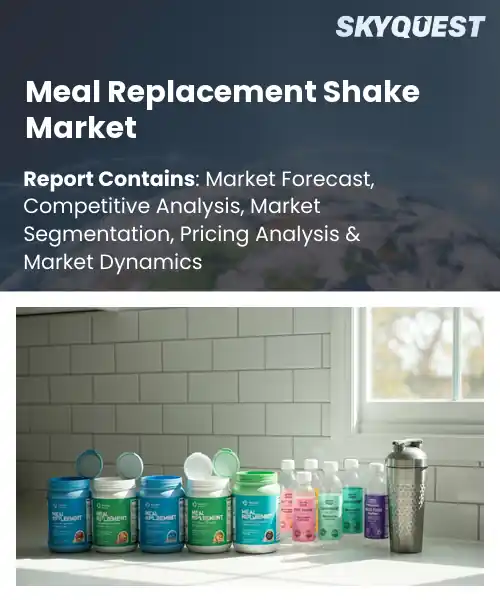
Meal Replacement Shake Market
Report ID: SQMIG30I2859
Report ID: SQMIG30I2859
[email protected]
USA +1 351-333-4748
Report ID:
SQMIG30I2859 |
Region:
Global |
Published Date: February, 2026
Pages:
157
|Tables:
202
|Figures:
80


Global Meal Replacement Shake Market size was valued at USD 5.7 Billion in 2024 and is poised to grow from USD 6.2 Billion in 2025 to USD 12.18 Billion by 2033, growing at a CAGR of 8.8% during the forecast period (2026-2033).
The global meal replacement shake market growth occurs because time-restricted consumers want to improve health through eating, which transforms a medical product into a common food category. The initial purpose of meal replacements, which helped people with clinical nutrition and weight loss, expanded when fitness enthusiasts and working professionals started using Soylent and Huel as portable food options that provided measured meal portions. The growth of retail stores and online shopping created better product access because advanced product formulas transformed items from basic powder forms into nutrient-packed ready-to-drink beverages that contained plant-based proteins and probiotics and extra vitamins.
The global meal replacement shake industry holds significance because it provides health solutions that meet consumer needs for effective wellness products which can be used by many people. Product personalization and channel innovation currently drive market growth because businesses will grow through tailored formulations and accessible procurement options, which will also boost customer base expansion and revenue generation over time. Consumers currently request specific macronutrient ratios together with allergen-free ingredients and microbiome-supporting additives, which leads manufacturers to create new R&D and product lines that enable premiumization and higher margins through subscription-based services which DTC plans used by busy professionals provide. The growing elderly population and medical recognition of malnutrition create demand for hospitals and senior care facilities which leads them to request regulatory-compliant products together with contractual agreements that boost product volumes and secure steady revenue streams in both short-term and long-term market operations.
How is AI Transforming Personalization in the Meal Replacement Shake Market?
AI technology revolutionizes the global meal replacement shake market outlook by connecting consumer preferences through wearable data with biological inputs to create specific product formulations and delivery methods. Personalization requires three core elements which include customized macronutrient distributions and preferred flavor options at designated serving times. Brands use machine learning to analyze purchase history of DNA and microbiome reports and recommend or create custom blends. The market has shifted from one-size-fits-all solutions to customized functional products that match different lifestyles and health objectives. The development of apps shows how users can create recipes through their wearable device feedback, while AI-driven ingredient optimization technology helps develop formulas faster by creating better sensory elements, which lead to more advanced product formulas.
Market snapshot - (2026-2033)
Global Market Size
USD 5.7 Billion
Largest Segment
Powder Mix
Fastest Growth
Ready-to-Drink
Growth Rate
8.8% CAGR
To get more insights on this market click here to Request a Free Sample Report
The global meal replacement shake market is segmented based on product type, flavor, distribution channel, age group, dietary concerns, functional benefits, protein source, and region. By product type, the market includes ready-to-drink shakes, powder mixes, and concentrates & syrups. In terms of flavor, the market is categorized into chocolate, vanilla, and fruit-flavored variants. Based on distribution channels, meal replacement shakes are sold through supermarkets and hypermarkets, convenience and drug stores, online retail platforms, and specialty nutrition stores. By age group, the market is segmented into children, adults, and seniors. Based on dietary concerns, it includes vegan, gluten-free, low-carbohydrate, and high-protein options. In terms of functional benefits, the market covers weight loss management, muscle building and recovery, improved nutrient intake, and boosted energy levels. Based on protein source, the market is segmented into plant-based, whey, casein, and collagen proteins. Regionally, the market is divided into North America, Europe, Asia Pacific, Latin America, and the Middle East & Africa.
As per the global meal replacement shake market analysis, consumers choose premixed formulations as their main option because they value ready-to-drink products, which provide them with immediate access to their beverages. Retailers prefer to use single-serve packaging for their products because it makes product placement easier and product restocking faster, while brands spend money on flavor and texture development to create products that match traditional beverage profiles. The product achieves broad market acceptance because its strong shelf life and standard measurement system enable users to test it at any time, which leads to continuous demand that drives product development and marketing activities.
Whereas the powder mix segment has become the fastest growing market segment because people want products that offer custom options and affordable solutions and products that can match diverse formulation requirements. Powder formats become the preferred choice for consumers and retailers because they allow users to create custom portion sizes and provide clear label information and enable the use of new plant-based proteins, which leads to product development and new subscription models and broader applications in fitness and medical nutrition.
According to the global meal replacement shake market forecast, the improved nutrient intake category achieves market dominance through its promise to provide all essential macro and micronutrients in a single package, which matches customer demand for complete and quick meal solutions. Healthcare and lifestyle consumers trust brands that choose to use fortification and create clinically correct ingredient lists and provide clear product information, which leads to product development that focuses on creating nutritious products with optimal absorption which delivers daily product more predictable product results and establishes product standards for retailers to select their inventory.
Whereas the weight loss management segment is predicted to have the largest meal replacement shake market share because consumers now want to use specific dietary solutions that include clinically proven meal plans and calorie-control methods. The demand in the market for specific diet plans which control appetite and utilize digital coaching and subscription services to deliver tailored solutions has become the main reason why tailored product development is increasing while businesses create new partnerships and market-expanding product development.
To get detailed segments analysis, Request a Free Sample Report
As per the meal replacement shake market's regional forecast, North America achieves its leading position because consumers demand products; distribution systems operate at advanced levels, and companies continue to develop new products. Existing retail systems and advanced online shopping systems enable fast product release together with complete market visibility, while brand funding for scientific studies and promotional work creates consumer confidence among people who prioritize their health. Companies develop various products, which include high-protein items and meal replacement solutions together with therapeutic products, to satisfy different needs that people have for weight control and athletic performance and medical dietary support. Companies can achieve production expansion through their manufacturing facilities, which enable them to maintain product quality and operational performance. Retailers and healthcare professionals team up with manufacturers to create educational programs, which promote product sampling and usage across different demographic groups.
The United States meal replacement shake sector expands through widespread retail distribution and consumer nutritional knowledge and the development of new product formulas and taste options. Companies invest in clinical research to establish brand presence in sports and weight management markets which support its premium product development and private brand expansion. They offer clean label products which feature various protein options in user-friendly packaging to meet the demands of both busy people and healthcare institutions which need research and specific marketing initiatives.
The Canadian meal replacement shake industry shows that consumers prefer products which contain genuine and functional materials while retail businesses maintain strong relationships with customers who trust health experts to validate their choices. Local companies create food products which mix plant-based proteins with dairy offerings to meet the taste requirements of different customers while foreign brands increase their standards for product excellence and environmental responsibility. Retailers use their private label products and educational programs to help customers try products before they decide to buy them repeatedly in both urban and suburban areas.
European countries experience quick market growth because consumers now prefer wholesome, easy-to-eat food items while there is a rising demand for plant-based and functional food products. The combination of physical retail locations and online pharmacy services together with e-commerce platforms allows both niche and popular brands to extend their business operations into new international markets. Consumers value product safety when they buy products through regulatory systems, which help establish their trust in products that offer transparent ingredient information. Local food science and nutrition innovation centers develop new product formulations, which align with consumer demand for sustainable products and clear label information. Retailers and healthcare professionals work together with startup companies to create educational programs which increase product testing and product development, which meets the dietary needs of different cultural groups and the rules of various regulatory systems throughout the region.
The Germany meal replacement shake market penetration depends on strong pharmacy networks together with retail systems which meet high-quality standards and companies that invest heavily in product development. Companies offer functional products, which have traceable ingredients and scientific evidence, to meet the requirements of both consumers and professional clients. They use support from nutrition scientists and sports organizations to develop their brand image, while its sustainable production methods and operational processes enable them to achieve environmentally friendly product development.
The United Kingdom Meal Replacement Shake Market experiences quick growth because retailers test new product formats and direct sales channels maintain momentum, while new businesses adopt flexible operational methods. Brands use influencer partnerships together with digital advertising and subscription services to enhance product testing and build customer loyalty. The retail market and health professional organizations work together to extend their market presence. Urban consumers who care about ingredients are drawn to products which offer transparent ingredient information and sustainable product development.
French consumers combine their culinary expertise with their rising health consciousness to drive market growth for meal replacement products. Companies develop flavors and product components, which match local consumer preferences, while promoting natural components and traditional production methods. The pharmacy and specialized retail channels foster customer trust, while increased online product access helps consumers find niche products. Companies achieve consumer acceptance through its sustainable products, which offer traceable information and attractive product packaging.
Asia Pacific improves its market position through its ability to customize products according to local food traditions and emerging needs of urban customers and its fast-growing retail and online distribution networks. Manufacturers create regional products that use local flavors and traditional ingredients, but they maintain global nutrition standards which require protein diversity and plant-based food options. Domestic brands and international companies collaborate to boost production capabilities while building their expertise in local markets. The combination of localized marketing initiatives and health professional endorsements and scalable supply chains leads to better product availability in both urban and peri-urban areas while growing knowledge about preventive nutrition helps people accept meal solutions that provide convenience. The combination of local innovation centers and agile startups drives the development of new formats which include on-the-go styles and fortified products designed for both active users and institutional buyers. Sustainable sourcing and localized supply networks help the region achieve cost efficiency while building consumer trust which allows the region to shift from niche experimental products to widespread mainstream product availability.
The Japanese meal replacement shake market requires precise formula creation which uses premium ingredients while matching local taste preferences. Health professionals build package credibility for the product through their recommendations while retail and convenience stores serve as distribution channels for the product. Traditional ingredients get combined with current nutritional science through manufacturers who create compact packages which exhibit premium design style. Product positioning emphasizes its functional advantages and strict quality control processes to attract health-conscious urban consumers throughout the country.
The South Korean meal replacement shake market experiences strong growth because of consumer behavior that follows current trends and the expansion of digital commerce and the fast development of new products. Beauty and wellness trends encourage brands to offer natural functional ingredients which they pack in stylish designs. Influencer marketing and convenience channels drive product awareness and trialing activities across the customer base. Manufacturers create new product formats through their efforts to test products which are developed with local flavors to meet city requirements while they plan to use their products in international markets.
To know more about the market opportunities by region and country, click here to
Buy The Complete Report
Rising Health and Wellness Awareness
More people are interested in preventive health and balanced nutrition, so they now prefer nutrient dense meals which they can easily access instead of traditional foods. Meal replacement shakes serve as a handy solution which helps people control their calorie intake while meeting their needed macro and micronutrient requirements according to the current wellness and disease prevention trends. This perception leads manufacturers and retailers to create more products because they want to reach both health-conscious customers who will try their products.
Convenience and Busy Consumer Lifestyles
Meal replacement shakes have become a popular nutrition solution for consumers who need to manage their professional and family commitments because of their busy lifestyles. The ready-to-drink or powder formulations show portable benefits which need quick preparation and provide stable nutrient content, making it easy for manufacturers to target professionals and students who are always moving. The establishment of convenience through packaging and distribution methods results in wider product adoption, which in turn drives innovation and retail development that enables ongoing market growth across different consumer usage scenarios.
Taste Preferences and Palatability Issues
Consumer expectations for taste and mouthfeel can limit repeat purchases when products do not meet sensory preferences, particularly among individuals accustomed to conventional foods. Consumers avoid trying meal replacement shakes because they find some flavors to be unappetizing while others have an artificial taste, and others cause texture changes, which leads them to return to products they previously used. The need for manufacturers to develop better flavors through their upcoming products makes companies spend resources on creating new flavors and taste-covering solutions which will extend product development time because of the need to maintain both flavor standard and nutritional standard, thus delaying product entry into regular market segments.
Regulatory and Labeling Challenges
Producers face approval challenges because they need to comply with ingredient disclosure and health claim and fortification standards which differ between markets for their meal replacement shakes. Product development costs go up because manufacturers need to follow compliance regulations which require them to either reformulate products or perform additional testing or use safe marketing methods. The distribution area gets limited when smaller businesses need to meet multiple regional requirements, which also causes their product development process to take longer. Regulatory requirements force businesses to choose a cautious market approach because they need to comply withvarious compliance rules, which creates competitive disadvantages that hinder innovation-based product development for new products to reach broad consumer markets.
Request Free Customization of this report to help us to meet your business objectives.
The global meal replacement shakes market experiences competition which leads to market consolidation through essential channel strategies while companies raise their scientific product differences. The market incumbents use strategic acquisition of other companies together with portfolio management to establish their products, but retail partners help them achieve national market presence. The challengers use their investment in clinical research and development of patentable formulation technology to protect their market position through retail shelf space and subscription services. The company Nestlé Health Science made stake acquisitions in Orgain and Vital Proteins while Supergut launched products which Supergut based on clinical research. Wonderlab and Heytea have established a D2C co-branding partnership for their Asian market business operations.
Personalized Nutrition Services: Customers want meal replacement products which match their specific goals and dietary requirements and their personal daily routines. The brands now use digital assessments to create personalized flavor and nutrient profiles which customers can use to change their subscription formulas whenever they choose. The trend builds stronger connections with customers while keeping them engaged through tailored experiences, and companies work with health experts and health platforms to provide proof of their results. Companies that create modular product designs together with responsive customer service systems can create a distinct market position which helps them build stronger customer relationships.
Sustainable Ingredient Innovation: Sustainable sourcing and new ingredient discovery have become the primary focus for manufacturers who want to meet the sustainable product demands of environmentally minded customers. Brands achieve their environmental reduction goals through plant-based proteins and fermented nutrients and upcycled components which enable them to present real supply chain stories to their customers. Brand strength improves through investment in ingredient traceability and partnerships for circular sourcing and procurement of regenerative resources. Companies that develop products using minimal processing and clear product origins, and specific product formulations will achieve premium market positions while they create strong market defenses against sustainability-based buying trends.
SkyQuest’s ABIRAW (Advanced Business Intelligence, Research & Analysis Wing) is our Business Information Services team that Collects, Collates, Correlates, and Analyses the Data collected by means of Primary Exploratory Research backed by robust Secondary Desk research.
As per SkyQuest analysis, the global meal replacement shake market is growing because busy consumers want to eat healthy products that deliver essential nutrients. Consumers still prefer product attributes which directly affect their buying decisions despite improvements in product development. North America leads the market because its retail and e-commerce systems have reached maturity, and its clinical and marketing spending shows strong growth. The category sees consumers favor ready-to-drink products because they want to use their drinks immediately without needing to prepare any items. The secondary growth driver shows how consumer customization has increased through AI-powered subscription services and customized product solutions which have enabled users of multiple channels to create personalized experiences.
| Report Metric | Details |
|---|---|
| Market size value in 2024 | USD 5.7 Billion |
| Market size value in 2033 | USD 12.18 Billion |
| Growth Rate | 8.8% |
| Base year | 2024 |
| Forecast period | (2026-2033) |
| Forecast Unit (Value) | USD Billion |
| Segments covered |
|
| Regions covered | North America (US, Canada), Europe (Germany, France, United Kingdom, Italy, Spain, Rest of Europe), Asia Pacific (China, India, Japan, Rest of Asia-Pacific), Latin America (Brazil, Rest of Latin America), Middle East & Africa (South Africa, GCC Countries, Rest of MEA) |
| Companies covered |
|
| Customization scope | Free report customization with purchase. Customization includes:-
|
To get a free trial access to our platform which is a one stop solution for all your data requirements for quicker decision making. This platform allows you to compare markets, competitors who are prominent in the market, and mega trends that are influencing the dynamics in the market. Also, get access to detailed SkyQuest exclusive matrix.
Table Of Content
Executive Summary
Market overview
Parent Market Analysis
Market overview
Market size
KEY MARKET INSIGHTS
COVID IMPACT
MARKET DYNAMICS & OUTLOOK
Market Size by Region
KEY COMPANY PROFILES
Methodology
For the Meal Replacement Shake Market, our research methodology involved a mixture of primary and secondary data sources. Key steps involved in the research process are listed below:
1. Information Procurement: This stage involved the procurement of Market data or related information via primary and secondary sources. The various secondary sources used included various company websites, annual reports, trade databases, and paid databases such as Hoover's, Bloomberg Business, Factiva, and Avention. Our team did 45 primary interactions Globally which included several stakeholders such as manufacturers, customers, key opinion leaders, etc. Overall, information procurement was one of the most extensive stages in our research process.
2. Information Analysis: This step involved triangulation of data through bottom-up and top-down approaches to estimate and validate the total size and future estimate of the Meal Replacement Shake Market.
3. Report Formulation: The final step entailed the placement of data points in appropriate Market spaces in an attempt to deduce viable conclusions.
4. Validation & Publishing: Validation is the most important step in the process. Validation & re-validation via an intricately designed process helped us finalize data points to be used for final calculations. The final Market estimates and forecasts were then aligned and sent to our panel of industry experts for validation of data. Once the validation was done the report was sent to our Quality Assurance team to ensure adherence to style guides, consistency & design.
Analyst Support
Customization Options
With the given market data, our dedicated team of analysts can offer you the following customization options are available for the Meal Replacement Shake Market:
Product Analysis: Product matrix, which offers a detailed comparison of the product portfolio of companies.
Regional Analysis: Further analysis of the Meal Replacement Shake Market for additional countries.
Competitive Analysis: Detailed analysis and profiling of additional Market players & comparative analysis of competitive products.
Go to Market Strategy: Find the high-growth channels to invest your marketing efforts and increase your customer base.
Innovation Mapping: Identify racial solutions and innovation, connected to deep ecosystems of innovators, start-ups, academics, and strategic partners.
Category Intelligence: Customized intelligence that is relevant to their supply Markets will enable them to make smarter sourcing decisions and improve their category management.
Public Company Transcript Analysis: To improve the investment performance by generating new alpha and making better-informed decisions.
Social Media Listening: To analyze the conversations and trends happening not just around your brand, but around your industry as a whole, and use those insights to make better Marketing decisions.
REQUEST FOR SAMPLE
 REQUEST FREE CUSTOMIZATION
Global Meal Replacement Shake Market size was valued at USD 5.7 Billion in 2024 and is poised to grow from USD 6.2 Billion in 2025 to USD 12.18 Billion by 2033, growing at a CAGR of 8.8% during the forecast period (2026-2033).
Competitive pressure in the global meal replacement shake market has driven consolidation and retail channel playbooks while elevating science-led differentiation; incumbents pursue strategic M&A and portfolio buyouts, retailers enable national rollouts, and challengers invest in clinical validation and formulation IP to defend shelf space and subscriptions. Examples include Nestlé Health Science’s stake acquisitions in Orgain and Vital Proteins, clinical-backed launches from Supergut, and Asia D2C co-branding such as Wonderlab with Heytea. 'Nestlé S.A.', 'Abbott Laboratories', 'Herbalife Nutrition', 'Amway Corporation', 'Glanbia PLC', 'Soylent', 'Huel', 'Bob’s Red Mill Natural Foods', 'Beachbody LLC', 'Danone S.A.', 'GNC Holdings Inc.', 'IdealShape LLC', 'Jimmy Joy', 'Kellogg Company', 'Labrada Nutrition', 'Orgain Inc.', 'PepsiCo Inc.', 'Premier Nutrition Co.', 'SlimFast', 'Vega'
Rising consumer interest in preventive health and balanced nutrition has encouraged many individuals to seek convenient, nutrient dense alternatives to traditional meals. Meal replacement shakes are perceived as a practical means to manage calorie intake while ensuring essential macro and micronutrient consumption, which aligns with growing emphasis on wellness and disease prevention. This perception motivates manufacturers and retailers to expand product offerings and messaging that highlight health benefits, thereby broadening appeal among health conscious segments and driving increased trial and adoption across diverse demographic groups.
Personalized Nutrition Services: Consumers are increasingly seeking meal replacement solutions tailored to individual goals, lifestyles and dietary needs. Brands are responding by integrating digital assessments, personalized flavor and nutrient profiles, and adaptive subscription models that allow consumers to modify formulations over time. This trend fosters closer consumer engagement, higher retention through customization, and strategic partnerships with health professionals and platforms to validate outcomes. Market players focusing on modular product design and responsive customer experiences gain differentiation and deepen loyalty in a crowded category.
As per the meal replacement shake market's regional forecast, North America achieves its leading position because consumers demand products; distribution systems operate at advanced levels, and companies continue to develop new products.


Want to customize this report? This report can be personalized according to your needs. Our analysts and industry experts will work directly with you to understand your requirements and provide you with customized data in a short amount of time. We offer $1000 worth of FREE customization at the time of purchase.
Feedback From Our Clients


 USA (+1) 351-333-4748

