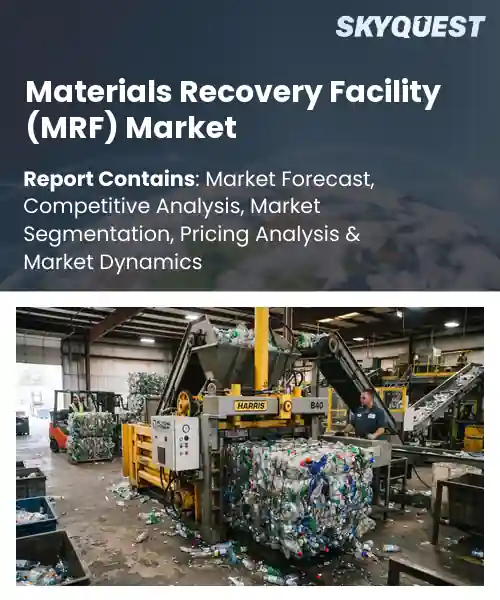
Materials Recovery Facility (MRF) Market
Report ID: SQMIG20L2127
Report ID: SQMIG20L2127
[email protected]
USA +1 351-333-4748
Report ID:
SQMIG20L2127 |
Region:
Global |
Published Date: September, 2026
Pages:
157
|Tables:
122
|Figures:
77


Global Materials Recovery Facility (Mrf) Market size was valued at USD 8.4 Billion in 2024 and is poised to grow from USD 8.91 Billion in 2025 to USD 14.32 Billion by 2033, growing at a CAGR of 6.1% during the forecast period (2026-2033).
The Materials Recovery Facility (MRF) market comprises businesses that sort, process, and prepare recyclable waste for resale, serving as a link between collection systems and secondary‑material manufacturers. Its importance stems from the need to divert landfill waste, reduce carbon emissions, and secure raw‑material supplies for industries such as packaging, construction, and automotive. Historically, the market expanded from small, manually operated plants in the 1970s to automated hubs that employ optical sorters, AI‑driven robotics, and conveyor systems. For example, a 2019 upgrade at a California MRF doubled its aluminum recovery rate, illustrating how technology adoption has accelerated efficiency and market growth. Regulatory pressure represents the key catalyst driving the global MRF market forward, because stringent recycling mandates compel municipalities and producers to secure processing capacity. When governments impose landfill taxes or set recycled-content targets, waste generators must contract with facilities that can meet purity standards, prompting investment in sorting lines. This dynamic creates opportunities for equipment manufacturers and technology providers; for instance, a European consortium received €45 million in funds to pilot sensor technology that isolates PET from mixed streams, thereby increasing revenue per ton. Consequently, regions with policy frameworks experience faster facility expansion, material yields, and supply‑chain integration, reinforcing market momentum.
How is AI enhancing sorting efficiency in the global Materials Recovery Facility (MRF) market?
AI boosts sorting efficiency in the global Materials Recovery Facility market by combining high‑resolution cameras with machine‑learning algorithms that instantly recognize material types, colors and contaminants. The technology feeds real‑time decisions to robotic arms that divert items to the correct stream, reducing manual labor and error rates. Facilities can run multiple lines simultaneously, handling higher volumes while maintaining purity standards. This shift is driven by stricter recycling regulations and the need to lower operating costs. Operators report faster throughput, lower contamination and the ability to process new material categories, making AI a cornerstone of modern MRF operations.AMP Robotics, March 2023, launched a next‑generation AI sorting system that identifies mixed plastics with greater speed, helping facilities increase output and support market growth through improved efficiency.
Market snapshot - (2026-2033)
Global Market Size
USD 8.4 Billion
Largest Segment
Single-Stream MRFs
Fastest Growth
Construction & Demolition MRFs
Growth Rate
6.1% CAGR
To get more insights on this market click here to Request a Free Sample Report
Global materials recovery facility (mrf) market is segmented by facility type, processing technology, recovered material, end user and region. Based on facility type, the market is segmented into Single-Stream MRFs, Dual-Stream MRFs, Mixed-Waste MRFs and Construction & Demolition MRFs. Based on processing technology, the market is segmented into Manual Sorting, Mechanical Sorting, Optical Sorting and Automated Robotic Sorting. Based on recovered material, the market is segmented into Paper & Cardboard, Plastics, Glass, Metals and Other Recyclable Materials. Based on end user, the market is segmented into Municipalities, Waste Management Companies, Recycling Companies and Industrial & Commercial Facilities. Based on region, the market is segmented into North America, Europe, Asia Pacific, Latin America and Middle East & Africa.
Single stream MRFs segment dominates because it aligns with municipal waste collection policies that prioritize simplicity for households. By consolidating all recyclables into one bin, these facilities reduce participation barriers, leading to higher contamination control through advanced sorting lines. The convenience factor drives widespread adoption, while economies of scale lower operational costs, reinforcing its leadership position within the Materials Recovery Facility market. Additional outreach tied to single stream designs boosts recovery rates and creates a feedback loop that strengthens the segment’s market foothold.
However, mixed waste MRFs are witnessing the strongest growth momentum because they address the increasing volume of heterogeneous streams generated by urban redevelopment projects. Innovative sorting configurations enable these facilities to extract value from previously discarded materials, attracting new investors and expanding the overall market opportunity.
Mechanical sorting segment leads because it provides reliable high throughput separation that forms the backbone of most facilities. Its proven reliability reduces downtime, and its adaptability to diverse material streams supports broad adoption across various facility types. The technology’s cost effectiveness and ease of integration make it the preferred foundation for operators seeking consistent material recovery performance. Additionally, continuous improvements in rotor design and sensor precision have extended its applicability, allowing operators to achieve higher purity streams without extensive capital upgrades.
Meanwhile, automated robotic sorting emerges as the fastest expanding area because advances in artificial intelligence enable precise identification and extraction of high value items. These systems reduce labor reliance, improve safety, and capture revenue from material streams previously considered uneconomic, attracting capital investment and prompting facilities to upgrade, thereby accelerating market expansion.
To get detailed segments analysis, Request a Free Sample Report
Asia Pacific leverages a confluence of robust manufacturing ecosystems, progressive regulatory frameworks, and proactive environmental agendas that together propel leadership in the MRF sector. The region’s deep integration of technology within waste processing operations enhances efficiency and resource recovery. Strong governmental commitment to circular economy principles fuels investment in advanced sorting and recycling infrastructure. Additionally, the concentration of high‑density urban centers creates economies of scale for facility operations, while collaborative initiatives between industry and academic institutions accelerate innovation. Together these dynamics establish a resilient and forward‑looking market environment that positions Asia Pacific at the forefront of global MRF development.
Materials Recovery Facility (MRF) Market in Japan benefits from a mature policy landscape that emphasizes waste hierarchy and resource efficiency. Sophisticated engineering expertise underpins the deployment of cutting‑edge sorting technologies, while strong public‑private partnerships facilitate continuous improvement. Consumer awareness and stringent product stewardship schemes further reinforce high recovery rates, creating a supportive ecosystem for facility expansion and performance optimization.
Materials Recovery Facility (MRF) Market in South Korea thrives on a strategic national focus on sustainable urban development and technology‑driven recycling solutions. Government incentives encourage the adoption of automated sorting lines, and industry collaboration accelerates the integration of smart monitoring systems. High levels of public participation combined with rigorous regulatory standards ensure consistent feedstock quality, reinforcing the country’s reputation as a regional hub for advanced material recovery practices.
North America experiences accelerated MRF growth driven by heightened environmental consciousness, evolving waste diversion mandates, and substantial capital allocation toward modernizing recycling infrastructure. Market participants are embracing automation and data analytics to improve material segregation precision, while collaborative efforts between municipalities and private operators streamline collection logistics. A robust research ecosystem supports the development of innovative processing techniques, and consumer demand for responsibly sourced products fuels market momentum. These combined forces create a dynamic environment that supports rapid scale‑up and continuous enhancement of facility capabilities across the continent.
Materials Recovery Facility (MRF) Market in the United States is characterized by a diverse network of public and private entities that prioritize operational efficiency and technology integration. Advanced sensor‑based sorting equipment has become a common feature, enhancing the recovery of valuable fractions. Policy frameworks encouraging extended producer responsibility are prompting greater collaboration among stakeholders, while community outreach initiatives elevate participation rates. This confluence of factors sustains a vibrant expansion trajectory for facilities nationwide.
Materials Recovery Facility (MRF) Market in Canada reflects a strong commitment to sustainable waste management aligned with national environmental objectives. Provincial programs promote the adoption of high‑performance sorting solutions, and industry partnerships drive the sharing of best practices. Public awareness campaigns support higher material quality inputs, while research institutions contribute to the development of low‑carbon processing methods. These elements collectively reinforce the country’s progressive stance on material recovery.
Europe reinforces its MRF standing through comprehensive regulatory directives, deep integration of circular economy concepts, and a tradition of collaborative innovation across borders. Stringent landfill restrictions compel municipalities to invest in sophisticated recovery facilities, while shared standards facilitate cross‑border technology transfer. Public funding mechanisms support research into next‑generation sorting and waste-to-resource technologies, and industry coalitions drive the scaling of best‑practice models. Together these actions cultivate a resilient market landscape that continuously enhances recovery rates and positions Europe as a benchmark for sustainable material management.
Materials Recovery Facility (MRF) Market in Germany is underpinned by a strong engineering tradition and a legislative environment that mandates high recovery targets. Integration of robotic sorting lines and AI‑driven analytics optimizes throughput and material purity. Close cooperation between waste operators and research institutes accelerates the rollout of innovative processing methods, while community engagement ensures consistent supply streams. This holistic approach sustains Germany’s leadership in efficient material recovery.
Materials Recovery Facility (MRF) Market in the United Kingdom benefits from a strategic emphasis on resource efficiency and a supportive policy framework encouraging recycling investment. Advanced optical sorting technologies are widely deployed, enhancing the separation of complex material streams. Collaborative platforms linking local authorities, private firms, and academic researchers foster continuous improvement, while public outreach campaigns raise awareness of recycling benefits. The resulting ecosystem drives steady advancement of recovery capabilities.
Materials Recovery Facility (MRF) Market in France leverages national commitments to waste reduction and robust public sector involvement. State‑backed initiatives promote the adoption of high‑precision sorting equipment, while industry clusters facilitate knowledge exchange on best practices. Strong consumer participation ensures quality feedstock, and ongoing research into biodegradable material processing supports diversification of recovered outputs. This integrated strategy reinforces France’s position within the broader European MRF landscape.
To know more about the market opportunities by region and country, click here to
Buy The Complete Report
Increasing Urban Waste Generation
Stricter Government Recycling Regulations
High Capital Investment Requirements
Complex Material Separation Challenges
Request Free Customization of this report to help us to meet your business objectives.
Intense competition among global waste‑management firms drives rapid adoption of advanced sorting technologies, with players leveraging M&A, partnerships and AI innovation to differentiate. Waste Management’s 2022 alliance with AMP Robotics deployed AI‑driven robots across its U.S. facilities, while Veolia’s 2023 acquisition of GreenTech Solutions accelerated its automated MRF portfolio, intensifying pressure on incumbents to upgrade capabilities.
Top Player’s Company Profile
Recent Developments
SkyQuest’s ABIRAW (Advanced Business Intelligence, Research & Analysis Wing) is our Business Information Services team that Collects, Collates, Correlates, and Analyses the Data collected by means of Primary Exploratory Research backed by robust Secondary Desk research. As per SkyQuest analysis, the global MRF market is being propelled primarily by stricter government recycling regulations that push municipalities and producers toward advanced sorting facilities, while the surge in circular‑economy initiatives further fuels investment in automated technologies. The single‑stream facility segment remains dominant because its simplicity aligns with household collection policies, and Asia Pacific leads the market thanks to strong policy support, dense urban centers and rapid technology adoption. However, the high capital investment required to build and upgrade facilities acts as a significant restraint, tempering the pace of new projects in many regions. Continued adoption of AI‑based sorting and hyperspectral sensors is expected to lift throughput and material purity, helping the region maintain its growth trajectory.
| Report Metric | Details |
|---|---|
| Market size value in 2024 | USD 8.4 Billion |
| Market size value in 2033 | USD 14.32 Billion |
| Growth Rate | 6.1% |
| Base year | 2024 |
| Forecast period | (2026-2033) |
| Forecast Unit (Value) | USD Billion |
| Segments covered |
|
| Regions covered | North America (US, Canada), Europe (Germany, France, United Kingdom, Italy, Spain, Rest of Europe), Asia Pacific (China, India, Japan, Rest of Asia-Pacific), Latin America (Brazil, Rest of Latin America), Middle East & Africa (South Africa, GCC Countries, Rest of MEA) |
| Companies covered |
|
| Customization scope | Free report customization with purchase. Customization includes:-
|
To get a free trial access to our platform which is a one stop solution for all your data requirements for quicker decision making. This platform allows you to compare markets, competitors who are prominent in the market, and mega trends that are influencing the dynamics in the market. Also, get access to detailed SkyQuest exclusive matrix.
Table Of Content
Executive Summary
Market overview
Parent Market Analysis
Market overview
Market size
KEY MARKET INSIGHTS
COVID IMPACT
MARKET DYNAMICS & OUTLOOK
Market Size by Region
KEY COMPANY PROFILES
Methodology
For the Materials Recovery Facility (MRF) Market, our research methodology involved a mixture of primary and secondary data sources. Key steps involved in the research process are listed below:
1. Information Procurement: This stage involved the procurement of Market data or related information via primary and secondary sources. The various secondary sources used included various company websites, annual reports, trade databases, and paid databases such as Hoover's, Bloomberg Business, Factiva, and Avention. Our team did 45 primary interactions Globally which included several stakeholders such as manufacturers, customers, key opinion leaders, etc. Overall, information procurement was one of the most extensive stages in our research process.
2. Information Analysis: This step involved triangulation of data through bottom-up and top-down approaches to estimate and validate the total size and future estimate of the Materials Recovery Facility (MRF) Market.
3. Report Formulation: The final step entailed the placement of data points in appropriate Market spaces in an attempt to deduce viable conclusions.
4. Validation & Publishing: Validation is the most important step in the process. Validation & re-validation via an intricately designed process helped us finalize data points to be used for final calculations. The final Market estimates and forecasts were then aligned and sent to our panel of industry experts for validation of data. Once the validation was done the report was sent to our Quality Assurance team to ensure adherence to style guides, consistency & design.
Analyst Support
Customization Options
With the given market data, our dedicated team of analysts can offer you the following customization options are available for the Materials Recovery Facility (MRF) Market:
Product Analysis: Product matrix, which offers a detailed comparison of the product portfolio of companies.
Regional Analysis: Further analysis of the Materials Recovery Facility (MRF) Market for additional countries.
Competitive Analysis: Detailed analysis and profiling of additional Market players & comparative analysis of competitive products.
Go to Market Strategy: Find the high-growth channels to invest your marketing efforts and increase your customer base.
Innovation Mapping: Identify racial solutions and innovation, connected to deep ecosystems of innovators, start-ups, academics, and strategic partners.
Category Intelligence: Customized intelligence that is relevant to their supply Markets will enable them to make smarter sourcing decisions and improve their category management.
Public Company Transcript Analysis: To improve the investment performance by generating new alpha and making better-informed decisions.
Social Media Listening: To analyze the conversations and trends happening not just around your brand, but around your industry as a whole, and use those insights to make better Marketing decisions.
REQUEST FOR SAMPLE
 REQUEST FREE CUSTOMIZATION


Want to customize this report? This report can be personalized according to your needs. Our analysts and industry experts will work directly with you to understand your requirements and provide you with customized data in a short amount of time. We offer $1000 worth of FREE customization at the time of purchase.
Feedback From Our Clients


 USA (+1) 351-333-4748

