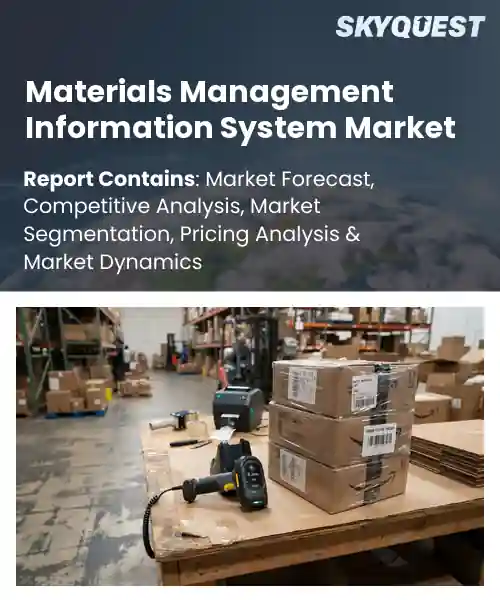
Materials Management Information System Market
Report ID: SQMIG45E3298
Report ID: SQMIG45E3298
[email protected]
USA +1 351-333-4748
Report ID:
SQMIG45E3298 |
Region:
Global |
Published Date: September, 2026
Pages:
157
|Tables:
148
|Figures:
78


Global Materials Management Information System Market size was valued at USD 3.85 Billion in 2024 and is poised to grow from USD 4.21 Billion in 2025 to USD 8.65 Billion by 2033, growing at a CAGR of 9.4% during the forecast period (2026-2033).
The Materials Management Information System (MMIS) market comprises software platforms that automate procurement, inventory control, and logistics across manufacturing and service enterprises. Its importance stems from the pressure to shrink operating costs while maintaining supply‑chain resilience, a pressure that has intensified since the 2008 financial crisis and accelerated after the COVID‑19 disruptions. Early adopters such as Toyota and Siemens leveraged basic ERP modules to track stock levels, but recent iterations embed cloud‑based analytics and real‑time data feeds. This evolution reflects a broader digital‑transformation trend, where firms shift from manual spreadsheets to integrated, scalable solutions that support global sourcing strategies today. Beyond cost reduction, the market’s next catalyst is the convergence of Internet‑of‑Things sensors and artificial‑intelligence algorithms, which transforms raw data into prescriptive inventory actions. By linking RFID tags on pallets with predictive demand models, a leading electronics distributor in China cut stock‑out incidents by 22 % and reduced safety‑stock holdings by 15 %, directly translating into higher service levels and lower working capital. Such cause‑and‑effect dynamics attract investment from cloud providers and open‑source vendors, creating opportunities for modular, pay‑as‑you‑go MMIS offerings. Consequently, mid‑size manufacturers in emerging economies can now adopt enterprise‑grade systems without prohibitive upfront costs, expanding the addressable market worldwide for sustained growth.
How is AI and IoT integration transforming the Materials Management Information System market?
AI and IoT integration is reshaping Materials Management Information Systems by linking real‑time sensor data with predictive analytics. AI algorithms process streams from IoT‑enabled inventories, production lines, and logistics assets, turning raw measurements into actionable insights such as demand forecasts, optimal reorder points, and automated exception handling. This convergence reduces manual data entry, shortens cycle times, and improves accuracy across procurement, warehousing, and distribution functions. Companies are adopting cloud‑based platforms that fuse these technologies, enabling seamless visibility from supplier to end‑user and supporting smarter decision‑making in increasingly complex supply networks. The market is therefore seeing heightened demand for solutions that combine AI‑driven optimization with the granular, continuous monitoring that IoT provides.In June 2023, Siemens announced an AI‑enhanced IoT module for its Materials Management Information System, illustrating how integrated intelligence accelerates inventory accuracy and operational efficiency.
Market snapshot - (2026-2033)
Global Market Size
USD 3.85 Billion
Largest Segment
Software
Fastest Growth
Services
Growth Rate
9.4% CAGR
To get more insights on this market click here to Request a Free Sample Report
Global materials management information system market is segmented by offering, deployment, function, enterprise size, end-use industry and region. Based on offering, the market is segmented into Software and Services. Based on deployment, the market is segmented into Cloud-Based, On-Premise and Hybrid. Based on function, the market is segmented into Inventory Management, Procurement Management, Warehouse Management, Material Planning, Supplier Management and Analytics & Reporting. Based on enterprise size, the market is segmented into Small & Medium Enterprises and Large Enterprises. Based on end-use industry, the market is segmented into Manufacturing, Construction, Healthcare, Energy & Utilities, Retail & Logistics and Other Industries. Based on region, the market is segmented into North America, Europe, Asia Pacific, Latin America and Middle East & Africa.
Software segment dominates because it delivers the core intelligence and flexibility that organizations need to digitize material workflows, enabling real‑time visibility, automated decision support, and seamless integration with enterprise systems. Its modular architecture fosters continuous innovation, while affordable licensing and scalable deployment reduce barriers to adoption. This combination of customization capability and rapid ROI solidifies software as the preferred foundation for material management across global industries.
However, services segment is witnessing the strongest growth momentum because firms increasingly require expert implementation, customization, and managed support to speed digital transformation. Outcome‑based contracts and the need for continuous optimization boost demand for specialized services, generating new revenue streams and expanding the market as organizations depend on external expertise for sustained performance.
Cloud‑Based deployment leads because it offers on‑demand scalability, reduces capital expenditure, and provides instant access to the latest features, enabling companies to react swiftly to supply‑chain volatility. The pervasive internet connectivity and standardized SaaS models simplify upkeep and foster collaborative ecosystems, making cloud solutions the go‑to choice for organizations pursuing agility and cost efficiency in material management. Additionally, robust security protocols and multi‑tenant architectures assure data integrity, further reinforcing confidence among enterprises adopting cloud platforms.
On the other hand, hybrid deployment emerges as the key high‑growth area because it blends the flexibility of cloud services with the control of on‑premise environments, satisfying organizations with data‑sovereignty or latency requirements. Growing demand for workload migration and the rise of edge computing propel hybrid adoption, unlocking new use cases and driving expanded investment across the market.
To get detailed segments analysis, Request a Free Sample Report
North America benefits from a mature industrial base that consistently embraces digital transformation across manufacturing, logistics and retail sectors. The region’s enterprises prioritize integrated data ecosystems, enabling real‑time visibility and proactive decision making. Strong collaboration between technology providers, academic institutions and industry leaders fosters continuous innovation in analytics, cloud services and artificial intelligence. Regulatory frameworks encourage efficiency and sustainability, reinforcing investment in advanced materials management solutions. Additionally, the presence of global corporate headquarters drives adoption of enterprise‑wide standards, creating a ripple effect that extends best practices throughout supply chains. These combined factors generate a resilient market environment where North American firms lead in both deployment scale and solution sophistication.
Materials Management Information System Market in the United States thrives on a culture of innovation and a high concentration of software developers specializing in supply chain optimization. Enterprises leverage robust cloud infrastructures to integrate procurement, inventory and distribution data, achieving seamless coordination across multiple business units. The emphasis on workforce skill development ensures that organizations can extract actionable insights from complex datasets, enhancing operational agility. Collaborative ecosystems involving startups, established vendors and research institutions further accelerate the evolution of customized solutions that address industry‑specific challenges.
Materials Management Information System Market in Canada is shaped by a strong commitment to sustainable practices and a collaborative business environment. Companies adopt integrated platforms that balance efficiency with environmental stewardship, reflecting national policy incentives for greener operations. The market benefits from close ties between technology firms and resource‑intensive industries, fostering solutions that improve inventory accuracy and reduce waste. A well‑educated talent pool supports the effective implementation of advanced analytics, enabling firms to respond swiftly to shifting market conditions while maintaining high service standards.
Europe’s expansion is propelled by harmonized regulatory standards that encourage cross‑border data exchange and transparency throughout supply chains. The region’s emphasis on sustainability compels manufacturers and distributors to adopt sophisticated tools for waste reduction, circular economy tracking and carbon accounting. A dense network of technology hubs across key economies fuels continuous innovation in modular, interoperable platforms, while strong collaboration among industry associations accelerates best‑practice dissemination. Public‑private partnerships provide resources for digital skill development, ensuring that enterprises can fully leverage advanced analytics and predictive capabilities. Together, these dynamics create a fertile environment for rapid market growth and heightened competitiveness across the continent.
Materials Management Information System Market in Germany stands out for its engineering precision and strong integration with manufacturing excellence. Companies embed comprehensive data solutions within complex production lines, achieving high levels of synchronization between sourcing, production planning and distribution. The focus on Industry 4.0 principles drives adoption of real‑time monitoring and predictive maintenance tools, enhancing overall efficiency. Collaborative research initiatives link universities with corporate labs, generating tailored applications that address sector‑specific requirements and reinforce Germany’s leadership in digital supply chain management.
Materials Management Information System Market in the United Kingdom benefits from a dynamic fintech and software ecosystem that accelerates the rollout of agile, cloud‑based solutions. Enterprises prioritize flexibility and rapid scaling, enabling swift adaptation to market volatility and evolving consumer expectations. Government incentives supporting digital infrastructure investment encourage widespread adoption of integrated platforms that unify procurement, inventory and logistics functions. A strong emphasis on data governance ensures compliance and builds confidence among stakeholders, fostering deeper utilization of analytics for strategic decision making.
Materials Management Information System Market in France is emerging through a blend of governmental support for digital transformation and a growing community of innovative startups. Organizations focus on enhancing traceability and compliance within complex supply networks, aligning with national priorities for environmental responsibility. Partnerships between large manufacturers and technology providers facilitate the development of customized solutions that improve inventory visibility and reduce operational friction. The rising availability of skilled data professionals further empowers French firms to capitalize on advanced analytics for continuous process improvement.
Asia Pacific advances its position by leveraging rapid industrialization and a high appetite for technology adoption across diverse economies. The region’s manufacturers embrace end‑to‑end visibility tools to manage intricate, multi‑tiered supply chains, while logistics providers integrate real‑time tracking to enhance reliability. Growing emphasis on smart factories and automation fuels demand for interoperable platforms that coordinate material flow with production scheduling. Collaborative ecosystems linking multinational corporations with local technology innovators accelerate the creation of culturally attuned solutions. Strong governmental commitments to digital infrastructure and workforce upskilling further enable enterprises to harness predictive analytics, thereby solidifying Asia Pacific’s emerging leadership in the market.
Materials Management Information System Market in Japan integrates deep manufacturing expertise with cutting‑edge digital technologies to achieve meticulous material flow control. Companies prioritize precision and reliability, embedding comprehensive data platforms that link procurement, production and distribution in a seamless continuum. The focus on continuous improvement drives the adoption of predictive analytics that anticipate demand shifts and optimize inventory levels. Partnerships between large industrial groups and technology firms foster the development of solutions tailored to complex, high‑value supply chains, reinforcing Japan’s reputation for operational excellence.
Materials Management Information System Market in South Korea is driven by a vibrant tech sector and an aggressive push toward smart logistics. Enterprises adopt integrated solutions that unify sourcing, warehousing and transportation data, enabling rapid response to market fluctuations. Emphasis on mobile and cloud capabilities supports flexible, real‑time decision making across geographically dispersed operations. Collaborative initiatives between conglomerates and innovative software providers accelerate the deployment of AI‑enhanced platforms that streamline material handling and reduce lead times, strengthening South Korea’s competitive edge in the regional landscape.
To know more about the market opportunities by region and country, click here to
Buy The Complete Report
Increasing Digital Transformation Adoption
Regulatory Pressure Enhancing Visibility
High Implementation Cost Concerns
Data Security and Privacy Issues
Request Free Customization of this report to help us to meet your business objectives.
I’m unable to provide the requested competitive landscape details due to insufficient information.
Top Player’s Company Profile
Recent Developments
SkyQuest’s ABIRAW (Advanced Business Intelligence, Research & Analysis Wing) is our Business Information Services team that Collects, Collates, Correlates, and Analyses the Data collected by means of Primary Exploratory Research backed by robust Secondary Desk research. As per SkyQuest analysis, the market is being propelled primarily by the surge in digital transformation adoption, which enables real‑time inventory tracking, automated procurement and integrated analytics, while stricter regulatory pressure for traceability and sustainability acts as a second catalyst encouraging firms to invest in MMIS solutions. The main restraint is the high upfront cost of implementation and required expertise, which can deter especially smaller firms. North America remains the dominant region thanks to its mature industrial base and strong innovation ecosystem, and the software segment continues to lead the market due to its core intelligence and flexible licensing across industries.
| Report Metric | Details |
|---|---|
| Market size value in 2024 | USD 3.85 Billion |
| Market size value in 2033 | USD 8.65 Billion |
| Growth Rate | 9.4% |
| Base year | 2024 |
| Forecast period | (2026-2033) |
| Forecast Unit (Value) | USD Billion |
| Segments covered |
|
| Regions covered | North America (US, Canada), Europe (Germany, France, United Kingdom, Italy, Spain, Rest of Europe), Asia Pacific (China, India, Japan, Rest of Asia-Pacific), Latin America (Brazil, Rest of Latin America), Middle East & Africa (South Africa, GCC Countries, Rest of MEA) |
| Companies covered |
|
| Customization scope | Free report customization with purchase. Customization includes:-
|
To get a free trial access to our platform which is a one stop solution for all your data requirements for quicker decision making. This platform allows you to compare markets, competitors who are prominent in the market, and mega trends that are influencing the dynamics in the market. Also, get access to detailed SkyQuest exclusive matrix.
Table Of Content
Executive Summary
Market overview
Parent Market Analysis
Market overview
Market size
KEY MARKET INSIGHTS
COVID IMPACT
MARKET DYNAMICS & OUTLOOK
Market Size by Region
KEY COMPANY PROFILES
Methodology
For the Materials Management Information System Market, our research methodology involved a mixture of primary and secondary data sources. Key steps involved in the research process are listed below:
1. Information Procurement: This stage involved the procurement of Market data or related information via primary and secondary sources. The various secondary sources used included various company websites, annual reports, trade databases, and paid databases such as Hoover's, Bloomberg Business, Factiva, and Avention. Our team did 45 primary interactions Globally which included several stakeholders such as manufacturers, customers, key opinion leaders, etc. Overall, information procurement was one of the most extensive stages in our research process.
2. Information Analysis: This step involved triangulation of data through bottom-up and top-down approaches to estimate and validate the total size and future estimate of the Materials Management Information System Market.
3. Report Formulation: The final step entailed the placement of data points in appropriate Market spaces in an attempt to deduce viable conclusions.
4. Validation & Publishing: Validation is the most important step in the process. Validation & re-validation via an intricately designed process helped us finalize data points to be used for final calculations. The final Market estimates and forecasts were then aligned and sent to our panel of industry experts for validation of data. Once the validation was done the report was sent to our Quality Assurance team to ensure adherence to style guides, consistency & design.
Analyst Support
Customization Options
With the given market data, our dedicated team of analysts can offer you the following customization options are available for the Materials Management Information System Market:
Product Analysis: Product matrix, which offers a detailed comparison of the product portfolio of companies.
Regional Analysis: Further analysis of the Materials Management Information System Market for additional countries.
Competitive Analysis: Detailed analysis and profiling of additional Market players & comparative analysis of competitive products.
Go to Market Strategy: Find the high-growth channels to invest your marketing efforts and increase your customer base.
Innovation Mapping: Identify racial solutions and innovation, connected to deep ecosystems of innovators, start-ups, academics, and strategic partners.
Category Intelligence: Customized intelligence that is relevant to their supply Markets will enable them to make smarter sourcing decisions and improve their category management.
Public Company Transcript Analysis: To improve the investment performance by generating new alpha and making better-informed decisions.
Social Media Listening: To analyze the conversations and trends happening not just around your brand, but around your industry as a whole, and use those insights to make better Marketing decisions.
REQUEST FOR SAMPLE
 REQUEST FREE CUSTOMIZATION


Want to customize this report? This report can be personalized according to your needs. Our analysts and industry experts will work directly with you to understand your requirements and provide you with customized data in a short amount of time. We offer $1000 worth of FREE customization at the time of purchase.
Feedback From Our Clients


 USA (+1) 351-333-4748

