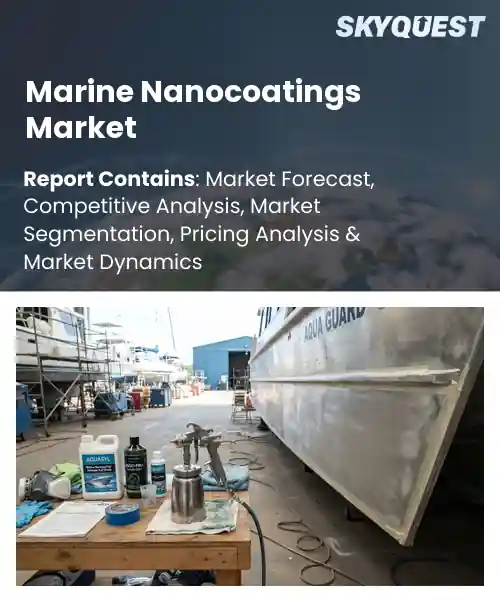
Marine Nanocoatings Market
Report ID: SQMIG15E4521
Report ID: SQMIG15E4521
[email protected]
USA +1 351-333-4748
Report ID:
SQMIG15E4521 |
Region:
Global |
Published Date: November, 2026
Pages:
157
|Tables:
122
|Figures:
77


Global Marine Nanocoatings Market size was valued at USD 480.0 Million in 2024 and is poised to grow from USD 527.04 Million in 2025 to USD 1113.43 Million by 2033, growing at a CAGR of 9.8% during the forecast period (2026-2033).
The marine nanocoatings market encompasses technologies applied to hulls, propellers, and offshore structures to reduce friction, corrosion, and biofouling. Its significance stems from the capacity of layers to extend vessel lifespan while cutting fuel consumption and emissions, a priority for regulators and ship owners alike. Historically, the sector emerged from laboratory breakthroughs in silver‑based biocides during the 2000s, progressed through the introduction of graphene‑infused epoxy in 2012, and accelerated after the International Maritime Organization imposed stricter carbon caps in 2020. These milestones illustrate how environmental mandates and material science have propelled market growth, establishing nanocoatings as an asset for operators. The growth catalyst stems from regulations and the surge in vessels that demand low‑drag hulls to maximize efficiency. When governments set CO₂ caps, ship owners turn to nanocoatings capable of cutting resistance by up to 15 %, which for a 150‑meter container ship translates into fuel savings of hundred thousand dollars annually. These cost benefits drive R&D investment, hastening the rollout of self‑healing silica‑nano composites that mend micro‑scratches in‑service and prolong maintenance cycles. As a result, suppliers are targeting emerging fleets in Southeast Asia, where stricter port inspections create a receptive market and underpin a projected CAGR above 12 % through 2035.
How is AI-driven automation influencing performance and adoption of marine nanocoatings?
AI‑driven automation is reshaping marine nanocoatings by accelerating formulation design, optimizing application processes, and enabling predictive performance monitoring. Machine‑learning models evaluate thousands of polymer‑nanoparticle combinations, identifying blends that deliver superior fouling resistance and corrosion protection while reducing material waste. Sensors embedded in coating lines feed real‑time data to control systems that adjust spray parameters, ensuring uniform thickness and adhesion across complex hull geometries. This digital feedback loop shortens development cycles and lowers entry barriers for shipyards, encouraging broader adoption. As vessels seek longer intervals between dry‑dockings, the promise of higher durability and lower lifecycle costs makes AI‑enhanced nanocoatings increasingly attractive to operators and manufacturers alike.In March 2024, AkzoNobel introduced an AI‑optimized nanocoating that self‑adjusts during application, boosting durability and streamlining installation, thereby supporting faster market uptake and operational efficiency.
Market snapshot - (2026-2033)
Global Market Size
USD 480.0 Million
Largest Segment
Anti-Corrosion Nanocoatings
Fastest Growth
Hydrophobic & Self-Cleaning Nanocoatings
Growth Rate
9.8% CAGR
To get more insights on this market click here to Request a Free Sample Report
Global marine nanocoatings market is segmented by coating type, substrate, application, end user and region. Based on coating type, the market is segmented into Anti-Corrosion Nanocoatings, Antifouling Nanocoatings, Wear-Resistant Nanocoatings, Hydrophobic & Self-Cleaning Nanocoatings and Other Nanocoatings. Based on substrate, the market is segmented into Metal, Composite Materials, Glass and Other Substrates. Based on application, the market is segmented into Hulls & Ship Structures, Offshore Structures, Marine Equipment & Components and Ports & Marine Infrastructure. Based on end user, the market is segmented into Commercial Shipping, Naval & Defense, Offshore Oil & Gas and Recreational Marine. Based on region, the market is segmented into North America, Europe, Asia Pacific, Latin America and Middle East & Africa.
Anti-Corrosion Nanocoatings segment dominates because it directly addresses the perpetual threat of metal degradation in marine environments, delivering molecular-level protection that extends vessel lifespans and reduces maintenance downtime. Shipowners and operators prioritize reliability and cost avoidance, prompting widespread adoption across new builds and retrofits. The proven efficacy of these coatings, combined with industry‑wide standards emphasizing corrosion mitigation, fuels continuous demand and entrenches its leading position in the market global sector.
However, Hydrophobic & Self-Cleaning Nanocoatings segment emerges as the fastest‑growing area because its ability to repel water and fouling dramatically cuts cleaning cycles and fuel consumption. Innovations in nano‑texture engineering and rising environmental regulations encouraging non‑toxic solutions are accelerating adoption, opening new avenues for efficiency gains across diverse marine assets.
Hulls & Ship Structures segment dominates because the hull remains the primary interface exposed to harsh seawater, biofouling, and mechanical wear, making it the focal point for protective nanocoatings. Operators seek to minimize drag, corrosion, and repair costs, driving extensive coating deployments on new and existing vessels. This central role secures its preeminence within the marine nanocoatings market by delivering measurable performance improvements and supporting regulatory compliance across global fleets.
Meanwhile, Ports & Marine Infrastructure segment is witnessing the strongest growth momentum because nanocoatings are increasingly applied to docks, piers, and submerged structures to extend service life and reduce biofouling. Focus on operational uptime and stricter environmental mandates drive investment, accelerating market expansion and creating new revenue streams.
To get detailed segments analysis, Request a Free Sample Report
The Asia Pacific region benefits from a confluence of advanced shipbuilding capacity, strong governmental emphasis on environmental stewardship, and a robust network of research institutions focused on nanotechnology. Leading yards in the region pursue high‑performance coatings to meet demanding operational schedules and stringent emissions regulations, driving early adoption of nanocoated solutions. Collaborative initiatives between academia, industry, and maritime authorities foster rapid innovation cycles, while cost‑effective production capabilities enable competitive pricing that attracts global customers. Additionally, the region’s extensive coastlines and busy shipping lanes create a natural laboratory for field testing, reinforcing confidence in product reliability and accelerating market penetration across a diverse fleet spectrum.
Japan Marine Nanocoatings Market
Marine Nanocoatings Market activity in Japan is propelled by a legacy of precision engineering and a strategic focus on sustainable maritime operations. Domestic shipbuilders prioritize cutting‑edge protective layers to extend vessel lifespan and reduce maintenance downtime, aligning with national objectives for greener shipping. Strong ties between research universities and coating manufacturers accelerate the translation of nanomaterial breakthroughs into commercial products, positioning Japan as a hub for high‑performance marine solutions.
South Korea Marine Nanocoatings Market
Marine Nanocoatings Market growth in South Korea is driven by a vibrant shipbuilding sector that embraces innovative surface technologies to enhance fuel efficiency and corrosion resistance. Government incentives encourage the adoption of environmentally friendly coatings, while close cooperation between shipyards and nanomaterial specialists shortens development timelines. The focus on export‑oriented shipbuilding amplifies the demand for premium nanocoated finishes that meet international standards, reinforcing South Korea’s role in the regional market.
Europe’s expansion is fueled by rigorous environmental directives, a strong tradition of engineering excellence, and a competitive maritime corridor that spans multiple economies. Regulatory frameworks compel operators to seek coatings that lower emissions and extend service intervals, while leading research clusters in key countries deliver continuous nanomaterial innovations. The presence of major naval architects and sophisticated shipyards creates a demand for high‑value protective solutions that align with sustainability goals. Collaborative industry consortia further streamline adoption across the continent, ensuring that advances in nanocoatings rapidly translate into operational benefits for commercial and naval fleets alike.
Germany Marine Nanocoatings Market
Marine Nanocoatings Market in Germany benefits from a dense concentration of engineering firms and research institutions that specialize in advanced materials. The country’s shipbuilding and repair landscape emphasizes precision and durability, prompting early uptake of nanocoated technologies to meet strict performance criteria. Strong collaboration between academia and industry accelerates the development of tailored solutions, reinforcing Germany’s position as a dominant market within Europe.
United Kingdom Marine Nanocoatings Market
Marine Nanocoatings Market in the United Kingdom is characterized by rapid uptake driven by ambitious sustainability targets and a flourishing maritime services sector. Leading ports and shipyards adopt nanocoatings to reduce downtime and comply with evolving environmental standards. A vibrant ecosystem of startups and established coating manufacturers nurtures innovation, while close ties to European research initiatives accelerate knowledge transfer, making the United Kingdom the fastest growing market in the region.
France Marine Nanocoatings Market
Marine Nanocoatings Market in France is emerging as a focal point for innovative coating applications, supported by a strong naval heritage and increasing emphasis on eco‑friendly maritime practices. Collaborative projects between French research labs and marine operators foster the development of bespoke nanocoated products. The growing awareness of maintenance cost reductions and performance gains is encouraging early adopters, positioning France as an emerging market within the European landscape.
North America reinforces its market position through a combination of advanced research capabilities, extensive commercial shipping networks, and a proactive regulatory environment encouraging greener technologies. Leading universities and private labs drive breakthroughs in nanomaterial formulation, while major shipyards integrate these innovations to improve vessel efficiency and longevity. Industry associations promote best practices that accelerate adoption across both commercial and defense fleets. The region’s emphasis on operational reliability and cost‑effective maintenance fuels sustained interest in nanocoatings, ensuring that North America remains a pivotal arena for market expansion and technological leadership.
United States Marine Nanocoatings Market
Marine Nanocoatings Market in the United States is propelled by a robust maritime industry that values high performance and regulatory compliance. Prominent shipbuilding hubs invest heavily in research collaborations to develop durable nanocoated solutions that lower fuel consumption and extend maintenance cycles. The focus on innovation, combined with strong demand from both commercial and naval fleets, sustains the United States as a key driver of market growth.
Canada Marine Nanocoatings Market
Marine Nanocoatings Market in Canada benefits from a strategic emphasis on cold‑water performance and corrosion protection for vessels operating in challenging maritime conditions. Partnerships between coastal research centers and coating manufacturers yield formulations optimized for harsh environments. Government initiatives encouraging sustainable shipping practices further support the adoption of advanced nanocoatings, solidifying Canada’s role in the North American market.
To know more about the market opportunities by region and country, click here to
Buy The Complete Report
Improved Hull Efficiency
Advanced Corrosion Protection
High Initial Application Costs
Limited Technical Expertise Availability
Request Free Customization of this report to help us to meet your business objectives.
The competitive landscape of the Global Marine Nanocoatings Market is shaped by intense rivalry among established chemical giants and agile innovators, driving accelerated adoption of high‑performance, environmentally compliant coatings. Market pressure has spurred strategic M&A such as a leading pigment producer acquiring a niche nanocoating firm, while partnerships between shipbuilders and technology providers accelerate field trials. Companies are also investing in breakthrough nanostructured antifouling technologies to differentiate product portfolios and capture premium segments.
Top Player’s Company Profile
Recent Developments
SkyQuest’s ABIRAW (Advanced Business Intelligence, Research & Analysis Wing) is our Business Information Services team that Collects, Collates, Correlates, and Analyses the Data collected by means of Primary Exploratory Research backed by robust Secondary Desk research. As per SkyQuest analysis the global marine nanocoatings market is being propelled primarily by improved hull efficiency, which reduces fuel consumption and emissions, while a second strong driver is advanced corrosion protection that extends vessel lifespan and cuts maintenance costs. The anti‑corrosion nanocoatings segment remains the market leader because it directly tackles metal degradation. Asia Pacific dominates the market thanks to its massive shipbuilding capacity, supportive regulations and active research ecosystem. However, high initial application costs act as a notable restraint, limiting adoption especially among smaller operators who must balance upfront spending against long‑term savings. These trends suggest continued growth through 2033 as more fleets modernize.
| Report Metric | Details |
|---|---|
| Market size value in 2024 | USD 480.0 Million |
| Market size value in 2033 | USD 1113.43 Million |
| Growth Rate | 9.8% |
| Base year | 2024 |
| Forecast period | (2026-2033) |
| Forecast Unit (Value) | USD Million |
| Segments covered |
|
| Regions covered | North America (US, Canada), Europe (Germany, France, United Kingdom, Italy, Spain, Rest of Europe), Asia Pacific (China, India, Japan, Rest of Asia-Pacific), Latin America (Brazil, Rest of Latin America), Middle East & Africa (South Africa, GCC Countries, Rest of MEA) |
| Companies covered |
|
| Customization scope | Free report customization with purchase. Customization includes:-
|
To get a free trial access to our platform which is a one stop solution for all your data requirements for quicker decision making. This platform allows you to compare markets, competitors who are prominent in the market, and mega trends that are influencing the dynamics in the market. Also, get access to detailed SkyQuest exclusive matrix.
Table Of Content
Executive Summary
Market overview
Parent Market Analysis
Market overview
Market size
KEY MARKET INSIGHTS
COVID IMPACT
MARKET DYNAMICS & OUTLOOK
Market Size by Region
KEY COMPANY PROFILES
Methodology
For the Marine Nanocoatings Market, our research methodology involved a mixture of primary and secondary data sources. Key steps involved in the research process are listed below:
1. Information Procurement: This stage involved the procurement of Market data or related information via primary and secondary sources. The various secondary sources used included various company websites, annual reports, trade databases, and paid databases such as Hoover's, Bloomberg Business, Factiva, and Avention. Our team did 45 primary interactions Globally which included several stakeholders such as manufacturers, customers, key opinion leaders, etc. Overall, information procurement was one of the most extensive stages in our research process.
2. Information Analysis: This step involved triangulation of data through bottom-up and top-down approaches to estimate and validate the total size and future estimate of the Marine Nanocoatings Market.
3. Report Formulation: The final step entailed the placement of data points in appropriate Market spaces in an attempt to deduce viable conclusions.
4. Validation & Publishing: Validation is the most important step in the process. Validation & re-validation via an intricately designed process helped us finalize data points to be used for final calculations. The final Market estimates and forecasts were then aligned and sent to our panel of industry experts for validation of data. Once the validation was done the report was sent to our Quality Assurance team to ensure adherence to style guides, consistency & design.
Analyst Support
Customization Options
With the given market data, our dedicated team of analysts can offer you the following customization options are available for the Marine Nanocoatings Market:
Product Analysis: Product matrix, which offers a detailed comparison of the product portfolio of companies.
Regional Analysis: Further analysis of the Marine Nanocoatings Market for additional countries.
Competitive Analysis: Detailed analysis and profiling of additional Market players & comparative analysis of competitive products.
Go to Market Strategy: Find the high-growth channels to invest your marketing efforts and increase your customer base.
Innovation Mapping: Identify racial solutions and innovation, connected to deep ecosystems of innovators, start-ups, academics, and strategic partners.
Category Intelligence: Customized intelligence that is relevant to their supply Markets will enable them to make smarter sourcing decisions and improve their category management.
Public Company Transcript Analysis: To improve the investment performance by generating new alpha and making better-informed decisions.
Social Media Listening: To analyze the conversations and trends happening not just around your brand, but around your industry as a whole, and use those insights to make better Marketing decisions.
REQUEST FOR SAMPLE
 REQUEST FREE CUSTOMIZATION


Want to customize this report? This report can be personalized according to your needs. Our analysts and industry experts will work directly with you to understand your requirements and provide you with customized data in a short amount of time. We offer $1000 worth of FREE customization at the time of purchase.
Feedback From Our Clients


 USA (+1) 351-333-4748

