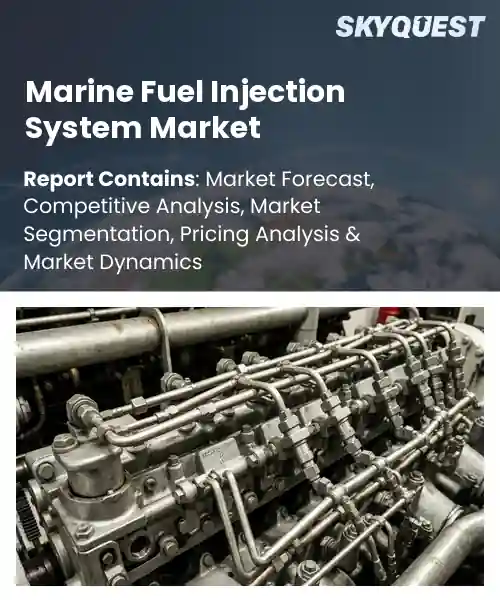
Marine Fuel Injection System Market
Report ID: SQMIG20F2071
Report ID: SQMIG20F2071
[email protected]
USA +1 351-333-4748
Report ID:
SQMIG20F2071 |
Region:
Global |
Published Date: June, 2026
Pages:
157
|Tables:
180
|Figures:
79


Global Marine Fuel Injection System Market size was valued at USD 4.7 Billion in 2024 and is poised to grow from USD 4.86 Billion in 2025 to USD 6.35 Billion by 2033, growing at a CAGR of 3.4% during the forecast period (2026-2033).
The marine fuel injection system market mostly revolves around those technologies that manage to deliver and meter fuel into ship engines, like making sure every drop is in the right place, and the big push behind it is this two-part need for regulatory emissions control and operational efficiency at the same time. As global shipping grows, stricter IMO rules plus regional sulfur caps forced operators to switch toward injection systems that can be more exact, so they cut down NOx and particulate outputs while also helping fuel economy. It ends up mattering for both compliance and operating margins. For a while, mechanical pumps were the norm, then electronic common-rail setups and smarter nozzles came along, as manufacturers and shipowners looked for retrofit work, and also for new-build projects.
And on top of emissions and efficiency pressure, technological integration is the key factor driving the marine fuel injection system market growth. Digital controls, plus sensors, let injection timing be more precise, and the fueling can become adaptive which then lowers overall consumption and maintenance spend. When ship operators add condition-based monitoring together with electronic common-rail systems, engines usually run nearer their best operating maps. That means less fuel burn and longer overhaul intervals. This outcome was described in tanker retrofit reports where owners said they saw double digit fuel savings. So then OEMs and aftermarket players can bundle hardware with analytics, and that opens up new financing opportunities. Meanwhile LNG and hybrid propulsion are getting more momentum, and those integrated packages seem to push adoption further and help companies capture more value from it.
IoT improves efficiency by adding continuous sensing and closed loop control directly into how the engines behave. The main pieces include onboard sensors for injection pressure and fuel flow, secure connectivity into ship systems, and analytics that turn raw signals into practical adjustments. Right now the market is shifting, it’s moving from basic telematics toward integrated platform services that blend edge processing with cloud intelligence. That helps operators still meet stricter emissions expectations while also reducing operating cost, mainly through adaptive injection mapping and condition based maintenance. Manufacturers and ship operators are also starting to offer remote diagnostics, plus lifecycle agreements, and those arrangements lean on live engine data so they can prevent faults and also tune injection timing for cleaner combustion, without waiting for breakdowns.
Market snapshot - (2026-2033)
Global Market Size
USD 4.7 Billion
Largest Segment
Mechanical Fuel Injection Systems
Fastest Growth
Common Rail Fuel Injection Systems
Growth Rate
3.4% CAGR
To get more insights on this market click here to Request a Free Sample Report
The global marine fuel injection system market is segmented by product type, engine type, fuel type, vessel type, component, end user and region. Based on product type, the market is segmented into Common Rail Fuel Injection Systems, Unit Injector Systems, Pump-Line-Nozzle Injection Systems, Electronic Fuel Injection Systems and Mechanical Fuel Injection Systems. Based on engine type, the market is segmented into Two-Stroke Marine Engines and Four-Stroke Marine Engines. Based on fuel type, the market is segmented into Heavy Fuel Oil (HFO), Marine Diesel Oil (MDO), Marine Gas Oil (MGO), Liquefied Natural Gas (LNG) and Methanol & Alternative Fuels. Based on vessel type, the market is segmented into Commercial Vessels, Naval Vessels, Offshore Support Vessels, Fishing Vessels and Recreational & Leisure Boats. Based on component, the market is segmented into Fuel Injectors, Fuel Pumps, Electronic Control Units (ECU), Fuel Valves, Fuel Rails and Nozzles. Based on end user, the market is segmented into Shipbuilding Companies, Marine Engine Manufacturers, Fleet Operators and Marine Repair & Retrofit Providers. Based on region, the market is segmented into North America, Europe, Asia Pacific, Latin America and Middle East & Africa.
As per the marine fuel injection system market analysis, the Electronic Control Units (ECU) segment leads, because modern ECUs put together precise injection timing, adaptive mapping,and closed-loop control in one place, which helps fuel systems hit stricter emissions plus efficiency targets. It also makes combustion optimization easier across all operating profiles. When ECUs integrate with sensors and diagnostics, reliability tends to go up and predictive maintenance becomes possible , so lifecycle expenses drop a bit, and that’s also pushing engine makers and fleet operators to adopt solutions for both newbuild and retrofit use cases, with performance, compliance, and digitalization in mind.
Still, the Fuel Injectors segment is showing the most noticeable growth momentum since advanced nozzle geometries and material choices keep improving for higher pressures, and for alternative fuels too. That’s basically why replacement cycles and upgrade demand are increasing. With progress in atomization behavior , wear resistance, and compatibility for low-sulfur fuels plus alternatives, retrofit activity accelerates. This then opens room for specialized suppliers and aftermarket services that can actually support those upgrades.
According to the marine fuel injection system market forecast, the Liquefied Natural Gas (LNG) segment stands out since the fuel is gaseous and its emissions profile is lower, so the whole injection setup has to shift. That means more changes in injection architecture, material selection, and sealing requirements. Developers are focusing on high-pressure gas delivery systems, specialized valves,and updated ECU strategies, all aimed at safe dual-fuel operation. Because of that, engine makers and injection suppliers are working closer to redesign components for reliability, stable combustion, and compliance as marine emission rules keep evolving.
On the other hand, Methanol & Alternative Fuels segment is becoming the fastest growing area, mainly due to the broad interest in lower-carbon liquid fuels, and the fact that engines can be adapted with less friction. Better injector compatibility, fuel handling setups, and regulatory support are helping pilot projects and retrofits move forward. As these activities expand, they create a steady need for new injection components, plus aftermarket solutions that can fit varying system designs.
To get detailed segments analysis, Request a Free Sample Report
As per the marine fuel injection system market regional forecast, Asia Pacific leads the market due to this packed shipbuilding capacity, plus strong maritime trade corridors, and a lot of retrofit activity across merchant, and offshore fleets not just one segment. Manufacturers there get to lean on dense supplier linkages, really solid component engineering, and they’re close to major engine producers which makes it easier to plug in efficient injection technologies fast. On top of that, policy talk about emissions reduction and better operational efficiency has pushed demand for low emission, and fuel efficient systems, like seriously. Then there’s this more collaborative, hand in hand research and development vibe between industry and academic circles, so electronic control adaptation and alternative fuel compatibility can move quicker. And, robust aftermarket services with skilled technical labor keep installation and maintenance rolling, so the region stays strong in both original equipment, and retrofit segments. Large domestic fleets, plus strategic port infrastructure investments, also fill out the market depth, making sure service hubs stay active and supply chain resilience doesn’t wobble.
Japan Marine Fuel Injection System Market
The Marine Fuel Injection System industry in Japan works well because it’s near leading engine manufacturers and there is this culture of precision engineering. Local suppliers focus on product reliability and on system integration with advanced electronic controls, targeting high performance commercial vessels, as well as specialized ship types. Strong maintenance networks allow quick service response and more efficient retrofit deployments. Plus collaboration between industry players and technical institutes keeps refining injection components and testing protocols so they align with strict operational expectations, reliably.
South Korea Marine Fuel Injection System Market
The Marine Fuel Injection System sector in South Korea is shaped by major shipbuilding capacity and a clear push for maritime technology innovation. Local manufacturers go for compact designs and compatibility with different fuel types, matching up with modernization initiatives across regional fleets. Service providers deliver integrated retrofit packages, and also diagnostic support, which helps improve system uptime in day to day operations. Partnerships between companies and research centers help speed up the adoption of advanced control algorithms, plus materials that support injection precision and long term durability.
What is Driving the Rapid Expansion of Marine Fuel Injection System Market in Europe?
Europe is seeing rapid marine fuel injection system market penetration because environmental policy pressure is coming together with fleet modernization, and there’s also a strong focus on fuel efficiency across commercial routes and coastal operations. Stricter emissions expectations, along with incentives for cleaner propulsion, has pushed operators to adopt advanced injection technologies and retrofit options. There is also a mature supplier ecosystem and deep engineering know how that supports electronic control deployments, and readiness for alternative fuels. Collaborative programs between ports, classification bodies, and technology vendors help standardize implementation, and also make aftermarket support more consistent. The region’s dense web of service providers and refit hubs helps ensure upgrades happen on time, while demand for low emission solutions is driving competition, and pushing innovation among equipment manufacturers. Financing mechanisms that are more accessible, plus dedicated testing facilities, reduce barriers for smaller operators trying to adopt modern injection systems and fuel management tools.
Germany Marine Fuel Injection System Market
The Marine Fuel Injection System Market in Germany is supported by strong engineering traditions and an established marine equipment manufacturing base. Suppliers stress system integration, careful testing, and compliance with classification needs, which helps adoption among shipowners in commercial segments, plus specialized operators too. With a dense network of service providers, complex upgrades become more manageable. Close collaboration between component manufacturers and research organizations also advances control electronics and fuel conditioning technologies that are tuned for demanding operational profiles.
United Kingdom Marine Fuel Injection System Market
Marine Fuel Injection System Market in the United Kingdom is typically described by rising interest in retrofit solutions, and remote monitoring capabilities. Suppliers and integrators lean into modular design approaches to support coastal operators, and specialty fleets with different needs. A fairly active services sector supports targeted overhauls and onshore testing, which reduces downtime during upgrades. Collaborative initiatives with port authorities, and technology vendors also help trial alternative fuel compatibility, plus refined control strategies aimed at improved efficiency levels.
France Marine Fuel Injection System Market
The Marine Fuel Injection System Market in France is gaining momentum as investments in low emission technologies ramp up, along with retrofit focused initiatives. Domestic manufacturers highlight adaptability to alternative fuels and control precision, supporting everything from coastal vessels to more specialized applications. Collaboration among ports, classification societies, and equipment vendors promotes standardized testing, and clearer certification pathways. At the same time expanding service networks, and refit facilities, are meeting growing interest in system upgrades, plus better fuel management solutions.
North America seems to be pushing harder into the marine fuel injection system market, mostly by doing a lot at the same time, fleet renewal, aftermarket services, and newer technology uptake among commercial plus coastal operators. In practice regional shipyards and service hubs handle those tough retrofits, with OEMs and suppliers leaning into electronic controls, diagnostics, and alternative fuel readiness, because the operational priorities keep shifting. There are also cooperative efforts between operators, technology vendors, and classification bodies, so that implementation stays more standardized and performance checks are actually consistent. At the same time, people are investing in digital fuel management and remote diagnostics, which gives better operational sight and then supports predictive maintenance, like anticipating issues before they become problems. A wider web of training centers plus certified service providers helps improve installation steadiness and lifecycle follow-up, and that in turn encourages broader market adoption, alongside small but continuous innovation across both equipment and service offerings. Port-led demonstration work plus co-funded models are also lowering the initial adoption friction for operators thinking about new injection platforms and fuel systems.
United States Marine Fuel Injection System Market
In the United States, the marine fuel injection system market benefits from a mix of commercial vessels and specialized craft that are actively seeking better fuel efficiency and lower emissions. Suppliers tend to highlight advanced electronic controls, strong diagnostics, and hybrid integration so they can match very different operational needs. There’s also a fairly wide aftermarket landscape, meaning retrofit know-how and parts availability are easier to access. Partnerships involving ports, research organizations, and classification societies help with testing alternative fuel compatibility and building maintenance approaches that can be scaled, which helps keep operational reliability stronger.
Canada Marine Fuel Injection System Market
In Canada, the marine fuel injection system market is shaped by coastal fleet requirements, plus an overall preference for dependable fuel efficient operation even when conditions get harsh in different marine environments. Suppliers adjust systems for cold-weather resilience and they also offer fuel flexibility, while service providers underline on-site diagnostics and retrofit support. Some partnerships with regional ports and research bodies run trials for alternative fuel, and control improvements, so the systems can be proven in real settings. Meanwhile, investment in certified training and maintenance networks builds technical capacity, and that supports continued upgrades without losing consistency.
To know more about the market opportunities by region and country, click here to
Buy The Complete Report
Rising Demand For Fuel Efficiency
Stringent Emission Regulations Worldwide
High Initial System Costs
Technical Integration Challenges
Request Free Customization of this report to help us to meet your business objectives.
The competitive landscape of the global marine fuel injection system market is shaped by, incumbent OEMs that keep pushing into dual fuel and low carbon injectors while regulators, and shipowners basically keep pressuring decarbonization so, that in turn leads to consolidation and technical partnerships. In recent market moves, there are acquisitions of analytics and digital fuel platforms, plus some product co-development between engine makers and fuel technology firms. Meanwhile the big players are investing in LPDI and HPDI innovations, to back methanol, ammonia, and hydrogen adoption.
Top Player’s Company Profile
Recent Developments in the Marine Fuel Injection System Market
SkyQuest’s ABIRAW (Advanced Business Intelligence, Research & Analysis Wing) is our Business Information Services team that Collects, Collates, Correlates, and Analyses the Data collected by means of Primary Exploratory Research backed by robust Secondary Desk research.
As per SkyQuest analysis, the global marine fuel injection system market is mostly pushed by strict emission regulations that basically force adoption of accurate injection technologies, while a major second driver is technological integration through IoT, sensors, and analytics that allow adaptive fueling plus predictive maintenance. Growth can be slowed by high upfront system costs, which can make retrofits on older vessels feel impractical. Asia Pacific still leads the market, largely because shipbuilding is concentrated there, supplier networks are dense, and retrofit activity is extensive. If zooming in on product components, the Electronic Control Unit segment tends to lead, since it centralizes injection timing, adaptive mapping and diagnostics, so it becomes key for compliance, efficiency, and the shift toward alternative fuels.
| Report Metric | Details |
|---|---|
| Market size value in 2024 | USD 4.7 Billion |
| Market size value in 2033 | USD 6.35 Billion |
| Growth Rate | 3.4% |
| Base year | 2024 |
| Forecast period | (2026-2033) |
| Forecast Unit (Value) | USD Billion |
| Segments covered |
|
| Regions covered | North America (US, Canada), Europe (Germany, France, United Kingdom, Italy, Spain, Rest of Europe), Asia Pacific (China, India, Japan, Rest of Asia-Pacific), Latin America (Brazil, Rest of Latin America), Middle East & Africa (South Africa, GCC Countries, Rest of MEA) |
| Companies covered |
|
| Customization scope | Free report customization with purchase. Customization includes:-
|
To get a free trial access to our platform which is a one stop solution for all your data requirements for quicker decision making. This platform allows you to compare markets, competitors who are prominent in the market, and mega trends that are influencing the dynamics in the market. Also, get access to detailed SkyQuest exclusive matrix.
Table Of Content
Executive Summary
Market overview
Parent Market Analysis
Market overview
Market size
KEY MARKET INSIGHTS
COVID IMPACT
MARKET DYNAMICS & OUTLOOK
Market Size by Region
KEY COMPANY PROFILES
Methodology
For the Marine Fuel Injection System Market, our research methodology involved a mixture of primary and secondary data sources. Key steps involved in the research process are listed below:
1. Information Procurement: This stage involved the procurement of Market data or related information via primary and secondary sources. The various secondary sources used included various company websites, annual reports, trade databases, and paid databases such as Hoover's, Bloomberg Business, Factiva, and Avention. Our team did 45 primary interactions Globally which included several stakeholders such as manufacturers, customers, key opinion leaders, etc. Overall, information procurement was one of the most extensive stages in our research process.
2. Information Analysis: This step involved triangulation of data through bottom-up and top-down approaches to estimate and validate the total size and future estimate of the Marine Fuel Injection System Market.
3. Report Formulation: The final step entailed the placement of data points in appropriate Market spaces in an attempt to deduce viable conclusions.
4. Validation & Publishing: Validation is the most important step in the process. Validation & re-validation via an intricately designed process helped us finalize data points to be used for final calculations. The final Market estimates and forecasts were then aligned and sent to our panel of industry experts for validation of data. Once the validation was done the report was sent to our Quality Assurance team to ensure adherence to style guides, consistency & design.
Analyst Support
Customization Options
With the given market data, our dedicated team of analysts can offer you the following customization options are available for the Marine Fuel Injection System Market:
Product Analysis: Product matrix, which offers a detailed comparison of the product portfolio of companies.
Regional Analysis: Further analysis of the Marine Fuel Injection System Market for additional countries.
Competitive Analysis: Detailed analysis and profiling of additional Market players & comparative analysis of competitive products.
Go to Market Strategy: Find the high-growth channels to invest your marketing efforts and increase your customer base.
Innovation Mapping: Identify racial solutions and innovation, connected to deep ecosystems of innovators, start-ups, academics, and strategic partners.
Category Intelligence: Customized intelligence that is relevant to their supply Markets will enable them to make smarter sourcing decisions and improve their category management.
Public Company Transcript Analysis: To improve the investment performance by generating new alpha and making better-informed decisions.
Social Media Listening: To analyze the conversations and trends happening not just around your brand, but around your industry as a whole, and use those insights to make better Marketing decisions.
REQUEST FOR SAMPLE
 REQUEST FREE CUSTOMIZATION
Global Marine Fuel Injection System Market size was valued at USD 4.7 Billion in 2024 and is poised to grow from USD 4.86 Billion in 2025 to USD 6.35 Billion by 2033, growing at a CAGR of 3.4% during the forecast period (2026-2033).
The competitive landscape for the global marine fuel injection system market is shaped by incumbent OEMs expanding into dual fuel and low carbon injectors while regulators and shipowners push decarbonization, driving consolidation and technical partnerships. Recent market activity shows acquisitions of analytics and digital fuel platforms and product co development between engine makers and fuel technology firms, with incumbents investing in LPDI and HPDI innovations to support methanol, ammonia and hydrogen use. 'Robert Bosch GmbH', 'Woodward, Inc.', 'L’Orange GmbH', 'Liebherr-International AG', 'Wärtsilä Corporation', 'Rolls-Royce plc', 'Cummins Inc.', 'Caterpillar Inc.', 'MAN Energy Solutions SE', 'Yanmar Holdings Co., Ltd.', 'Mitsubishi Heavy Industries, Ltd.', 'Hyundai Heavy Industries Co., Ltd.', 'Doosan Enerbility Co., Ltd.', 'Kubota Corporation', 'Daihatsu Diesel Mfg. Co., Ltd.', 'Scania AB', 'Volvo Penta', 'YANMAR Marine International B.V.', 'Nikko Co., Ltd.', 'Dellner Bubenzer Germany GmbH'
Improved focus on operational efficiency among shipowners drives adoption of advanced fuel injection systems that optimize combustion and reduce fuel consumption. These systems enable better engine tuning and smoother fuel delivery, which translates into lower operating costs and extended engine life. As shipping companies prioritize cost reduction and environmental performance, demand for precision injection technologies increases, encouraging manufacturers to invest in development and deployment. This alignment of commercial incentives and technological capability supports sustained market growth through broader retrofit and new build uptake across diverse vessel classes.
Decarbonization Driven Fuel Shifts: Marine operators and equipment suppliers are increasingly prioritizing low carbon and alternative fuel pathways, prompting manufacturers to adapt injection technologies for broader fuel compatibility and cleaner combustion. This trend emphasizes collaboration between shipowners, engine makers, and fuel providers to enable regulatory compliance and long term sustainability goals. Demand centers on modular solutions that support gradual transition and retrofitability, as stakeholders seek to balance operational reliability with evolving emissions standards and corporate environmental commitments and economic resilience measures.
Why does Asia Pacific Dominate the Global Marine Fuel Injection System Market? |@12


Want to customize this report? This report can be personalized according to your needs. Our analysts and industry experts will work directly with you to understand your requirements and provide you with customized data in a short amount of time. We offer $1000 worth of FREE customization at the time of purchase.
Feedback From Our Clients


 USA (+1) 351-333-4748

