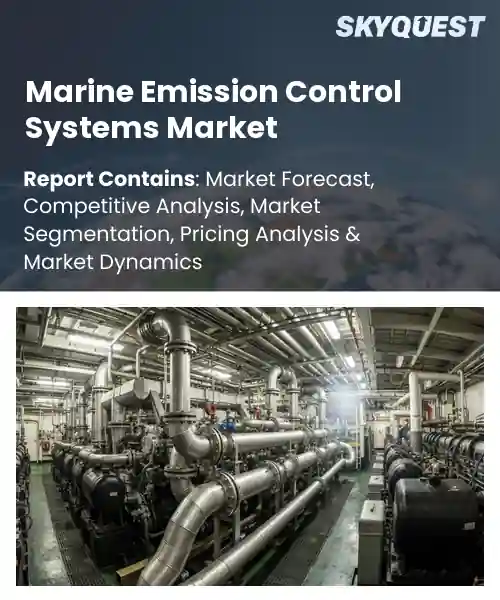
Marine Emission Control Systems Market
Report ID: SQMIG20T2037
Report ID: SQMIG20T2037
[email protected]
USA +1 351-333-4748
Report ID:
SQMIG20T2037 |
Region:
Global |
Published Date: May, 2026
Pages:
157
|Tables:
119
|Figures:
72


Global Marine Emission Control Systems Market size was valued at USD 4.82 Billion in 2024 and is poised to grow from USD 5.2 Billion in 2025 to USD 9.52 Billion by 2033, growing at a CAGR of 7.88% during the forecast period (2026-2033).
The marine emission control systems market covers technologies and services that reduce ship air pollutants, such as scrubbers, SCR units, particulate filters and shore power integration. It matters because international and regional regulations now limit sulfur oxides, nitrogen oxides and particulates, compelling shipowners to adopt abatement or cleaner fuels. During the past decade regulatory milestones like IMO 2020 and the establishment of emission control areas in North America and Europe moved the sector from pilots to broad retrofit and newbuild programs. Container lines and cruise operators provide examples of accelerated investment as compliance obligations reshaped fleet engineering and procurement strategies.The principal growth driver is regulatory stringency combined with shifting fuel economics, which creates direct demand for emission control technologies and related services. When stricter limits are imposed, operators must comply, so shipowners weigh retrofitting scrubbers against switching to low-sulfur or alternative fuels; historically wide spreads between high-sulfur and compliant fuels accelerated scrubber paybacks and triggered large retrofit campaigns on container and tanker fleets. Meanwhile port electrification incentives cause more vessels to install shore power interfaces, producing new revenue for yards and system integrators. These cause-and-effect dynamics open opportunities in retrofit engineering, remote monitoring, washwater treatment and lifecycle service contracts.
How is AI enhancing efficiency in the marine emission control systems market?
AI is improving efficiency in the marine emission control systems market by combining advanced sensors data analytics and control algorithms to enable real time monitoring predictive maintenance and adaptive process control. Key aspects include sensor fusion for exhaust composition machine learning models that predict scrubber performance and digital twins that optimise system settings under varied sea and fuel conditions. The market is shifting as stricter regulations and retrofit demand push operators toward data driven solutions. Examples range from autonomous fault detection that reduces downtime to voyage optimisation that lowers fuel related emissions while simplifying compliance.Kongsberg Maritime February 2026, launched KM Performance a unified digital platform that uses sensor data and analytics to automate emissions reporting and voyage optimisation. By applying AI for dynamic trim and hull performance analytics the platform helps operators reduce fuel use and simplifies compliance which supports market growth.
Market snapshot - (2026-2033)
Global Market Size
USD 4.82 Billion
Largest Segment
Exhaust Gas Cleaning Systems (Scrubbers)
Fastest Growth
Selective Catalytic Reduction (SCR)
Growth Rate
7.88% CAGR
To get more insights on this market click here to Request a Free Sample Report
Global marine emission control systems market is segmented by system type, scrubber type, vessel type, pollutant controlled and region. Based on system type, the market is segmented into Exhaust Gas Cleaning Systems (Scrubbers), Selective Catalytic Reduction (SCR), Exhaust Gas Recirculation (EGR) and Seawater Scrubber. Based on scrubber type, the market is segmented into Open Loop, Closed Loop and Hybrid. Based on vessel type, the market is segmented into Container Ships, Bulk Carriers, Tankers and Cruise Ships. Based on pollutant controlled, the market is segmented into SOx, NOx and PM. Based on region, the market is segmented into North America, Europe, Asia Pacific, Latin America and Middle East & Africa.
Selective Catalytic Reduction (SCR) segment leads because SCR delivers the most reliable and proven pathway to achieve stringent NOx limits across diverse marine engines, enabling operators to meet regulatory requirements while preserving engine performance. Its dominance is driven by established technology maturity, compatibility with retrofit installations, predictable maintenance regimes, and operator familiarity, which reduce operational uncertainty and encourage shipowners and OEMs to prioritize SCR when planning long term emissions strategies.
However, Exhaust Gas Recirculation (EGR) is emerging as the most rapidly expanding area due to evolving engine designs and demand for non catalytic NOx solutions. Its growth is propelled by lower chemical dependency, simpler waste handling, and integration potential with low speed engines, positioning EGR to unlock retrofit opportunities and diversify compliance pathways for operators.
Closed loop segment stands out because closed loop scrubbers allow vessels to meet stringent discharge constraints while operating not reliant on seawater circulation, giving operators reliable compliance in sensitive waters and during port calls. Their technical strengths include controlled pH management, reduced washwater discharge, and easier documentation for regulators, which together reduce operational risk, simplify route planning, and increase adoption where environmental monitoring and discharge limits are critical.
However, hybrid scrubbers are witnessing the strongest growth momentum as they offer operational flexibility to switch between open and closed modes, addressing uncertainty in discharge regulations and varying water conditions. Continued innovation in hybrid designs, improved footprint for retrofits, and operator preference for adaptable systems are accelerating deployment and expanding retrofit opportunity across diverse fleets.
To get detailed segments analysis, Request a Free Sample Report
Asia Pacific dominance reflects a convergence of concentrated shipbuilding activity, extensive fleet operations, and a mature manufacturing ecosystem capable of delivering complete emissions control packages. Regional shipyards and engine makers maintain close working relationships with system suppliers, enabling early integration of technologies into newbuilds and efficient retrofit workflows. Strong aftermarket networks and technical service capacity reduce downtime and support wide deployment across coastal and deepsea segments. Strategic industry collaboration with research institutions and targeted national initiatives encourage innovation and scale, while dense port infrastructure and sustained demand from major trade routes create persistent market pull. This combination of supply chain depth, engineering capability, and high local demand sustains leadership and drives export of expertise to other regions.
Marine Emission Control Systems Market in Japan benefits from advanced maritime engineering, a robust supplier base, and notable integration between engine manufacturers and system providers. The market emphasizes high reliability, compact integration for complex vessel types, and strong aftersales support delivered through port clusters. Close cooperation among shipyards, research centers, and regulatory bodies fosters technology maturation and operational testing. This environment supports sophisticated solutions and positions local companies as leaders in system refinement and global supply chains.
Marine Emission Control Systems Market in South Korea is anchored by large scale shipbuilding capacity and deep technical know how in maritime systems integration. Local shipyards and engineering firms specialize in efficient installation and commissioning of emission control equipment for diverse vessel classes. The market benefits from streamlined retrofit processes, skilled installation crews, and established supplier networks that support rapid deployment across domestic and export fleets. A focus on cost efficient engineering and strong industry collaboration underpins competitive offerings and growing aftermarket services.
Rapid expansion in Europe is driven by stringent environmental policy expectations, concentrated maritime trade hubs, and a proactive industry focus on cleaner operations. European ports and shipping clusters serve as early adopters, creating visible use cases that accelerate uptake across coastal and shortsea trades. Suppliers and shipyards in the region leverage strong engineering traditions and collaborative innovation models to deliver integrated solutions, while financing and service ecosystems support retrofits and new installations. Cross sector partnerships among technology firms, port authorities, and shipping companies facilitate pilot programs and knowledge sharing. The result is a dynamic market environment where regulatory pressure, commercial incentives, and a dense professional services network combine to propel adoption and continual enhancement of emission control systems.
Marine Emission Control Systems Market in Germany is underpinned by high engineering capability and an established industrial supply chain for maritime equipment. The market emphasizes precision design, rigorous testing, and seamless integration with vessel propulsion systems. Port authorities and operators provide practical deployment environments that support technical validation and maintenance services. German suppliers often focus on customization for industrial and merchant vessels, partnering with shipyards and technology providers to deliver robust, export oriented solutions that reflect strong manufacturing and engineering traditions.
Marine Emission Control Systems Market in the United Kingdom benefits from a strong maritime services sector, innovative technology development, and a commercial shipping community willing to trial new solutions. Financial and legal expertise concentrated in key ports supports complex retrofit financing and project execution. Research institutions and private enterprises collaborate on pilot programs that demonstrate operational benefits, while ship management firms prioritize compliance and efficiency. This combination of service orientation, innovation capacity, and market readiness contributes to rapid market expansion and heightened adoption rates.
Marine Emission Control Systems Market in France is emerging through a blend of naval engineering heritage, targeted industrial initiatives, and growing port commitments to cleaner operations. Suppliers and shipyards are focusing on modular solutions and integration strategies suited to regional ferry and coastal fleets. Collaboration with research centers and participation in cross sector pilots helps validate technologies within local operational contexts. As the market matures, French firms emphasize adaptability and service models that address specific operator needs in ecologically sensitive maritime zones.
North America is strengthening its position by leveraging a combination of regulatory focus in coastal jurisdictions, growing interest in port electrification, and investment in domestic manufacturing and service capabilities. Industry stakeholders are forming partnerships to localize supply chains, enhance aftermarket support, and develop retrofit pathways that align with operator cost structures. Innovative financing mechanisms and pilot projects in major harbors provide practical frameworks for deployment, while research organizations and system integrators tailor solutions to regional vessel profiles and environmental priorities. The market approach emphasizes resilience, operational reliability, and compatibility with broader decarbonization initiatives, enabling steady progress in capability and market presence.
Marine Emission Control Systems Market in the United States reflects concentrated demand around major ports and coastal trades, supported by a diverse supplier landscape and strong technical service networks. Operators prioritize solutions that minimize operational disruption and integrate with existing vessel systems. Collaboration among ports, technology vendors, and ship managers advances pilot deployments and best practices for retrofits, while financing and logistics expertise facilitate project delivery. Emphasis on operational reliability and lifecycle support strengthens the market for both installation and ongoing maintenance services.
Marine Emission Control Systems Market in Canada is shaped by attention to sensitive coastal environments and a pragmatic approach to fleet modernization. Port authorities and regional stakeholders promote cleaner maritime operations through coordinated programs and pilot initiatives. Suppliers and service providers focus on solutions tailored to coastal and offshore vessel types, delivering installation expertise and localized maintenance support. Partnerships with research institutions and indigenous communities inform deployment strategies, ensuring that technical solutions align with environmental priorities and operational realities.
To know more about the market opportunities by region and country, click here to
Buy The Complete Report
Stricter International Emission Regulations
Adoption Of Advanced Scrubber Technologies
High Initial Installation and Retrofit Costs
Operational Complexity and Maintenance Requirements
Request Free Customization of this report to help us to meet your business objectives.
Competitive dynamics in marine emission control systems are driven by incumbent OEMs, specialist suppliers and venture backed innovators deploying concrete strategies such as M&A, industrial partnerships and on vessel pilots. Examples include Alfa Laval’s StormGeo acquisition and PureSOx connectivity, Wärtsilä’s CCS ready scrubber orders, and visible startup demonstrations from ammonia to power and modular onboard carbon capture.
Top Player’s Company Profile
Recent Developments
SkyQuest’s ABIRAW (Advanced Business Intelligence, Research & Analysis Wing) is our Business Information Services team that Collects, Collates, Correlates, and Analyses the Data collected by means of Primary Exploratory Research backed by robust Secondary Desk research. As per SkyQuest analysis, a key driver is growing regulatory stringency that forces shipowners to adopt scrubbers, SCR and other abatement technologies to meet tighter SOx, NOx and particulate limits. A second driver is shifting fuel economics which, together with port electrification incentives, makes retrofits and shore power integration commercially attractive. A restraint is the high initial installation and retrofit costs that slow uptake, particularly for smaller operators. Asia Pacific dominates the market thanks to concentrated shipbuilding, strong supplier ecosystems and expansive retrofit capacity. Selective Catalytic Reduction leads by segment due to proven NOx control, retrofit compatibility and operator familiarity, positioning SCR providers for sustained demand and aftermarket services.
| Report Metric | Details |
|---|---|
| Market size value in 2024 | USD 4.82 Billion |
| Market size value in 2033 | USD 9.52 Billion |
| Growth Rate | 7.88% |
| Base year | 2024 |
| Forecast period | (2026-2033) |
| Forecast Unit (Value) | USD Billion |
| Segments covered |
|
| Regions covered | North America (US, Canada), Europe (Germany, France, United Kingdom, Italy, Spain, Rest of Europe), Asia Pacific (China, India, Japan, Rest of Asia-Pacific), Latin America (Brazil, Rest of Latin America), Middle East & Africa (South Africa, GCC Countries, Rest of MEA) |
| Companies covered |
|
| Customization scope | Free report customization with purchase. Customization includes:-
|
To get a free trial access to our platform which is a one stop solution for all your data requirements for quicker decision making. This platform allows you to compare markets, competitors who are prominent in the market, and mega trends that are influencing the dynamics in the market. Also, get access to detailed SkyQuest exclusive matrix.
Table Of Content
Executive Summary
Market overview
Parent Market Analysis
Market overview
Market size
KEY MARKET INSIGHTS
COVID IMPACT
MARKET DYNAMICS & OUTLOOK
Market Size by Region
KEY COMPANY PROFILES
Methodology
For the Marine Emission Control Systems Market, our research methodology involved a mixture of primary and secondary data sources. Key steps involved in the research process are listed below:
1. Information Procurement: This stage involved the procurement of Market data or related information via primary and secondary sources. The various secondary sources used included various company websites, annual reports, trade databases, and paid databases such as Hoover's, Bloomberg Business, Factiva, and Avention. Our team did 45 primary interactions Globally which included several stakeholders such as manufacturers, customers, key opinion leaders, etc. Overall, information procurement was one of the most extensive stages in our research process.
2. Information Analysis: This step involved triangulation of data through bottom-up and top-down approaches to estimate and validate the total size and future estimate of the Marine Emission Control Systems Market.
3. Report Formulation: The final step entailed the placement of data points in appropriate Market spaces in an attempt to deduce viable conclusions.
4. Validation & Publishing: Validation is the most important step in the process. Validation & re-validation via an intricately designed process helped us finalize data points to be used for final calculations. The final Market estimates and forecasts were then aligned and sent to our panel of industry experts for validation of data. Once the validation was done the report was sent to our Quality Assurance team to ensure adherence to style guides, consistency & design.
Analyst Support
Customization Options
With the given market data, our dedicated team of analysts can offer you the following customization options are available for the Marine Emission Control Systems Market:
Product Analysis: Product matrix, which offers a detailed comparison of the product portfolio of companies.
Regional Analysis: Further analysis of the Marine Emission Control Systems Market for additional countries.
Competitive Analysis: Detailed analysis and profiling of additional Market players & comparative analysis of competitive products.
Go to Market Strategy: Find the high-growth channels to invest your marketing efforts and increase your customer base.
Innovation Mapping: Identify racial solutions and innovation, connected to deep ecosystems of innovators, start-ups, academics, and strategic partners.
Category Intelligence: Customized intelligence that is relevant to their supply Markets will enable them to make smarter sourcing decisions and improve their category management.
Public Company Transcript Analysis: To improve the investment performance by generating new alpha and making better-informed decisions.
Social Media Listening: To analyze the conversations and trends happening not just around your brand, but around your industry as a whole, and use those insights to make better Marketing decisions.
REQUEST FOR SAMPLE
 REQUEST FREE CUSTOMIZATION


Want to customize this report? This report can be personalized according to your needs. Our analysts and industry experts will work directly with you to understand your requirements and provide you with customized data in a short amount of time. We offer $1000 worth of FREE customization at the time of purchase.
Feedback From Our Clients


 USA (+1) 351-333-4748

