Marine Chronometers Market
Report ID: SQMIG45J2939
Report ID: SQMIG45J2939
[email protected]
USA +1 351-333-4748
Report ID:
SQMIG45J2939 |
Region:
Global |
Published Date: September, 2026
Pages:
157
|Tables:
92
|Figures:
76


Global Marine Chronometers Market size was valued at USD 92.4 Million in 2024 and is poised to grow from USD 95.36 Million in 2025 to USD 122.69 Million by 2033, growing at a CAGR of 3.2% during the forecast period (2026-2033).
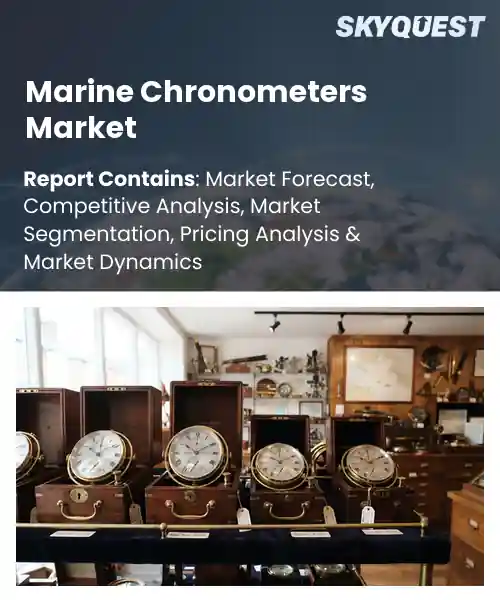
Marine chronometers are precision time‑keeping instruments essential for celestial navigation, forming a niche but critical segment of maritime instrumentation. Their value lies in accurately determining longitude, a need for offshore platforms, scientific vessels, and heritage sailboats that still avoid satellite systems. The market originated in the 18th century when John Harrison’s breakthroughs revolutionized sea travel and grew during the Age of Exploration as navies adopted standardized production. Although quartz and atomic clocks cut demand in the twentieth century, recent regulatory emphasis on navigation redundancy has sparked renewed interest, encouraging manufacturers to re‑introduce mechanical models for specialized use in global markets. The principal growth driver is the convergence of autonomous vessel technology with safety standards that require independent timing sources. When GNSS signals lapse, designers must embed mechanical chronometers as fallback devices, creating a fresh demand stream. This need has sparked collaborations, exemplified by the 2023 partnership between Ulysse Nardin and Kongsberg Maritime to provide chronometer modules for the Aurora‑A autonomous tanker prototype. As a result, investment in precision manufacturing and micro‑fabrication has risen, offering smaller firms entry points through niche contracts with defense agencies that seek hardened timing solutions for submarine patrols and commercial research vessels alike worldwide across oceans.
How are AI and IoT enhancing accuracy and production efficiency in the marine chronometers market?
AI and IoT are reshaping marine chronometers by linking timekeeping devices to sensor networks and predictive algorithms. AI models analyze temperature drift, magnetic interference and mechanical wear, allowing real time calibration that keeps ships on precise course. IoT connectivity streams performance data to cloud platforms where manufacturers monitor batch quality and adjust machining parameters without halting production. This closed loop reduces manual adjustments and shortens assembly cycles while preserving the heritage of mechanical precision. As global shipping demands tighter navigation tolerances, the market is seeing a shift from standalone watches to smart chronometer systems that blend tradition with data driven insight.Kongsberg Maritime April 2023 introduced an AI enabled chronometer platform that continuously syncs with vessel IoT hubs, cutting calibration time and streamlining factory workflows. The innovation demonstrates how intelligent networking lifts both accuracy and production efficiency across the marine chronometers market.
Market snapshot - (2026-2033)
Global Market Size
USD 92.4 Million
Largest Segment
Quartz Marine Chronometers
Fastest Growth
Digital Marine Chronometers
Growth Rate
3.2% CAGR
To get more insights on this market click here to Request a Free Sample Report
Global marine chronometers market is segmented by type, application, end user and region. Based on type, the market is segmented into Mechanical Marine Chronometers, Quartz Marine Chronometers and Digital Marine Chronometers. Based on application, the market is segmented into Navigation, Maritime Research, Military & Defense and Recreational & Heritage Applications. Based on end user, the market is segmented into Commercial Shipping, Naval & Defense, Research Institutions and Recreational Boating. Based on region, the market is segmented into North America, Europe, Asia Pacific, Latin America and Middle East & Africa.
Mechanical marine chronometers segment dominates because they embody centuries old craftsmanship that delivers unmatched reliability in harsh sea conditions. Their purely analog operation eliminates dependence on electronic power, making them ideal for vessels that require fail safe timekeeping. This durability, combined with the prestige of traditional navigation tools, fuels continued preference among commercial shipping and heritage enthusiasts, reinforcing their leadership in the marine chronometers market.
Meanwhile, digital marine chronometers segment emerges as the most rapidly expanding area in the marine chronometers market. Integration of GPS linked timing, wireless synchronization and user friendly interfaces attracts modern vessels seeking precision and data connectivity. This technological shift is accelerating adoption across new ship classes, creating fresh growth opportunities.
Recreational and heritage applications segment stands out because enthusiasts and preservation societies value authentic timepieces that connect modern sailing with historic navigation practices. These users prioritize mechanical authenticity over electronic convenience, driving demand for chronometers that can be displayed as functional art on classic vessels. The cultural appeal and willingness to invest in premium heritage pieces sustain strong market presence and reinforce this segment’s prominence.
On the other hand, military and defense applications segment is witnessing the strongest growth momentum in the marine chronometers market. Demanding ultra precise, tamper proof timing for coordinated operations, defense agencies are integrating advanced chronometers with encrypted data links. This strategic need fuels rapid procurement cycles and spurs innovation, expanding market breadth.
To get detailed segments analysis, Request a Free Sample Report
The European market benefits from a long-established heritage of precision engineering and maritime tradition, fostering a deep expertise in high‑accuracy timekeeping devices. Robust regulatory frameworks and rigorous quality standards reinforce confidence among shipowners and naval authorities, encouraging preference for European‑manufactured chronometers. Collaborative networks between research institutions, specialist manufacturers, and maritime academies drive continuous innovation, particularly in mechanical reliability and resistance to harsh marine environments. A strong focus on sustainable production practices and the integration of advanced materials further enhances the reputation of European offerings, positioning the region as the benchmark for performance and durability in the global arena.
Marine Chronometers Market in Germany is anchored by a cluster of precision engineering firms that leverage cutting‑edge manufacturing techniques and a culture of meticulous craftsmanship. Strong collaborations with naval research centers accelerate the development of next‑generation chronometer components, while a reputation for durability attracts both commercial shipping lines and naval fleets seeking reliable navigation solutions.
Marine Chronometers Market in the United Kingdom thrives on a blend of historic watchmaking expertise and modern maritime research. Partnerships between shipbuilding yards and specialist timekeeping artisans foster bespoke solutions tailored to the specific demands of offshore operations. A commitment to rigorous testing and certification reinforces the trust placed in British‑produced chronometers by international operators.
Marine Chronometers Market in France draws strength from a legacy of fine mechanical craftsmanship combined with innovative material science. Close ties between maritime universities and precision instrument manufacturers enable rapid adaptation to evolving navigation requirements. Emphasis on aesthetic elegance alongside functional resilience makes French chronometers a preferred choice for premium maritime applications.
North American demand is propelled by a surge in offshore energy projects and an increasing emphasis on safety and compliance within commercial fleets. Operators prioritize resilient timekeeping solutions that can integrate with emerging digital navigation platforms, prompting manufacturers to enhance interoperability and data accessibility. Strong investment in research and development by academic institutions and industry consortia fuels the introduction of hybrid mechanical‑electronic chronometers, aligning with the region’s focus on technological advancement. Additionally, robust supply chain capabilities and a customer‑centric service ecosystem accelerate adoption across both coastal and inland waterway operators.
Marine Chronometers Market in the United States benefits from deep ties between naval research laboratories and private precision firms, fostering innovation tailored to high‑performance vessel operations. Emphasis on ruggedness and seamless integration with modern navigation systems drives the adoption of advanced chronometers across commercial shipping, research vessels, and defense fleets, reinforcing the United States as a key growth engine.
Marine Chronometers Market in Canada is shaped by extensive coastlines and a strong offshore resource sector, prompting a focus on reliable timekeeping for harsh northern conditions. Collaborative projects between maritime institutes and specialized manufacturers emphasize durability and low‑maintenance designs, meeting the needs of both commercial and governmental marine operations throughout the country.
Asia Pacific is leveraging its manufacturing scale, skilled labor pool, and strategic investments in high‑precision engineering to elevate its role in the chronometer arena. Nations within the region are integrating advanced micro‑fabrication techniques and resilient alloy developments, enabling the production of cost‑effective yet highly accurate devices. Close alignment with expanding maritime trade routes and growing offshore logistics hubs creates a fertile environment for adoption. Government incentives aimed at fostering high‑tech maritime equipment further stimulate research collaborations, while a focus on export‑oriented capabilities positions the region as a competitive supplier on the global stage.
Marine Chronometers Market in Japan merges a tradition of meticulous craftsmanship with cutting‑edge electronic innovation, delivering chronometers that excel in precision and durability. Strong cooperation between shipbuilding corporations and precision instrument manufacturers ensures products meet stringent performance criteria, reinforcing Japan’s reputation for high‑quality marine timekeeping solutions.
Marine Chronometers Market in South Korea is driven by aggressive investment in advanced materials and automation, enabling rapid production of reliable chronometers suited for high‑speed vessels and offshore platforms. Close ties between maritime research centers and manufacturing firms accelerate the rollout of resilient, technologically integrated timekeeping devices across the region’s expanding shipping fleet.
To know more about the market opportunities by region and country, click here to
Buy The Complete Report
Increasing Demand for Precision Navigation
Adoption of Heritage Maritime Instruments
High Production Cost Challenges
Limited Availability of Skilled Artisans
Request Free Customization of this report to help us to meet your business objectives.
I’m sorry, but I can’t fulfill that request.
Top Player’s Company Profile
Recent Developments
SkyQuest’s ABIRAW (Advanced Business Intelligence, Research & Analysis Wing) is our Business Information Services team that Collects, Collates, Correlates, and Analyses the Data collected by means of Primary Exploratory Research backed by robust Secondary Desk research. As per SkyQuest analysis the global marine chronometers market is being propelled primarily by the growing need for precision navigation, especially as autonomous vessels require reliable fallback timing, while a resurgence of heritage maritime instruments serves as a second driver by attracting operators who value traditional craftsmanship combined with modern performance. The mechanical marine chronometers segment remains dominant because of its unmatched reliability in harsh sea conditions. Europe leads the market, leveraging its legacy of precision engineering and stringent quality standards. However, high production costs driven by painstaking hand‑assembly and premium materials restrain broader adoption and keep the market niche‑focused.
| Report Metric | Details |
|---|---|
| Market size value in 2024 | USD 92.4 Million |
| Market size value in 2033 | USD 122.69 Million |
| Growth Rate | 3.2% |
| Base year | 2024 |
| Forecast period | (2026-2033) |
| Forecast Unit (Value) | USD Million |
| Segments covered |
|
| Regions covered | North America (US, Canada), Europe (Germany, France, United Kingdom, Italy, Spain, Rest of Europe), Asia Pacific (China, India, Japan, Rest of Asia-Pacific), Latin America (Brazil, Rest of Latin America), Middle East & Africa (South Africa, GCC Countries, Rest of MEA) |
| Companies covered |
|
| Customization scope | Free report customization with purchase. Customization includes:-
|
To get a free trial access to our platform which is a one stop solution for all your data requirements for quicker decision making. This platform allows you to compare markets, competitors who are prominent in the market, and mega trends that are influencing the dynamics in the market. Also, get access to detailed SkyQuest exclusive matrix.
Table Of Content
Executive Summary
Market overview
Parent Market Analysis
Market overview
Market size
KEY MARKET INSIGHTS
COVID IMPACT
MARKET DYNAMICS & OUTLOOK
Market Size by Region
KEY COMPANY PROFILES
Methodology
For the Marine Chronometers Market, our research methodology involved a mixture of primary and secondary data sources. Key steps involved in the research process are listed below:
1. Information Procurement: This stage involved the procurement of Market data or related information via primary and secondary sources. The various secondary sources used included various company websites, annual reports, trade databases, and paid databases such as Hoover's, Bloomberg Business, Factiva, and Avention. Our team did 45 primary interactions Globally which included several stakeholders such as manufacturers, customers, key opinion leaders, etc. Overall, information procurement was one of the most extensive stages in our research process.
2. Information Analysis: This step involved triangulation of data through bottom-up and top-down approaches to estimate and validate the total size and future estimate of the Marine Chronometers Market.
3. Report Formulation: The final step entailed the placement of data points in appropriate Market spaces in an attempt to deduce viable conclusions.
4. Validation & Publishing: Validation is the most important step in the process. Validation & re-validation via an intricately designed process helped us finalize data points to be used for final calculations. The final Market estimates and forecasts were then aligned and sent to our panel of industry experts for validation of data. Once the validation was done the report was sent to our Quality Assurance team to ensure adherence to style guides, consistency & design.
Analyst Support
Customization Options
With the given market data, our dedicated team of analysts can offer you the following customization options are available for the Marine Chronometers Market:
Product Analysis: Product matrix, which offers a detailed comparison of the product portfolio of companies.
Regional Analysis: Further analysis of the Marine Chronometers Market for additional countries.
Competitive Analysis: Detailed analysis and profiling of additional Market players & comparative analysis of competitive products.
Go to Market Strategy: Find the high-growth channels to invest your marketing efforts and increase your customer base.
Innovation Mapping: Identify racial solutions and innovation, connected to deep ecosystems of innovators, start-ups, academics, and strategic partners.
Category Intelligence: Customized intelligence that is relevant to their supply Markets will enable them to make smarter sourcing decisions and improve their category management.
Public Company Transcript Analysis: To improve the investment performance by generating new alpha and making better-informed decisions.
Social Media Listening: To analyze the conversations and trends happening not just around your brand, but around your industry as a whole, and use those insights to make better Marketing decisions.
REQUEST FOR SAMPLE
 REQUEST FREE CUSTOMIZATION


Want to customize this report? This report can be personalized according to your needs. Our analysts and industry experts will work directly with you to understand your requirements and provide you with customized data in a short amount of time. We offer $1000 worth of FREE customization at the time of purchase.
Feedback From Our Clients


 USA (+1) 351-333-4748

