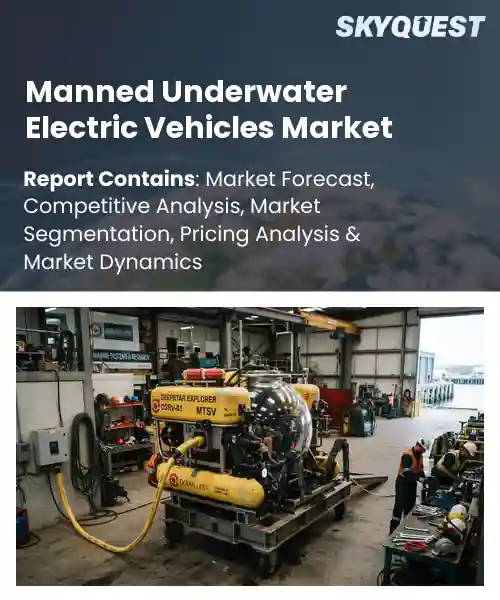
Manned Underwater Electric Vehicles Market
Report ID: SQMIG20T2069
Report ID: SQMIG20T2069
[email protected]
USA +1 351-333-4748
Report ID:
SQMIG20T2069 |
Region:
Global |
Published Date: August, 2026
Pages:
157
|Tables:
118
|Figures:
77


Global Manned Underwater Electric Vehicles Market size was valued at USD 1.64 Billion in 2024 and is poised to grow from USD 1.86 Billion in 2025 to USD 5.17 Billion by 2033, growing at a CAGR of 13.6% during the forecast period (2026-2033).
The global market for manned underwater electric vehicles (MUEVs) comprises battery‑powered submersibles used for scientific research, offshore inspection, and defence missions. Its relevance stems from the ability to operate silently, without emissions, and with reduced maintenance compared with combustion‑driven craft. The primary driver is stringent environmental regulation that forces oil‑and‑gas operators and naval forces to adopt greener propulsion, prompting manufacturers such as Oceanic Robotics and SeaPower to launch modular electric classes in five years. Historical growth reflects a shift from early diesel‑electric prototypes in the 1990s to lithium‑ion‑driven platforms that now achieve 30‑hour endurance at significant depths of 500 meters. Building on that regulatory impetus, the second key factor reshaping the MUEV market is the advancement of high‑density battery technology, which expands operational range and lowers acquisition cost. As energy‑to‑weight ratios improve, operators can undertake longer seabed surveys, enabling oil fields to be inspected without divers and allowing marine scientists to map coral habitats continuously. Companies such as DeepBlue Systems have leveraged lithium‑sulphur cells to deliver 40‑hour missions, prompting contracts with the US Navy for covert reconnaissance in littoral zones. This cause‑effect loop better batteries driving new applications creates a feedback cycle that attracts capital, stimulates component‑supplier ecosystems, and accelerates market penetration.
How is AI enhancing navigation precision in the manned underwater electric vehicles market?
AI is reshaping navigation in manned underwater electric vehicles by fusing sonar inertial and visual data through deep learning models. These models generate high resolution maps that update in real time allowing pilots to steer with confidence even in low visibility conditions. Machine learning based path planners anticipate currents and suggest optimal routes reducing operator workload. Adaptive control loops adjust thruster output to maintain course when disturbances arise. The market driven by expanding offshore activities and scientific exploration is seeing manufacturers embed AI chips directly into vehicle consoles creating tighter feedback loops and smoother rides. This convergence of AI and electric propulsion is raising performance standards across the sectorOceaneering June 2026, introduced an AI enhanced navigation suite for its electric work class submersible that fuses sensor streams to deliver centimeter level positioning cutting transit time and fuel use. The upgrade showcases how AI precision fuels market growth by improving mission efficiency
Market snapshot - (2026-2033)
Global Market Size
USD 1.64 Billion
Largest Segment
Tethered Manned Underwater Vehicles
Fastest Growth
Autonomous Manned Underwater Vehicles
Growth Rate
13.6% CAGR
To get more insights on this market click here to Request a Free Sample Report
Global manned underwater electric vehicles market is segmented by vehicle type, application, propulsion system, depth rating and region. Based on vehicle type, the market is segmented into Autonomous Manned Underwater Vehicles, Tethered Manned Underwater Vehicles and Hybrid Manned Underwater Vehicles. Based on application, the market is segmented into Defense & Security, Scientific Research, Commercial Operations, Tourism & Recreation and Search & Rescue. Based on propulsion system, the market is segmented into Battery Electric and Hybrid Electric. Based on depth rating, the market is segmented into Shallow Water, Mid-Depth and Deep Water. Based on region, the market is segmented into North America, Europe, Asia Pacific, Latin America and Middle East & Africa.
Autonomous manned underwater vehicles segment dominates because operators value the flexibility of self guided missions combined with onboard crew presence delivering precise data collection without tether constraints. The ability to execute extended dives while maintaining real time decision making drives investment from both commercial and governmental users. This synergy of autonomy and human expertise reduces mission risk and enhances operational efficiency positioning the segment at the core of market activity.
However, hybrid manned underwater vehicles are witnessing the strongest growth momentum as fuel cell and battery integrations extend endurance while preserving zero emission operation. This technology meets rising demand for longer missions in remote sites, prompting developers to prioritize hybrid designs that unlock new commercial and scientific opportunities, accelerating market expansion.
Defense & security segment dominates because governments prioritize stealthy crewed platforms capable of covert surveillance and asset protection beneath the surface. Electric propulsion delivers low acoustic signatures aligning with mission requirements for silent operation. The need to counter underwater threats and secure critical infrastructure drives sustained funding, fostering specialized vehicle development and integration with advanced sensor suites. This strategic importance elevates the segment as the primary driver of market activity.
On the other hand, scientific research segment emerges as the key high growth area as marine scientists demand friendly platforms for biodiversity surveys and climate data collection. The push for sustainable exploration fuels investment in electric power systems, while projects expand use cases, creating revenue streams and broadening market adoption beyond traditional defense applications.
To get detailed segments analysis, Request a Free Sample Report
Asia Pacific leverages a confluence of deep‑sea resource activities, advanced shipbuilding capabilities, and proactive policy environments that prioritize sustainable marine operations. The region benefits from extensive offshore energy exploration, scientific research initiatives, and a tradition of naval engineering excellence, fostering strong demand for quiet, low‑emission underwater platforms. Collaborative ecosystems among research institutes, defense agencies, and commercial operators accelerate technology transfer and product refinement. Furthermore, strategic investment in electric propulsion research and a cultural emphasis on environmental stewardship reinforce the region’s leadership, creating a resilient supply chain and a robust pipeline of innovative solutions that shape global market direction.
Manned Underwater Electric Vehicles Market in Japan is propelled by a long‑standing heritage of precision engineering and a vibrant maritime research community. Government marine safety programmes encourage adoption of electric platforms for scientific and security missions, while leading manufacturers integrate cutting‑edge battery technology to enhance endurance. Collaborative projects between universities and industry accelerate prototype development, positioning Japan as a benchmark for reliability and operational efficiency in subsea exploration.
Manned Underwater Electric Vehicles Market in South Korea benefits from a strong shipbuilding sector and aggressive environmental regulation that favors low‑noise, zero‑emission solutions. National research institutions focus on electric propulsion innovations, supporting commercial and defense applications. Partnerships between tech firms and marine operators facilitate rapid testing in diverse coastal conditions, reinforcing South Korea’s reputation for integrating advanced electronics with robust underwater platforms.
Europe’s expansion rests on a blend of stringent environmental directives, deep‑sea scientific ambition, and a collaborative industrial framework that unites defense, research, and energy sectors. Robust funding mechanisms for sustainable marine technologies encourage the transition to electric propulsion, while a network of maritime research centers accelerates knowledge sharing across borders. The region’s emphasis on offshore wind and renewable energy infrastructure creates demand for quiet, emission‑free underwater vehicles for inspection and maintenance. Strong regulatory support for reduced acoustic impact further incentivizes adoption, fostering a fertile environment for continuous innovation and market growth.
Manned Underwater Electric Vehicles Market in Germany is anchored by world‑class engineering firms and a dense cluster of marine technology institutes. Government incentives promote the development of electric propulsion systems geared toward offshore wind farm servicing and scientific exploration. Collaborative consortia between industry and academia streamline prototype validation, establishing Germany as a hub for high‑performance, reliable underwater solutions.
Manned Underwater Electric Vehicles Market in United Kingdom experiences rapid growth driven by a vibrant offshore energy sector and ambitious marine research agendas. Policy focus on carbon‑neutral maritime operations fuels investment in electric platforms for subsea inspection and research. A dynamic start‑up ecosystem couples innovative battery technologies with established shipyards, accelerating deployment and positioning United Kingdom as a leader in fast‑adapting underwater capabilities.
Manned Underwater Electric Vehicles Market in France is emerging through strong support from national research agencies and a growing emphasis on marine environmental monitoring. Collaborative projects link oceanographic institutes with defense contractors, fostering the adaptation of electric propulsion for diverse missions. Emphasis on sustainable tourism and coastal protection also expands usage scenarios, nurturing an emerging market niche.
North America advances its position through a confluence of robust defense spending, expanding offshore renewable energy projects, and a culture of rapid technological commercialization. Leading research universities partner closely with private firms to push the boundaries of battery density and autonomous control, while government programs incentivize low‑noise, zero‑emission underwater operations. The region’s extensive coastline and deep‑water resources provide a natural testbed for varied applications, from scientific surveys to industrial inspections. Integration of advanced data analytics and real‑time monitoring further enhances operational value, reinforcing North America’s role as an innovation engine in the global market.
Manned Underwater Electric Vehicles Market in United States thrives on strong defense research initiatives and a burgeoning offshore wind sector that demand quiet, efficient subsea vehicles. Entrepreneurial ecosystems in key coastal hubs accelerate the translation of academic breakthroughs into commercial products. Strategic partnerships with oil and gas operators also broaden application scope, reinforcing a diversified market landscape.
Manned Underwater Electric Vehicles Market in Canada leverages its extensive Arctic and Atlantic coastlines to focus on cold‑water performance and environmental stewardship. Federal research programs emphasize sustainable marine operations, encouraging the adoption of electric propulsion for scientific and fisheries monitoring. Collaboration between indigenous communities, research institutes, and technology firms promotes tailored solutions that address unique regional challenges.
To know more about the market opportunities by region and country, click here to
Buy The Complete Report
Rising Demand for Offshore Survey
Adoption leveraging Advanced Battery Technologies
High Capital Investment Requirements
Regulatory Compliance and Certification Complexity
Request Free Customization of this report to help us to meet your business objectives.
The competitive landscape is shaped by intensified rivalry among defense contractors, specialized marine technology firms, and energy‑focused operators seeking to capture submarine‑inspection contracts. Market pressure drives M&A, illustrated by a major defense group absorbing a boutique electric submersible developer, while partnerships link naval OEMs with battery‑tech startups to accelerate silent propulsion. Continuous tech innovation around modular hulls and long‑duration power cells further differentiates players.
Top Player’s Company Profile
Recent Developments
SkyQuest’s ABIRAW (Advanced Business Intelligence, Research & Analysis Wing) is our Business Information Services team that Collects, Collates, Correlates, and Analyses the Data collected by means of Primary Exploratory Research backed by robust Secondary Desk research. As per SkyQuest analysis the global market is being propelled chiefly by the surge in offshore survey activities that require quiet, zero‑emission platforms, while the parallel advance of high‑energy‑density batteries provides longer dive times and lower operating costs, acting as a second growth catalyst. The strongest restraint remains the substantial upfront capital required for vehicle development, certification and supporting infrastructure, which can delay purchase decisions. Asia Pacific leads the market thanks to its deep‑sea resource work, shipbuilding expertise and supportive policies, and the autonomous manned underwater vehicle segment holds the largest share because operators value self‑guided missions combined with crew presence. Together these forces shape the market’s trajectory.
| Report Metric | Details |
|---|---|
| Market size value in 2024 | USD 1.64 Billion |
| Market size value in 2033 | USD 5.17 Billion |
| Growth Rate | 13.6% |
| Base year | 2024 |
| Forecast period | (2026-2033) |
| Forecast Unit (Value) | USD Billion |
| Segments covered |
|
| Regions covered | North America (US, Canada), Europe (Germany, France, United Kingdom, Italy, Spain, Rest of Europe), Asia Pacific (China, India, Japan, Rest of Asia-Pacific), Latin America (Brazil, Rest of Latin America), Middle East & Africa (South Africa, GCC Countries, Rest of MEA) |
| Companies covered |
|
| Customization scope | Free report customization with purchase. Customization includes:-
|
To get a free trial access to our platform which is a one stop solution for all your data requirements for quicker decision making. This platform allows you to compare markets, competitors who are prominent in the market, and mega trends that are influencing the dynamics in the market. Also, get access to detailed SkyQuest exclusive matrix.
Table Of Content
Executive Summary
Market overview
Parent Market Analysis
Market overview
Market size
KEY MARKET INSIGHTS
COVID IMPACT
MARKET DYNAMICS & OUTLOOK
Market Size by Region
KEY COMPANY PROFILES
Methodology
For the Manned Underwater Electric Vehicles Market, our research methodology involved a mixture of primary and secondary data sources. Key steps involved in the research process are listed below:
1. Information Procurement: This stage involved the procurement of Market data or related information via primary and secondary sources. The various secondary sources used included various company websites, annual reports, trade databases, and paid databases such as Hoover's, Bloomberg Business, Factiva, and Avention. Our team did 45 primary interactions Globally which included several stakeholders such as manufacturers, customers, key opinion leaders, etc. Overall, information procurement was one of the most extensive stages in our research process.
2. Information Analysis: This step involved triangulation of data through bottom-up and top-down approaches to estimate and validate the total size and future estimate of the Manned Underwater Electric Vehicles Market.
3. Report Formulation: The final step entailed the placement of data points in appropriate Market spaces in an attempt to deduce viable conclusions.
4. Validation & Publishing: Validation is the most important step in the process. Validation & re-validation via an intricately designed process helped us finalize data points to be used for final calculations. The final Market estimates and forecasts were then aligned and sent to our panel of industry experts for validation of data. Once the validation was done the report was sent to our Quality Assurance team to ensure adherence to style guides, consistency & design.
Analyst Support
Customization Options
With the given market data, our dedicated team of analysts can offer you the following customization options are available for the Manned Underwater Electric Vehicles Market:
Product Analysis: Product matrix, which offers a detailed comparison of the product portfolio of companies.
Regional Analysis: Further analysis of the Manned Underwater Electric Vehicles Market for additional countries.
Competitive Analysis: Detailed analysis and profiling of additional Market players & comparative analysis of competitive products.
Go to Market Strategy: Find the high-growth channels to invest your marketing efforts and increase your customer base.
Innovation Mapping: Identify racial solutions and innovation, connected to deep ecosystems of innovators, start-ups, academics, and strategic partners.
Category Intelligence: Customized intelligence that is relevant to their supply Markets will enable them to make smarter sourcing decisions and improve their category management.
Public Company Transcript Analysis: To improve the investment performance by generating new alpha and making better-informed decisions.
Social Media Listening: To analyze the conversations and trends happening not just around your brand, but around your industry as a whole, and use those insights to make better Marketing decisions.
REQUEST FOR SAMPLE
 REQUEST FREE CUSTOMIZATION


Want to customize this report? This report can be personalized according to your needs. Our analysts and industry experts will work directly with you to understand your requirements and provide you with customized data in a short amount of time. We offer $1000 worth of FREE customization at the time of purchase.
Feedback From Our Clients


 USA (+1) 351-333-4748

