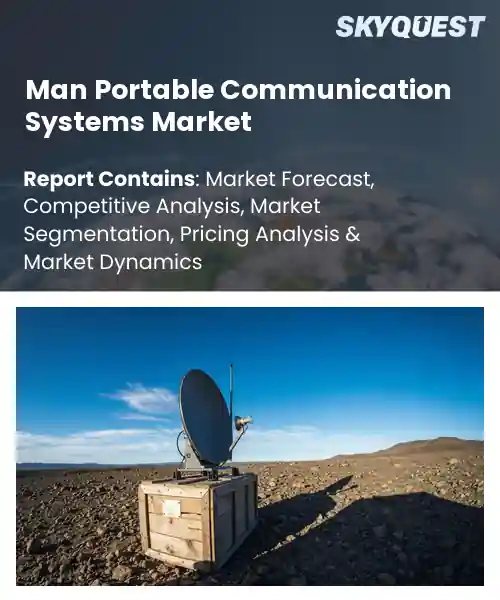
Man Portable Communication Systems Market
Report ID: SQMIG20A2721
Report ID: SQMIG20A2721
[email protected]
USA +1 351-333-4748
Report ID:
SQMIG20A2721 |
Region:
Global |
Published Date: July, 2026
Pages:
157
|Tables:
117
|Figures:
77


Global Man Portable Communication Systems Market size was valued at USD 8.52 Billion in 2024 and is poised to grow from USD 9.06 Billion in 2025 to USD 14.85 Billion by 2033, growing at a CAGR of 6.32% during the forecast period (2026-2033).
The dominant growth driver now is the convergence of 5G edge computing with ruggedized portable terminals, which transforms simple voice links into sensor networks for command centers. As edge nodes process data locally, latency drops and bandwidth demands decrease, prompting defense contractors to embed AI‑enabled analytics into handheld radios for threat detection.
This capability fuels procurement by NATO allies seeking interoperable platforms that can switch between terrestrial, LTE, and satellite links during exercises. Likewise, oil‑field operators leverage technology to monitor pipeline integrity in remote locations, turning communication hardware into a dual‑purpose safety and operational tool that expands significant market demand.
How is AI enhancing the performance of Man portable communication systems?
AI is reshaping man‑portable communication systems by embedding intelligent signal processing, voice recognition and predictive maintenance. Modern devices now analyze background noise in real time, boosting clarity for users in noisy environments. Integrated AI assistants enable hands‑free operation, allowing field personnel to issue commands and receive status updates without manual input. The market is expanding as defense and public safety agencies adopt these smarter radios to improve coordination and reduce equipment downtime. Real‑world examples include AI‑driven adaptive filters that automatically adjust to changing acoustic conditions and predictive analytics that alert operators to potential hardware failures before they occur, making deployments more reliable and efficient.
Market snapshot - (2026-2033)
Global Market Size
USD 8.52 Billion
Largest Segment
Man-Portable Radios (HF/VHF/UHF)
Fastest Growth
Software-Defined Radios (SDR)
Growth Rate
6.32% CAGR
To get more insights on this market click here to Request a Free Sample Report
Global man portable communication systems market is segmented by system type, frequency, application, end-user and region. Based on system type, the market is segmented into Man-Portable Radios (HF/VHF/UHF), Satellite Communication Terminals and Software-Defined Radios (SDR). Based on frequency, the market is segmented into HF (3-30 MHz), VHF (30-300 MHz) and UHF (300-3000 MHz). Based on application, the market is segmented into Tactical Operations, Special Forces and Disaster Relief. Based on end-user, the market is segmented into Army, Special Operations Forces and Paramilitary. Based on region, the market is segmented into North America, Europe, Asia Pacific, Latin America and Middle East & Africa.
UHF segment dominates with large man portable communication systems market share because its ability to penetrate urban environments while maintaining clear voice transmission makes it the preferred choice for frontline units. Tactical operations rely on robust line of sight communication, and UHF frequencies provide the optimal balance of range and antenna size for dismounted soldiers. This reliability drives procurement decisions, and manufacturers focus on enhancing durability and encryption, reinforcing UHF’s leadership in the man portable communication systems market.
As per man portable communication systems market outlook, software defined radio segment emerges as the most rapidly expanding area because its reconfigurable architecture enables field upgrades without hardware swaps. Continuous firmware innovation supports multi band operation and advanced waveforms, attracting forces that need flexible, future proof solutions. This adaptability fuels new contracts and accelerates overall market growth.
HF segment dominates because its long range propagation characteristics allow communication beyond line of sight, essential for disaster relief and extended tactical missions. HF radios can reach distant command centers using skywave paths, reducing the need for repeaters in austere environments. Operators value the resilience of HF against terrain obstacles, and procurement programs prioritize this capability, cementing HF’s leading role in the man portable communication systems market.
As per man portable communication systems market analysis, VHF segment witnesses the strongest growth momentum because its balance of range and bandwidth supports both voice and data links in semi urban theaters. Emerging digital waveforms and enhanced antenna designs improve clarity and reduce interference, prompting forces to replace legacy equipment. This surge in modernization drives procurement and expands the market’s future potential.
To get detailed segments analysis, Request a Free Sample Report
The Asia Pacific region benefits from a confluence of advanced manufacturing capabilities, deep engineering talent pools, and a strategic emphasis on resilient communication infrastructure for both civilian and defense sectors. Strong governmental support for research and development fuels continuous innovation in compact, rugged devices, while dense urban environments and frequent natural events drive demand for reliable, rapid‑deployment solutions. Regional supply chains enable swift scaling of production, and collaborative standards initiatives promote interoperability across multinational operations, reinforcing the region’s leadership in the market.
As per man portable communication systems market regional outlook, Japan thrives on a sophisticated electronics ecosystem and a long‑standing commitment to public safety technology. The country’s emphasis on disaster preparedness creates a persistent need for reliable, portable communication tools that can function under extreme conditions. Integration with cutting‑edge sensor networks and autonomous platforms further enhances the appeal of these systems for both civilian agencies and security forces.
As per man portable communication systems market regional forecast, South Korea is propelled by a vibrant defense industry and a culture of rapid technological adoption. Government initiatives prioritize modernizing communication capabilities for emergency responders and military units, encouraging the development of lightweight, high‑performance devices. Close collaboration between manufacturers and research institutions accelerates the introduction of next‑generation features, ensuring that the market remains responsive to evolving operational requirements.
In North America, the market is energized by a strong focus on public safety modernization, extensive investment in mission‑critical communication solutions, and a deep integration of digital technologies within emergency response frameworks. Robust procurement processes and a culture of innovation across defense and civilian sectors foster the adoption of sophisticated, interoperable devices. Emphasis on user‑centered design, rugged durability, and seamless connectivity to broader command networks sustains growth, while partnerships between manufacturers and agencies drive continuous refinement of product offerings.
As per man portable communication systems industry analysis, United States is shaped by an expansive network of federal, state, and local agencies that prioritize resilient communication capabilities. The emphasis on real‑time data exchange and integration with advanced analytics platforms drives demand for highly reliable, portable solutions. Collaborative research programs and a competitive manufacturing landscape further support rapid adoption across emergency services and defense units.
Canada reflects a strong commitment to safeguarding expansive and remote communities. National strategies that focus on enhancing response times in challenging terrains encourage the deployment of robust, lightweight communication tools. Partnerships with indigenous groups and a focus on environmental resilience ensure that solutions are tailored to the unique geographical and operational demands of the region.
Europe reinforces its market stance through stringent regulatory standards, a focus on interoperability across multinational forces, and sustained investment in research collaborations that push the boundaries of portable communication technology. Emphasis on secure, encrypted channels and alignment with broader defense integration frameworks bolsters confidence among public safety entities. The region’s dedication to sustainability, combined with a mature supply chain and active participation in cross‑border training exercises, cultivates a dynamic environment that continuously upgrades system capabilities and adoption rates.
Germany benefits from a strong engineering tradition and close coordination with European defense alliances. National priorities on fast, secure communication for both civilian emergency services and military applications drive continuous product enhancements. The country’s focus on modular, scalable designs ensures that solutions can adapt to diverse operational scenarios.
United Kingdom is underpinned by a robust public safety infrastructure and an active defense sector. Investments in joint training initiatives and standardization efforts promote seamless integration of portable devices across agencies. Emphasis on rugged performance and user‑friendly interfaces supports widespread adoption among first responders.
France is shaped by a strategic emphasis on rapid deployment capabilities for both urban and overseas operations. Collaborative research with national laboratories fuels innovation in compact, high‑reliability devices. The commitment to interoperability with NATO partners further enhances market relevance and adoption.
To know more about the market opportunities by region and country, click here to
Buy The Complete Report
Increasing Demand for Real-Time Communication
Adoption of Ruggedized Handheld Devices
High Cost of Advanced Platforms
Limited Battery Life in Harsh Environments
Request Free Customization of this report to help us to meet your business objectives.
The competitive landscape is shaped by rapid tech integration and strategic alliances, with AI‑driven platforms and satellite connectivity emerging as key differentiators. Companies are accelerating product cycles through joint development agreements, while larger defense OEMs pursue acquisitions of niche AI and IoT specialists to broaden portfolio breadth and meet growing field‑operational demands.
SkyQuest’s ABIRAW (Advanced Business Intelligence, Research & Analysis Wing) is our Business Information Services team that Collects, Collates, Correlates, and Analyses the Data collected by means of Primary Exploratory Research backed by robust Secondary Desk research.
As per SkyQuest analysis the man portable communication systems market growth is being propelled primarily by the surging demand for real‑time voice and data links that let defense and public‑safety teams operate without fixed infrastructure, while the parallel push for ruggedized handheld devices adds a second boost by ensuring durability in harsh field conditions. High cost of advanced platforms remains a notable restraint, limiting uptake in budget‑constrained programs. The Asia Pacific region leads the market due to strong manufacturing bases and government support, and within the frequency landscape UHF radios dominate because of their urban penetration and optimal balance of range and antenna size. The global man-portable communication systems market trend driven by increasing defense modernization programs, battlefield digitization, demand for secure tactical communications, and adoption of lightweight, software-defined radio technologies.
| Report Metric | Details |
|---|---|
| Market size value in 2024 | USD 8.52 Billion |
| Market size value in 2033 | USD 14.85 Billion |
| Growth Rate | 6.32% |
| Base year | 2024 |
| Forecast period | (2026-2033) |
| Forecast Unit (Value) | USD Billion |
| Segments covered |
|
| Regions covered | North America (US, Canada), Europe (Germany, France, United Kingdom, Italy, Spain, Rest of Europe), Asia Pacific (China, India, Japan, Rest of Asia-Pacific), Latin America (Brazil, Rest of Latin America), Middle East & Africa (South Africa, GCC Countries, Rest of MEA) |
| Companies covered |
|
| Customization scope | Free report customization with purchase. Customization includes:-
|
To get a free trial access to our platform which is a one stop solution for all your data requirements for quicker decision making. This platform allows you to compare markets, competitors who are prominent in the market, and mega trends that are influencing the dynamics in the market. Also, get access to detailed SkyQuest exclusive matrix.
Table Of Content
Executive Summary
Market overview
Parent Market Analysis
Market overview
Market size
KEY MARKET INSIGHTS
COVID IMPACT
MARKET DYNAMICS & OUTLOOK
Market Size by Region
KEY COMPANY PROFILES
Methodology
For the Man Portable Communication Systems Market, our research methodology involved a mixture of primary and secondary data sources. Key steps involved in the research process are listed below:
1. Information Procurement: This stage involved the procurement of Market data or related information via primary and secondary sources. The various secondary sources used included various company websites, annual reports, trade databases, and paid databases such as Hoover's, Bloomberg Business, Factiva, and Avention. Our team did 45 primary interactions Globally which included several stakeholders such as manufacturers, customers, key opinion leaders, etc. Overall, information procurement was one of the most extensive stages in our research process.
2. Information Analysis: This step involved triangulation of data through bottom-up and top-down approaches to estimate and validate the total size and future estimate of the Man Portable Communication Systems Market.
3. Report Formulation: The final step entailed the placement of data points in appropriate Market spaces in an attempt to deduce viable conclusions.
4. Validation & Publishing: Validation is the most important step in the process. Validation & re-validation via an intricately designed process helped us finalize data points to be used for final calculations. The final Market estimates and forecasts were then aligned and sent to our panel of industry experts for validation of data. Once the validation was done the report was sent to our Quality Assurance team to ensure adherence to style guides, consistency & design.
Analyst Support
Customization Options
With the given market data, our dedicated team of analysts can offer you the following customization options are available for the Man Portable Communication Systems Market:
Product Analysis: Product matrix, which offers a detailed comparison of the product portfolio of companies.
Regional Analysis: Further analysis of the Man Portable Communication Systems Market for additional countries.
Competitive Analysis: Detailed analysis and profiling of additional Market players & comparative analysis of competitive products.
Go to Market Strategy: Find the high-growth channels to invest your marketing efforts and increase your customer base.
Innovation Mapping: Identify racial solutions and innovation, connected to deep ecosystems of innovators, start-ups, academics, and strategic partners.
Category Intelligence: Customized intelligence that is relevant to their supply Markets will enable them to make smarter sourcing decisions and improve their category management.
Public Company Transcript Analysis: To improve the investment performance by generating new alpha and making better-informed decisions.
Social Media Listening: To analyze the conversations and trends happening not just around your brand, but around your industry as a whole, and use those insights to make better Marketing decisions.
REQUEST FOR SAMPLE
 REQUEST FREE CUSTOMIZATION
Global Man Portable Communication Systems Market size was valued at USD 8.52 Billion in 2024 and is poised to grow from USD 9.06 Billion in 2025 to USD 14.85 Billion by 2033, growing at a CAGR of 6.32% during the forecast period (2026-2033).
The competitive landscape is shaped by rapid tech integration and strategic alliances, with AI‑driven platforms and satellite connectivity emerging as key differentiators. Companies are accelerating product cycles through joint development agreements, while larger defense OEMs pursue acquisitions of niche AI and IoT specialists to broaden portfolio breadth and meet growing field‑operational demands. 'Harris Corporation (L3Harris)', 'Thales Group', 'General Dynamics Mission Systems', 'Motorola Solutions', 'Raytheon Technologies', 'BAE Systems', 'Elbit Systems', 'Northrop Grumman', 'Cobham (Advent International)', 'Bren-Tronics', 'Iridium Communications', 'ViaSat Inc.', 'Rockwell Collins (Collins Aerospace)', 'TeleCommunication Systems (TCS)', 'Barrett Communications', 'Codan Radio Communications', 'SEA (Signal Equipment Associates)', 'KANDA COMMUNICATIONS', 'Handheld Group', 'Leonardo SpA'
Enterprises and public safety agencies are increasingly requiring continuous, secure voice and data exchange, driving the adoption of portable communication systems that can operate without reliance on fixed infrastructure. These devices enable rapid situational awareness, facilitate coordinated response, and support mission‑critical operations, which in turn encourages organizations to prioritize investment in rugged, interoperable handheld solutions. Consequently, manufacturers are expanding feature sets and integrating emerging connectivity standards, further reinforcing market momentum and prompting broader deployment across diverse sectors. This trend also accelerates collaborative innovation among suppliers and end‑users.
Ai‑Driven Interoperability: The convergence of artificial‑intelligence algorithms with handheld radios enables automatic frequency selection, context‑aware encryption, and seamless hand‑off between legacy and next‑generation networks. Operators gain real‑time spectrum awareness, reducing manual configuration and minimizing communication latency in mission‑critical scenarios. This intelligence layer also supports adaptive waveforms that self‑optimize for terrain and interference, fostering greater situational awareness while simplifying user training. Consequently, manufacturers are embedding AI modules as standard, reshaping product roadmaps toward smarter, more autonomous field communication solutions.
Why does Asia Pacific Dominate the Global Man Portable Communication Systems Market? |@12


Want to customize this report? This report can be personalized according to your needs. Our analysts and industry experts will work directly with you to understand your requirements and provide you with customized data in a short amount of time. We offer $1000 worth of FREE customization at the time of purchase.
Feedback From Our Clients


 USA (+1) 351-333-4748

