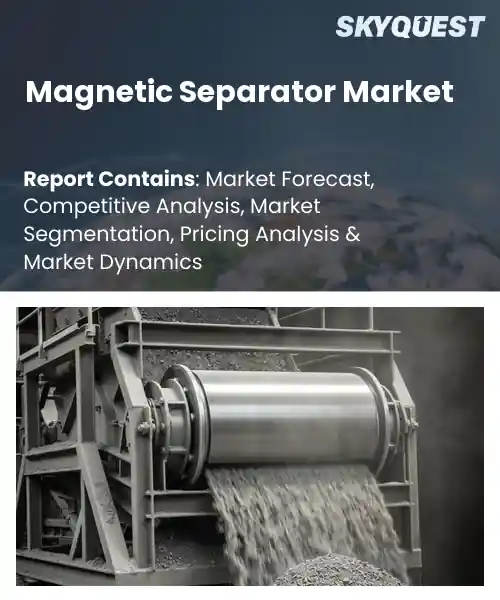
Magnetic Separator Market
Report ID: SQMIG20I3202
Report ID: SQMIG20I3202
[email protected]
USA +1 351-333-4748
Report ID:
SQMIG20I3202 |
Region:
Global |
Published Date: July, 2026
Pages:
157
|Tables:
119
|Figures:
77


Global Magnetic Separator Market size was valued at USD 1067.6 Billion in 2024 and is poised to grow from USD 1120.98 Billion in 2025 to USD 1642.5 Billion by 2033, growing at a CAGR of 5.0% during the forecast period (2026-2033).
Global Magnetic Separator Market provides equipment that uses magnetic forces to separate ferrous and paramagnetic contaminants from raw materials, liquids and powders in various industries such as mining, recycling, food processing, and pharmaceuticals. Its importance is to protect downstream equipment, ensure product purity and comply with strict environmental regulations. The sector began in the 1970s with simple drum separators for coal handling but took off in the 1990s, when breakthroughs in rare-earth magnets made it possible to create compact, high-gradient designs that vastly improved efficiency. Magnetic separation is no longer a niche operation but a critical, global, fundamental and efficient pre-processing step, with advances in magnetic flux density and automation ongoing. The growth of the magnetic separator market is primarily driven by environmental regulations and the demand for sustainable production, forcing companies to adopt separation technologies.
Companies are resorting to magnetic separators that can trap trace amounts of iron particles to comply with tighter limits on metal residues in food, water and pharmaceuticals, cutting waste-treatment costs and avoiding recalls. That pressure creates opportunities in economies where plants are upgrading; Chinese steel recyclers, for example, have installed large magnetic drum systems to raise scrap purity and meet export rules. Vendors that offer IoT monitoring and predictive maintenance for separators have an advantage, as the data allows users to maximize throughput while minimizing consumption.
How are AI and IoT Technologies Reshaping Performance In The Magnetic Separator Market?
The smart and self-optimising magnetic separators of the future will be based on AI and IoT. Now sensors measure the strength of the magnetic field, the flow and temperature of the particles in real-time, relaying the information to cloud platforms where machine-learning models predict wear, recommend cleaning cycles and adjust operating parameters on the fly. This constant feedback loop reduces downtime, accelerates recovery and prolongs the life of the equipment.
Operators can watch performance on mobile dashboards, which enable quick response to process variations and tighter integration with waste-handing or mineral-processing lines. The technology also facilitates predictive maintenance schedules, converting reactive repairs into scheduled interventions, freeing staff to focus on higher-value tasks.
Market snapshot - (2026-2033)
Global Market Size
USD 1067.6 Billion
Largest Segment
Magnetic Drum Separator
Fastest Growth
Plate Magnet Separator
Growth Rate
5.0% CAGR
To get more insights on this market click here to Request a Free Sample Report
Global magnetic separator market is segmented by product, material type, magnet type, end use and region. Based on product, the market is segmented into Magnetic Drum Separator, Magnetic Roller Separator, Overband Separator and Plate Magnet Separator. Based on material type, the market is segmented into Wet Separators and Dry Separators. Based on magnet type, the market is segmented into Electromagnets and Permanent Magnets. Based on end use, the market is segmented into Mining, Recycling, Waste Management, Food and Beverage, Ceramics and Chemical and Pharmaceutical. Based on region, the market is segmented into North America, Europe, Asia Pacific, Latin America and Middle East & Africa.
Magnetic Drum Separator segment holds the highest market share due to its continuous processing ability, catering to high throughput industrial needs, facilitating efficient removal of ferrous contaminants from bulk streams. The rugged construction will tolerate abrasive feed and the drum design provides even magnetic flux reducing equipment wear and down time. These features are what make it the preferred choice for large-scale operations looking for reliability and operational efficiency. It also makes it easier to integrate into existing conveyor systems, which reduces capital expenditures.
On the other hand, Magnetic Roller Separator is the fastest growing segment, due to its compact footprint that fits tight plant layouts and the roller configuration that provides superior magnetic field exposure for fine particles. The adoption of the product is driven by the increasing demand for space-efficient equipment in advanced manufacturing, and innovations in roller magnet design are improving recovery and speeding up market growth and new opportunities.
The recycling segment is leading, as it is meeting the increasing demand for reclaiming ferrous materials from post-consumer waste, directly underpinning circular economy goals. Magnetic separators are a powerful tool for removing steel and iron from mixed streams to reduce our reliance on landfill and add value to secondary raw materials. And this alignment with sustainability goals plus stricter regulations on waste handling, drives widespread adoption among metal scrap processors and municipal facilities.
The Food and Beverage segment is the fastest growing segment, with manufacturers integrating magnetic separation at the beginning of processing lines to meet rising consumer demand for safe metal free products. Better detection technologies and stricter quality certifications drive adoption, while product diversification broadens the application scope, fast-tracking market penetration and creating new opportunities for separator suppliers.
To get detailed segments analysis, Request a Free Sample Report
The Asia Pacific region’s dominance rests on a combination of industry scale, technology know-how and enabling policy frameworks. The region contains large manufacturing clusters (electronics, automotive, heavy‐industry) in which magnetic separation plays a vital role in product quality and waste minimization. The design of separators, especially high-gradient and dry-type separators, is based on strong research institutions and a tradition of precision engineering which ensures constant innovation. The region’s leadership position is further cemented by the dense network of original equipment manufacturers that ensures quick commercialization and localized service support, and by tight linkage with downstream recycling efforts and aggressive environmental compliance regimes that further spur demand. Regional trade agreements allow for cross-border flow of equipment and government incentives for clean-technology adoption encourage new installations and retrofits in a range of process industries. This scale, innovation and policy alignment creates a self-reinforcing ecosystem that underpins Asia Pacific’s preeminence in the magnetic separator landscape.
Japan's Magnetic Separator Market benefits from the country's advanced electronics and precision engineering base, as the production of high-purity components necessitates the reliable separation of ferrous contaminants. Strong tradition in industrial automation and high quality standards means there is constant demand for customized, high-gradient solutions. Domestic manufacturers partner with research labs to integrate magnetic technology into rare earth recycling streams, reinforcing Japan’s reputation for innovative low-footprint separator designs and effective cost-control for end-users.
South Korea’s Magnetic Separator Market is driven by the presence of a strong heavy-industry industry, especially in steel production and automotive component manufacturing, where the removal of magnetic particles is very important to the integrity of the product. Government initiatives advocating smart manufacturing and environmental responsibility are driving the uptake of energy-efficient separator systems. South Korean technology companies are also developing small, high-efficiency dry separators for large plants and future micro-fabrication plants, which will further boost South Korea’s competitiveness in high-end separation solutions.
The rapid expansion in Europe is fueled by stringent environmental regulations that compel manufacturers to adopt magnetic separation for waste reduction and resource recovery. Mature automotive and aerospace sectors demand high‑precision removal of metallic contaminants to meet safety and performance standards. Significant investment in research collaborations across Germany, the United Kingdom, and France accelerates development of energy‑efficient and compact separator technologies suited for Industry 4.0 environments. Additionally, the growing emphasis on circular economy initiatives encourages integration of magnetic separators into recycling loops for electronic waste and rare‑metal recovery, creating a fertile market landscape where innovation and compliance converge to drive sustained growth across the continent.
Magnetic Separator Market in Germany is anchored by a strong engineering tradition and a dense network of precision machinery firms that require reliable removal of ferrous particles from high‑value production lines. The country’s rigorous environmental standards stimulate the adoption of magnetic technologies across steel processing, automotive assembly, and advanced plastics recycling. Collaborative efforts between industry associations and research institutes foster continuous improvement of high‑gradient and energy‑saving separator designs, reinforcing Germany’s leadership role in the European market.
Magnetic Separator Market in the United Kingdom is accelerating due to a vibrant renewable energy and battery manufacturing sector that necessitates precise separation of metallic impurities to ensure product reliability. Government incentives for sustainable manufacturing and waste‑to‑resource initiatives drive rapid uptake of compact magnetic separators in both legacy heavy‑industry plants and emerging green‑tech facilities. Academic partnerships with technology incubators further enhance the development of innovative, low‑maintenance separator solutions, positioning the United Kingdom as a fast‑growing hub for magnetic separation technologies.
Magnetic Separator Market in France is emerging as manufacturers in aerospace, pharmaceuticals, and specialty chemicals increasingly prioritize magnetic filtration to meet strict purity and environmental criteria. National research programs support the scaling of dry magnetic separator technology for use in high‑value product streams and waste valorization. The growing collaboration between French industrial clusters and start‑ups accelerates the commercialization of modular, energy‑efficient separators, helping France to carve out a niche within the broader European magnetic separation ecosystem.
North America is strengthening its position through a combination of innovative manufacturing practices, strong demand for high‑performance materials, and a proactive regulatory environment that encourages adoption of magnetic separation for sustainability. The United States benefits from extensive heavy‑industry supply chains and a growing focus on recycling of electronic waste and rare‑earth metals, driving the need for advanced, high‑gradient separators. Canada’s emphasis on clean‑technology development and its resource‑rich mining sector fosters integration of magnetic solutions for ore beneficiation and waste reduction. Collaborative research initiatives across universities and industry accelerate the rollout of energy‑efficient separator designs, while investments in automation and digital monitoring enhance reliability, collectively reinforcing North America’s competitive edge in the global magnetic separator landscape.
Magnetic Separator Market in the United States is driven by a diverse industrial base encompassing automotive, aerospace, and electronics manufacturing, where removal of ferrous contaminants is critical for product reliability and compliance. Advanced research institutions collaborate with leading equipment manufacturers to develop high‑gradient, low‑maintenance separators tailored for large‑scale processing and smart‑factory integration. Federal sustainability programs further incentivize adoption of magnetic technologies in recycling and waste‑to‑resource initiatives, reinforcing the United States’ pivotal role in market advancement.
Magnetic Separator Market in Canada benefits from the country’s strong mining sector and growing emphasis on clean‑energy technologies, prompting integration of magnetic separation for ore beneficiation and industrial waste minimization. Collaborative programs between government research agencies and equipment manufacturers focus on developing robust, energy‑efficient separators suitable for remote operations and harsh environments. The rising demand for sustainable material recovery across pulp‑and‑paper, petrochemical, and recycling industries further accelerates adoption, positioning Canada as a key contributor to North American magnetic separator innovation.
To know more about the market opportunities by region and country, click here to
Buy The Complete Report
Increasing Demand for Clean Metals
Advancements In Magnetic Material Technology
High Initial Capital Expenditure
Limited Awareness of Technology Benefits
Request Free Customization of this report to help us to meet your business objectives.
The market is intensifying as established magnetic separator manufacturers confront venture‑backed entrants that leverage AI and advanced recycling processes, driving a shift toward integrated, high‑efficiency solutions; incumbents are responding with strategic funding rounds and technology partnerships, exemplified by Scout AI’s $115.2 million equity raise to accelerate AI‑driven sorting platforms that challenge conventional magnetic separation equipment.
SkyQuest’s ABIRAW (Advanced Business Intelligence, Research & Analysis Wing) is our Business Information Services team that Collects, Collates, Correlates, and Analyses the Data collected by means of Primary Exploratory Research backed by robust Secondary Desk research.
As per SkyQuest analysis, the global magnetic separator market is propelled primarily by the rising demand for clean metals, which pushes manufacturers toward environmentally friendly magnetic separation to meet stricter regulations and sustainability goals. A second driver comes from recent breakthroughs in neodymium‑iron‑boron and ferrite magnets that boost flux density and reliability, expanding applications across mining and recycling. However, the high initial capital expenditure required for advanced equipment limits adoption, especially among smaller firms. Asia Pacific dominates the market due to its large industrial base, supportive policies, and strong engineering expertise, while the magnetic drum separator remains the leading segment due to its continuous high‑throughput capability.
| Report Metric | Details |
|---|---|
| Market size value in 2024 | USD 1067.6 Billion |
| Market size value in 2033 | USD 1642.5 Billion |
| Growth Rate | 5.0% |
| Base year | 2024 |
| Forecast period | (2026-2033) |
| Forecast Unit (Value) | USD Billion |
| Segments covered |
|
| Regions covered | North America (US, Canada), Europe (Germany, France, United Kingdom, Italy, Spain, Rest of Europe), Asia Pacific (China, India, Japan, Rest of Asia-Pacific), Latin America (Brazil, Rest of Latin America), Middle East & Africa (South Africa, GCC Countries, Rest of MEA) |
| Companies covered |
|
| Customization scope | Free report customization with purchase. Customization includes:-
|
To get a free trial access to our platform which is a one stop solution for all your data requirements for quicker decision making. This platform allows you to compare markets, competitors who are prominent in the market, and mega trends that are influencing the dynamics in the market. Also, get access to detailed SkyQuest exclusive matrix.
Table Of Content
Executive Summary
Market overview
Parent Market Analysis
Market overview
Market size
KEY MARKET INSIGHTS
COVID IMPACT
MARKET DYNAMICS & OUTLOOK
Market Size by Region
KEY COMPANY PROFILES
Methodology
For the Magnetic Separator Market, our research methodology involved a mixture of primary and secondary data sources. Key steps involved in the research process are listed below:
1. Information Procurement: This stage involved the procurement of Market data or related information via primary and secondary sources. The various secondary sources used included various company websites, annual reports, trade databases, and paid databases such as Hoover's, Bloomberg Business, Factiva, and Avention. Our team did 45 primary interactions Globally which included several stakeholders such as manufacturers, customers, key opinion leaders, etc. Overall, information procurement was one of the most extensive stages in our research process.
2. Information Analysis: This step involved triangulation of data through bottom-up and top-down approaches to estimate and validate the total size and future estimate of the Magnetic Separator Market.
3. Report Formulation: The final step entailed the placement of data points in appropriate Market spaces in an attempt to deduce viable conclusions.
4. Validation & Publishing: Validation is the most important step in the process. Validation & re-validation via an intricately designed process helped us finalize data points to be used for final calculations. The final Market estimates and forecasts were then aligned and sent to our panel of industry experts for validation of data. Once the validation was done the report was sent to our Quality Assurance team to ensure adherence to style guides, consistency & design.
Analyst Support
Customization Options
With the given market data, our dedicated team of analysts can offer you the following customization options are available for the Magnetic Separator Market:
Product Analysis: Product matrix, which offers a detailed comparison of the product portfolio of companies.
Regional Analysis: Further analysis of the Magnetic Separator Market for additional countries.
Competitive Analysis: Detailed analysis and profiling of additional Market players & comparative analysis of competitive products.
Go to Market Strategy: Find the high-growth channels to invest your marketing efforts and increase your customer base.
Innovation Mapping: Identify racial solutions and innovation, connected to deep ecosystems of innovators, start-ups, academics, and strategic partners.
Category Intelligence: Customized intelligence that is relevant to their supply Markets will enable them to make smarter sourcing decisions and improve their category management.
Public Company Transcript Analysis: To improve the investment performance by generating new alpha and making better-informed decisions.
Social Media Listening: To analyze the conversations and trends happening not just around your brand, but around your industry as a whole, and use those insights to make better Marketing decisions.
REQUEST FOR SAMPLE
 REQUEST FREE CUSTOMIZATION
Global Magnetic Separator Market size was valued at USD 1067.6 Billion in 2024 and is poised to grow from USD 1120.98 Billion in 2025 to USD 1642.5 Billion by 2033, growing at a CAGR of 5.0% during the forecast period (2026-2033).
The market is intensifying as established magnetic separator manufacturers confront venture‑backed entrants that leverage AI and advanced recycling processes, driving a shift toward integrated, high‑efficiency solutions; incumbents are responding with strategic funding rounds and technology partnerships, exemplified by Scout AI’s $115.2 million equity raise to accelerate AI‑driven sorting platforms that challenge conventional magnetic separation equipment. 'Eriez Manufacturing Co', 'Goudsmit Magnetics Group BV', 'Industrial Magnetics Inc', 'Eclipse Magnetics Ltd', 'Nippon Magnetics Inc', 'Metso Outotec Corporation', 'Bunting Magnetics Co', 'Multotec Pty Ltd', 'KW Supply Magneetsystemen', 'STEINERT GmbH', 'LONGi Magnet Co Ltd', 'Kanetec Co Ltd', 'Sollau sro', 'Shandong Huate Magnet Technology', 'Malvern Engineering Pty Ltd', 'Jupiter Magnetics Pvt Ltd', 'Permanent Magnets Limited', 'Magnetic Products Inc', 'A AND A Magnetics Inc', 'SLon Magnetic Separator Ltd'
The push for environmentally friendly manufacturing processes drives manufacturers to adopt magnetic separation technology, as it enables efficient removal of contaminants without using chemicals. This aligns with stricter environmental regulations and corporate sustainability goals, encouraging investment in advanced separation equipment. By providing higher recovery rates and lower waste generation, magnetic separators enhance product quality and reduce disposal costs, creating a compelling value proposition that accelerates market adoption across mining, recycling, and steel processing industries and supporting long‑term operational resilience for future expansion.
Sustainable Processing Shift: Customers across chemicals, mining, and food sectors are increasingly prioritising environmentally‑friendly operations, driving demand for magnetic separators that enable closed‑loop recycling and waste minimisation. Manufacturers are integrating energy‑efficient magnetic technologies with advanced filtration to reduce water usage and chemical discharge, aligning product portfolios with stricter sustainability regulations and corporate ESG goals. As a result, suppliers that offer modular, low‑footprint solutions are gaining market traction, while end‑users seek equipment that supports circular economy initiatives and reduces their carbon footprints significantly overall.
Why does Asia Pacific Dominate the Global Magnetic Separator Market? |@12


Want to customize this report? This report can be personalized according to your needs. Our analysts and industry experts will work directly with you to understand your requirements and provide you with customized data in a short amount of time. We offer $1000 worth of FREE customization at the time of purchase.
Feedback From Our Clients


 USA (+1) 351-333-4748

