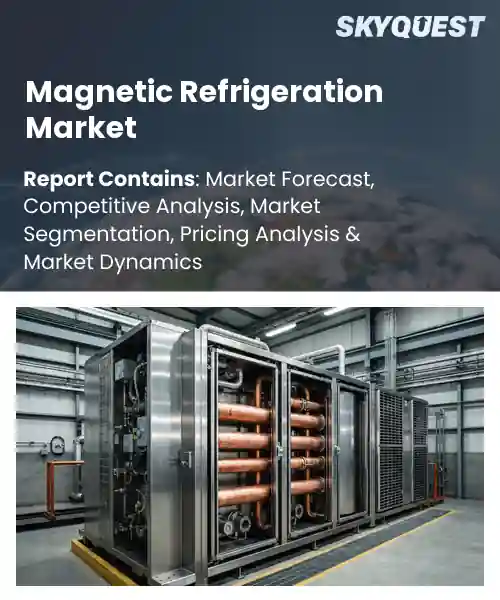
Magnetic Refrigeration Market
Report ID: SQMIG20I2649
Report ID: SQMIG20I2649
[email protected]
USA +1 351-333-4748
Report ID:
SQMIG20I2649 |
Region:
Global |
Published Date: February, 2026
Pages:
157
|Tables:
182
|Figures:
79


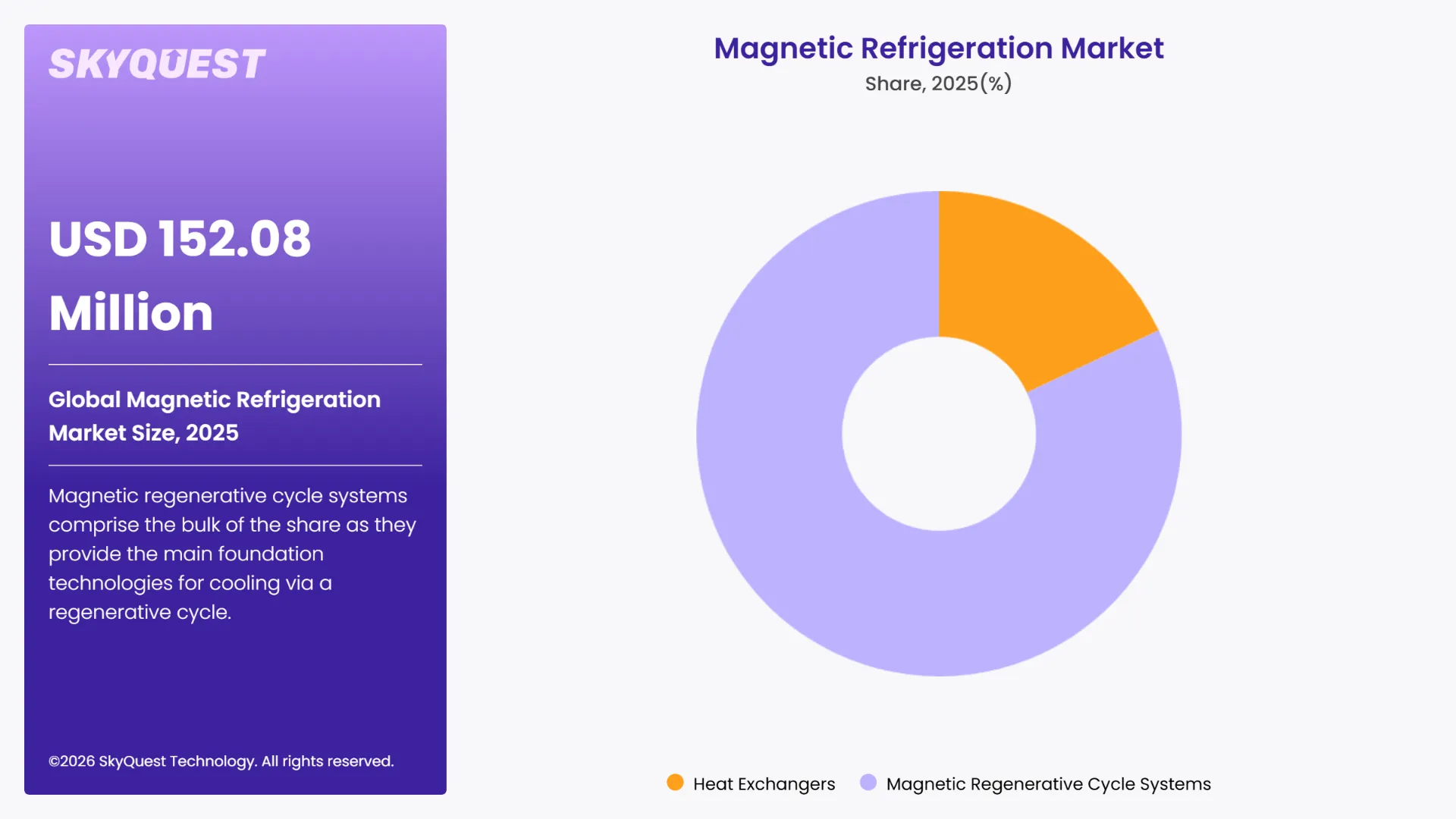
Global Magnetic Refrigeration Market size was valued at USD 145.66 Million in 2024 and is poised to grow from USD 152.08 Million in 2025 to USD 214.79 Million by 2033, growing at a CAGR of 4.41% during the forecast period (2026-2033).
The magnetic refrigeration market is experiencing rapid growth due to the increasing demand for environmentally responsible alternatives to traditional refrigeration systems. The magnetocaloric effect is harnessed by magnetic refrigeration because it allows for the generation of cool temperatures without the use of harmful chemicals, thus fulfilling the requirements of international regulations aimed at reducing greenhouse gas emissions. Commercial, industrial, transportation and health care industries are expected to adopt this technology at an accelerating pace as electricity prices rise and as people become more aware of the need to conserve energy and to promote sustainable practices.
Advances in both magnetocaloric materials and magnetic field engineering have improved the efficiency and practical application of magnetic refrigeration systems. Manufacturers are now using magnetic refrigeration in commercial appliances, beverage coolers, HVAC systems, cold chain logistics and specialty refrigeration systems, many of which originally went through pilot programs before they were commercialized. Regions that have made significant investments in research and development and that have implemented environmental protection legislation have been early adopters of magnetic refrigeration, while the rapid industrialization and urbanization of emerging economies is increasing their demand for cooling solutions.
While continued innovations, favorable government policies and an expanding customer base provide a compelling argument for increased investments in the magnetic refrigeration market, challenges such as high material costs and the requirement for further advancement of commercial scalability continue to impede market growth and are likely to prevent magnetic refrigeration from being commercially viable until manufacturers resolve these issues.
How is IoT Improving Performance Monitoring in the Magnetic Refrigeration Market?
IoT is transforming performance monitoring in the magnetic refrigeration industry by equipping magnetocaloric modules with compact sensors that deliver continuous telemetry on temperature, magnetic field, flow and vibration. These specialized sensors provide real-time telemetry data including temperature, magnetic field, flow, and vibration that can then be captured by edge analytics as well as cloud-based models. Edge and cloud analytics then help identify anomalies, refine cycle-based controls, and provide predictive maintenance capabilities. As a result, the tools provided to vendors and operators today, help to accelerate the validation of prototypes and reduce unplanned downtime for all commercial and industrial applications. Evidence from the current market context indicates that this increase in speed of building out from lab-based prototypes into field units and the ability to service these systems will create greater buyer confidence and speed up the broader adoption of magnetic refrigeration systems by end-users.
Magnoric's announcement at Chillventa (October) regarding their new magnetocaloric display cabinet along with pre industrialization of larger systems will be aided by the IoT enabled monitoring of these prototypes, which will in turn create a repository of in-service performance data that will accelerate commissioning as well as improve operational efficiencies arising from the operational data obtained from the sensors.
Market snapshot - 2026-2033
Global Market Size
USD 0.85 Billion
Largest Segment
Magnetic Regenerative Cycle Systems
Fastest Growth
Magnetic Regenerative Cycle Systems
Growth Rate
25.6% CAGR
To get more insights on this market click here to Request a Free Sample Report
Global magnetic refrigeration market is segmented into component type, product, technology, type, application, end-use and region. Based on component type, the market is segmented into heat exchangers and magnetic regenerative cycle systems. Based on product, the market is segmented into refrigeration systems, air conditioning systems, heat pumps, beverage and wine coolers, cryogenic and ult freezers and others. Based on technology, the market is segmented into magnetic cooling technology, thermal management systems and magnetocaloric materials. Based on type, the market is segmented into reciprocating type and rotary type. Based on application, the market is segmented into refrigeration, air conditioning, heat pumps, cryogenic systems and others. Based on end-use, the market is segmented into residential, commercial, industrial, healthcare, transportation, food & beverage, logistics, automotive, aerospace, marine and others. Based on region, the market is segmented into North America, Europe, Asia Pacific, Latin America and Middle East & Africa.
Magnetic regenerative cycle systems comprise the bulk of the share as they provide the main foundation technologies for cooling via a regenerative cycle. They make use of magnetocaloric materials, magnetic sources of the field, and regeneration mechanisms enabling direct modification of temperature. Manufacturers devote significant resources to developing magnetic-regenerative cycle performance, efficiency, and commercial viability, since these all rely upon the effectiveness of the regenerative cycle. This means that the regenerative cycle ultimately contributes the most value to the totality of architecture across the entire system.
As per magnetic refrigeration market outlook, heat exchangers emerge as the fastest growing component segment of magnetic refrigeration. With the transition of magnetic refrigeration systems from research and pilot projects to commercial use, thermal management efficiency becomes more important than ever. Advanced heat exchanger designs provide better heat transfer rates, greater compactness, and reduced energy losses, all of which are critical to scaling the technology for large scale industrial and HVAC applications. A broader R&D effort focusing on improving thermal conductance and system interoperability will accelerate demand for high-performance heat exchangers.
As per magnetic refrigeration market forecast, refrigeration systems segment currently dominate the market. Magnetic refrigeration is the most advanced and usable technology within conventional refrigeration, including commercial refrigerators, beverage coolers, food storage cold chains, and cold chain logistics. The increased regulatory push to phase out HFC refrigerants and the increased demand for energy-efficient cooling in the retail and industrial sectors are driving this segment to grow faster than other segments.
As per magnetic refrigeration market analysis, the air conditioning systems segment is expected to have the most rapid expansion compared to the other segments of the overall HVAC business. As energy consumption for cooling of buildings continues to rise globally, governments and businesses are actively looking for sustainable, energy-efficient alternatives to HVAC systems. Magnetic cooling has the potential to consume less energy than traditional cooling methods and provide the opportunity to eliminate the use of hazardous refrigerants. Increased emphasis on green buildings is expected to accelerate the adoption of magnetic cooling techniques in the air conditioning and heating system markets as commercialization issues are resolved.
To get detailed segments analysis, Request a Free Sample Report
Asia Pacific's dominance in the market is due to a combination of strong manufacturing ecosystems, research collaboration, and nationalism/ commercial adoption of refrigeration equipment throughout Asia Pacific's appliance & industrial segments. The integrated supply chains of magnet materials and precision components supported by regional industry leaders and their suppliers allow for efficient and cost competitive scale-up of refrigerants across these regions. Collaborative networks between universities, corporate labs, and government-sponsored programs provide regional leaders with access to accelerated prototyping and standards development as well as large-scale consumer markets that drive demand for energy-efficient refrigerants.
Japan's market involves the convergence of advanced research in new materials, precision manufacture, and the education of, and adoption by, the refrigerator manufacturers. Manufacturers collaborate with their industrial research centers and corporate facilities to develop prototypes for commercialization, while established supply chains exist for the precision component fabrication necessary to produce the prototypes.
South Korea is positioned to lead the market due to its leading capabilities in electronics manufacturing, agility in system integration, and proactivity in collaborating with both industry and research institutions. Korean companies have focused on designing compact, highly capable modules that are designed for the consumer appliance and industrial application market by leveraging the capabilities of existing component manufacturers and suppliers. The marketplace has emphasized deployment, resilience of the supply chain, and developing partnerships that synchronize with energy-centric procurement and design activities to promote widespread adoption across end-use applications.
In Europe, rapid growth is occurring because of a combination of three important factors - the existence of well-established policies for energy efficiency, strong interest from the appliance industry to supply alternatives to conventional appliances, and the presence of a highly concentrated pool of technical expertise in materials and systems engineering. Continued success with collaborative pilot programs and cross border consortia has facilitated the establishment of common standards, thereby accelerating market readiness. Investors and technology providers have increasingly identified sustainable cooling solutions as investment targets and are thus developing routes to market across the residential, commercial, and industrial sectors. Together these characteristics of Europe create the basis for the complementary national contributions of Germany as a manufacturing powerhouse, the United Kingdom as an innovation hub, and France as a provider of policy support, all of which has led to the continued collaboration between manufacturers in developing supply chains, testing facilities, demonstration capabilities, and gaining customer acceptance to support coordinated market growth and regulatory leadership throughout Europe. In addition, strong research networks and specialized manufacturing clusters are supporting component improvement and cost reduction, while public procurement programs and commercial retrofitting are providing opportunities for practical deployment. Finally, cross sector alignment among utilities, manufacturers, and regulators is creating more opportunities for market entry and building customer confidence.
As per the magnetic refrigeration market regional outlook, Germany is supported by an extensive manufacturing base, a skilled engineering workforce, and testing capabilities that allow the transition from pilot to production. Companies in Germany are primarily developing industrial and commercial magnetic refrigeration systems with a strong emphasis on manufacturability, quality of components, and overall lifecycle performance. Close collaboration between universities, applied research centres, and industry has facilitated iterations to improve both the magnet assembly and the integration of the heat exchanger.
As per the magnetic refrigeration market regional forecast, the United Kingdom has a strong innovation ecosystem within the market. There are numerous university spin-offs and relatively many start-up companies working towards developing compact and modular systems. Most of the businesses are emphasizing design for manufacturability and system integration specific to commercial and premium home applications. The technology developers work closely with venture capitalists and demonstration partners to validate prototypes in a real operational environment. Through dialogue with regulators and partnerships with industry, businesses are developing the pathways necessary to achieve scale and align their initiatives with the broader objectives of decarbonization.
The magnetic refrigeration market trends in France is being driven by public policy efforts, university research capabilities, and the growing commercial interest in cooling products that are environmentally sustainable. Material testing and system testing is being done at various laboratories, while industrial partners are integrating magnetic refrigeration technologies into their commercial refrigeration and industrial applications. Pilot projects being developed through public procurements and the regional collaboration of industry partners are assisting the development of demonstration projects and building the supply chain necessary to support both the rapidly growing number of new technologies in the magnetic refrigeration market, and to build the supply chain infrastructure to support both the growing number of applications and the growing number of customers interested in purchasing magnetic refrigeration solutions.
By investing in research, collaborating between academia and industry, and attracting commercial customers that prioritize low-impact cooling technology, North America continues to increase its magnetic refrigeration market share. Technology developers are channelling most of their efforts into modular designs for use in existing and new construction; while manufacturers use pilot manufacturing and supply chain partnerships to expand their capabilities. Meanwhile, the creation of developing policies and standards for testing procedures and procurement criteria continues to be a work in progress.
As per the magnetic refrigeration industry analysis, in the United States, private investments, academic research and industrial partnerships have created an environment that promotes the commercialization of magnetic refrigeration technologies. Developers are focusing their efforts on developing modular systems that can be easily expanded to serve the needs of commercial and industrial users; this is being accomplished by conducting pilot demonstrations and developing partnerships with electric power companies. The combined efforts to develop standards, provide training to skilled workers and create supply chain relationships with producer and component suppliers will enable American manufacturers to be ready to manufacture products when they enter the commercial market. Before commercial buyers begin purchasing products, they will have already validated the operational effectiveness of the products that will be available for commercial purchase.
In Canada, magnetic refrigeration technologies are being advanced by many of the same collaborative methods as in the United States (i.e. collaborative research networks, funding sources and partnerships with industrial companies) but with more emphasis placed on developing a larger base of demonstration projects that can support commercialisation. Canadian developers have established their focus on developing robust and adaptable magnetic refrigeration systems that are suitable for use in commercial and industrial applications and will use their manufacturing capacity and supplier partnerships to help achieve this goal.
To know more about the market opportunities by region and country, click here to
Buy The Complete Report
Energy Efficiency Incentives
Technological Advancements in Components
High Material and Manufacturing Costs
Limited Adoption by Commercial Customers
Request Free Customization of this report to help us to meet your business objectives.
There is an increase in competitive intensity among players in the global market because of startup companies and legacy research groups who have formed strategic partnerships to consolidate patents, develop partnerships with manufacturers, and differentiate themselves using technologies. The demand for the pressure placed on companies to phase out refrigerants that have a high potential for global warming has created pressure on companies to develop partnerships that can be used to acquire assets through mergers and acquisitions.
Sustainable Cold Chain Expansion: As logistics for the food and pharmaceutical industries place a greater emphasis on decarbonization, stakeholders are assessing refrigeration technologies that will remove high global warming potential gases from the atmosphere, as well as reduce energy consumption. One promising option for refrigeration in these industries is magnetic refrigeration, which uses non-volatile refrigerants, has a small footprint, and can provide precise temperature control all of which align well with retailer and distributor sustainability goals. This new technology could create opportunities for pilot projects in warehousing, transport refrigeration, and last-mile facilities, and will lead to greater collaboration between original equipment manufacturers (OEMs), cold chain service providers, and sustainability-focused procurement teams to create modular solutions, show total-life-cycle benefits, and reduce total cost of operation.
Industrial Process Cooling Adoption: The increasing demand for precise, stable cooling in industries such as pharmaceuticals, semiconductor manufacturing, and specialty chemicals has led industrial operators to begin evaluating alternative refrigeration technologies. Magnetic refrigeration is a technology that provides accurate temperature control while also minimizing the potential for leakage and greatly simplifying maintenance requirements. This allows organizations to better integrate magnetic refrigeration into continuous production lines and controlled environment facilities. Many suppliers are currently working with their industrial customers to test new retrofits and modular installations and demonstrate resilience, simplify regulatory compliance, and lower the environmental impact of these systems over time, which will give organizations confidence in deploying magnetic refrigeration technologies more widely across complex industrial applications in the future.
SkyQuest’s ABIRAW (Advanced Business Intelligence, Research & Analysis Wing) is our Business Information Services team that Collects, Collates, Correlates, and Analyses the Data collected by means of Primary Exploratory Research backed by robust Secondary Desk research.
As per SkyQuest analysis, there has been a noticeable increase in demand for global magnetic refrigerator products. It is mainly due to an internationally recognized requirement to improve the energy efficiency and eco-friendliness of refrigeration technologies, and due to policy incentives, which support this magnetic refrigeration market growth. However, the high cost of materials and manufacturing methods limits the commercial introduction of these technologies to the market. Asia Pacific still holds its position as the dominant region in this sector because of its well-developed and integrated manufacturing networks and supply chains. Currently, the magnetocaloric materials segment is dominant because of its function in the overall performance of magnetic refrigeration systems. Technological advancements in magnet materials, regenerator designs, and system integration work together to provide support for accelerating the development of prototypes and commercial pilot manufacture. However, the continued growth of the magnetic refrigeration market will depend heavily upon continued reductions in manufacturing cost, supply chain scaling and increasing the demand for magnetic refrigeration products.
| Report Metric | Details |
|---|---|
| Market size value in 2024 | USD 145.66 Million |
| Market size value in 2033 | USD 214.79 Million |
| Growth Rate | 4.41% |
| Base year | 2024 |
| Forecast period | 2026-2033 |
| Forecast Unit (Value) | USD Million |
| Segments covered |
|
| Regions covered | North America (US, Canada), Europe (Germany, France, United Kingdom, Italy, Spain, Rest of Europe), Asia Pacific (China, India, Japan, Rest of Asia-Pacific), Latin America (Brazil, Rest of Latin America), Middle East & Africa (South Africa, GCC Countries, Rest of MEA) |
| Companies covered |
|
| Customization scope | Free report customization with purchase. Customization includes:-
|
To get a free trial access to our platform which is a one stop solution for all your data requirements for quicker decision making. This platform allows you to compare markets, competitors who are prominent in the market, and mega trends that are influencing the dynamics in the market. Also, get access to detailed SkyQuest exclusive matrix.
Table Of Content
Executive Summary
Market overview
Parent Market Analysis
Market overview
Market size
KEY MARKET INSIGHTS
COVID IMPACT
MARKET DYNAMICS & OUTLOOK
Market Size by Region
KEY COMPANY PROFILES
Methodology
For the Magnetic Refrigeration Market, our research methodology involved a mixture of primary and secondary data sources. Key steps involved in the research process are listed below:
1. Information Procurement: This stage involved the procurement of Market data or related information via primary and secondary sources. The various secondary sources used included various company websites, annual reports, trade databases, and paid databases such as Hoover's, Bloomberg Business, Factiva, and Avention. Our team did 45 primary interactions Globally which included several stakeholders such as manufacturers, customers, key opinion leaders, etc. Overall, information procurement was one of the most extensive stages in our research process.
2. Information Analysis: This step involved triangulation of data through bottom-up and top-down approaches to estimate and validate the total size and future estimate of the Magnetic Refrigeration Market.
3. Report Formulation: The final step entailed the placement of data points in appropriate Market spaces in an attempt to deduce viable conclusions.
4. Validation & Publishing: Validation is the most important step in the process. Validation & re-validation via an intricately designed process helped us finalize data points to be used for final calculations. The final Market estimates and forecasts were then aligned and sent to our panel of industry experts for validation of data. Once the validation was done the report was sent to our Quality Assurance team to ensure adherence to style guides, consistency & design.
Analyst Support
Customization Options
With the given market data, our dedicated team of analysts can offer you the following customization options are available for the Magnetic Refrigeration Market:
Product Analysis: Product matrix, which offers a detailed comparison of the product portfolio of companies.
Regional Analysis: Further analysis of the Magnetic Refrigeration Market for additional countries.
Competitive Analysis: Detailed analysis and profiling of additional Market players & comparative analysis of competitive products.
Go to Market Strategy: Find the high-growth channels to invest your marketing efforts and increase your customer base.
Innovation Mapping: Identify racial solutions and innovation, connected to deep ecosystems of innovators, start-ups, academics, and strategic partners.
Category Intelligence: Customized intelligence that is relevant to their supply Markets will enable them to make smarter sourcing decisions and improve their category management.
Public Company Transcript Analysis: To improve the investment performance by generating new alpha and making better-informed decisions.
Social Media Listening: To analyze the conversations and trends happening not just around your brand, but around your industry as a whole, and use those insights to make better Marketing decisions.
REQUEST FOR SAMPLE
 REQUEST FREE CUSTOMIZATION
Global Magnetic Refrigeration Market size was valued at USD 0.85 Billion in 2024 and is poised to grow from USD 1.07 Billion in 2025 to USD 6.61 Billion by 2033, growing at a CAGR of 25.6% during the forecast period (2026-2033).
Competitive intensity in the global magnetic refrigeration market is rising as startups and legacy research groups pursue patent consolidation, manufacturing partnerships, and technology led differentiation. Regulatory pressure to phase down high global warming potential refrigerants and procurement demand for zero leakage systems drive rivals to pursue strategic partnerships and asset acquisitions. Examples include MagnoTherm’s retail and 3D printed component partnerships and Magnoric’s patent and prototype consolidation. 'General Electric', 'Samsung Electronics', 'Daikin Industries', 'Whirlpool Corporation', 'LG Electronics', 'Mitsubishi Electric', 'Bosch Thermotechnology', 'Emerson Electric', 'Panasonic Corporation', 'Hitachi Ltd.', 'HAIER SMART HOME CO., LTD', 'Danfoss AS', 'Kiutra GmbH', 'Magnoric Inc.', 'VACUUMSCHMELZE GMBH & CO. KG', 'ASTRONAUTICS CORPORATION OF AMERICA', 'CAMFRIDGE LTD', 'BASF SE', 'Trane Technologies plc', 'Bluefors Oy'
Government incentives and policy support for energy-efficient technologies encourage manufacturers and end users to invest in magnetic refrigeration by improving project economics and reducing perceived financial risk. Such incentives stimulate demand signals that justify scale-up of production, encourage private investment, and promote research collaborations, which together strengthen supplier ecosystems and distribution channels. By lowering initial barriers and supporting demonstration projects, incentive programs enable wider market exposure and stakeholder confidence, helping to accelerate commercialization and aggregate market growth through sustained adoption and industry commitment.
Asia Pacific Dominates the Global Magnetic Refrigeration Market.


Want to customize this report? This report can be personalized according to your needs. Our analysts and industry experts will work directly with you to understand your requirements and provide you with customized data in a short amount of time. We offer $1000 worth of FREE customization at the time of purchase.
Feedback From Our Clients


 USA (+1) 351-333-4748

