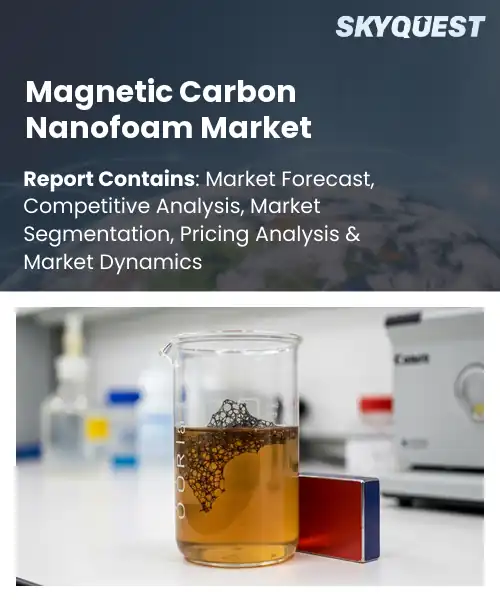
Magnetic Carbon Nanofoam Market
Report ID: SQMIG15E4102
Report ID: SQMIG15E4102
[email protected]
USA +1 351-333-4748
Report ID:
SQMIG15E4102 |
Region:
Global |
Published Date: August, 2026
Pages:
157
|Tables:
118
|Figures:
77


Global Magnetic Carbon Nanofoam Market size was valued at USD 186.7 Million in 2024 and is poised to grow from USD 210.6 Million in 2025 to USD 551.98 Million by 2033, growing at a CAGR of 12.8% during the forecast period (2026-2033).
The magnetic carbon nanofoam market revolves around a lightweight, porous carbon material that exhibits ferromagnetic properties at temperature, enabling applications from electromagnetic shielding to biomedical devices. Its emergence stems from advances in nanostructuring techniques that allow precise control of pore size and surface chemistry, thereby turning an otherwise inert carbon scaffold into a functional magnet. Research in 2010 demonstrated that nitrogen‑doped foam could retain magnetization without rare‑earth elements, prompting pilot production in Japan and the United States. As industries seek sustainable alternatives to metallic magnets, the market has expanded from niche research labs to commercial scale, underscoring its strategic relevance.
The key trend driving the global magnetic carbon nanofoam sector is its capacity to replace ferromagnetic alloys in electronics, where weight and corrosion resistance improve performance. When manufacturers embed nanofoam in inductors or antennas, reduced eddy‑current loss enhances signal fidelity, prompting adoption in 5G base stations and satellite modules. The biomedical sector also leverages the material’s biocompatibility and magnetic response to enable targeted drug delivery; a field guides foam carriers to tumors, increasing efficacy while lowering systemic toxicity. These two industry drivers generate a loop that spurs R&D, expands production capacity and draws venture capital, thereby accelerating worldwide market penetration.
How is AI-Driven Automation Reshaping the Magnetic Carbon Nanofoam Market?
The Global Magnetic Carbon Nanofoam Market is highly research-oriented, with international companies including Cabot Corporation, NanoXplore Inc., Arkema S.A., OCSiAl, Orion S.A., Thomas Swan & Co. Ltd., and ACS Material advancing nanocarbon technologies. Competition centers on material performance, scalability, and application development. Cabot invests in conductive carbon innovation, NanoXplore emphasizes graphene production expansion and strategic supply agreements, while Arkema focuses on sustainable advanced materials and collaborations to accelerate commercialization in energy storage, electronics, and composite applications.
In February 2026, BASF SE expanded the use of artificial intelligence across its materials research and specialty chemicals operations, applying machine learning and autonomous laboratory platforms to accelerate discovery of advanced carbon-based materials. These AI-driven capabilities improve formulation development and process optimization for high-performance nanomaterials, including technologies relevant to magnetic carbon nanofoam applications.
Market snapshot - (2026-2033)
Global Market Size
USD 186.7 Million
Largest Segment
Iron-Based Nanofoam
Fastest Growth
Cobalt-Based Nanofoam
Growth Rate
12.8% CAGR
To get more insights on this market click here to Request a Free Sample Report
Global magnetic carbon nanofoam market is segmented by product type, application, form, end user and region. Based on product type, the market is segmented into iron-based nanofoam, nickel-based nanofoam and cobalt-based nanofoam. Based on application, the market is segmented into energy storage, electromagnetic shielding, environmental remediation and sensors. Based on form, the market is segmented into sheets, blocks and custom structures. Based on end user, the market is segmented into electronics, energy and research institutes. Based on region, the market is segmented into North America, Europe, Asia Pacific, Latin America and Middle East & Africa.
Based on the global magnetic carbon nanofoam market growth, Iron-based nanofoam segment dominates because its intrinsic magnetic permeability and high electrical conductivity make it ideally suited for energy storage architectures, delivering rapid charge transfer while maintaining lightweight structural integrity. The material’s relatively straightforward synthesis pathway lowers entry barriers for manufacturers, encouraging widespread adoption. Additionally, its compatibility with existing carbon frameworks simplifies integration, fostering confidence among product designers and reinforcing its leadership position in the magnetic carbon nanofoam market.
Conversely, nickel-based nanofoam segment is witnessing the strongest growth momentum because its superior corrosion resistance and tunable magnetic properties are unlocking new possibilities in electromagnetic shielding solutions. Emerging demand for durable, high performance protective layers drives research investment, accelerating product development and expanding market opportunities for innovative shielding applications across multiple industries.
Electromagnetic shielding application stands out because its ability to attenuate high frequency interference aligns with the growing need for compact, lightweight protective layers in modern electronic systems. The inherent magnetic carbon matrix provides both conductive pathways and magnetic loss mechanisms, enabling efficient absorption of electromagnetic waves. Manufacturers value this dual functionality, which reduces the need for multiple materials, driving robust adoption and cementing its prominence within the market.
Meanwhile, sensors application is witnessing rapid expansion because its high surface area and tunable magnetic response enable ultra sensitive detection of chemical and physical stimuli. The push for time monitoring in healthcare, industrial automation, and environmental surveillance fuels investment, prompting developers to integrate magnetic carbon nanofoam into next generation sensor platforms, generating fresh growth avenues.
To get detailed segments analysis, Request a Free Sample Report
As per the global magnetic carbon nanofoam market share, Asia Pacific benefits from a confluence of deep scientific expertise and robust industrial capacity. Extensive government investment in advanced materials research creates a fertile environment for innovation, while leading universities and research institutes drive breakthrough discoveries. Large‑scale manufacturing hubs in the region enable efficient production, and established supply chains reduce material costs. Strong demand from electronics, automotive, and renewable energy sectors further accelerates adoption, positioning the region as a central hub for both development and commercialization of magnetic carbon nanofoam technologies.
Magnetic carbon nanofoam market in Japan thrives on close collaboration between academia and industry, fostering rapid prototyping and scale‑up. The nation’s focus on high‑performance electronics and next‑generation energy storage devices creates a steady demand, while government policy encourages sustainable material solutions, reinforcing Japan’s role as a leader in specialty nanomaterial applications.
Magnetic carbon nanofoam market in South Korea is propelled by a vibrant startup ecosystem and substantial public‑private research funding. Emphasis on advanced battery technology and aerospace composites drives commercial interest, while strong intellectual property frameworks support long‑term investment in material innovation, cementing South Korea’s competitive edge in the nanofoam sector.
Based on global magnetic carbon nanofoam regional forecast, North America benefits from a highly diversified economy and a culture of aggressive commercialization. Significant research budgets from federal agencies and private foundations fuel continuous innovation, while a mature venture capital landscape accelerates the translation of laboratory breakthroughs into market‑ready products. Strategic partnerships among leading aerospace, defense, and energy firms create demand pipelines, and a skilled workforce adept at high‑precision manufacturing ensures rapid scale‑up, collectively fueling swift market expansion across the region.
Magnetic carbon nanofoam market in the United States is energized by strong collaboration between top research universities and industrial players, targeting applications in aerospace, defense, and high‑density storage. Federal research initiatives and a vibrant venture ecosystem provide both funding and pathways to commercialization, encouraging rapid adoption of magnetic carbon nanofoam in cutting‑edge technology platforms.
Magnetic carbon nanofoam market in Canada leverages its reputation for clean technology development and strong governmental support for sustainable materials. Partnerships between research institutions and emerging clean‑energy firms drive focused exploration of nanofoam for advanced filtration and lightweight composite uses, positioning Canada as an innovative contributor to the North American market landscape.
As per global magnetic carbon nanofoam regional outlook, Europe advances its market position through coordinated research programs that align with stringent sustainability goals. The European Union’s emphasis on green technologies steers funding toward low‑impact material solutions, while established industrial clusters in automotive and renewable energy sectors provide ready avenues for integration. Collaborative networks across borders enhance knowledge sharing, and a proactive regulatory environment encourages the adoption of magnetic carbon nanofoam in high‑value applications, reinforcing Europe’s strategic role in the global landscape.
Magnetic carbon nanofoam market in Germany benefits from a strong engineering tradition and a dense network of specialized manufacturers. The country’s focus on high‑efficiency automotive components and industrial filtration systems creates targeted demand, while research collaborations with leading technical universities drive continuous material optimisation.
Magnetic carbon nanofoam market in the United Kingdom is shaped by a vibrant research community and growing investment in advanced manufacturing. Emphasis on aerospace and defense applications, combined with supportive innovation policies, encourages the development of high‑performance nanofoam solutions for critical infrastructure.
Magnetic carbon nanofoam market in France is propelled by strategic emphasis on renewable energy and aerospace sectors. Collaborative projects between national research institutes and key industry players foster the integration of magnetic carbon nanofoam into next‑generation battery technologies and lightweight structural components.
To know more about the market opportunities by region and country, click here to
Buy The Complete Report
Increasing Demand for Lightweight Materials
Advances in Synthesis Techniques
High Production Cost Challenges
Regulatory and Safety Concerns
Request Free Customization of this report to help us to meet your business objectives.
The global magnetic carbon nanofoam market outlook is emerging and innovation-driven, with international companies such as Cabot Corporation, NanoXplore Inc., Orion S.A., Arkema S.A., OCSiAl, Thomas Swan & Co. Ltd., and ACS Material participating through advanced nanocarbon research and specialty material development. Cabot focuses on conductive carbon innovation, NanoXplore expands graphene production through strategic partnerships, while Arkema invests in high-performance nanomaterials and sustainable advanced composites for energy, electronics, and industrial applications.
Top Player’s Company Profile
Recent Developments
SkyQuest’s ABIRAW (Advanced Business Intelligence, Research & Analysis Wing) is our Business Information Services team that Collects, Collates, Correlates, and Analyses the Data collected by means of Primary Exploratory Research backed by robust Secondary Desk research.
As per SkyQuest analysis the global magnetic carbon nanofoam industry is being propelled primarily by the rising demand for lightweight materials that combine strength with magnetic functionality, especially in electronics and aerospace, while advances in synthesis techniques that lower energy use and enable roll‑to‑roll production serve as a second catalyst for faster adoption. The iron‑based nanofoam segment leads the market thanks to its high permeability and ease of integration, and Asia Pacific dominates regionally due to strong research funding, manufacturing capacity and demand from high‑tech industries. However, high production costs remain a key restraint, slowing broader rollout until economies of scale and cost‑reduction measures take hold.
| Report Metric | Details |
|---|---|
| Market size value in 2024 | USD 186.7 Million |
| Market size value in 2033 | USD 551.98 Million |
| Growth Rate | 12.8% |
| Base year | 2024 |
| Forecast period | (2026-2033) |
| Forecast Unit (Value) | USD Million |
| Segments covered |
|
| Regions covered | North America (US, Canada), Europe (Germany, France, United Kingdom, Italy, Spain, Rest of Europe), Asia Pacific (China, India, Japan, Rest of Asia-Pacific), Latin America (Brazil, Rest of Latin America), Middle East & Africa (South Africa, GCC Countries, Rest of MEA) |
| Companies covered |
|
| Customization scope | Free report customization with purchase. Customization includes:-
|
To get a free trial access to our platform which is a one stop solution for all your data requirements for quicker decision making. This platform allows you to compare markets, competitors who are prominent in the market, and mega trends that are influencing the dynamics in the market. Also, get access to detailed SkyQuest exclusive matrix.
Table Of Content
Executive Summary
Market overview
Parent Market Analysis
Market overview
Market size
KEY MARKET INSIGHTS
COVID IMPACT
MARKET DYNAMICS & OUTLOOK
Market Size by Region
KEY COMPANY PROFILES
Methodology
For the Magnetic Carbon Nanofoam Market, our research methodology involved a mixture of primary and secondary data sources. Key steps involved in the research process are listed below:
1. Information Procurement: This stage involved the procurement of Market data or related information via primary and secondary sources. The various secondary sources used included various company websites, annual reports, trade databases, and paid databases such as Hoover's, Bloomberg Business, Factiva, and Avention. Our team did 45 primary interactions Globally which included several stakeholders such as manufacturers, customers, key opinion leaders, etc. Overall, information procurement was one of the most extensive stages in our research process.
2. Information Analysis: This step involved triangulation of data through bottom-up and top-down approaches to estimate and validate the total size and future estimate of the Magnetic Carbon Nanofoam Market.
3. Report Formulation: The final step entailed the placement of data points in appropriate Market spaces in an attempt to deduce viable conclusions.
4. Validation & Publishing: Validation is the most important step in the process. Validation & re-validation via an intricately designed process helped us finalize data points to be used for final calculations. The final Market estimates and forecasts were then aligned and sent to our panel of industry experts for validation of data. Once the validation was done the report was sent to our Quality Assurance team to ensure adherence to style guides, consistency & design.
Analyst Support
Customization Options
With the given market data, our dedicated team of analysts can offer you the following customization options are available for the Magnetic Carbon Nanofoam Market:
Product Analysis: Product matrix, which offers a detailed comparison of the product portfolio of companies.
Regional Analysis: Further analysis of the Magnetic Carbon Nanofoam Market for additional countries.
Competitive Analysis: Detailed analysis and profiling of additional Market players & comparative analysis of competitive products.
Go to Market Strategy: Find the high-growth channels to invest your marketing efforts and increase your customer base.
Innovation Mapping: Identify racial solutions and innovation, connected to deep ecosystems of innovators, start-ups, academics, and strategic partners.
Category Intelligence: Customized intelligence that is relevant to their supply Markets will enable them to make smarter sourcing decisions and improve their category management.
Public Company Transcript Analysis: To improve the investment performance by generating new alpha and making better-informed decisions.
Social Media Listening: To analyze the conversations and trends happening not just around your brand, but around your industry as a whole, and use those insights to make better Marketing decisions.
REQUEST FOR SAMPLE
 REQUEST FREE CUSTOMIZATION
Global Magnetic Carbon Nanofoam Market size was valued at USD 186.7 Million in 2024 and is poised to grow from USD 210.6 Million in 2025 to USD 551.98 Million by 2033, growing at a CAGR of 12.8% during the forecast period (2026-2033).
Top Player’s Company Profile 'Cabot Corporation', 'Arkema S.A.', 'NanoAmor Inc.', 'US Research Nanomaterials, Inc.', 'Nanografi Nano Technology', 'ACS Material, LLC', 'American Elements', 'Merck KGaA', 'Thermo Fisher Scientific Inc.', 'Strem Chemicals, Inc.', 'NanoLab, Inc.', 'OCSiAl Group', 'Thomas Swan & Co. Ltd.', 'Raymor Industries Inc.', 'Graphenea S.A.', 'Nano-C, Inc.', 'Directa Plus S.p.A.', 'NanoIntegris Technologies, Inc.', 'Nanoshel LLC', 'SkySpring Nanomaterials, Inc.'
The adoption of lightweight composites across automotive, aerospace, and consumer electronics sectors drives demand for magnetic carbon nanofoam due to its exceptional strength‑to‑weight ratio and magnetic functionality. Engineers seek materials that reduce overall mass while maintaining performance, and nanofoam offers a porous architecture that delivers both. This creates a compelling value proposition, encouraging manufacturers to integrate the material into design processes, thereby expanding market adoption and stimulating growth through broader application possibilities. The material’s compatibility with existing manufacturing lines further accelerates its acceptance across global supply chains.
Advanced Energy Storage Integration: The unique combination of high surface area and magnetic properties enables magnetic carbon nanofoam to serve as a superior electrode material in next‑generation batteries and supercapacitors, facilitating faster charge‑discharge cycles and longer life spans. Manufacturers are increasingly embedding this material into modular energy‑storage platforms for renewable‑grid buffering, portable electronics, and electric‑vehicle powertrains, driving demand across sectors seeking lightweight, high‑efficiency solutions that support decarbonization and resilient power networks and enabling more flexible system architectures worldwide for future.
Why does Asia Pacific Dominate the Global Magnetic Carbon Nanofoam Market? |@12


Want to customize this report? This report can be personalized according to your needs. Our analysts and industry experts will work directly with you to understand your requirements and provide you with customized data in a short amount of time. We offer $1000 worth of FREE customization at the time of purchase.
Feedback From Our Clients


 USA (+1) 351-333-4748

