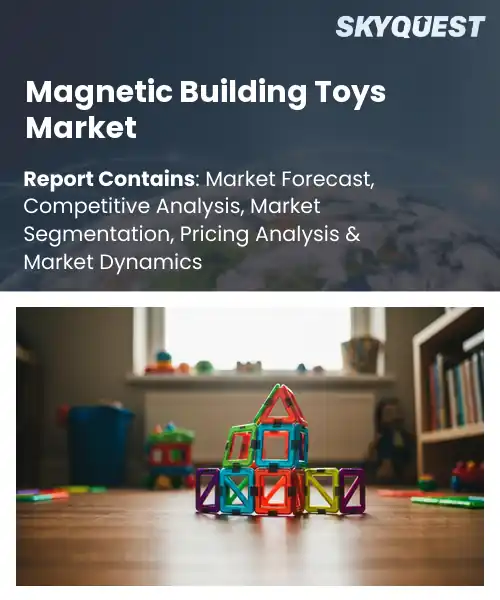
Magnetic Building Toys Market
Report ID: SQMIG25J2276
Report ID: SQMIG25J2276
[email protected]
USA +1 351-333-4748
Report ID:
SQMIG25J2276 |
Region:
Global |
Published Date: July, 2026
Pages:
157
|Tables:
145
|Figures:
78


Global Magnetic Building Toys Market size was valued at USD 1.68 Billion in 2024 and is poised to grow from USD 1.84 Billion in 2025 to USD 3.77 Billion by 2033, growing at a CAGR of 9.4% during the forecast period (2026-2033).
The global magnetic building toys market comprises modular sets that use permanent magnets to interlock plastic or metal pieces, allowing children and adults to create three‑dimensional structures without adhesives. Its significance lies in blending play with engineering concepts, fostering spatial reasoning and problem‑solving skills that align with STEM curricula. The sector began in the early 1990s with Geomag and gained momentum after 2010 when Magformers and Playmags introduced color‑coded, snap‑together components that appealed to schools and hobbyists. This evolution mirrors a shift toward learning tools that reinforce scientific literacy, positioning magnetic building toys as a staple in educational recreational spaces. An catalyst for market expansion is the rising demand for developmental applications, where magnetic building sets serve as tactile interventions for children with autism spectrum disorder or motor‑coordination challenges. Manufacturers collaborate with occupational therapists to design kits that emphasize fine‑motor control, encouraging repetitive grasping and assembly motions that improve neural pathways. As schools incorporate these kits into inclusive curricula, procurement budgets increase, prompting distributors to diversify product lines with curriculum‑aligned themes such as renewable‑energy models or architectural landmarks. Consequently, brands that integrate augmentation augmented‑reality instructions or app‑driven challenges gain competitive advantage, attracting tech‑savvy families and unlocking revenue streams through subscription‑based content.
How is AI enhancing customization in the magnetic building toys market?
AI is reshaping magnetic building toys by turning static sets into adaptive creative tools. Machine‑learning models analyze a child’s past constructions and suggest new configurations that match their skill level and interests. Integrated apps can modify magnet shapes, colors and themes on demand, letting users personalize each build without manual part swaps. Real‑time feedback guides assembly, reducing frustration and encouraging experimentation. This blend of tactile play with digital insight creates a loop where the toy learns from the user and the user learns from the toy, making each session feel uniquely tailored and more engaging for families seeking educational entertainment.In October 2025, LEGO highlighted its new digital builder platform, demonstrating how technology can personalize play experiences and support market growth.
Market snapshot - (2026-2033)
Global Market Size
USD 1.68 Billion
Largest Segment
Magnetic Tiles
Fastest Growth
Magnetic Rod & Ball Sets
Growth Rate
9.4% CAGR
To get more insights on this market click here to Request a Free Sample Report
Global magnetic building toys market is segmented by product type, age group, application, distribution channel, end user and region. Based on product type, the market is segmented into Magnetic Tiles, Magnetic Blocks, Magnetic Rod & Ball Sets and Magnetic Construction Kits. Based on age group, the market is segmented into 1–3 Years, 4–7 Years and 8 Years & Above. Based on application, the market is segmented into Educational Learning, STEM Education and Recreational Play. Based on distribution channel, the market is segmented into Toy Stores, Hypermarkets & Supermarkets and Online Retail. Based on end user, the market is segmented into Households, Schools and Daycare Centers. Based on region, the market is segmented into North America, Europe, Asia Pacific, Latin America and Middle East & Africa.
Magnetic Tiles segment dominates because its flat, colorful surfaces enable children to create intricate two dimensional designs that translate easily to digital sharing and storytelling, fostering creative expression and tactile engagement. The intuitive snap fit mechanic reduces learning curves, making it a preferred choice for parents seeking immediate play value. This ease of use, paired with strong visual appeal, fuels repeat purchases and entrenches magnetic tiles as the core driver of market activity.
However, Magnetic Rod & Ball Sets segment is witnessing the strongest growth momentum as designers introduce modular kinetic structures that appeal to older children and hobbyists seeking engineering challenges. The versatile connectors inspire play, encouraging experimentation with physics concepts, which expands the market’s frontier and opens new avenues for product differentiation.
STEM Education segment dominates because it aligns directly with parental and institutional priorities for skill development, linking magnetic construction to coding, robotics, and problem solving curricula. The tangible nature of the toys translates abstract concepts into hands on experiences, fostering deeper comprehension and sustained interest. This educational relevance drives strong adoption in schools and homes, positioning STEM focused magnetic sets as the market’s primary growth engine.
Meanwhile, Recreational Play segment emerges as the key high growth area as families seek versatile, screen free entertainment that encourages collaborative storytelling and imaginative construction. New design themes and seasonal collections refresh the product line, stimulating frequent purchases and expanding the market’s appeal beyond educational contexts, thereby fueling broader consumer demand.
To get detailed segments analysis, Request a Free Sample Report
Asia Pacific leads the global magnetic building toys market due to a convergence of strong consumer demand, advanced manufacturing ecosystems, and a cultural emphasis on educational play. The region benefits from a dense population of young families with high willingness to invest in developmental toys that promote creativity and engineering concepts. Local manufacturers excel in integrating magnetic technology with sustainable materials, while rapidly evolving retail channels ensure broad product visibility. Collaborative ecosystems between toy designers, educational institutions, and technology firms foster continuous innovation, reinforcing the region’s reputation as a hub for next‑generation play solutions. In addition, regional policy initiatives that support STEM education and intellectual property protection create a favourable environment for both domestic and international players. The synergy of consumer preferences for premium, safe, and interactive products with agile supply chains accelerates product rollout, solidifying Asia Pacific’s dominant position.
Magnetic Building Toys Market in Japan is characterised by a strong alignment with educational curricula and parental expectations for skill‑building play. Manufacturers collaborate closely with schools to embed magnetic concepts within STEAM programs, fostering early interest in engineering. Retail environments showcase premium designs that emphasize safety and precision, resonating with discerning consumers. The integration of cutting‑edge magnetic technology with traditional Japanese craftsmanship creates a product narrative that sustains consumer enthusiasm.
Magnetic Building Toys Market in South Korea thrives on a blend of technological innovation and cultural appreciation for interactive learning. Companies leverage advanced magnet engineering to produce modular systems that appeal to youth and parents focused on cognitive development. Distribution channels emphasize experiential retail, allowing hands‑on trials that highlight product versatility. Partnerships with entertainment franchises amplify brand visibility, while outreach programs integrate magnetic kits into school activities, reinforcing market momentum.
North America experiences rapid expansion of magnetic building toys driven by a confluence of consumer preferences for experiential learning, robust retail ecosystems, and strong support for creative STEM initiatives. Parents increasingly view magnetic kits as essential tools for fostering problem‑solving abilities, prompting heightened demand across diverse income segments. Retail channels ranging from specialty hobby stores to major e‑commerce platforms provide extensive product access and enable immersive demonstrations that reinforce perceived educational value. Collaborative programs between toy manufacturers and educational nonprofits amplify outreach, positioning magnetic toys as integral components of after‑school and community workshops. Moreover, a culture of innovation and early adoption of emerging play technologies sustains a vibrant pipeline of novel designs, reinforcing the region’s momentum in market growth. These dynamics collectively shape a robust ecosystem across the continent.
Magnetic Building Toys Market in United States reflects a sophisticated blend of consumer demand for high‑tech play experiences and a vibrant ecosystem of innovation hubs. Leading manufacturers partner with technology incubators to embed smart features, while major retailers emphasize interactive in‑store displays that allow children to experiment with magnetic structures. Educational collaborations integrate kits into curriculum‑based projects, reinforcing the perception of magnetic toys as essential learning tools that also entertain.
Magnetic Building Toys Market in Canada benefits from strong governmental emphasis on early childhood education and a collaborative retail landscape that prioritizes hands‑on product experiences. Local distributors focus on sourcing eco‑friendly magnetic systems, aligning with consumer preferences for sustainable play solutions. Partnerships with public libraries and community centres enable outreach programs where magnetic kits support creative workshops, reinforcing the market’s reputation as an educational catalyst within the Canadian context today.
Europe strengthens its position in magnetic building toys through a concerted focus on sustainable design, collaborative standards development, and deep integration with formal education systems. Manufacturers prioritize recyclable materials and low‑impact production processes, aligning with stringent regional environmental regulations and consumer expectations for green products. Cross‑border industry consortia work to harmonize safety standards, facilitating smoother market entry for innovative designs across the continent. Educational ministries incorporate magnetic construction kits into curricula that emphasize hands‑on problem solving, reinforcing the toys’ role as pedagogical tools. Additionally, a rich heritage of design excellence drives aesthetic refinement, while vibrant maker communities champion open‑source projects that expand the creative possibilities of magnetic play, collectively enhancing Europe’s competitive edge. Strategic investment in digital marketing and influencer collaborations further amplifies product visibility across diverse consumer segments, reinforcing Europe’s market leadership.
Magnetic Building Toys Market in Germany emphasizes precision engineering and environmental stewardship, reflecting the nation’s broader industrial ethos. Producers integrate high‑quality magnetic components with rigorous safety testing, meeting exacting consumer expectations. Retail strategies highlight educational value through collaborations with schools, offering workshops that demonstrate practical applications of magnetic construction. Sustainable packaging and recyclable materials are standard, resonating with eco‑conscious shoppers and reinforcing Germany’s reputation as a leader in toy manufacturing.
Magnetic Building Toys Market in United Kingdom blends play with a tradition of maker culture, fostering product designs that captivate children and hobbyists. Companies partner with design schools to explore artistic applications of magnetic structures, while retail outlets provide demo zones that encourage tactile experimentation. Educational initiatives integrate magnetic kits into STEM outreach programmes, reinforcing the perception of these toys as valuable tools for nurturing inventors across the British market.
Magnetic Building Toys Market in France is shaped by an emphasis on artistic expression and innovation, aligning with the country’s appreciation for creativity. Manufacturers collaborate with art academies to develop magnetic sets that inspire design thinking, while retailers host ateliers that invite children to construct and showcase their creations. Partnerships with programs embed magnetic kits into classroom activities, reinforcing the role of these toys as catalysts for learning and enrichment.
To know more about the market opportunities by region and country, click here to
Buy The Complete Report
Increasing Educational Interest
Advancements in Magnetic Technology
High Production Cost Challenges
Safety Regulation Compliance Issues
Request Free Customization of this report to help us to meet your business objectives.
The market is shaped by intense rivalry as firms race to embed AI and subscription models into magnetic building toys, prompting rapid product upgrades and investor‑backed expansions. Companies such as Bondu are launching AI‑driven magnetic sets, while Theelefant secures venture funding to scale its curated subscription service, illustrating how tech innovation and strategic capital partnerships are the primary competitive levers driving market dynamics.
Top Player’s Company Profile
Recent Developments
SkyQuest’s ABIRAW (Advanced Business Intelligence, Research & Analysis Wing) is our Business Information Services team that Collects, Collates, Correlates, and Analyses the Data collected by means of Primary Exploratory Research backed by robust Secondary Desk research. As per SkyQuest analysis, the global magnetic building toys market is being propelled primarily by rising educational interest, as parents and schools seek hands‑on tools that boost spatial reasoning and STEM skills. A second important driver is the rapid advancement in magnetic technology, which enhances safety and modularity, opening the product to both casual and hobbyist users, however, high production costs associated with rare‑earth magnets act as a restraint, limiting price‑sensitive adoption. The Asia Pacific region dominates the market thanks to its large young population, strong manufacturing base and supportive education policies, while magnetic tiles remain the leading segment due to their intuitive design and strong
| Report Metric | Details |
|---|---|
| Market size value in 2024 | USD 1.68 Billion |
| Market size value in 2033 | USD 3.77 Billion |
| Growth Rate | 9.4% |
| Base year | 2024 |
| Forecast period | (2026-2033) |
| Forecast Unit (Value) | USD Billion |
| Segments covered |
|
| Regions covered | North America (US, Canada), Europe (Germany, France, United Kingdom, Italy, Spain, Rest of Europe), Asia Pacific (China, India, Japan, Rest of Asia-Pacific), Latin America (Brazil, Rest of Latin America), Middle East & Africa (South Africa, GCC Countries, Rest of MEA) |
| Companies covered |
|
| Customization scope | Free report customization with purchase. Customization includes:-
|
To get a free trial access to our platform which is a one stop solution for all your data requirements for quicker decision making. This platform allows you to compare markets, competitors who are prominent in the market, and mega trends that are influencing the dynamics in the market. Also, get access to detailed SkyQuest exclusive matrix.
Table Of Content
Executive Summary
Market overview
Parent Market Analysis
Market overview
Market size
KEY MARKET INSIGHTS
COVID IMPACT
MARKET DYNAMICS & OUTLOOK
Market Size by Region
KEY COMPANY PROFILES
Methodology
For the Magnetic Building Toys Market, our research methodology involved a mixture of primary and secondary data sources. Key steps involved in the research process are listed below:
1. Information Procurement: This stage involved the procurement of Market data or related information via primary and secondary sources. The various secondary sources used included various company websites, annual reports, trade databases, and paid databases such as Hoover's, Bloomberg Business, Factiva, and Avention. Our team did 45 primary interactions Globally which included several stakeholders such as manufacturers, customers, key opinion leaders, etc. Overall, information procurement was one of the most extensive stages in our research process.
2. Information Analysis: This step involved triangulation of data through bottom-up and top-down approaches to estimate and validate the total size and future estimate of the Magnetic Building Toys Market.
3. Report Formulation: The final step entailed the placement of data points in appropriate Market spaces in an attempt to deduce viable conclusions.
4. Validation & Publishing: Validation is the most important step in the process. Validation & re-validation via an intricately designed process helped us finalize data points to be used for final calculations. The final Market estimates and forecasts were then aligned and sent to our panel of industry experts for validation of data. Once the validation was done the report was sent to our Quality Assurance team to ensure adherence to style guides, consistency & design.
Analyst Support
Customization Options
With the given market data, our dedicated team of analysts can offer you the following customization options are available for the Magnetic Building Toys Market:
Product Analysis: Product matrix, which offers a detailed comparison of the product portfolio of companies.
Regional Analysis: Further analysis of the Magnetic Building Toys Market for additional countries.
Competitive Analysis: Detailed analysis and profiling of additional Market players & comparative analysis of competitive products.
Go to Market Strategy: Find the high-growth channels to invest your marketing efforts and increase your customer base.
Innovation Mapping: Identify racial solutions and innovation, connected to deep ecosystems of innovators, start-ups, academics, and strategic partners.
Category Intelligence: Customized intelligence that is relevant to their supply Markets will enable them to make smarter sourcing decisions and improve their category management.
Public Company Transcript Analysis: To improve the investment performance by generating new alpha and making better-informed decisions.
Social Media Listening: To analyze the conversations and trends happening not just around your brand, but around your industry as a whole, and use those insights to make better Marketing decisions.
REQUEST FOR SAMPLE
 REQUEST FREE CUSTOMIZATION


Want to customize this report? This report can be personalized according to your needs. Our analysts and industry experts will work directly with you to understand your requirements and provide you with customized data in a short amount of time. We offer $1000 worth of FREE customization at the time of purchase.
Feedback From Our Clients


 USA (+1) 351-333-4748

