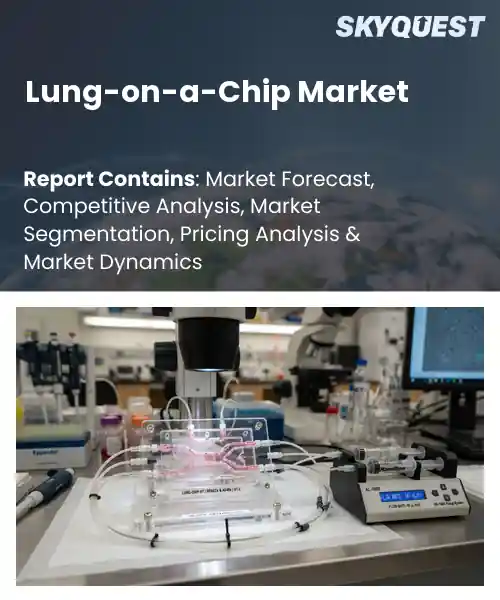
Lung-on-a-Chip Market
Report ID: SQMIG35J2870
Report ID: SQMIG35J2870
[email protected]
USA +1 351-333-4748
Report ID:
SQMIG35J2870 |
Region:
Global |
Published Date: November, 2026
Pages:
157
|Tables:
93
|Figures:
76


Global Lung-On-A-Chip Market size was valued at USD 112.7 Million in 2024 and is poised to grow from USD 144.82 Million in 2025 to USD 1076.6 Million by 2033, growing at a CAGR of 28.5% during the forecast period (2026-2033).
The lung‑on‑a‑chip market comprises microfluidic platforms that replicate human pulmonary physiology for drug testing, disease modeling, and toxicity screening. Its significance lies in reducing reliance on animal experiments while delivering more predictive data for respiratory therapeutics. The primary driver is the accelerating demand for preclinical models amid rising respiratory disease prevalence, especially after the COVID‑19 pandemic highlighted gaps in testing. Early prototypes built by university labs in 2010 evolved into commercial products from companies such as Emulate and Mimetas by 2020. These systems now integrate stretchable membranes and immune cells, enabling realistic airflow and inflammatory responses that attract pharmaceutical investment. The integration of lung‑on‑a‑chip platforms with high‑throughput screening drives the market’s next growth phase. When chips are paired with automated imaging and AI analytics, researchers screen thousands of compounds daily, shrinking years of animal testing to weeks. This speed cuts development costs, prompting major pharmaceutical companies such as Pfizer and AstraZeneca to fund multi‑million projects with device makers. The resulting data satisfy regulators seeking mechanistic evidence, thereby hastening IND approvals. In parallel, the ability to load patient‑derived cells onto chips enables personalized assessment of inhaled therapies, creating lucrative niche markets for biotech innovators and accelerating revenue generation across markets worldwide.
How is AI-driven automation influencing the development and adoption of lung‑on‑a‑chip platforms?
AI driven automation is reshaping lung‑on‑a‑chip platforms by linking real time sensing with machine learning to streamline experiment design and data interpretation. The technology enables precise control of fluid flow, mechanical stretch and cellular environment, reducing manual intervention and improving reproducibility. As pharmaceutical companies seek more predictive human models, the demand for scalable, high throughput chips is rising. Startups such as TissUse and Mimetas have incorporated AI algorithms to predict tissue responses, while larger players are building integrated software suites that guide users from cell seeding to result analysis. This convergence of biology and computation accelerates validation cycles and lowers barriers for broader adoption across research and drug development.Emulate announced in April 2024 the integration of AI driven automation into its lung‑on‑a‑chip platform, enabling autonomous fluidic control and real time data analytics, which shortens experiment cycles and supports broader adoption in pharmaceutical testing.
Market snapshot - (2026-2033)
Global Market Size
USD 112.7 Million
Largest Segment
Microfluidic Lung-on-a-Chip Devices
Fastest Growth
Integrated Lung-on-a-Chip Systems
Growth Rate
28.5% CAGR
To get more insights on this market click here to Request a Free Sample Report
Global lung-on-a-chip market is segmented by product type, application, end user and region. Based on product type, the market is segmented into Microfluidic Lung-on-a-Chip Devices, Integrated Lung-on-a-Chip Systems and Lung-on-a-Chip Consumables. Based on application, the market is segmented into Drug Discovery & Development, Toxicity Testing, Disease Modeling, Personalized Medicine and Other Applications. Based on end user, the market is segmented into Pharmaceutical & Biotechnology Companies, Academic & Research Institutes, Contract Research Organizations and Other End Users. Based on region, the market is segmented into North America, Europe, Asia Pacific, Latin America and Middle East & Africa.
Microfluidic Lung-on-a-Chip Devices segment leads because they provide the most realistic physiological mimicry through precise fluid control and cellular architecture, enabling researchers to replicate alveolar‑capillary interfaces. Their inherent flexibility supports a wide range of experimental designs, making them the preferred foundation for early‑stage testing. Consequently, developers prioritize these devices to reduce animal usage, accelerate timelines, and generate reproducible data that meets regulatory expectations and facilitate cross‑disciplinary collaborations across pharma and academic labs.
However, Integrated Lung-on-a-Chip Systems segment is witnessing the strongest growth momentum as they combine chip hardware with sensors, data analytics, and fluid handling, creating ready‑to‑use solutions. This integration reduces setup complexity and shortens user learning curves, encouraging broader adoption beyond specialist labs. The resulting scalability fuels partnerships and expands market reach, positioning this area as a catalyst for future expansion.
Disease Modeling segment dominates because it directly addresses the need for physiologically relevant platforms that recapitulate complex pulmonary pathologies, enabling scientists to study mechanisms of infection, fibrosis, and asthma with unprecedented fidelity. By providing a bridge between cellular assays and whole‑organ responses, these models attract substantial funding and collaborative projects. Their ability to streamline hypothesis testing accelerates therapeutic target validation, making them indispensable for advancing respiratory research.
On the other hand, Personalized Medicine segment emerges as the key high‑growth area as clinicians seek patient‑specific lung models to predict individual drug responses and adverse effects. Advances in stem‑cell differentiation and bio‑printing enable creation of donor‑derived tissues, driving adoption in precision therapy development. This patient‑centric focus expands market opportunities and encourages regulatory endorsement, propelling rapid expansion of the overall market.
To get detailed segments analysis, Request a Free Sample Report
North America leads the global Lung‑on‑Chip market because it combines a deep research ecosystem with extensive funding mechanisms that accelerate translation of microphysiological technologies. The region benefits from a concentration of world‑class universities, research institutes, and biotech incubators that foster interdisciplinary collaboration. Robust intellectual‑property frameworks and supportive regulatory pathways encourage commercial investment and rapid product development. Close proximity of major pharmaceutical companies to innovative startups creates a fertile environment for co‑development of organ‑on‑chip platforms. Additionally, strong government and private sector commitment to precision medicine and alternative testing methods reinforces the market’s momentum, positioning North America as the benchmark for technological advancement and adoption.
Lung-on-a-Chip Market in the United States thrives on a dense network of academic research centers and venture‑backed startups that push the frontiers of respiratory modeling. Collaborative programs linking federal research agencies with industry accelerate prototype validation and scale‑up. The presence of leading pharmaceutical firms drives demand for human‑relevant testing, while regulatory encouragement for non‑animal methods reinforces adoption across drug development pipelines. This ecosystem also nurtures talent pipelines that feed both academia and industry, ensuring sustained innovation and market growth.
Lung-on-a-Chip Market in Canada benefits from a collaborative research culture that bridges universities, government labs, and health‑care institutions. Federal innovation programs provide strategic support for early‑stage technology translation, while a strong emphasis on ethical testing aligns with national priorities. Partnerships with multinational pharmaceutical players leverage Canadian expertise in respiratory disease, fostering the development of clinically relevant chip models. This integrated approach positions Canada as a key contributor to the broader North American ecosystem.
Europe experiences rapid expansion of the Lung‑on‑Chip market due to a confluence of progressive regulatory environments and a deep commitment to humane research practices. The European Union’s emphasis on reducing animal testing creates a receptive landscape for microphysiological platforms that offer human‑relevant data. Robust public and private research funding fuels cross‑border collaborations among leading universities, specialized biotech clusters, and pharmaceutical giants. The region’s strong tradition of precision medicine and personalized therapeutics drives demand for organ‑on‑chip solutions that can de‑risk clinical development. Additionally, a well‑established network of standards bodies and regulatory guidance accelerates market acceptance, positioning Europe as a catalyst for innovative respiratory modeling and a benchmark for ethical drug discovery.
Germany Lung-on-a-Chip Market benefits from a dense concentration of engineering excellence and biomedical research institutions that prioritize translational science. National research initiatives encourage partnerships between universities, medical centers, and industrial partners, fostering the development of high‑fidelity respiratory chip models. The country’s strong pharmaceutical manufacturing base seeks advanced testing tools to streamline product pipelines, while regulatory alignment with European directives supports swift adoption. This synergy sustains Germany’s dominant role within the European ecosystem.
United Kingdom Lung-on-a-Chip Market is the fastest growing segment, propelled by a vibrant life‑science cluster that blends academic ingenuity with entrepreneurial vigor. Government‑backed innovation schemes accelerate the commercialization of chip technologies, while leading medical schools provide deep expertise in pulmonary biology. The presence of global pharmaceutical firms creates a demand for predictive, human‑relevant testing platforms that can shorten development cycles. Collaborative networks across the UK foster rapid knowledge exchange, reinforcing its position as a dynamic hub for respiratory organ‑on‑chip advancement.
France Lung-on-a-Chip Market is emerging, driven by a strong emphasis on interdisciplinary research that merges bioengineering with clinical expertise. National research agencies fund collaborative projects that link Parisian biotech incubators with university hospitals, encouraging the creation of lung models tailored to disease phenotypes prevalent in the population. The French pharmaceutical sector’s interest in reducing reliance on animal studies aligns with regulatory encouragement for alternative methods. This supportive environment nurtures early‑stage innovation and positions France as a rising contributor to the European Lung‑on‑Chip landscape.
Asia Pacific is strengthening its position in the Lung‑on‑Chip market through a combination of advanced manufacturing capabilities, strategic government initiatives, and a growing ecosystem of biotech innovators. Nations in the region prioritize the integration of micro‑fabrication expertise with biomedical research, enabling rapid prototyping of high‑resolution respiratory models. Public funding programs encourage collaborations between universities, research institutes, and emerging start‑ups, fostering a pipeline of novel chip designs tailored to regional disease burdens. The increasing acceptance of alternative testing by regulatory bodies further accelerates adoption, while partnerships with global pharmaceutical companies provide market access and validation. This multifaceted approach positions Asia Pacific as an emerging hub for next‑generation lung modeling technologies.
Japan Lung-on-a-Chip Market leverages world‑class precision engineering and a deep tradition of medical research to drive innovation. Collaborative networks linking leading universities with technology firms enable the creation of highly detailed lung micro‑environments that reflect native physiology. Government‑supported research programs emphasize translational outcomes, encouraging the movement of prototypes from lab to commercial use. The Japanese pharmaceutical sector’s focus on safety and efficacy aligns with the demand for predictive, human‑relevant testing platforms, reinforcing the country’s role as a key contributor to regional advancement.
South Korea Lung-on-a-Chip Market is propelled by a vibrant biotech sector that integrates cutting‑edge semiconductor manufacturing with life‑science research. National innovation strategies fund joint projects between research universities and technology conglomerates, accelerating the development of sophisticated lung chip platforms. The country’s emphasis on personalized medicine drives demand for models that can capture patient‑specific responses, while regulatory encouragement of non‑animal testing supports market uptake. These dynamics position South Korea as a forward‑looking player contributing to the broader Asia Pacific growth trajectory.
To know more about the market opportunities by region and country, click here to
Buy The Complete Report
Personalized Medicine Adoption
Regulatory Acceptance of In‑vitro Models
High Initial Capital Investment
Limited Standardization Across Platforms
Request Free Customization of this report to help us to meet your business objectives.
The global lung‑on‑a‑chip market is shaped by intense competition as leading firms accelerate M&A activity, forge strategic partnerships with pharmaceutical giants, and push rapid technology innovation such as integrated microfluidic sensors and AI‑driven data analytics; recent examples include a high‑profile acquisition of a micro‑organ‑on‑chip platform by a major biotech and a joint venture between a leading chip manufacturer and a drug‑discovery company to co‑develop personalized respiratory disease models.
Top Player’s Company Profile
Recent Developments
SkyQuest’s ABIRAW (Advanced Business Intelligence, Research & Analysis Wing) is our Business Information Services team that Collects, Collates, Correlates, and Analyses the Data collected by means of Primary Exploratory Research backed by robust Secondary Desk research. As per SkyQuest analysis, the global lung‑on‑a‑chip market is being propelled primarily by the surge in personalized medicine, where patient‑derived cells enable drug screening that reflects individual responses, encouraging pharma and academia to invest heavily. A second strong driver is the growing regulatory acceptance of advanced in‑vitro models, which shortens approval timelines and validates chip‑generated data. The market is most concentrated in North America, benefiting from a dense research ecosystem and major pharmaceutical hubs. Microfluidic lung‑on‑a‑chip devices dominate the product landscape because they offer the most realistic physiological mimicry and design flexibility. However, high initial capital investment remains a notable restraint, limiting rapid uptake among smaller labs.
| Report Metric | Details |
|---|---|
| Market size value in 2024 | USD 112.7 Million |
| Market size value in 2033 | USD 1076.6 Million |
| Growth Rate | 28.5% |
| Base year | 2024 |
| Forecast period | (2026-2033) |
| Forecast Unit (Value) | USD Million |
| Segments covered |
|
| Regions covered | North America (US, Canada), Europe (Germany, France, United Kingdom, Italy, Spain, Rest of Europe), Asia Pacific (China, India, Japan, Rest of Asia-Pacific), Latin America (Brazil, Rest of Latin America), Middle East & Africa (South Africa, GCC Countries, Rest of MEA) |
| Companies covered |
|
| Customization scope | Free report customization with purchase. Customization includes:-
|
To get a free trial access to our platform which is a one stop solution for all your data requirements for quicker decision making. This platform allows you to compare markets, competitors who are prominent in the market, and mega trends that are influencing the dynamics in the market. Also, get access to detailed SkyQuest exclusive matrix.
Table Of Content
Executive Summary
Market overview
Parent Market Analysis
Market overview
Market size
KEY MARKET INSIGHTS
COVID IMPACT
MARKET DYNAMICS & OUTLOOK
Market Size by Region
KEY COMPANY PROFILES
Methodology
For the Lung-on-a-Chip Market, our research methodology involved a mixture of primary and secondary data sources. Key steps involved in the research process are listed below:
1. Information Procurement: This stage involved the procurement of Market data or related information via primary and secondary sources. The various secondary sources used included various company websites, annual reports, trade databases, and paid databases such as Hoover's, Bloomberg Business, Factiva, and Avention. Our team did 45 primary interactions Globally which included several stakeholders such as manufacturers, customers, key opinion leaders, etc. Overall, information procurement was one of the most extensive stages in our research process.
2. Information Analysis: This step involved triangulation of data through bottom-up and top-down approaches to estimate and validate the total size and future estimate of the Lung-on-a-Chip Market.
3. Report Formulation: The final step entailed the placement of data points in appropriate Market spaces in an attempt to deduce viable conclusions.
4. Validation & Publishing: Validation is the most important step in the process. Validation & re-validation via an intricately designed process helped us finalize data points to be used for final calculations. The final Market estimates and forecasts were then aligned and sent to our panel of industry experts for validation of data. Once the validation was done the report was sent to our Quality Assurance team to ensure adherence to style guides, consistency & design.
Analyst Support
Customization Options
With the given market data, our dedicated team of analysts can offer you the following customization options are available for the Lung-on-a-Chip Market:
Product Analysis: Product matrix, which offers a detailed comparison of the product portfolio of companies.
Regional Analysis: Further analysis of the Lung-on-a-Chip Market for additional countries.
Competitive Analysis: Detailed analysis and profiling of additional Market players & comparative analysis of competitive products.
Go to Market Strategy: Find the high-growth channels to invest your marketing efforts and increase your customer base.
Innovation Mapping: Identify racial solutions and innovation, connected to deep ecosystems of innovators, start-ups, academics, and strategic partners.
Category Intelligence: Customized intelligence that is relevant to their supply Markets will enable them to make smarter sourcing decisions and improve their category management.
Public Company Transcript Analysis: To improve the investment performance by generating new alpha and making better-informed decisions.
Social Media Listening: To analyze the conversations and trends happening not just around your brand, but around your industry as a whole, and use those insights to make better Marketing decisions.
REQUEST FOR SAMPLE
 REQUEST FREE CUSTOMIZATION


Want to customize this report? This report can be personalized according to your needs. Our analysts and industry experts will work directly with you to understand your requirements and provide you with customized data in a short amount of time. We offer $1000 worth of FREE customization at the time of purchase.
Feedback From Our Clients


 USA (+1) 351-333-4748

