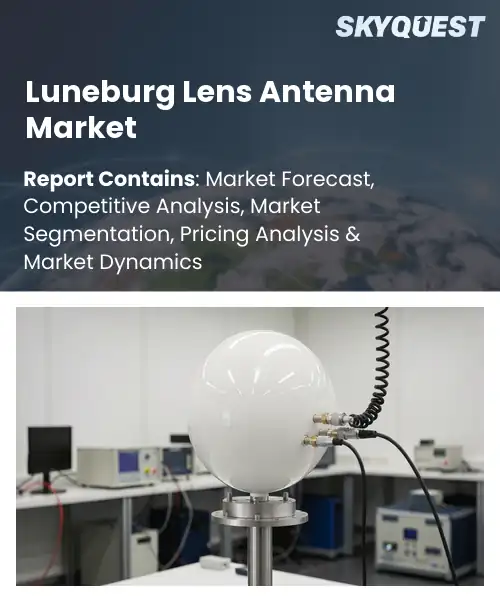
Luneburg Lens Antenna Market
Report ID: SQMIG45H2152
Report ID: SQMIG45H2152
[email protected]
USA +1 351-333-4748
Report ID:
SQMIG45H2152 |
Region:
Global |
Published Date: February, 2026
Pages:
157
|Tables:
113
|Figures:
77


Global Luneburg Lens Antenna Market size was valued at USD 204.1 Million in 2024 and is poised to grow from USD 224.51 Million in 2025 to USD 481.26 Million by 2033, growing at a CAGR of 10.0% during the forecast period (2026-2033).
Rise in deployment of satellite communication networks, growing wide-angle radar coverage demand, increasing adoption of UAVs and maritime surveillance systems, advancements in additive manufacturing, and expansion of low-earth orbit (LEO) satellite constellations are forecasted to boost the demand for Luneburg lens antennas.
Initially developed through academic electromagnetic research and later adopted in defense radar systems, Luneburg lens antennas have transitioned into commercial satellite ground stations and airborne platforms. Growing need for high-gain, wide-field-of-view antennas with lower system complexity is expected to primarily drive Luneburg lens antenna market growth. Additive manufacturing and graded dielectric fabrication are lowering unit costs and shortening lead times, allowing system integrators to deploy Luneburg lenses in UAVs, portable ground terminals, and maritime surveillance systems. Satellite operators are increasingly integrating these antennas for portable LEO tracking and gateway solutions.
On the contrary, high initial development costs, competition from electronically steered phased-array antennas, technical complexity in precision material fabrication, and limited awareness in commercial markets are estimated to impede Luneburg lens antenna market penetration through 2033 and beyond.
How is AI Enhancing Performance of Luneburg Lens Antennas?
AI is enhancing Luneburg lens antennas by automating beam steering, improving multi-band calibration, and enabling adaptive signal processing that can handle interference and mobility. These improvements shorten deployment timelines and make integration easier for satellite ground stations, airborne sensors, and mobile communication platforms. Advancements in 3D printing and low-profile lens designs reduce weight and simplifying installation. This combination of AI-driven optimization and improved manufacturing supports wider adoption in both commercial and defense applications.
Market snapshot - 2026-2033
Global Market Size
USD 204.1 Million
Largest Segment
Reflective Antennas
Fastest Growth
Refractive Antennas
Growth Rate
10.0% CAGR
To get more insights on this market click here to Request a Free Sample Report
Global luneburg lens antenna market is segmented by antenna type, frequency band, application, end user, and region. Based on antenna type, the market is segmented into reflective antennas and refractive antennas. Based on frequency bands, the market is segmented into microwave bands and millimeter waves. Based on application, the market is segmented into telecommunications and defense. Based on end users, the market is segmented into consumer electronics and industrial. Based on region, the market is segmented into North America, Europe, Asia Pacific, Latin America, and Middle East & Africa.
The refractive antennas segment is estimated to spearhead the global luneburg lens antenna market revenue generation in the future. Their gradient-index spherical structure enables high gain, predictable sidelobe control, and simplified mechanical design, which helps cement the dominance of this segment. Continued advancements in dielectric materials and additive manufacturing are also contributing to continued dominance of this segment.
The demand for reflective antennas is slated to rise at a robust pace as per this luneburg lens antenna industry analysis. Growing adoption in mobile ground terminals and UAV-based systems is expanding the business scope of companies focused on this segment.
The telecommunications segment is estimated to account for the highest luneburg lens antenna market share going forward. Increasing deployment of LEO constellations and expanding satellite communication needs are slated to help bolster the dominance of this application segment. Strong investments in global connectivity and mobile backhaul solutions also create new business scope.
The defense segment is slated to expand at an impressive CAGR over the coming years. Luneburg lens antennas support radar platforms, airborne systems, maritime monitoring, and UAV tracking with high reliability and simplified beamforming.
To get detailed segments analysis, Request a Free Sample Report
Growing investments in defense modernization and presence of a vibrant innovation and R&D ecosystem are helping this region maintain a dominant stance. Increasing collaboration between aerospace and defense firms to innovate and expand the application scope of Luneburg lens antennas is also forecasted to help cement the high share of North America. Government funding for universities exploring Luneburg lens antenna innovation is also helping create a new business scope. Rapid expansion space sector and a growing number of satellites launches in the region are also forecasted to boost the sales of Luneburg lens antennas in the long run. The focus on interoperability, compliance to standards, and systems-level integration creates sustained demand in the region.
The presence of top aerospace and defense companies and the presence of expansive research facilities are helping govern Luneburg lens antenna adoption in the country. Scalable lens solutions and comprehensive validation processes are in demand among satellite and space companies operating in the United States. Demand for Luneburg lens antennas that are compliant with regional standards and certifications is predicted to be high in the country going forward. Extensive test range infrastructure is also expected to boost the deployment of Luneburg lens antenna in the future.
Canada’s expertise in maritime surveillance, Arctic operations, and space research collaborations are helping drive consistent demand for Luneburg lens antennas through 2033. Development of ruggedized Luneburg lens antennas that can withstand harsh climate of the country is slated to the prime focus of market players. Export-focused and partnerships with larger system integrators enable suppliers to supply components and subsystems to global initiatives while maintaining local expertise and capabilities.
Advanced manufacturing capabilities and robust adoption of Luneburg lens antennas in defense and commercial sectors are expected to help create new business scope in Asia Pacific. Indigenous companies are leveraging their collaborative expertise to innovate and expand the application scope of Luneburg lens antennas. Government support and funding for rapid prototyping and scalable production of precision antenna components is also helping generate new revenue generation opportunities for market players in the future. Use of Luneburg lens antennas in satellite, maritime, and radar applications is slated to bring in the most revenue in countries such as India, China, South Korea, and Japan. Emphasis on miniaturization and integration of phased array technology is also expanding the application scope of Luneburg lens antennas.
High preference for precision engineering coupled with strong integration between electronics manufacturers and defense integrators is helping boost Luneburg lens antennaadoption in Japan. Local companies rely on advanced testing facilities and a high degree of collaboration with research institutions to improve lens manufacturing and beamforming expertise. Preference for Luneburg lens antennas that focus on compact design and advanced system-level integration is expected to be high among Japanese end users through 2033.
Robust electronics manufacturing expertise and presence of established shipbuilding and defense sectors are governing Luneburg lens antenna adoption in South Korea. Domestic Luneburg lens antenna manufacturers invest heavily in the R&D of compact solutions suited for naval, aerospace, and telecommunication systems. Government backing for innovation and rising collaboration between universities and government research institutions are also creating new business scope in the long run.
Collaborative research initiatives and robust engineering expertise makes Europe a key market for Luneburg lens antenna companies. Launch of new collaborations and partnerships between specialist manufacturers with system integrators is also driving up the demand for novel Luneburg lens antennas. Development of dual use technologies that meet both defence and commercial satellite requirements is being prioritized across Europe. Luneburg lens antenna manufacturers in the region are also expected to focus on material science, sustainable manufacturing processes, and precision fabrication practices to stand out from the competition. Investment in public and private sector prototyping hubs and SME networks promotes accelerated commercialization and improved lifecycle services and aftermarket support for antennas throughout the entire European region.
Established tradition of precision engineering, materials research, and industrial production is shaping Luneburg lens antenna adoption in Germany. Collaborations between automotive and aerospace radar expertise are also enabling the development of high-performance lens solutions in the country. Growing demand for manufacturing automation and improvement of quality management ensures sustained demand for Luneburg lens antenna in the long run.
Presence of leading defense research institutes, a robust aerospace ecosystem, and system integrators is shaping Luneburg lens antenna adoption in the United Kingdom. A service-minded supply base provides testing, certification, and post-delivery services, allowing suppliers to fulfill challenging platform requirements and pursue export markets. The emphasis on naval and airborne radar systems creates a demand for high-accuracy lens calibration and integration.
In France, the Luneburg lens antenna market benefits from extensive experience in the space sector, defence electronics, as well as active research institutions. The majority oforganisations are focusing on producing highly reliable lens designs for use in satellite payloads and radar systems; therefore, attention to both materials and thermal management is critical. Collaborative projects are in place between researchers and manufacturers to assist with system integration and qualification. An industrial ecosystem will allow domestic companies to provide complete solutions for their customers and develop additional customer relationships through exporting.
To know more about the market opportunities by region and country, click here to
Buy The Complete Report
Rising Demand for High Precision
A surge in demand for high-precision electromagnetic control across multiple industry verticals is forecasted to boost the adoption of Luneburg lens antennas. Luneburg lens antennas are especially high in satellite communications, radar imaging, and directed energy systems. The demand for better system design, which includes components that can enhance signal integrity and spatial resolution, fuels the integration of Luneburg lens solutions. This fuels the need for development, customization, and scaling of production, thereby increasing market adoption and encouraging more applications in mission-critical systems.
Advances in Beam Steering Techniques
Rising investments in R&D have resulted in advanced beam steering techniques that enhance the functional appeal of Luneburg lens antennas. Ease of dynamic beam control and the absence of the need for complex phased array architectures are expected to enhance the appeal of Luneburg lens antennas. As the design and operational advantages become more apparent, purchasing decisions shift towards these antennas, fueling product development at a faster pace.
High Manufacturing Complexity and Cost
Limitations to price-sensitive applications are present due to high complexity and cost of manufacturing, ultimately limiting supplier capabilities to produce Luneburg lens antennas at scale for competitive prices. Price-sensitive end users might opt for simpler antennas within their budget/volume constraints, which creates longer cycle times for procurement and longer development cycles for entry level products, thereby hurting Luneburg lens antenna market outlook as well.
Limited Standardization and Interoperability
A lack of standardization and compatibility makes the widespread use of Luneburg lens antennas difficult, as it makes it more complicated to integrate with the current communication and radar systems in use, thus undermining buyer confidence and, in turn, slowing down the procurement process. The various designs and custom-made feed designs make it difficult for system designers to make them compatible, thus requiring extra work, which in turn makes some end users reluctant to adopt Luneburg-based solutions.
Request Free Customization of this report to help us to meet your business objectives.
Competitive dynamics in the global Luneburg lens antenna market center on technology differentiation, strategic partnerships, and targeted defense and satellite contracts that reshape supplier positioning. Firms pursue M&A, OEM alliances and product innovation.
Satellite Constellation Demand: Rapid expansion of low Earth orbit satellite deployments is driving interest in Luneburg lens antennas for wide-angle, high-gain, and low-profile links. System designers favor their unique beamforming flexibility and tracking capability to support dense nodal architectures and resilient space-ground connectivity. Market conversations emphasize lightweight integration, ease of payload accommodation, and compatibility with phased arrays. Suppliers are positioning modular lens solutions for scalability, streamlined qualification, and lifecycle support to meet evolving operational and serviceability expectations across commercial and government satellite programs.
Autonomous Platform Integration: Increasing deployment of unmanned and autonomous platforms is accelerating demand for compact, multi-beam Luneburg lens antennas that enable robust command, control, and sensor exchange. Designers highlight the lens' capacity to support agile pointing, consolidated RF apertures, and reduced electromagnetic interference within constrained airframe or hull envelopes. This trend propels collaboration between antenna developers and autonomy integrators to co-design form factors, thermal and mechanical interfaces, and certification pathways, emphasizing mission adaptability, endurance, and simplified maintainability and logistics across diverse operational environments.
SkyQuest’s ABIRAW (Advanced Business Intelligence, Research & Analysis Wing) is our Business Information Services team that Collects, Collates, Correlates, and Analyses the Data collected by means of Primary Exploratory Research backed by robust Secondary Desk research.
As per SkyQuest analysis, rising demand for wide-angle beam coverage in satellite communications and radar systems along with expanding deployment of LEO satellite constellations are anticipated to drive the demand for Luneburg lens antennas going forward. However, high initial development costs, competition from electronically steered phased-array antennas, and technical complexity in graded dielectric manufacturing are slated to slow down the adoption of Luneburg lens antennas in the future. North America is slated to spearhead the demand for Luneburg lens antennas owing to strong defense investments, advanced satellite infrastructure, and increasing UAV deployment. Advancements in additive manufacturing and integration with portable ground terminals and maritime surveillance platforms are anticipated to be key trends driving the Luneburg lens antenna sector through 2033 and beyond.
| Report Metric | Details |
|---|---|
| Market size value in 2024 | USD 204.1 Million |
| Market size value in 2033 | USD 481.26 Million |
| Growth Rate | 10.0% |
| Base year | 2024 |
| Forecast period | 2026-2033 |
| Forecast Unit (Value) | USD Million |
| Segments covered |
|
| Regions covered | North America (US, Canada), Europe (Germany, France, United Kingdom, Italy, Spain, Rest of Europe), Asia Pacific (China, India, Japan, Rest of Asia-Pacific), Latin America (Brazil, Rest of Latin America), Middle East & Africa (South Africa, GCC Countries, Rest of MEA) |
| Companies covered |
Luneburg Lens Antenna Market Company Profile
|
| Customization scope | Free report customization with purchase. Customization includes:-
|
To get a free trial access to our platform which is a one stop solution for all your data requirements for quicker decision making. This platform allows you to compare markets, competitors who are prominent in the market, and mega trends that are influencing the dynamics in the market. Also, get access to detailed SkyQuest exclusive matrix.
Table Of Content
Executive Summary
Market overview
Parent Market Analysis
Market overview
Market size
KEY MARKET INSIGHTS
COVID IMPACT
MARKET DYNAMICS & OUTLOOK
Market Size by Region
KEY COMPANY PROFILES
Methodology
For the Luneburg Lens Antenna Market, our research methodology involved a mixture of primary and secondary data sources. Key steps involved in the research process are listed below:
1. Information Procurement: This stage involved the procurement of Market data or related information via primary and secondary sources. The various secondary sources used included various company websites, annual reports, trade databases, and paid databases such as Hoover's, Bloomberg Business, Factiva, and Avention. Our team did 45 primary interactions Globally which included several stakeholders such as manufacturers, customers, key opinion leaders, etc. Overall, information procurement was one of the most extensive stages in our research process.
2. Information Analysis: This step involved triangulation of data through bottom-up and top-down approaches to estimate and validate the total size and future estimate of the Luneburg Lens Antenna Market.
3. Report Formulation: The final step entailed the placement of data points in appropriate Market spaces in an attempt to deduce viable conclusions.
4. Validation & Publishing: Validation is the most important step in the process. Validation & re-validation via an intricately designed process helped us finalize data points to be used for final calculations. The final Market estimates and forecasts were then aligned and sent to our panel of industry experts for validation of data. Once the validation was done the report was sent to our Quality Assurance team to ensure adherence to style guides, consistency & design.
Analyst Support
Customization Options
With the given market data, our dedicated team of analysts can offer you the following customization options are available for the Luneburg Lens Antenna Market:
Product Analysis: Product matrix, which offers a detailed comparison of the product portfolio of companies.
Regional Analysis: Further analysis of the Luneburg Lens Antenna Market for additional countries.
Competitive Analysis: Detailed analysis and profiling of additional Market players & comparative analysis of competitive products.
Go to Market Strategy: Find the high-growth channels to invest your marketing efforts and increase your customer base.
Innovation Mapping: Identify racial solutions and innovation, connected to deep ecosystems of innovators, start-ups, academics, and strategic partners.
Category Intelligence: Customized intelligence that is relevant to their supply Markets will enable them to make smarter sourcing decisions and improve their category management.
Public Company Transcript Analysis: To improve the investment performance by generating new alpha and making better-informed decisions.
Social Media Listening: To analyze the conversations and trends happening not just around your brand, but around your industry as a whole, and use those insights to make better Marketing decisions.
REQUEST FOR SAMPLE
 REQUEST FREE CUSTOMIZATION
Global Luneburg Lens Antenna Market size was valued at USD 204.1 Million in 2024 and is poised to grow from USD 224.51 Million in 2025 to USD 481.26 Million by 2033, growing at a CAGR of 10.0% during the forecast period (2026-2033).
Competitive dynamics in the global Luneburg lens antenna market center on technology differentiation, strategic partnerships, and targeted defense and satellite contracts that reshape supplier positioning. Firms pursue M&A, OEM alliances and product innovation; for example MatSing expanded multibeam satellite lens offerings in 2024, while Lunewave announced automotive and NVIDIA DRIVE integrations to secure channel and platform access. 'Antenna Research Associates', 'Wainwright Instruments', 'GlobTek, Inc.', 'SpaceX', 'NEC Corporation', 'Harris Corporation', 'Altair Engineering', 'Metaspace', 'RF Micro Devices', 'Satcom Direct', 'Anokiwave', 'Raytheon Technologies', 'L3Harris Technologies', 'Aethera', 'AR RF/Microwave Instrumentation', 'VIAVI Solutions', 'NuWaves Engineering', 'Microwave Solutions', 'Keysight Technologies', 'General Dynamics Mission Systems'
Rising demand for high-precision electromagnetic control in applications such as satellite communications, radar imaging, and directed-energy systems drives adoption of Luneburg lens antennas because their unique focusing properties enable tighter beam control and enhanced target discrimination. System designers prioritize components that improve signal integrity and spatial resolution, and Luneburg lens solutions are integrated to meet those expectations. This preference motivates manufacturers to invest in development, customization, and supply chain scaling, thereby expanding market uptake and encouraging broader application across mission-critical platforms.
Asia Pacific Dominates the Global Luneburg Lens Antenna Market


Want to customize this report? This report can be personalized according to your needs. Our analysts and industry experts will work directly with you to understand your requirements and provide you with customized data in a short amount of time. We offer $1000 worth of FREE customization at the time of purchase.
Feedback From Our Clients


 USA (+1) 351-333-4748

