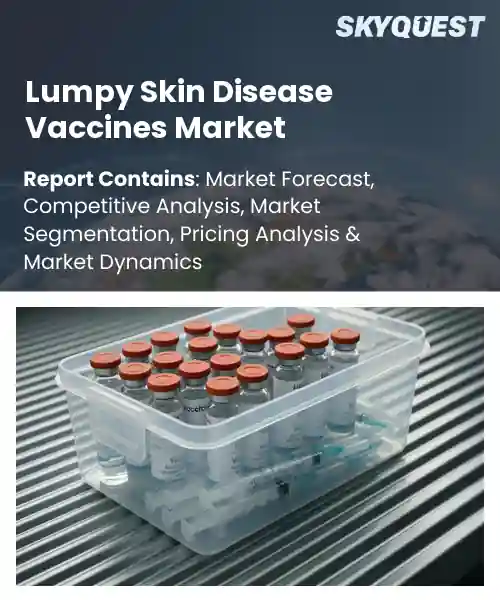
Lumpy Skin Disease Vaccines Market
Report ID: SQMIG35J2227
Report ID: SQMIG35J2227
[email protected]
USA +1 351-333-4748
Report ID:
SQMIG35J2227 |
Region:
Global |
Published Date: February, 2026
Pages:
157
|Tables:
117
|Figures:
77


Global Lumpy Skin Disease Vaccines Market size was valued at USD 2.70 Billion in 2024 and is poised to grow from USD 2.84 Billion in 2025 to USD 4.19 Billion by 2033, growing at a CAGR of 5.0% during the forecast period (2026-2033).
Growing incidence of lumpy skin disease outbreaks, increasing emphasis on livestock health management, expansion of mass vaccination programs, and rising awareness regarding prevention of transboundary animal diseases are driving demand for lumpy skin disease vaccines.
Enhanced disease surveillance activities, along with improvements in cold chain and vaccine delivery systems, are also helping in the timely conduct of vaccination campaigns. In response, manufacturers are working on thermostable and single-dose vaccine products that help in efficient vaccination efforts. Public–private partnerships and regulatory cooperation are further strengthening production capacity and regional vaccine stockpiles, encouraging broader adoption across cattle-producing economies.
Evolution of lumpy skin disease vaccines from localized responses in Africa to coordinated vaccination campaigns across Asia and Europe, with initiatives such as large-scale cattle immunization programs in India and vaccine stockpiling in countries like Turkey also create new business scope. Growing frequency and geographic spread of lumpy skin disease among cattle around the world coupled with the need for effective preventive veterinary interventions are estimated to shape lumpy skin disease vaccines market growth in the future.
On the contrary, high costs associated with vaccine production and distribution, limited veterinary infrastructure in developing regions, cold chain maintenance challenges, and regulatory approval complexities are anticipated to slow down lumpy skin disease vaccines market penetration across the study period and beyond.
How is AI Improving Surveillance And Distribution for Lumpy Skin Disease Vaccines?
AI is improving surveillance and distribution in the lumpy skin disease vaccines market by combining automated disease detection with smarter supply planning. Faster detection helps authorities avoid unnecessary mass vaccination campaigns and instead target vaccine supplies where they are needed most. Use of AI enables image-based screening at farms, open-source outbreak monitoring, and AI-driven demand forecasting.
Market snapshot - (2026-2033)
Global Market Size
USD 2.7 Billion
Largest Segment
Live Attenuated Vaccines
Fastest Growth
Recombinant Vaccines
Growth Rate
5.0% CAGR
To get more insights on this market click here to Request a Free Sample Report
Global lumpy skin disease vaccines market is segmented by vaccine type, administration route, target animal, end-user, and region. Based on vaccine type, the market is segmented into live attenuated vaccines, inactivated vaccines, and recombinant vaccines. Based on administration route, the market is segmented into intramuscular, subcutaneous, and oral. Based on target animal, the market is segmented into cattle, buffalo, and others. Based on end-user, the market is segmented into veterinary clinics, livestock farmers, and research institutions. Based on region, the market is segmented into North America, Europe, Asia Pacific, Latin America, and Middle East & Africa.
The live attenuated vaccines segment is slated to hold the highest global lumpy skin disease vaccines market share in the future. The ability of this vaccine to offer elicit robust, broad immune responses that mirror natural infection is helping them hold sway over others. Their methods of production and efficacy are responsible for their adoption by veterinarians and farmers, thereby minimizing outbreaks and their consequent costs. Their familiarity with regulations and efficacy has instilled confidence in their use, resulting in their widespread use and cementing their position in the industry landscape.
However, recombinant vaccines are emerging as the most rapidly expanding segment as per this lumpy skin disease vaccines industry analysis. Focus on innovation in platforms enables antigen selection and safety, which is attractive for investment and regulatory support. Advances in molecular biology and adjuvant platforms accelerate development and enable DIVA, which opens new business opportunities and accelerates future growth in lumpy skin disease vaccine product lines.
The livestock farmers segment is estimated to spearhead the global lumpy skin disease vaccines market revenue generation in the long run. Herd owners are responsible for the frontline vaccination strategy and volume demand creation through regular and response programs, focusing on cost-effectiveness and ease of administration. The demand for vaccines that can lower morbidity and labor requirements drives the market offerings towards a stable, ready-to-use product. This direct market impact fuels the dominance of this segment.
However, veterinary clinics are emerging as the fastest-growing segment as the professional management skills facilitate an increase in the uptake of vaccines in targeted prevention programs. The clinics provide for the adoption of advanced vaccines, thus offering a value-added service that fuels the growth of the market.
To get detailed segments analysis, Request a Free Sample Report
High concentration of advanced veterinary research, established vaccine manufacturers, and coordinated public health strategies help this region maintain its dominant stance. Clear and robust regulations for product approval have led to an effective and efficient process for the development of vaccine technology. Cooperation among countries has also allowed for the rapid transfer of vaccine technology and best practices. Commercial producers are also utilizing the vaccination of animals as part of their routine herd health program, being another factor in maintaining a deep market. The investment in a cold chain and distribution system is crucial to ensuring there is adequate supply for the diverse production systems in Asia Pacific through 2033.
A mature veterinary infrastructure with emphasis on quality, regulatory compliance, and collaboration between industry and academia helps drive lumpy skin disease vaccines demand in Japan. The high standards for vaccine development and distribution provide for a high level of trust among livestock producers, while extension services provide for specific support for the implementation of vaccines. The focus is on the reliability and safety of the product, while the distribution network ensures consistent delivery to meet the varied production systems.
Dynamic research activity, proactive regulatory engagement, and strong private sector participation boosts lumpy skin disease vaccines R&D in South Korea. The focus on the translation of scientific achievements into commercialized products helps in the development of various vaccine choices. The cold chain and distribution channel are well-integrated to provide reliable distribution in the intense production environment.
Coordinated veterinary networks, heightened awareness among producers, and a diverse manufacturing base helps support steady demand for lumpy skin disease vaccines across Europe. Strong regulatory harmonization between countries allows for the cross-border approval and distribution of vaccines. The use of collaborative research consortia is speeding up the development of vaccines targeted to regional disease needs. Public and private entities are working together to provide technical assistance at the field level, while the cold chain has been established across farms and provides timely distribution of vaccines. Training programs specifically targeted to promoting vaccine use by both commercial producers and smallholders are also encouraging vaccine use. Overall, the combination of these efforts will enable the rapid expansion of veterinary networks in Europe.
Robust manufacturing capacity, coordinated public private initiatives, and high adoption among commercial producers make Germany a key market for lumpy skin disease vaccines vendors. Emphasis on productive facilities and quality control helps drive the development of specific vaccine solutions for field requirements. Established distribution networks and veterinary support help facilitate implementation at the farm level.
Targeted public awareness, evolving regulatory frameworks, and growing engagement from private sector stakeholders help boost lumpy skin disease vaccines demand in the United Kingdom. The focus on disease monitoring and advisory systems helps in making well-informed decisions regarding vaccination programs for different types of farms. Smaller businesses bring flexibility to the distribution channels, and collaborations are underway to develop approaches that are farm-specific.
Presence of leading manufacturers, coordinated regulation, and widespread adoption in commercial systems help support steady lumpy skin disease vaccines demand in France. The extensive network of distributors and veterinarians provides support for the effective use of these products within various types of farms. The research ensures continued improvement of these products and techniques, maintaining France’s position as key market in the European region.
North America is also strengthening its position through its research capabilities, manufacturing diversity, and industry regulatory engagement, which all play a key role in increasing market sophistication. There are partnerships in place that provide support in the knowledge transfer process from research to application in the field. Additionally, there is a focus within manufacturing to ensure that products are of high quality, safe, and can be produced at a large scale. There is also a strong supply chain in place that can provide support to diverse manufacturing systems. There is also increasing collaboration between institutions, manufacturers, and service providers that will play a key role in increasing innovation in the market.
Advanced biomedical research, contract manufacturing capacity, and active engagement between industry and regulators support steady demand for lumpy skin disease vaccines in the country. Distribution systems and cold storage facilities help in easy and consistent delivery to both large and small-scale manufacturers. Veterinary extension and outreach activities help in promoting vaccines, and close association with industry helps in improving vaccines across the United States.
Advanced research capability, collaborative veterinary networks, and a responsive regulatory environment support consistent demand for lumpy skin disease vaccines across Canada. The importance of quality assurance and advisory services promotes practical applications in different business operations and among different types of farmers. The logistical and refrigerated storage facilities are designed to address different geographical conditions, and cooperative relationships with industry and educational institutions concentrate on improving vaccine formulation and strategies for practical applications.
To know more about the market opportunities by region and country, click here to
Buy The Complete Report
Expanded Vaccination Campaigns In Endemic Regions
Advances In Vaccine Technology And Formulations
Regulatory Approval Complexities And Delays
Cold Chain And Distribution Constraints
Request Free Customization of this report to help us to meet your business objectives.
Competitive landscape is driven by platform differentiation, targeted partnerships and consolidation that reshape distribution and regulatory reach. AI antigen design and computational platforms are creating new entrants that compete on speed and cross-protection rather than price alone. Strategic funding and collaborations, for example Baseimmune’s institutional backing from MSD and IQ Capital, and Animol’s Series B led by Novalis, are accelerating candidate pipelines while M&A such as Elanco’s acquisition of Bayer Animal Health alters channel scale and go-to-market capabilities.
SkyQuest’s ABIRAW (Advanced Business Intelligence, Research & Analysis Wing) is our Business Information Services team that Collects, Collates, Correlates, and Analyses the Data collected by means of Primary Exploratory Research backed by robust Secondary Desk research.
As per SkyQuest analysis, rising incidence and geographic spread of lumpy skin disease among cattle are anticipated to drive the demand for lumpy skin disease vaccines going forward. However, challenges related to vaccine distribution, cold chain maintenance, and limited veterinary infrastructure in developing regions are slated to slow down the adoption of lumpy skin disease vaccines in the future. Asia Pacific is slated to spearhead the demand for lumpy skin disease vaccines owing to large cattle populations, frequent outbreak occurrences, and increasing government-led vaccination programs. Development of thermostable vaccine formulations and strengthening of disease surveillance systems are anticipated to be key trends driving the lumpy skin disease vaccines sector in the long run.
| Report Metric | Details |
|---|---|
| Market size value in 2024 | USD 2.7 Billion |
| Market size value in 2033 | USD 4.19 Billion |
| Growth Rate | 5.0% |
| Base year | 2024 |
| Forecast period | (2026-2033) |
| Forecast Unit (Value) | USD Billion |
| Segments covered |
|
| Regions covered | North America (US, Canada), Europe (Germany, France, United Kingdom, Italy, Spain, Rest of Europe), Asia Pacific (China, India, Japan, Rest of Asia-Pacific), Latin America (Brazil, Rest of Latin America), Middle East & Africa (South Africa, GCC Countries, Rest of MEA) |
| Companies covered |
|
| Customization scope | Free report customization with purchase. Customization includes:-
|
To get a free trial access to our platform which is a one stop solution for all your data requirements for quicker decision making. This platform allows you to compare markets, competitors who are prominent in the market, and mega trends that are influencing the dynamics in the market. Also, get access to detailed SkyQuest exclusive matrix.
Table Of Content
Executive Summary
Market overview
Parent Market Analysis
Market overview
Market size
KEY MARKET INSIGHTS
COVID IMPACT
MARKET DYNAMICS & OUTLOOK
Market Size by Region
KEY COMPANY PROFILES
Methodology
For the Lumpy Skin Disease Vaccines Market, our research methodology involved a mixture of primary and secondary data sources. Key steps involved in the research process are listed below:
1. Information Procurement: This stage involved the procurement of Market data or related information via primary and secondary sources. The various secondary sources used included various company websites, annual reports, trade databases, and paid databases such as Hoover's, Bloomberg Business, Factiva, and Avention. Our team did 45 primary interactions Globally which included several stakeholders such as manufacturers, customers, key opinion leaders, etc. Overall, information procurement was one of the most extensive stages in our research process.
2. Information Analysis: This step involved triangulation of data through bottom-up and top-down approaches to estimate and validate the total size and future estimate of the Lumpy Skin Disease Vaccines Market.
3. Report Formulation: The final step entailed the placement of data points in appropriate Market spaces in an attempt to deduce viable conclusions.
4. Validation & Publishing: Validation is the most important step in the process. Validation & re-validation via an intricately designed process helped us finalize data points to be used for final calculations. The final Market estimates and forecasts were then aligned and sent to our panel of industry experts for validation of data. Once the validation was done the report was sent to our Quality Assurance team to ensure adherence to style guides, consistency & design.
Analyst Support
Customization Options
With the given market data, our dedicated team of analysts can offer you the following customization options are available for the Lumpy Skin Disease Vaccines Market:
Product Analysis: Product matrix, which offers a detailed comparison of the product portfolio of companies.
Regional Analysis: Further analysis of the Lumpy Skin Disease Vaccines Market for additional countries.
Competitive Analysis: Detailed analysis and profiling of additional Market players & comparative analysis of competitive products.
Go to Market Strategy: Find the high-growth channels to invest your marketing efforts and increase your customer base.
Innovation Mapping: Identify racial solutions and innovation, connected to deep ecosystems of innovators, start-ups, academics, and strategic partners.
Category Intelligence: Customized intelligence that is relevant to their supply Markets will enable them to make smarter sourcing decisions and improve their category management.
Public Company Transcript Analysis: To improve the investment performance by generating new alpha and making better-informed decisions.
Social Media Listening: To analyze the conversations and trends happening not just around your brand, but around your industry as a whole, and use those insights to make better Marketing decisions.
REQUEST FOR SAMPLE
 REQUEST FREE CUSTOMIZATION
Global Lumpy Skin Disease Vaccines Market size was valued at USD 2.7 Billion in 2024 and is poised to grow from USD 2.84 Billion in 2025 to USD 4.19 Billion by 2033, growing at a CAGR of 5.0% during the forecast period (2026-2033).
Competitive landscape is driven by platform differentiation, targeted partnerships and consolidation that reshape distribution and regulatory reach. AI antigen design and computational platforms are creating new entrants that compete on speed and cross-protection rather than price alone. Strategic funding and collaborations, for example Baseimmune’s institutional backing from MSD and IQ Capital, and Animol’s Series B led by Novalis, are accelerating candidate pipelines while M&A such as Elanco’s acquisition of Bayer Animal Health alters channel scale and go-to-market capabilities. 'Zoetis', 'Merck Animal Health', 'Boehringer Ingelheim', 'Elanco Animal Health', 'Virbac', 'Ceva Santé Animale', 'Oxford Immunotec', 'Vetoquinol', 'Huvepharma', 'iO Veterinary', 'Algenex', 'MSD Animal Health', 'AgriLabs', 'Intervet', 'Bioniche Animal Health', 'KindredBio', 'Indian Immunologicals Ltd.', 'Adimmune Corporation', 'Biovac', 'Kye Pharmaceuticals'
Expanded vaccination campaigns in endemic regions increase demand for lumpy skin disease vaccines by coordinating resources, engaging veterinary services, and prioritizing cattle immunization schedules. Government and donor-supported programs enhance cold chain infrastructure, training, and outreach, which enables broader vaccine distribution and higher uptake among farmers. Improved logistics and organized mass vaccination efforts reduce barriers to access and build trust in vaccination outcomes, encouraging repeat campaigns and procurement commitments from public and private stakeholders, thereby sustaining steady market expansion and incentivizing manufacturers to scale production.
Localized Manufacturing Capacity: Manufacturers are prioritizing regional production and technology transfer building manufacturing capacity closer to affected markets. This shift reduces reliance on distant suppliers, fosters strategic partnerships with local firms and governments, enabling faster scaling of vaccine volumes during disease events. Investment in fill finish capabilities and workforce development supports supply continuity and responsiveness. Tailoring production to regional strain profiles and regulatory environments enhances adoption by veterinary services, strengthens supply chain resilience, and supports long term market growth through localized value creation.
High concentration of advanced veterinary research, established vaccine manufacturers, and coordinated public health strategies help this region maintain its dominant stance. Clear and robust regulations for product approval have led to an effective and efficient process for the development of vaccine technology.


Want to customize this report? This report can be personalized according to your needs. Our analysts and industry experts will work directly with you to understand your requirements and provide you with customized data in a short amount of time. We offer $1000 worth of FREE customization at the time of purchase.
Feedback From Our Clients


 USA (+1) 351-333-4748

