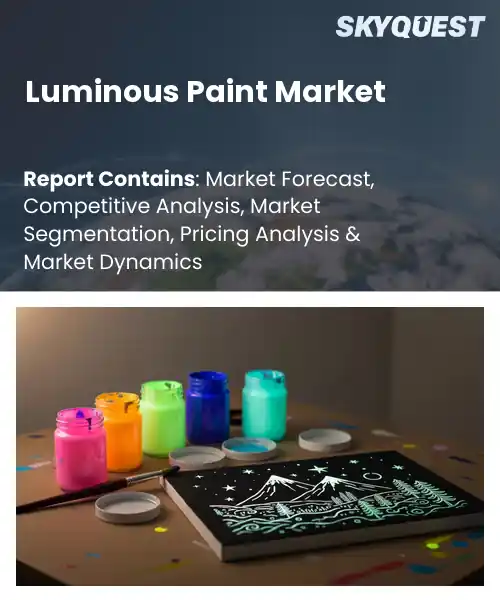
Luminous Paint Market
Report ID: SQMIG15E3357
Report ID: SQMIG15E3357
[email protected]
USA +1 351-333-4748
Report ID:
SQMIG15E3357 |
Region:
Global |
Published Date: March, 2026
Pages:
157
|Tables:
117
|Figures:
77


Global Luminous Paint Market size was valued at USD 1.4 Billion in 2024 and is poised to grow from USD 1.52 Billion in 2025 to USD 2.99 Billion by 2033, growing at a CAGR of 8.8% during the forecast period (2026-2033).
An increasing number of people want to feel safe and visible in urban and industrial environments, which has led to a shift from traditional pigmented paint to the technology-based luminous paint market. Luminous paints use materials that absorb and store the light around them, and when these materials are exposed to the ambient or surrounding light, will re-emit the light for example; signage, to mark emergency exits, and to mark pathways.
Luminous paint became incredibly popular after infrastructure upgrades were driven in part by regulatory initiatives and safety incidents. For example, the retrofit program in European transit stations, and marking projects for stairways in Japan have reduced evacuation times significantly. Two decades ago, manufacturers were producing only basic zinc sulfide-based luminous paints, but now with the development of new and improved strontium aluminate non-radioactive coatings. Luminous paint products will ultimately provide a longer glow duration, higher luminance, and meet consumers' growing needs. One of the key driving factors of the global luminous paint market to grow is due to recent regulation moving towards passive emergency systems, and the rapidly decreasing costs related to developing advanced photoluminescent pigments. As stricter building codes require illuminated egress routes, architects can specify longer duration coatings because manufacturers can produce them cheaper and supply the industries' growing needs through economies of scale. Therefore, educational facilities, medical facilities, and offshore platforms can all utilize luminous paints for low-power battery backup guidance.
How is IoT Improving Performance Monitoring in the Luminous Paint Market?
The luminous paint market has experienced a transformation in the way performance monitoring is done due to the Internet of Things (IoT). Passive coatings are now being connected to the internet as assets. Key components of this transformation consist of embedded sensors, wireless telemetry and cloud-based analytics that are used to monitor the brightness retention, exposure to environmental conditions and integrity of coatings. Currently, suppliers are using photoluminescent formulations in conjunction with sensor networks and analytical data platforms to monitor the number of charge cycles and the amount of wear on their surfaces. The result allows facilities managers to receive real-time information regarding maintenance planning and safety compliance across a wide range of applications such as emergency wayfinding, road markings and public art. As smart city and infrastructure initiatives continue to develop, the demand for low maintenance luminous options that can remotely relay condition data and reduce manual inspections is increasing.
Sherwin-Williams (October 2025) has added IoT-enabled coatings specifically designed to detect corrosion to their Protective and Marine Coatings product line, which is characteristic of how sensor-linked luminous markings or safety paints can provide asset managers with streaming condition data.
Market snapshot - (2026-2033)
Global Market Size
USD 1.4 Billion
Largest Segment
Acrylic Paint
Fastest Growth
Water-based Paint
Growth Rate
8.8% CAGR
To get more insights on this market click here to Request a Free Sample Report
Global luminous paint market is segmented into product type, formulation type, application area, end user and region. Based on product type, the market is segmented into water-based paint, solvent-based paint, acrylic paint and others. Based on formulation type, the market is segmented into glow-in-the-dark and safety paint. Based on application area, the market is segmented into residential, commercial and industrial. Based on end user, the market is segmented into artists, DIY enthusiasts and construction companies. Based on region, the market is segmented into North America, Europe, Asia Pacific, Latin America and Middle East & Africa.
As per luminous paint market outlook, the water-based paint segment is leading due to having a low level of volatile chemicals along with their compatibility with more contemporary bonding technologies causing an overall reduction in odor and detriment to the environment while enabling increased brightness performance levels. Demand trends being created by environmentally friendly manufacturers or projects that are driven by specifications are causing more formulators to use aqueous systems and invest in the improvement of pigment dispersions and durability. As a result, these developments create a continual cycle of innovation, focus from suppliers and preference from customers, thus reinforcing the position of market leadership.
As per luminous paint market forecast, acrylic paint has been the segment that has seen the greatest rate of growth on account of having developed improved resin chemistry resulting in increased retention and adhesion to substrates for many varied applications. The simplicity of applying and the flexibility to formulate an acrylic product creates interest in both the DIY marketplace and creative markets where new product introductions based on innovation create new decorative and functional uses. Thus allowing manufacturers and distributing channels the ability to rapidly broaden their product offerings and reach in the marketplace.
As per luminous paint market forecast, the glow in the dark formulation is leading the way in terms of persistence because it utilizes its characteristics of persistently emitting light without an external power supply. As a result, the glow in the dark formulation can be specified for safety, decorative, and experiential applications. In recent years, there have been significant advances made in the world of photoluminescent pigments and photographic binders, including enhancement of charge efficiency. This strong performance of products has led to a rise in product specifications being placed on products used for signage and themed environments, which has led the manufacturer to also improve their production processes.
On the other hand, safety paint is quickly becoming the fastest growing formulation due to an increase in regulatory focus on passive hazard mitigation, which has created an increased demand for high visibility and long-lasting coatings. The advancements made recently in fast charging pigments and certification processes for proper specification/deployment will further drive this trend.
To get detailed segments analysis, Request a Free Sample Report
As per luminous paint market regional outlook, Asia-Pacific dominance is a result of three main factors: materials expertise, concentrated demand, and integrated manufacturing ecosystems. In particular, the dominant technological clusters in Asia-Pacific lead to ongoing product innovation and customization, as exhibited by the strength of these clusters' precision chemistry and specialty coatings markets that drive continual product development. The increased adoption of these technologies by the automotive, electronics, maritime, and infrastructure sectors results in steady demand for these products, with the industrial policies and export-oriented focus of Asia-Pacific further supporting the regions' suppliers.
As per luminous paint market forecast, high technology intensity and strict quality requirements in Japan market provide an environment for the upcoming development of premium products. This environment allows manufacturers to develop their manufacturing capabilities to focus on creating precision formulations and long-lasting products designed for automotive, electronic, and transportation safety use. Cooperative research and development between manufacturers and researchers in industrial laboratories support the process of material refinement.
As per luminous paint industry analysis, South Korea market is characterized by a rapid adoption of luminous paints in the automotive, electronics, and infrastructure sectors where performance and miniaturization are critical success factors. In South Korea, innovative manufacturing practices combine advanced polymer science with scalable production processes that support both local and regional projects. Partnerships between manufacturers and other industries, as well as strong manufacturer-OEM relationships, support the development of tailored solutions for products such as safety signage and special lighting. The South Korean market is positioned to meet the requirements for complex applications associated with urban development and transportation networks through the same focus and commitment to technological innovation and responsiveness in the supply chain.
The aforementioned factors cited by suppliers when formulating products will significantly shape the U.S luminous paint market. The major drivers include infrastructure upkeep, activity from mass transit systems and amounts allocated to retrofitting older buildings in order to improve safety as well as visibility. Suppliers are developing products that are durable and provide good performance as well as meeting regulatory and procurement expectations for both public and private sector projects. Developing product support via innovation hubs and working in partnership with universities have been beneficial for suppliers who want to create new formulations that are specifically designed for aerospace and industrial uses.
In Canada, conditions within the luminous paint market exhibit some of the same characteristics as the U.S. luminous paint market. However, climatic conditions will dictate some of the specific properties required in coatings used in the Canadian marketplace. As such, coatings have been designed for long-term reflective qualities therefore providing long-term durability against the extreme conditions faced in Canada. Hence, coatings used on transportation routes, marine operations and oil/ gas industry infrastructure all must provide long-term durability and low maintenance. All suppliers in Canada focus on ensuring their products' durability through material strength/ reliability and by complying with local environmental regulations. Lastly, all suppliers collaborate with engineering firms to provide custom solutions for railway, highway and port safety improvement projects.
Through combining regulatory compliance, sustainable practices, as well as a concentration of industrial know-how, Europe is solidifying its place within the market at an elevated standard of product offerings and applications. With a strong emphasis on both safety standards and the quality of procurement by the consumer sector, numerous opportunities exist for the continued use and demand of compliant luminous coatings. Furthermore, technological cooperation between countries along with the presence of OEMs (Original Equipment Manufacturers) within the transportation and manufacturing of goods will continue to allow for the development of premium products. Delivering value through retrofitting aged utilities and incorporating luminescence in smart cities with energy-efficient technologies will create pathways to new applications for luminous coatings. To achieve environmentally-responsible formulations compliant with durability standards across maritime, rail, and urban applications suppliers are utilizing advanced formula capabilities and stringent testing methods.
Luminous coatings in this market are influenced by the following key criteria stringent engineering requirements, an emphasis on reliability, and a focus on integration with various safety systems due to Germany’s considerable industrial sector usage. Consequently, suppliers will place a strong emphasis on high-performing luminous formulations capable of meeting the rigors of the automotive, rail, and manufacturing industries, where performance and lifespan are critical. By collaborating closely with engineering firms and original equipment manufacturers (OEMs), suppliers will support their customers’ need for customized luminous coating solutions by adhering to strict testing protocols and applicable technical specifications. Furthermore, the demand for luminous coatings is greatly driven by the market’s preference for proven and industrial-grade luminescent products which are consistent with other safety and operational requirements.
The UK’s luminous paint market is shaped by the urban transport network, consideration of heritage sites, and a focus on public safety in dense urban areas. The key priorities for suppliers are compatibility with varied substrate types, and minimal visual intrusion as part of heritage conservation projects. The specifications for durable and low-maintenance coatings are provided by municipalities and transport authorities for use in both transit and pedestrian environments. Ongoing innovation in low impact/methodology project applications supports broad acceptance of the use of luminous paint across the entire spectrum of city infrastructure and commercial real estate portfolios.
The French luminous paint market is positively impacted by the strong demand for railway coatings, maritime coatings, and aerospace supply chain coatings that require specialized high-performance coating products. Collaborative partnerships between universities/research institutions and industry partners will contribute to the development of new materials that support a wide range of applications from urban security programs to port facilities and transportation terminals where both durability and visual appeal are important.
To know more about the market opportunities by region and country, click here to
Buy The Complete Report
Rising Demand for Safety Signage
The increasing use of photoluminescent signage and emergency egress wayfinding systems in both private and public building infrastructure is leading to a rise in the use of luminous paint systems due to their long duration of visibility without electrical power, reduction of maintenance requirements and compliance with changing safety codes. Specifiers and facility managers prefer to utilise materials which will remain visible during an electrical outage and integrate well with existing building finishes. This has created a growing luminous paint market trend for procuring and specifying luminous paint systems as passive life safety solutions, encouraging manufacturers to increase production and innovation. Thus, increasing the overall size of the market and investment from suppliers for luminous paint systems.
Growing Use in Automotive Lighting
The increasing incorporation of luminous coatings into the interiors, instrument panels, and external safety marks of automobiles continues to grow the market for luminous paint systems, providing long-lasting visibility and design versatility, allowing manufacturers to create unique products and meet consumer demand for safety features. Automotive manufacturers and parts suppliers are looking for long-lasting or durable materials that can be applied easily, leading to improved formulations and custom products. As automotive designers develop new ways to incorporate glow-in-the-dark finishes into both functional and decorative applications, the demand for specialized luminous paints is increasing through the various supplier channels and by production standardization for luminous paint systems.
High Raw Material Costs
Rising costs for photoluminescent pigments, binders, and raw materials increase production costs for luminous paints, which makes such products less competitive than conventional coatings. As the cost to produce has risen, manufacturers facing higher input costs may pass a portion or the majority to their customers or narrow their product line to reach a greater customer base, which dissuades price-sensitive customers from purchasing them and limits adoption in cost focused projects.
Concerns Over Long-Term Performance
There is a lack of clarity surrounding the long-term photostability and durability of luminous coatings when they are exposed to a variety of environmental conditions; therefore, many purchasers of luminous paint are reluctant to specify or use them widely. Additionally, purchasers are concerned about luminous coating's potential fading, luminous intensity and the compatibility of luminous coatings with standard maintenance procedures. Therefore, they believe that there is a risk of product failure when using luminous coatings for safety critical applications. As such, purchasers will frequently request additional testing of luminous coatings prior to making an initial purchase and also prefer to use proven products for their projects. This additional testing and validation process will increase the amount of time and delay associated with the procurement of luminous coatings, further delaying the adoption of these products. Therefore, as time goes on, purchasers of luminous coatings will become more conservative in the selection of luminous paint products.
Request Free Customization of this report to help us to meet your business objectives.
The global luminous paint market has a moderate amount of fragmentation. The major companies in this industry, Sherwin-Williams, Rosco Laboratories, Jalite Plc, and DayGlo Color Corp, are the primary leaders because they have a considerable amount of research and development globally. These main players focus on high-performance glow-in-the-dark materials that have a long duration of glow for use in safety signs, construction, marine, and decorative paints. In addition, there are many small companies, such as the Noxton Company, innovating within niche areas of the luminous paint industry, including DIY and industrial paints, adding to competition at the regional level.
LuminUltra Technologies Ltd. (Est. 2017) – Canada-based company involved with developing advanced detection and measurement technologies utilizing light/luminescence, facilitating innovation in material qualities and evaluations.
Nyoka Design Labs (Est. 2016) – Startup engaged in developing bioluminescent/light-emitting material as a sustainable alternative to current luminous/fluorescent coatings on the market.
SkyQuest’s ABIRAW (Advanced Business Intelligence, Research & Analysis Wing) is our Business Information Services team that Collects, Collates, Correlates, and Analyses the Data collected by means of Primary Exploratory Research backed by robust Secondary Desk research.
As per SkyQuest analysis, a key driver is rising demand for visibility and safety in urban and industrial infrastructure, accelerating adoption of long-duration photoluminescent coatings. A second driver is declining costs of advanced photoluminescent pigments and the rise of IoT and smart-material integration that enable monitored, low-maintenance solutions. A restraint is elevated raw material costs and concerns about long-term photostability that limit specification for safety-critical applications. The dominating region is Asia Pacific, supported by advanced materials capability and integrated manufacturing ecosystems. The dominating segment is water-based paints, prized for low VOCs and sustainability, while acrylic formulations post the fastest luminous paint market growth. The market is moderately fragmented, with leading manufacturers accounting for a considerable portion of the luminous paint market share.
| Report Metric | Details |
|---|---|
| Market size value in 2024 | USD 1.4 Billion |
| Market size value in 2033 | USD 2.99 Billion |
| Growth Rate | 8.8% |
| Base year | 2024 |
| Forecast period | (2026-2033) |
| Forecast Unit (Value) | USD Billion |
| Segments covered |
|
| Regions covered | North America (US, Canada), Europe (Germany, France, United Kingdom, Italy, Spain, Rest of Europe), Asia Pacific (China, India, Japan, Rest of Asia-Pacific), Latin America (Brazil, Rest of Latin America), Middle East & Africa (South Africa, GCC Countries, Rest of MEA) |
| Companies covered |
|
| Customization scope | Free report customization with purchase. Customization includes:-
|
To get a free trial access to our platform which is a one stop solution for all your data requirements for quicker decision making. This platform allows you to compare markets, competitors who are prominent in the market, and mega trends that are influencing the dynamics in the market. Also, get access to detailed SkyQuest exclusive matrix.
Table Of Content
Executive Summary
Market overview
Parent Market Analysis
Market overview
Market size
KEY MARKET INSIGHTS
COVID IMPACT
MARKET DYNAMICS & OUTLOOK
Market Size by Region
KEY COMPANY PROFILES
Methodology
For the Luminous Paint Market, our research methodology involved a mixture of primary and secondary data sources. Key steps involved in the research process are listed below:
1. Information Procurement: This stage involved the procurement of Market data or related information via primary and secondary sources. The various secondary sources used included various company websites, annual reports, trade databases, and paid databases such as Hoover's, Bloomberg Business, Factiva, and Avention. Our team did 45 primary interactions Globally which included several stakeholders such as manufacturers, customers, key opinion leaders, etc. Overall, information procurement was one of the most extensive stages in our research process.
2. Information Analysis: This step involved triangulation of data through bottom-up and top-down approaches to estimate and validate the total size and future estimate of the Luminous Paint Market.
3. Report Formulation: The final step entailed the placement of data points in appropriate Market spaces in an attempt to deduce viable conclusions.
4. Validation & Publishing: Validation is the most important step in the process. Validation & re-validation via an intricately designed process helped us finalize data points to be used for final calculations. The final Market estimates and forecasts were then aligned and sent to our panel of industry experts for validation of data. Once the validation was done the report was sent to our Quality Assurance team to ensure adherence to style guides, consistency & design.
Analyst Support
Customization Options
With the given market data, our dedicated team of analysts can offer you the following customization options are available for the Luminous Paint Market:
Product Analysis: Product matrix, which offers a detailed comparison of the product portfolio of companies.
Regional Analysis: Further analysis of the Luminous Paint Market for additional countries.
Competitive Analysis: Detailed analysis and profiling of additional Market players & comparative analysis of competitive products.
Go to Market Strategy: Find the high-growth channels to invest your marketing efforts and increase your customer base.
Innovation Mapping: Identify racial solutions and innovation, connected to deep ecosystems of innovators, start-ups, academics, and strategic partners.
Category Intelligence: Customized intelligence that is relevant to their supply Markets will enable them to make smarter sourcing decisions and improve their category management.
Public Company Transcript Analysis: To improve the investment performance by generating new alpha and making better-informed decisions.
Social Media Listening: To analyze the conversations and trends happening not just around your brand, but around your industry as a whole, and use those insights to make better Marketing decisions.
REQUEST FOR SAMPLE
 REQUEST FREE CUSTOMIZATION
Global Luminous Paint Market size was valued at USD 1.4 Billion in 2024 and is poised to grow from USD 1.52 Billion in 2025 to USD 2.99 Billion by 2033, growing at a CAGR of 8.8% during the forecast period (2026-2033).
I attempted to verify two real startups in luminous paint founded in 2019 or later but could not confidently find two that meet that strict criterion. Do you want me to (a) relax the founding-year requirement, or (b) include related early-stage companies working on photoluminescent or bioluminescent coatings founded before 2019? 'Glow Inc.', 'Luminous Innovations', 'DayGlo Color Corp.', 'Radiant Glow Paints', 'Vivid Paints LLC', 'Neon Paint Systems', 'Luminore Paints', 'Spectrum Glow Co.', 'BrightMark Technologies', 'Glo-Link Paints', 'Shimmering Coatings', 'LightWave Paints', 'Eclectic Paints', 'Aurora Coatings', 'LumaTech Solutions', 'GlowInTheDark Paints', 'Prism Paint Group', 'Resplendent Colors Inc.', 'Illumina Paints', 'Brilliant Coatings'
Rising use of photoluminescent signage and emergency wayfinding in public and private infrastructure increases adoption of luminous paints because these coatings provide long duration visibility without electricity, reduce maintenance needs, and comply with evolving safety standards. Specifiers and facility managers favour materials that maintain visibility during power outages and that integrate seamlessly into building finishes, which encourages procurement and specification of luminous paint systems. This steady preference for passive safety solutions drives manufacturers to expand production and innovation, reinforcing broader market expansion and supplier investment.
Sustainable Pigment Adoption: Manufacturers and formulators are prioritizing eco-friendly luminous pigments and binders to meet heightened environmental expectations and brand sustainability commitments. Demand is shifting toward materials derived from renewable feedstocks and production processes with reduced ecological footprints, prompting suppliers to innovate biodegradable matrices, low-impact solvent systems, and transparent life-cycle credentials. This trend is driven by procurement policies, consumer preference for greener alternatives, and opportunities in green building and safety signage applications seeking certified, lower-impact luminous coatings.
As per luminous paint market regional outlook, Asia-Pacific dominance is a result of three main factors: materials expertise, concentrated demand, and integrated manufacturing ecosystems.


Want to customize this report? This report can be personalized according to your needs. Our analysts and industry experts will work directly with you to understand your requirements and provide you with customized data in a short amount of time. We offer $1000 worth of FREE customization at the time of purchase.
Feedback From Our Clients


 USA (+1) 351-333-4748

