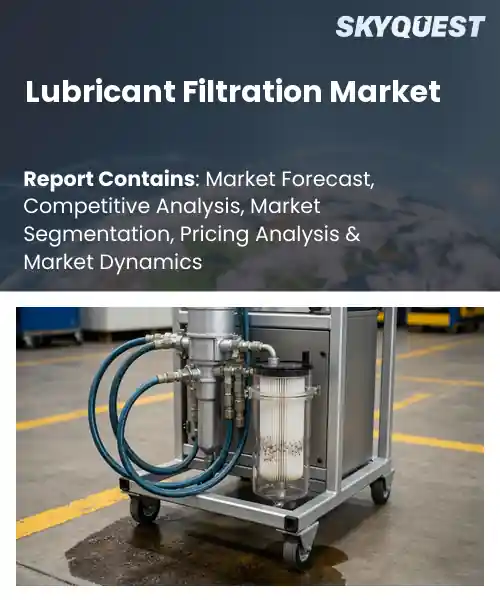
Lubricant Filtration Market
Report ID: SQMIG20G2114
Report ID: SQMIG20G2114
[email protected]
USA +1 351-333-4748
Report ID:
SQMIG20G2114 |
Region:
Global |
Published Date: March, 2026
Pages:
157
|Tables:
113
|Figures:
77


Global Lubricant Filtration Market size was valued at USD 3.6 Billion in 2024 and is poised to grow from USD 3.88 Billion in 2025 to USD 7.02 Billion by 2033, growing at a CAGR of 7.7% during the forecast period (2026-2033).
Growing focus on equipment reliability, rising need to reduce maintenance costs, increasing adoption of predictive maintenance practices, advancements in filtration technologies, and expanding industrial operations are driving sales of lubricant filtration systems.
Advances in filter media and real-time monitoring technologies with predictive maintenance solutions are important factors driving the adoption of lubricant filtration solutions. These technologies can help in the early detection of contamination and take the required measures to prevent equipment failures. With the help of sensors and analytics in the oil, maintenance strategies are no longer based on time intervals.
Rather, the focus is on condition-based maintenance. This is helping the maritime industry, the power industry, and other industries to reduce oil changes and lower operating costs. As the oil is being used for longer periods, it is also opening up opportunities to develop aftermarket business models, retrofitting business models, and service-based business models. Growing emphasis on minimizing equipment downtime and improving operational efficiency across industries coupled with increasing awareness regarding the impact of lubricant contamination are expected to primarily drive lubricant filtration market growth.
On the contrary, high initial investment costs, maintenance complexity, lack of awareness in small-scale industries, variability in filtration standards, and challenges in system integration are anticipated to impede lubricant filtration market penetration across the forecast period.
How Lubricant Filtration is Enabling Predictive Maintenance through Use of AI?
Predictive maintenance is being improved by AI in the lubrication filter market by interpreting oil condition data into understandable and actionable information. Particle levels and types of contamination are constantly being monitored by sensors, and abnormal patterns are quickly detected by edge analytics. Machine learning in the cloud is able to learn the normal patterns of each machine and identify problems before they happen. Real-world examples include pumps and mobile sensors connected by IoT devices sending data to analytics platforms for recommendations.
Market snapshot - 2026-2033
Global Market Size
USD 3.6 Billion
Largest Segment
Mechanical Filters
Fastest Growth
Chemical Filters
Growth Rate
7.7% CAGR
To get more insights on this market click here to Request a Free Sample Report
Global lubricant filtration market is segmented by filter type, application, material, end-user, and region. Based on filter type, the market is segmented into mechanical filters and chemical filters. Based on application, the market is segmented into industrial lubrication and automotive lubrication. Based on material, the market is segmented into polymer-based materials and metal-based materials. Based on end-user, the market is segmented into OEMs and aftermarket. Based on region, the market is segmented into North America, Europe, Asia Pacific, Latin America, and Middle East & Africa.
The mechanical filters segment is forecasted to lead the global lubricant filtration market revenue generation in the future. Straightforward particle capture mechanism directly addresses the most common failure modes, which makes them the preferred choice in multiple applications. The well-established media selection criteria and the predictable hydraulic response provide low maintenance uncertainty, which makes them the preferred choice for routine maintenance programs. The compatibility with existing housings and the robust performance through various contamination profiles contribute to the high selection rates by OEMs.
However, chemical filters are emerging as the fastest growing segment as per this lubricant filtration industry analysis. Their ability to target dissolved contaminants and oxidative byproducts that mechanical capture cannot be removed is helping boost their demand. Improvements in adsorbent chemistry and medium formulations have provided opportunities for condition-based maintenance and oil reclamation strategies, which have opened new opportunities for service and application of these technologies where control of fluid chemistry extends the life of the equipment and provides cost savings.
The polymer-based materials segment is slated to hold the highest global lubricant filtration market share in the future. Molded and nonwoven synthetics offer a versatile combination of low cost, corrosion resistance and adaptable pore structures to help this segment hold sway over others. Fabrication ease and pleating and bonding processability make production and replacement easier, and reduced weight and chemical resistance make these materials easier to integrate into various types of automotive and industrial filter configurations.
However, metal-based materials are appearing as the most promising segment in terms of growth potential due to the need for high-temperature and abrasive resistant filters in heavy-duty applications. Improvements in sintering technology and coating techniques have resulted in robust, cleanable products that support the concept of reusable filters, thus enabling premium product placement.
To get detailed segments analysis, Request a Free Sample Report
High manufacturing activity, extensive automotive and industrial equipment production, and a robust supplier ecosystem are helping Asia Pacific lead lubricant filtration demand on a global level. With competitive priced manufacturing processes available for filters as a result of the integration of manufacturing and supply chains across the region, many new filter media and designs can be brought to market quickly.
Furthermore, numerous companies located within markets such as Japan and South Korea specialize in advanced technology capabilities and have established high-quality production standards that enable them to offer distinct differentiating features in their products. In addition to the strength of demand from various end-user industries that require aftermarket products, many OEMs work together with suppliers to specify new advanced filtration technologies in real-time and bolster the dominance of this region.
Robust culture of precision engineering and close collaboration between equipment makers and filter suppliers support consistent lubricant filtration adoption in Japan. The country’s emphasis on advanced materials, testing, and the integration of lubricant filters into complex equipment is driving the market. The aftermarket and OEM routes ensure consistent market adoption, especially in the automotive and industrial sectors, as well as in research and development.
Rapid technology adoption and strong linkages between heavy industry and filter innovators are boosting lubricant filtration demand in South Korea. Emphasis on high-efficiency filtration and miniaturized designs is well-aligned with high-tech industry and marine requirements. Service infrastructures also play an important role in driving replacement and upgrade activity, supporting market demand in industrial, marine, and automotive segments.
Stringent operational and environmental standards, a mature industrial base with high expectations for equipment uptime are supporting lubricant filtration demand in European countries. Service providers and strengthened aftermarket networks have made installation, monitoring, and upgrades easier to facilitate. Local manufacturers have been using filtration and materials science know-how to provide a wide range of different filter and related products to meet various application requirements.
End-users are looking for reduced lifetime costs & increased capability, thus encouraging investment in the use of high-quality filters and how they can be maintained over time. Sustainability objectives and the principles of the circular economy are having impacts on market opportunities by focusing on the prevention of contaminants from entering production processes, extending filter and lubricant lifetime, and responsible end-of-life activities. Cross-border supply chains and skilled technical service providers continue to create opportunities to penetrate the market further with seamless solutions for customers.
Robust industrial ecosystem and exacting engineering standards that prioritize equipment reliability support high lubricant filtration demand in Germany. Ties to heavy industry and automotive markets provide strong support for high-performance filter media and systems, further securing Germany's position as a center for quality leadership. Domestic industry and OEMs incorporate high-tech filtration specifications into equipment supply chains, with service organizations providing preventive maintenance and fluid management services.
Rising emphasis on fleet reliability, industrial servicing, and retrofit opportunities across sectors is boosting lubricant filtration adoption in the United Kingdom. Increasing partnership between fleet operators and technology suppliers is also driving the adoption of condition monitoring and servicing programs across sectors. The presence of flexible suppliers and service organizations that can adapt to the requirements for older equipment and new installations alike also creates new business scope.
Growing industrial modernization and a focus on sustainability and efficiency are supporting consistent lubricant filtration demand in France. Local players are promoting innovations in the lubricant filter media and the lifespan of the filters to improve the longevity of the lubricant. This is further supplemented by the country’s focus on the lifespan of the filters and the development of the sector with the help of operators and research centers.
Emphasis on technological advancement, mature service ecosystems, and close alignment between OEM requirements and aftermarket capabilities creates an opportune setting in this region. Digital diagnostics and customized service contracts are being used to achieve these goals. Within the energy, transportation, and heavy industry sectors there are strong linkages that create demand for specialized filtration media and filter systems integrated into various applications, while domestic manufacturers are focused on providing products with high performance, certifications, and compatibility with international standards.
Collaborative development among suppliers, operators, and research organizations is accelerating product improvements and supporting the deployment of comprehensive distribution networks that provide fast deployment and ongoing technical support for a wide range of end use applications. End users are looking for filtration solutions that will help them monitor conditions, predict maintenance needs, and increase the availability of their assets. Investments in localized manufacturing as well as a focus on service innovation are helping to enhance regional competitiveness and supply chain resiliency.
Technology-driven ecosystem and demand across energy, transportation, and industrial equipment sectors drives consistent lubricant filtration adoption in the United States. Growing investments in diagnostic technologies and filtration media development are also expected to boost the R&D of novel lubricant filtration solutions. Collaborations between OEMs and suppliers also ensure consistent supply of advanced lubricant filtration products.
Emphasis on natural resources, transportation, and harsh operating environments that emphasize reliability and contamination control drive steady lubricant filtration demand in Canada. Suppliers and service providers offer filtration solutions for remote operations and fleet maintenance, where they emphasize robust media and systems. They work with engineering companies and operators to test and develop solutions for different conditions, and they offer after-sales service and advice for replacement and upgrading equipment in industries.
To know more about the market opportunities by region and country, click here to
Buy The Complete Report
Rising Industrial And Automotive Demand
Lubricant filtration demand is fueled by increasing industrial and automotive requirements for longer equipment life and greater operating efficiency. As industries focus on minimizing unscheduled downtime, there is a greater focus on filtration systems to maintain cleanliness in lubricants and protect critical equipment; hence, there is a greater adoption of advanced filtration systems. Further, there is a greater focus in maintenance activities towards preventive maintenance techniques based on reliable filtration systems to increase lubricant and equipment operating intervals. This is a direct factor in increasing filtration requirements in various industries.
Advances In Filtration Technology
Constant innovation in filter media, design, and monitoring technology is helping to increase the capabilities of lubricant filtration products. Innovations in synthetic media help in the capture of more particles without flow restriction. The modularity of these products makes it easier for users to address specific problems related to contamination. The technology has helped end users match the performance of lubricant filtration products to the ever-changing lubricant chemistries. The technology has helped in the development of filtration products that have made procurement decisions easier for end users.
High Capital Expenditure Requirements
The huge investment cost in terms of acquiring advanced level filtration systems, as well as retrofitting, acts as a constraint to the growth of the market, considering the reduced willingness to invest, particularly in small and medium-sized businesses. The high perceived cost of procurement and installation acts as a barrier, leading to a reduced rate of replacing outdated or less efficient filters, thereby reducing the rate at which advanced level filtration solutions are adopted. Budgetary constraints, particularly in prioritizing current operational needs over future reliability improvement, also act as a constraint for global lubricant filtration market outlook
Compatibility Challenges With Lubricants
Inconsistency in the composition of the lubricants and the additives also creates compatibility issues, which affect the widespread applicability of the filtration products. It might affect the performance of the filters and oil, which is a hindrance to the growth of the filtration market. Compatibility issues arise because the filters might react with the base oil and the additives. It might affect the performance of the oil, which is a drawback for lubricant filtration providers in the long run.
Request Free Customization of this report to help us to meet your business objectives.
Investing in R&D of advanced filtration technologies and predictive maintenance solutions remains the prime emphasis of all major and new lubricant filtration companies. Enhancing product efficiency, durability, and integration with IoT and analytics platforms is also a key opportunity as per this lubricant filtration market analysis. Strategic partnerships, aftermarket services, and retrofit solutions further boost revenue generation potential for lubricant filtration companies. Here are some startups that are expected to boost lubricant filtration innovation in the long run.
Sustainability And Circularity
Digitalization And Predictive Maintenance
SkyQuest’s ABIRAW (Advanced Business Intelligence, Research & Analysis Wing) is our Business Information Services team that Collects, Collates, Correlates, and Analyses the Data collected by means of Primary Exploratory Research backed by robust Secondary Desk research.
As per SkyQuest analysis, growing emphasis on equipment reliability, increasing need to reduce maintenance costs, and rising adoption of predictive maintenance solutions are anticipated to drive the demand for lubricant filtration systems going forward. On the contrary, high initial investment costs and challenges in integrating advanced filtration systems with existing equipment are slated to slow down the adoption of lubricant filtration solutions in the future. Asia Pacific is slated to spearhead the demand for lubricant filtration solutions owing to strong industrial base and presence of leading market players. Integration of AI-driven analytics and IoT-enabled monitoring systems along with advancements in filtration media are anticipated to be key trends driving the lubricant filtration industry in the long run.
| Report Metric | Details |
|---|---|
| Market size value in 2024 | USD 3.6 Billion |
| Market size value in 2033 | USD 7.02 Billion |
| Growth Rate | 7.7% |
| Base year | 2024 |
| Forecast period | 2026-2033 |
| Forecast Unit (Value) | USD Billion |
| Segments covered |
|
| Regions covered | North America (US, Canada), Europe (Germany, France, United Kingdom, Italy, Spain, Rest of Europe), Asia Pacific (China, India, Japan, Rest of Asia-Pacific), Latin America (Brazil, Rest of Latin America), Middle East & Africa (South Africa, GCC Countries, Rest of MEA) |
| Companies covered |
|
| Customization scope | Free report customization with purchase. Customization includes:-
|
To get a free trial access to our platform which is a one stop solution for all your data requirements for quicker decision making. This platform allows you to compare markets, competitors who are prominent in the market, and mega trends that are influencing the dynamics in the market. Also, get access to detailed SkyQuest exclusive matrix.
Table Of Content
Executive Summary
Market overview
Parent Market Analysis
Market overview
Market size
KEY MARKET INSIGHTS
COVID IMPACT
MARKET DYNAMICS & OUTLOOK
Market Size by Region
KEY COMPANY PROFILES
Methodology
For the Lubricant Filtration Market, our research methodology involved a mixture of primary and secondary data sources. Key steps involved in the research process are listed below:
1. Information Procurement: This stage involved the procurement of Market data or related information via primary and secondary sources. The various secondary sources used included various company websites, annual reports, trade databases, and paid databases such as Hoover's, Bloomberg Business, Factiva, and Avention. Our team did 45 primary interactions Globally which included several stakeholders such as manufacturers, customers, key opinion leaders, etc. Overall, information procurement was one of the most extensive stages in our research process.
2. Information Analysis: This step involved triangulation of data through bottom-up and top-down approaches to estimate and validate the total size and future estimate of the Lubricant Filtration Market.
3. Report Formulation: The final step entailed the placement of data points in appropriate Market spaces in an attempt to deduce viable conclusions.
4. Validation & Publishing: Validation is the most important step in the process. Validation & re-validation via an intricately designed process helped us finalize data points to be used for final calculations. The final Market estimates and forecasts were then aligned and sent to our panel of industry experts for validation of data. Once the validation was done the report was sent to our Quality Assurance team to ensure adherence to style guides, consistency & design.
Analyst Support
Customization Options
With the given market data, our dedicated team of analysts can offer you the following customization options are available for the Lubricant Filtration Market:
Product Analysis: Product matrix, which offers a detailed comparison of the product portfolio of companies.
Regional Analysis: Further analysis of the Lubricant Filtration Market for additional countries.
Competitive Analysis: Detailed analysis and profiling of additional Market players & comparative analysis of competitive products.
Go to Market Strategy: Find the high-growth channels to invest your marketing efforts and increase your customer base.
Innovation Mapping: Identify racial solutions and innovation, connected to deep ecosystems of innovators, start-ups, academics, and strategic partners.
Category Intelligence: Customized intelligence that is relevant to their supply Markets will enable them to make smarter sourcing decisions and improve their category management.
Public Company Transcript Analysis: To improve the investment performance by generating new alpha and making better-informed decisions.
Social Media Listening: To analyze the conversations and trends happening not just around your brand, but around your industry as a whole, and use those insights to make better Marketing decisions.
REQUEST FOR SAMPLE
 REQUEST FREE CUSTOMIZATION
Global Lubricant Filtration Market size was valued at USD 3.6 Billion in 2024 and is poised to grow from USD 3.88 Billion in 2025 to USD 7.02 Billion by 2033, growing at a CAGR of 7.7% during the forecast period (2026-2033).
Key vendors in the Lubricant Filtration Market include Robert Bosch GmbH, Denso Corporation, 3M Company, Eaton Corporation, Parker-Hannifin Corporation, Mann+Hummel GmbH, Alfa Laval AB, and Donaldson Company, along with Pall Corporation and Mahle GmbH, driving innovation and global market growth.
The key driver of the Lubricant Filtration Market is the increasing demand for equipment efficiency and longer machinery lifespan, supported by the need to reduce maintenance costs and improve performance across automotive and industrial applications.
The key market trend in the Lubricant Filtration Market is the increasing adoption of advanced and automated filtration technologies, along with a growing focus on eco-friendly solutions and predictive maintenance to improve efficiency and reduce operational costs.
North America accounted for the largest share in the Lubricant Filtration Market, driven by strong industrial activity, high adoption of advanced filtration technologies, and the presence of major automotive and manufacturing industries.


Want to customize this report? This report can be personalized according to your needs. Our analysts and industry experts will work directly with you to understand your requirements and provide you with customized data in a short amount of time. We offer $1000 worth of FREE customization at the time of purchase.
Feedback From Our Clients


 USA (+1) 351-333-4748

