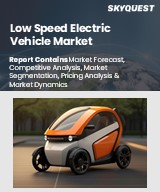
Low Speed Electric Vehicle Market
Report ID: SQMIG20X2008
Report ID: SQMIG20X2008
[email protected]
USA +1 351-333-4748
Report ID:
SQMIG20X2008 |
Region:
Global |
Published Date: November, 2024
Pages:
187
|Tables:
66
|Figures:
73


Low Speed Electric Vehicle Market size was valued at USD 6.49 Billion in 2024 and is poised to grow from USD 6.85 Billion in 2025 to USD 10.51 Billion by 2033, growing at a CAGR of 5.5% during the forecast period (2026–2033).
The growth of low-speed electric vehicle market depends on several factors, such as adoption of 3D printing technology to customize vehicles, rapid introduction of LSEVs and growing awareness of LSEVs as cost-effective. The low speed electric vehicle market is supported by increasing environmental awareness, congested urban roads and stringent emission regulations. Trends include advances in battery technology, competitive pricing and the expansion of EV charging infrastructure. In addition, government incentives and pressure to reduce emissions are accelerating the adoption of urban transport and last-mile freight.
Low-speed electric vehicles are alternative forms of the powerful vehicles, such as wagons and other vehicles. These vehicles are more comfortable and safer than any other golf cart on this market. For example, the demand for electric vehicles has increased.
Stricter government regulations and policies driving the fast pace of low-speed electric vehicle market developments related to vehicle emissions and higher fuel costs. Erasing higher vehicle costs driving low-cost electric vehicles (LSEV) development and production, pollution, growth, increase in the automobile industry.
Market snapshot - 2026-2033
Global Market Size
USD 6.15 Billion
Largest Segment
Passenger Vehicle
Fastest Growth
Heavy Duty Vehicle
Growth Rate
5.5% CAGR
To get more insights on this market click here to Request a Free Sample Report
Global Low Speed Electric Vehicle Market is segmented by Application Type, by Vehicle Type, by Propulsion, by Power Output, by Motor Type, by Battery Type and by Region. Based on Application Type, the market is segmented into Golf course, Hotels & resort, Airport, Industrial facility, Other applications. Based on Vehicle Type, the market is segmented into Golf cart, Commercial turf utility vehicle, Industrial utility vehicle, Personal mobility vehicle. Based on Power Output, the market is segmented into ≤5 KW, 6-15 KW, >15 KW. Based on Motor Type, the market is segmented into AC Motor, DC Motor. Based on Battery, the market is segmented into Li-lon Battery, Lead Acid Battery, and Others. Based on region, the market is segmented into North America, Europe, Asia Pacific, Latin America and Middle East & and Africa.
The passenger vehicle segment is dominant in the market. The passenger vehicle segment has a significant share in the low-speed electric vehicle market, catering mainly to urban commuters, older people, who seek environmentally friendly transportation solutions, the short distances. They usually use these vehicles for personal transportation in urban areas, small communities, resorts and neighborhoods because of their compact, affordable design and energy efficiency. It is gaining popularity as it provides a viable alternative to conventional vehicles for short trips, reducing traffic congestion and carbon emissions. Also, government incentives for vehicles and subsidies are offered to help these vehicles to increase their acceptance. Passenger LSEVs are also popular because of their low maintenance costs and ease of use, appealing to a wide range of people. The rise of smart cities and the need for sustainable mobility options are driving the demand for LSEV transportation, especially in urban areas where congestion and pollution are key factors which are disturbing.
Heavy duty vehicle segment is fastest growing in the market. The heavy-duty vehicle segment of the low speed electric vehicle market is mainly focused on commercial and industrial applications, such as logistics, waste management, construction in urban or restricted areas. The growth of e-commerce and last-mile delivery services has significantly increased the demand for electric cargo vehicles and LSEVs, which are environmentally friendly and cost-effective for corporate observers on urban infrastructure. Furthermore, governments are pushing for cleaner and lower emissions options in commercial fleets to encourage off-duty heavy LSEVs. These vehicles are also seeing increasing use in areas such as agriculture, construction and urban infrastructure where low-speed, high-performance vehicles are needed for operational tasks.
The golf courses segment is the dominant in the market. LSEVs are mostly used in the golf course segment, where they serve as golf carts for transporting players and equipment to golf courses. This segment has long been a market for low-powered electric vehicles, as golf courses prefer pollution-free quiet vehicles to maintain a serene environment. LSEVs are particularly suited to this application due to their low speed, their capacity consumption and electricity, which reduces operating costs. While this sector is important and stable, it is relatively saturated, with established players dominating the market. Growth in this segment has been steady but slow, as demand is closely linked to the expansion of golf courses and the replacement of old vehicles.
The tourist destination segment is growing rapidly and is a strong force in the LSEV market. Tourism destinations such as theme parks, resorts, historic sites, and environmentally friendly destinations are increasingly adopting LSEVs to provide convenient, not eco-friendly tourist transportation uses these vehicles for guided tours, shuttles and general transportation in large areas often car- restricted areas. As the global travel and tourism industry recovers and becomes more sustainable, the demand for LSEVs in tourist destinations is increasing. Factors such as increased environmental awareness and the desire for cleaner and quieter transportation to enhance the tourist experience are fueling this growth Furthermore, tourist destinations are frequent requires a wide range of LSEVs, and their growing numbers present expanding opportunities for manufacturers.
To get detailed segments analysis, Request a Free Sample Report
North America plays a dominant role in the low speed electric vehicle market, mainly driven by the focus on sustainable transportation solutions in urban areas and recreational vehicles such as demand for golf carts and local electric vehicles (NEVs). U.S. is the leading region in the market with efficiency systems for electric vehicles and LSEVs adopted in retirement communities, resorts, universities, and corporate campuses. Government policies encouraging transportation along with tax incentives, are further encouraging the adoption of LSEVs. However, in terms of market increase, North America is experiencing moderate enlargement, pushed by means of the high demand from mature markets together with golf publications and gated communities. While the market is steady, it isn't developing as rapidly as other regions.
Asia Pacific is the fastest growing region in the low-speed electric vehicle market. China is the largest producer and consumer of LSEVs, fuelled by the country's push toward reducing urban pollution, adopting electric mobility, and offering affordable transportation solutions for short distances. Other countries in the region, such as India and Japan, are also adopting the LSEVs in growing numbers due to the rising urbanization and need for cost-effective, sustainable transport options. In many parts of China, LSEVs are viewed as a low-cost opportunity to the conventional vehicles, in smaller cities and cities wherein infrastructure for the high-pace electric powered vehicles is limited.
To know more about the market opportunities by region and country, click here to
Buy The Complete Report
Increasing Environmental Awareness
Rising Urbanization and Traffic Congestion
Limited Range and Battery Life
Lack Of Charging Infrastructure
Request Free Customization of this report to help us to meet your business objectives.
The competitive landscape of the low-speed electric vehicle marketplace is dynamic and increasingly crowded, with a combination of mounted car giants, specialized electric powered automobile manufacturers, and progressive startups competing for market percentage. Key players inside the LSEV market, along with BYD, Polaris Industries, and Shifeng Group, are leveraging their production understanding and economies of scale to provide lower priced, efficient. LSEVs aimed at urban and suburban purchasers. These corporations are specializing in enhancing car performance, increasing product portfolios, and capitalizing on government subsidies that assist electric powered car adoption. Emerging gamers like the Kandi Technologies and Eli Electric Vehicles also are making sizeable strides, targeting niche markets with custom designed, technologically advanced LSEVs tailored for unique applications including urban shipping offerings, gated groups, and leisure use.
Technological Advancement in Battery Systems
Integration of Smart Features and Connectivity
SkyQuest's ABIRAW (Advanced Business Intelligence, Research & Analysis Wing) is our Business Information Services team that Collects, Collates, Correlates, and Analyses the Data collected by means of Primary Exploratory Research backed by robust Secondary Desk research.
According to SkyQuest analysis, the low-speed electric vehicle market continues to grow, driven by increased environmental awareness, urbanization and traffic congestion in cities. These vehicles compact, energy efficient and zero emissions have become a popular solution for long distance transportation, especially in the densely populated areas. LSEVs are gaining rapid adoption, especially in urban areas. However, they are hampered by challenges such as the portability of these vehicles, and the lack of advanced charging facilities, especially in rural and urban areas, low battery life. Moreover, manufacturers are developing GPS, IoT-based systems, to improve driving safety, comfort and user experience. Greater integration of smart infrastructure such as automotive and business networks. As cities around the world prioritize sustainability and continue to reduce carbon emissions, LSEVs have positioning itself to play a dominant role in urban transportation, making conventional gasoline-powered vehicles practical and environmentally friendly. Despite these limitations, advances in battery technology, such as faster charging and extended battery life, are expected to enhance the performance and appeal of LSEVs.
| Report Metric | Details |
|---|---|
| Market size value in 2024 | USD 6.49 Billion |
| Market size value in 2033 | USD 10.51 Billion |
| Growth Rate | 5.5% |
| Base year | 2024 |
| Forecast period | 2026-2033 |
| Forecast Unit (Value) | USD Billion |
| Segments covered |
|
| Regions covered | North America (US, Canada), Europe (Germany, France, United Kingdom, Italy, Spain, Rest of Europe), Asia Pacific (China, India, Japan, Rest of Asia-Pacific), Latin America (Brazil, Rest of Latin America), Middle East & Africa (South Africa, GCC Countries, Rest of MEA) |
| Companies covered |
|
| Customization scope | Free report customization with purchase. Customization includes:-
|
To get a free trial access to our platform which is a one stop solution for all your data requirements for quicker decision making. This platform allows you to compare markets, competitors who are prominent in the market, and mega trends that are influencing the dynamics in the market. Also, get access to detailed SkyQuest exclusive matrix.
Table Of Content
Executive Summary
Market overview
Parent Market Analysis
Market overview
Market size
KEY MARKET INSIGHTS
COVID IMPACT
MARKET DYNAMICS & OUTLOOK
Market Size by Region
KEY COMPANY PROFILES
Methodology
For the Low Speed Electric Vehicle Market, our research methodology involved a mixture of primary and secondary data sources. Key steps involved in the research process are listed below:
1. Information Procurement: This stage involved the procurement of Market data or related information via primary and secondary sources. The various secondary sources used included various company websites, annual reports, trade databases, and paid databases such as Hoover's, Bloomberg Business, Factiva, and Avention. Our team did 45 primary interactions Globally which included several stakeholders such as manufacturers, customers, key opinion leaders, etc. Overall, information procurement was one of the most extensive stages in our research process.
2. Information Analysis: This step involved triangulation of data through bottom-up and top-down approaches to estimate and validate the total size and future estimate of the Low Speed Electric Vehicle Market.
3. Report Formulation: The final step entailed the placement of data points in appropriate Market spaces in an attempt to deduce viable conclusions.
4. Validation & Publishing: Validation is the most important step in the process. Validation & re-validation via an intricately designed process helped us finalize data points to be used for final calculations. The final Market estimates and forecasts were then aligned and sent to our panel of industry experts for validation of data. Once the validation was done the report was sent to our Quality Assurance team to ensure adherence to style guides, consistency & design.
Analyst Support
Customization Options
With the given market data, our dedicated team of analysts can offer you the following customization options are available for the Low Speed Electric Vehicle Market:
Product Analysis: Product matrix, which offers a detailed comparison of the product portfolio of companies.
Regional Analysis: Further analysis of the Low Speed Electric Vehicle Market for additional countries.
Competitive Analysis: Detailed analysis and profiling of additional Market players & comparative analysis of competitive products.
Go to Market Strategy: Find the high-growth channels to invest your marketing efforts and increase your customer base.
Innovation Mapping: Identify racial solutions and innovation, connected to deep ecosystems of innovators, start-ups, academics, and strategic partners.
Category Intelligence: Customized intelligence that is relevant to their supply Markets will enable them to make smarter sourcing decisions and improve their category management.
Public Company Transcript Analysis: To improve the investment performance by generating new alpha and making better-informed decisions.
Social Media Listening: To analyze the conversations and trends happening not just around your brand, but around your industry as a whole, and use those insights to make better Marketing decisions.
REQUEST FOR SAMPLE
 REQUEST FREE CUSTOMIZATION


Want to customize this report? This report can be personalized according to your needs. Our analysts and industry experts will work directly with you to understand your requirements and provide you with customized data in a short amount of time. We offer $1000 worth of FREE customization at the time of purchase.
Feedback From Our Clients


 USA (+1) 351-333-4748

