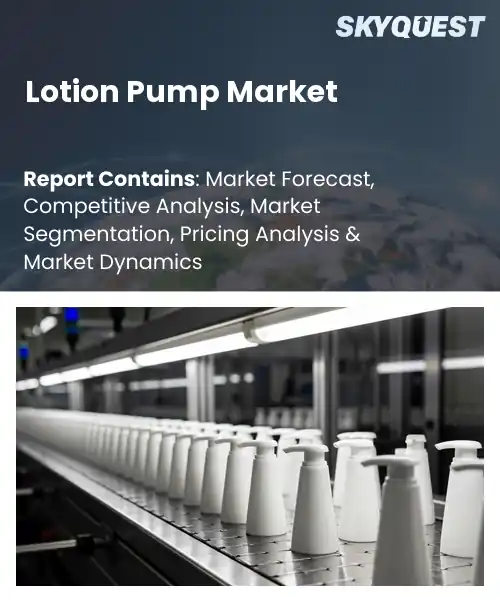
Lotion Pump Market
Report ID: SQMIG15G2187
Report ID: SQMIG15G2187
[email protected]
USA +1 351-333-4748
Report ID:
SQMIG15G2187 |
Region:
Global |
Published Date: June, 2026
Pages:
157
|Tables:
175
|Figures:
79


Global Lotion Pump Market size was valued at USD 6.14 Billion in 2024 and is poised to grow from USD 6.43 Billion in 2025 to USD 9.29 Billion by 2033, growing at a CAGR of 4.7% during the forecast period (2026-2033).
Environmental sustainability acts as a catalyst reshaping the lotion pump market as regulators and shoppers pressure brands to minimize plastic waste. This demand compels manufacturers to adopt recyclable polymers and develop refillable pump designs, which lower material costs and extend product lifecycles; a skincare line introduced a glass‑bottle system with a detachable, recyclable pump, halving its carbon footprint while boosting consumer loyalty.
The shift creates new revenue streams for suppliers of bio‑based resins and for logistics firms offering reverse‑supply services, prompting retailers to highlight green credentials, thereby amplifying market penetration and fostering long‑term growth through increased brand equity and sales.
How is AI-driven automation reshaping the lotion pump market?
AI driven automation is redefining how lotion pumps are conceived, produced, and delivered. Machine learning models now generate ergonomic nozzle geometries that balance flow consistency with material savings, while robotic assembly lines adjust torque in real time to reduce defects. Predictive analytics monitor equipment health, cutting downtime and enabling just in time manufacturing. At the same time, AI powered demand forecasting aligns production with seasonal skin care trends, allowing brands to launch limited edition scents without excess inventory. These capabilities create faster product cycles, lower costs, and greener packaging, making the sector more responsive to consumer expectations. Overall, the integration of AI transforms both design and supply chain efficiency.
Procter & Gamble in June 2024, introduced an AI optimized refillable lotion pump that automatically calibrates dispensing volume based on viscosity data, reducing waste and streamlining production. The innovation showcases how intelligent automation can boost sustainability and speed time to market in the lotion pump sector. It also enables brands to personalize dosage for different skin types.
Market snapshot - (2026-2033)
Global Market Size
USD 6.14 Billion
Largest Segment
Fastest Growth
Growth Rate
4.7% CAGR
To get more insights on this market click here to Request a Free Sample Report
Global lotion pump market is segmented by product type, material type, application, dispensing capacity, end user, sales channel, and region. Based on product type, the market is segmented into airless pumps, standard lotion pumps, trigger pumps, foaming pumps, lockable pumps, and treatment pumps. Based on material type, the market is segmented into plastic, metal, glass, and hybrid materials. Based on application, the market is segmented into personal care & cosmetics, skincare, haircare, pharmaceuticals, household products, and food & beverages. Based on dispensing capacity, the market is segmented into up to 1 ml, 1–2 ml, 2–4 ml, and above 4 ml per stroke. Based on end user, the market is segmented into cosmetic manufacturers, pharmaceutical companies, household product manufacturers, food & beverage manufacturers, and contract packaging companies. Based on sales channel, the market is segmented into direct sales, distributors & wholesalers, online channels, and retail stores. Based on region, the market is segmented into North America, Europe, Asia Pacific, Latin America and Middle East & Africa.
Airless pump segment dominates with large lotion pump market share because it provides superior product protection, dispensing accuracy, and shelf life extension, which are critical for premium lotion formulations. Its sealed mechanism prevents oxidation and contamination, meeting consumer demand for hygiene and efficacy. The design also supports sleek aesthetic packaging, aligning with brand differentiation strategies, thus driving widespread adoption across luxury and mainstream brands. Additionally, the pump’s ability to dispense precise doses reduces product waste and enhances user experience, encouraging repeat purchase.
As per lotion pump market outlook, trigger pump segment is witnessing the strongest growth momentum because its simple mechanism and lower cost appeal to value oriented brands expanding into emerging markets. The openness to formulation variations and ease of retrofitting existing lines accelerate adoption, creating new opportunities for volume driven manufacturers and expanding the overall market footprint.
As per lotion pump market forecast, plastic material segment dominates because it offers cost efficiency, lightweight properties, and manufacturing flexibility that align with high volume lotion pump production. The material can be molded into intricate designs, supporting branding aesthetics while maintaining durability. Its compatibility with a wide range of pigments and additives enables color customization, meeting diverse consumer preferences and facilitating rapid market entry for new product lines. Moreover, the recyclability initiatives surrounding polymer grades strengthen brand sustainability narratives, further reinforcing market preference.
Meanwhile, metal material segment emerges as the key high growth area because its premium perception and enhanced barrier properties cater to luxury lotion brands seeking premium user experience. Innovative coating technologies improve corrosion resistance and tactile feel, attracting eco conscious consumers who value durability, thereby unlocking new premium market niches and driving future market expansion.
To get detailed segments analysis, Request a Free Sample Report
North America maintains a leading position in the global lotion pump market due to a confluence of mature consumer preferences, sophisticated supply chain networks, and a strong emphasis on product innovation. The region benefits from a deep‑rooted culture of personal care consumption, where convenience and hygiene drive demand for precision dispensing solutions. Established manufacturers leverage advanced engineering capabilities and robust quality‑assurance frameworks to deliver highly reliable pump designs that meet stringent regulatory expectations. Retail channels in the United States and Canada provide extensive shelf presence, while e‑commerce platforms amplify reach to diverse consumer segments. Collaborative partnerships between packaging suppliers and cosmetic brands further accelerate the introduction of sustainable and user‑friendly pump technologies, reinforcing North America’s dominance. Continuous investment in research and development also ensures that the market stays ahead of emerging trends.
As per lotion pump market regional outlook, United States is shaped by a diversified consumer base that values convenience, product performance, and sustainability. Leading brands prioritize sleek design and precise dosing mechanisms, while innovators focus on recyclable materials and reduced waste. Strong collaborations between packaging engineers and skincare manufacturers foster prototyping, enabling swift response to evolving consumer expectations. Distribution channels ranging from retailers to online marketplaces ensure accessibility and reinforce market vitality.
As per lotion pump market regional forecast, Canada reflects a consumer culture that emphasizes natural ingredients, functional design, and environmental stewardship. Packaging firms collaborate closely with local skincare brands to develop pumps that deliver consistent flow while minimizing material usage. The market benefits from a regulatory environment that encourages innovation in biodegradable components and refillable systems. Retail networks spanning specialty boutiques to major pharmacy chains provide product visibility, supporting adoption across consumer segments.
Europe’s rapid expansion of the lotion pump market is propelled by a blend of consumer sophistication, regulatory support for sustainable packaging, and a strong tradition of design excellence. Shoppers across the continent demand high‑performance dispensing solutions that align with eco‑friendly values, prompting manufacturers to adopt recyclable polymers and refill‑ready mechanisms. The region’s dense network of cosmetics innovators fosters collaborative development, enabling swift integration of advanced valve technologies and ergonomic aesthetics. Legislative frameworks that encourage circular economy practices further stimulate investment in reusable pump systems. Additionally, a mature retail landscape, ranging from upscale department stores to digital platforms, ensures that innovative pump formats reach a wide audience, reinforcing Europe’s position as a growth engine for the sector. Collaborative research hubs across key markets also accelerate the validation of new materials, reinforcing the continent’s leadership in sustainable dispensing solutions.
As per lotion pump industry analysis, Germany benefits from an engineering ecosystem that prioritizes precision and durability. Local manufacturers collaborate closely with skincare brands to create pumps featuring refined valve control and recyclable components, aligning with consumer expectations for greener packaging. Distribution channels, including beauty retailers and online platforms, ensure that innovative pump solutions achieve market penetration across the German consumer base. R&D investment enhances and reinforces Germany’s reputation for dispensing technology.
United Kingdom is driven by a consumer preference for aesthetics and user‑friendly functionality. British brands emphasize design innovation, integrating ergonomic grips and transparent dosing indicators to enhance the user experience. Sustainability pressures encourage the shift toward recyclable materials and modular refill systems, resonating with environmentally conscious shoppers. A vibrant e‑commerce ecosystem, complemented by retailers, accelerates the diffusion of cutting‑edge pump technologies across the UK market.
France reflects a cultural emphasis on personal care and eco‑responsibility. French cosmetics houses collaborate with packaging innovators to produce pumps that combine aesthetics with precise dispensing performance. Market participants are actively exploring biodegradable polymers and refill‑friendly concepts to satisfy regulatory expectations and consumer demand for reduced waste. Distribution channels ranging from boutique parfumeries to online retailers facilitate widespread adoption of pump solutions within the French market.
Asia Pacific is steadily strengthening its position in the lotion pump market through a combination of rising consumer awareness, rapid product innovation, and expanding manufacturing capabilities. The region’s large and diverse population drives demand for convenient, hygienic dispensing solutions, while local brands invest heavily in design refinements that cater to both premium and value‑oriented segments. Advancements in polymer technology and precision engineering enable the production of high‑performance pumps that meet stringent quality expectations. Governmental incentives supporting sustainable packaging encourage the adoption of recyclable and refill‑compatible pump designs. Moreover, the growth of digital retail channels accelerates market penetration, allowing manufacturers to reach a broad consumer base across urban and emerging markets, thereby solidifying Asia Pacific’s influence in the global landscape overall.
Japan is characterized by a focus on precision engineering and user experience. Domestic manufacturers collaborate with leading skincare labels to produce pumps that deliver consistent flow rates and maintain product integrity. Sustainability trends inspire the incorporation of eco‑friendly materials and refill concepts, aligning with consumer expectations for responsible packaging. A distribution network, spanning beauty stores and online platforms, ensures market adoption of pump solutions across Japan.
South Korea is driven by a consumer base that values innovative design and convenience. Korean manufacturers integrate dispensing features, such as ergonomic valves and forms, to enhance user interaction. Environmental awareness promotes the use of recyclable polymers and modular refill systems, meeting demand for sustainable packaging. A retail environment, encompassing department stores and e‑commerce platforms, accelerates the rapid diffusion of advanced pump technologies throughout South Korea.
To know more about the market opportunities by region and country, click here to
Buy The Complete Report
Growing Consumer Demand For Convenience
Adoption Of Sustainable Packaging Solutions
High Cost of Advanced Pump Technology
Regulatory Scrutiny Over Material Safety
Request Free Customization of this report to help us to meet your business objectives.
The global lotion pump industry is shaped by intense rivalry among manufacturers that are accelerating product innovation, expanding distribution networks, and pursuing strategic M&A to broaden portfolio breadth. Recent partnerships between packaging firms and cosmetic brands have enabled faster time‑to‑market for eco‑friendly pump designs, while acquisitions of niche dispenser specialists have strengthened technology pipelines and geographic reach.
SkyQuest’s ABIRAW (Advanced Business Intelligence, Research & Analysis Wing) is our Business Information Services team that Collects, Collates, Correlates, and Analyses the Data collected by means of Primary Exploratory Research backed by robust Secondary Desk research.
As per SkyQuest analysis, the global lotion pump market growth is being propelled primarily by rising consumer demand for convenient, hygienic dispensing, while a second strong catalyst is the shift toward sustainable packaging that leverages recyclable polymers and refillable designs. The high cost of advanced pump technology acts as a restraint, limiting adoption among price‑sensitive brands and slowing the rollout of premium mechanisms. North America remains the dominant region, supported by mature retail networks and heavy R&D investment. Within product formats, airless pumps hold the largest share because they protect formulations, ensure dosing accuracy and align with premium‑brand positioning, reinforcing overall market growth. The global lotion pump market trend driven by rising demand for convenient, hygienic, and controlled dispensing solutions across personal care, cosmetics, pharmaceuticals, and household products.
| Report Metric | Details |
|---|---|
| Market size value in 2024 | USD 6.14 Billion |
| Market size value in 2033 | USD 9.29 Billion |
| Growth Rate | 4.7% |
| Base year | 2024 |
| Forecast period | (2026-2033) |
| Forecast Unit (Value) | USD Billion |
| Segments covered |
|
| Regions covered | North America (US, Canada), Europe (Germany, France, United Kingdom, Italy, Spain, Rest of Europe), Asia Pacific (China, India, Japan, Rest of Asia-Pacific), Latin America (Brazil, Rest of Latin America), Middle East & Africa (South Africa, GCC Countries, Rest of MEA) |
| Companies covered |
|
| Customization scope | Free report customization with purchase. Customization includes:-
|
To get a free trial access to our platform which is a one stop solution for all your data requirements for quicker decision making. This platform allows you to compare markets, competitors who are prominent in the market, and mega trends that are influencing the dynamics in the market. Also, get access to detailed SkyQuest exclusive matrix.
Table Of Content
Executive Summary
Market overview
Parent Market Analysis
Market overview
Market size
KEY MARKET INSIGHTS
COVID IMPACT
MARKET DYNAMICS & OUTLOOK
Market Size by Region
KEY COMPANY PROFILES
Methodology
For the Lotion Pump Market, our research methodology involved a mixture of primary and secondary data sources. Key steps involved in the research process are listed below:
1. Information Procurement: This stage involved the procurement of Market data or related information via primary and secondary sources. The various secondary sources used included various company websites, annual reports, trade databases, and paid databases such as Hoover's, Bloomberg Business, Factiva, and Avention. Our team did 45 primary interactions Globally which included several stakeholders such as manufacturers, customers, key opinion leaders, etc. Overall, information procurement was one of the most extensive stages in our research process.
2. Information Analysis: This step involved triangulation of data through bottom-up and top-down approaches to estimate and validate the total size and future estimate of the Lotion Pump Market.
3. Report Formulation: The final step entailed the placement of data points in appropriate Market spaces in an attempt to deduce viable conclusions.
4. Validation & Publishing: Validation is the most important step in the process. Validation & re-validation via an intricately designed process helped us finalize data points to be used for final calculations. The final Market estimates and forecasts were then aligned and sent to our panel of industry experts for validation of data. Once the validation was done the report was sent to our Quality Assurance team to ensure adherence to style guides, consistency & design.
Analyst Support
Customization Options
With the given market data, our dedicated team of analysts can offer you the following customization options are available for the Lotion Pump Market:
Product Analysis: Product matrix, which offers a detailed comparison of the product portfolio of companies.
Regional Analysis: Further analysis of the Lotion Pump Market for additional countries.
Competitive Analysis: Detailed analysis and profiling of additional Market players & comparative analysis of competitive products.
Go to Market Strategy: Find the high-growth channels to invest your marketing efforts and increase your customer base.
Innovation Mapping: Identify racial solutions and innovation, connected to deep ecosystems of innovators, start-ups, academics, and strategic partners.
Category Intelligence: Customized intelligence that is relevant to their supply Markets will enable them to make smarter sourcing decisions and improve their category management.
Public Company Transcript Analysis: To improve the investment performance by generating new alpha and making better-informed decisions.
Social Media Listening: To analyze the conversations and trends happening not just around your brand, but around your industry as a whole, and use those insights to make better Marketing decisions.
REQUEST FOR SAMPLE
 REQUEST FREE CUSTOMIZATION
Global Lotion Pump Market size was valued at USD 6.14 Billion in 2024 and is poised to grow from USD 6.43 Billion in 2025 to USD 9.29 Billion by 2033, growing at a CAGR of 4.7% during the forecast period (2026-2033).
The global lotion pump market is shaped by intense rivalry among manufacturers that are accelerating product innovation, expanding distribution networks, and pursuing strategic M&A to broaden portfolio breadth. Recent partnerships between packaging firms and cosmetic brands have enabled faster time‑to‑market for eco‑friendly pump designs, while acquisitions of niche dispenser specialists have strengthened technology pipelines and geographic reach. 'AptarGroup, Inc.', 'Silgan Holdings Inc.', 'Berry Global Group, Inc.', 'Albea Group', 'Rieke Packaging Systems', 'Raepak Limited', 'Frapak Packaging B.V.', 'Canyon Europe Ltd.', 'Yuyao Shunlong Sprayer & Technology Co., Ltd.', 'Yuyao Golden Queen Commodity Packaging Co., Ltd.', 'Ningbo Songmile Packaging Co., Ltd.', 'CCL Industries Inc.', 'RPC Group Plc', 'Mitani Valve Co., Ltd.', 'Taplast S.p.A.', 'Afa Dispensing Group B.V.', 'Shanghai Sunwin Industry Group Co., Ltd.', 'Quadpack Industries, S.A.', 'Luum Pack S.A.', 'APackaging Group LLC'
Consumers increasingly prefer lotion pump dispensers because they provide quick, hygienic application and minimize product waste, aligning with modern lifestyles that value convenience and efficiency. This preference drives manufacturers to expand pump-compatible product lines, prompting retailers to allocate more shelf space for such offerings. As a result, brand visibility improves and repeat purchases rise, reinforcing a cycle of demand that fuels overall market expansion without reliance on price competition and strengthens consumer loyalty across diverse demographics, further supporting sustained growth trajectories.
Sustainable Packaging Demand: Consumers increasingly prioritize eco‑friendly cosmetics, prompting manufacturers to adopt recyclable and biodegradable pump components. Brands are reformulating containers with post‑consumer recycled plastics and plant‑based polymers, while ensuring dispensing performance remains consistent. This shift drives collaborations with sustainable material suppliers and encourages investment in low‑temperature molding techniques to preserve product integrity. Retailers highlight green credentials, influencing purchase decisions, and regulatory bodies favor circular‑economy solutions, making sustainability a pivotal factor in product development and market positioning for long‑term brand resilience and loyalty.
Why does North America Dominate the Global Lotion Pump Market? |@12


Want to customize this report? This report can be personalized according to your needs. Our analysts and industry experts will work directly with you to understand your requirements and provide you with customized data in a short amount of time. We offer $1000 worth of FREE customization at the time of purchase.
Feedback From Our Clients


 USA (+1) 351-333-4748

