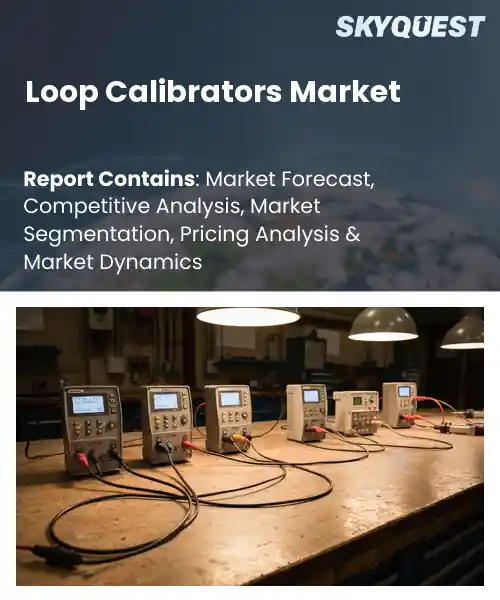
Loop Calibrators Market
Report ID: SQMIG35A4016
Report ID: SQMIG35A4016
[email protected]
USA +1 351-333-4748
Report ID:
SQMIG35A4016 |
Region:
Global |
Published Date: June, 2026
Pages:
157
|Tables:
190
|Figures:
79


Global Loop Calibrators Market size was valued at USD 341.1 Million in 2024 and is poised to grow from USD 361.22 Million in 2025 to USD 571.41 Million by 2033, growing at a CAGR of 5.9% during the forecast period (2026-2033).
The global loop calibrators market is focused on devices that produce precise current or voltage loops for testing and calibrating process-control instruments such as transmitters, valves and sensors. The importance of the system lies in the need for accurate measurement across oil-gas, chemical and power sectors where small errors can lead to costly shutdowns and safety breaches. The market began in the late 1990s, when analog loop testing was replaced with digital solutions that provided faster diagnostics and remote verification. Yokogawa and Fluke were also among the first to bring handheld calibrators to the market, which rapidly replaced manual bench testing on offshore rigs and refinery sites, signifying the shift to on-site validation.
Industry 4.0 standards are gaining popularity, and manufacturers require data integrity to feed analytics and maintenance, which is driving the global loop calibrator market. Digital twins simulate behavior of the plant but the signals that are looped and do not match the plant behavior can reduce the accuracy of the models. Operators buy calibrators that provide certification, cloud logging and connectivity. A European petrochemical complex installed smart calibrators in its control system, reducing calibration down time by 30 percent and extending the life of transmitters by monitoring. This cause-effect chain Regulatory pressure of reliability and availability of devices creates a sizable opportunity for vendors to expand service contracts and offer subscription-based analytics.
How is AI-driven automation influencing the Loop calibrators market?
Loop calibrators are now integrating intelligent algorithms through AI-powered automation to continuously monitor performance and predict drift before it impacts production. They are directly connected to industrial IoT networks, which allows them to exchange information in real-time and make remote adjustments, thereby minimizing manual interaction. The technology also enables adaptive calibration cycles, adjusting test frequencies to the actual wear of the equipment, not fixed schedules. The manufacturer wants to be more precise, have less downtime, so they are putting AI modules into legacy and next-gen calibrators to create a feedback loop that improves accuracy and eases maintenance workflows. As a result, loop calibrators are increasingly keeping up with the fast pace requirements of today’s automation lines, leading to wider application in sectors that depend on accurate control loops .
In May 2026, an AI-based calibration platform was launched, which reduced the setup time and improved the consistency of measurement and supported the market growth with faster loop calibration solutions with higher reliability.
Market snapshot - (2026-2033)
Global Market Size
USD 341.1 Million
Largest Segment
Benchtop Loop Calibrators
Fastest Growth
Portable Loop Calibrators
Growth Rate
5.9% CAGR
To get more insights on this market click here to Request a Free Sample Report
Global loop calibrators market is segmented by product type, function, application, end user, connectivity, distribution channel and region. Based on product type, the market is segmented into Portable Loop Calibrators, Benchtop Loop Calibrators, Multifunction Loop Calibrators, Documenting Loop Calibrators, Intrinsically Safe Loop Calibrators and Others. Based on function, the market is segmented into Current Calibration, Voltage Calibration, Pressure Loop Calibration, Temperature Loop Calibration, Signal Simulation, Process Instrument Calibration and Others. Based on application, the market is segmented into Process Industries, Oil & Gas, Power Generation, Chemical & Petrochemical, Water & Wastewater, Pharmaceuticals, Food & Beverage and Others. Based on end user, the market is segmented into Industrial Manufacturing, Utilities, Calibration Laboratories, Engineering Service Providers, Maintenance & Repair Organizations and Others. Based on connectivity, the market is segmented into Standalone Calibrators, HART Communication Enabled, Wireless Enabled, Bluetooth Enabled and Others. Based on distribution channel, the market is segmented into Direct Sales, Authorized Distributors, E-commerce, Third-Party Instrument Suppliers and Others. Based on region, the market is segmented into North America, Europe, Asia Pacific, Latin America and Middle East & Africa.
Field technicians find the mobility of portable loop calibrators convenient to quickly verify the integrity of the loop on-site without spending much time on the setup, which accounts for the largest share. The light weight and battery operation minimize down time and directly aid continuous process control. They are easy to handle and therefore fit well to lean maintenance strategies. They are commonly used in many different plants. Thus, portable models are preferred by manufacturers, and have made their way into the preferred option for frequent calibration needs in critical operational settings across the globe.
However, the Multifunction Loop Calibrators are witnessing the highest growth momentum as they combine calibration, signal simulation and data logging in one unit, thereby meeting the needs of the advanced users looking for all-in-one solutions. Increasing market opportunities and growing demand for these flexible devices are driven by emerging workflows and the need for predictive maintenance.
Calibration segment is the leader in precise Current loop verification, which remains necessary for Process Instrumentation reliability and constitute the foundation of most Control loops. Accurate current measurements are required for routine maintenance, safety reasons, and to avoid drift – it’s a must-have. It is an area that is used in all the industries and therefore there is always a demand for it. Hence this is a prioritized area for the manufacturers to have strong current calibration capabilities in their product portfolio for diversified sectors with a quest for operational excellence across the globe.
Signal Simulation is the next biggest high growth segment, allowing engineers to simulate sensor outputs for advanced testing without the need for physical prototypes. As the adoption of twins and remote diagnostics increases, so does the importance of simulation capabilities. OEMs can add these capabilities and accelerate the market growth, creating new opportunities for value added services.
To get detailed segments analysis, Request a Free Sample Report
North America is leading the way thanks to a combination of advanced technology, strong industrial expertise, and a broad focus on preventive maintenance across key industries. A strong network of original equipment manufacturers within the region has loop calibration integrated into the core product designs, providing seamless integration. Strong R&D ecosystems drive innovation in calibration technologies Stringent safety and performance regulations require continued investment in high-precision testing tools Rapid adoption and reliable support are facilitated by the highly skilled engineering workforce and well established distribution channels, further cementing market dominance and setting industry standards worldwide.
United States Loop Calibrators market is backed by a strong emphasis on operational reliability across the country’s vast energy and manufacturing sectors. Leading companies have focused on precision testing with strict compliance requirements, resulting in continued demand for advanced calibration solutions. Joint government/private sector projects drive technology development. Complete support from a proven network of aftermarket services. This ecosystem is creating a resilient marketplace that continuously adopts cutting-edge instrumentation to protect critical infrastructure.
Asset integrity is big business in the power generation and oil-and-gas industries in Canada, and that is driving the Loop Calibrators Market. Organizations are committed to safety and environmental stewardship and use proven calibration tools to ensure that equipment is operating within peak parameters. Strong links between research institutes and equipment suppliers encourage local innovation, while government incentives for energy efficiency increase the attractiveness of the market. The result is an increasing demand across the country for loop calibration equipment that is accurate and reliable.
Europe’s growth is driven by a collective focus on energy efficiency, stringent regulations, and a collaborative industrial environment that fosters technology sharing. As the region works to modernize grid infrastructure and add renewable sources, accurate loop calibration is required to maintain system stability. Major economies have strong engineering traditions and strong funding for R&D. This results in continual improvement in calibration accuracy and automation. The growing trend of sustainability and digital transformation is leading utilities and manufacturers to adopt advanced testing solutions, thereby driving market growth across the continent.
Germany Loop Calibrators Market is supported by Germany’s reputation of precision engineering and dense network of high-tech manufacturers. Automotive and heavy industry require rigorous testing of equipment, so there is a constant demand for sophisticated calibration tools. Close cooperation between research institutes and equipment manufacturers creates a pipeline of innovative solutions developed to high quality standards. This environment guarantees a leading market position and increases Germany's position as a benchmark of reliability and technical competence in loop calibration.
The Loop Calibrators Market is gaining traction as companies in the United Kingdom emphasize digital modernization and the reliability of utility services. The move towards smart grid technologies in the sector increases the demand for accurate loop verification and therefore, the use of advanced calibration instruments. Academic centers and industry, working together, accelerate the development of data-driven solutions that are user-friendly. A strong service oriented market culture further supports the synergy positioning the United Kingdom as the fastest growing hub for loop calibrator utilization in Europe.
France is attracting interest as a smart-grid hub, and there are also efforts for renewable integration in France, making it a market of interest for loop calibrators. Slow market adoption is driven by growing awareness of the value of precise loop testing to ensure network resilience. Government programs and equipment manufacturers are collaborating to create next-generation calibration devices to keep up with evolving grid standards. This new environment is encouraging French utilities and industrial players to deploy reliable testing solutions, paving the way for sustainable market development.
Rapid industrialization, increasing focus on automation and strategic government support for infrastructure modernization is gaining the market stature in the Asia Pacific region. Across the region countries are deploying smart manufacturing and resilient power systems that require strict loop calibration to preserve operational integrity. Competitive manufacturing capabilities enable the cost effective production of sophisticated calibration equipment. Strong adoption demand fueled by growing energy & electronics sectors. The collaborative ecosystems connecting research institutions, technology providers and end-users further accelerate the spread of advanced loop calibration practices, shaping Asia Pacific into a vibrant and increasingly influential actor on the world stage.
Japan’s precision instrumentation strength and culture of reliability make it an ideal market for Loop Calibrators. Loop Testing is an integral part of advanced energy networks and high-performance manufacturing for safety and downtime prevention. This close collaboration between the academic research centers and the equipment manufacturers results in a continuous improvement of the calibration technology with a focus on accuracy and integration ease. This environment requires sophisticated loop calibrators and underpins Japan’s reputation as a provider of high quality standards for critical infrastructure.
The South Korea Loop Calibrators Market is driven by the fast adoption of advanced manufacturing processes and smart-grid solutions in the country. Loop calibration accuracy is quickly becoming a key cornerstone of operational excellence for utilities and industrials alike, with a view towards technology integration. Government incentives for digital transformation and a robust domestic sensor industry are driving the development of innovative and compact calibration tools. This synergy quickly creates market momentum, positioning South Korea as a key player in the increasing regional demand for reliable loop calibration equipment.
To know more about the market opportunities by region and country, click here to
Buy The Complete Report
Rising Demand for Precision Calibration
Adoption Of Automated Calibration Systems
High Initial Investment Costs
Limited Technical Expertise Availability
Request Free Customization of this report to help us to meet your business objectives.
The competitive landscape is marked by multiple manufacturers for accelerating product upgrades and forming strategic alliances to seize market share. The push for faster and more accurate calibration cycles fuels the rivalry in the competitive landscape. M&A is an important avenue for companies to expand their sensor portfolios, partner with industrial IoT platforms to enable remote diagnostics, and invest in AI-enabled calibration software to differentiate.
SkyQuest’s ABIRAW (Advanced Business Intelligence, Research & Analysis Wing) is our Business Information Services team that Collects, Collates, Correlates, and Analyses the Data collected by means of Primary Exploratory Research backed by robust Secondary Desk research. As per SkyQuest analysis the global loop calibrators market is projected to reach $571.4 million by 2033, driven primarily by the rising demand for precision calibration that fuels investment in high‑accuracy devices across oil‑gas, power and manufacturing. A second strong catalyst is AI‑driven calibration automation, which embeds predictive algorithms and real‑time analytics, shortening downtime and aligning with Industry 4.0 goals. The market is led by North America, where stringent safety regulations and a deep OEM ecosystem accelerate adoption, and portable loop calibrators dominate the segment landscape owing to their mobility and on‑site convenience. However, high initial investment costs constrain smaller firms, tempering broader penetration despite the overall growth momentum.
| Report Metric | Details |
|---|---|
| Market size value in 2024 | USD 341.1 Million |
| Market size value in 2033 | USD 571.41 Million |
| Growth Rate | 5.9% |
| Base year | 2024 |
| Forecast period | (2026-2033) |
| Forecast Unit (Value) | USD Million |
| Segments covered |
|
| Regions covered | North America (US, Canada), Europe (Germany, France, United Kingdom, Italy, Spain, Rest of Europe), Asia Pacific (China, India, Japan, Rest of Asia-Pacific), Latin America (Brazil, Rest of Latin America), Middle East & Africa (South Africa, GCC Countries, Rest of MEA) |
| Companies covered |
|
| Customization scope | Free report customization with purchase. Customization includes:-
|
To get a free trial access to our platform which is a one stop solution for all your data requirements for quicker decision making. This platform allows you to compare markets, competitors who are prominent in the market, and mega trends that are influencing the dynamics in the market. Also, get access to detailed SkyQuest exclusive matrix.
Table Of Content
Executive Summary
Market overview
Parent Market Analysis
Market overview
Market size
KEY MARKET INSIGHTS
COVID IMPACT
MARKET DYNAMICS & OUTLOOK
Market Size by Region
KEY COMPANY PROFILES
Methodology
For the Loop Calibrators Market, our research methodology involved a mixture of primary and secondary data sources. Key steps involved in the research process are listed below:
1. Information Procurement: This stage involved the procurement of Market data or related information via primary and secondary sources. The various secondary sources used included various company websites, annual reports, trade databases, and paid databases such as Hoover's, Bloomberg Business, Factiva, and Avention. Our team did 45 primary interactions Globally which included several stakeholders such as manufacturers, customers, key opinion leaders, etc. Overall, information procurement was one of the most extensive stages in our research process.
2. Information Analysis: This step involved triangulation of data through bottom-up and top-down approaches to estimate and validate the total size and future estimate of the Loop Calibrators Market.
3. Report Formulation: The final step entailed the placement of data points in appropriate Market spaces in an attempt to deduce viable conclusions.
4. Validation & Publishing: Validation is the most important step in the process. Validation & re-validation via an intricately designed process helped us finalize data points to be used for final calculations. The final Market estimates and forecasts were then aligned and sent to our panel of industry experts for validation of data. Once the validation was done the report was sent to our Quality Assurance team to ensure adherence to style guides, consistency & design.
Analyst Support
Customization Options
With the given market data, our dedicated team of analysts can offer you the following customization options are available for the Loop Calibrators Market:
Product Analysis: Product matrix, which offers a detailed comparison of the product portfolio of companies.
Regional Analysis: Further analysis of the Loop Calibrators Market for additional countries.
Competitive Analysis: Detailed analysis and profiling of additional Market players & comparative analysis of competitive products.
Go to Market Strategy: Find the high-growth channels to invest your marketing efforts and increase your customer base.
Innovation Mapping: Identify racial solutions and innovation, connected to deep ecosystems of innovators, start-ups, academics, and strategic partners.
Category Intelligence: Customized intelligence that is relevant to their supply Markets will enable them to make smarter sourcing decisions and improve their category management.
Public Company Transcript Analysis: To improve the investment performance by generating new alpha and making better-informed decisions.
Social Media Listening: To analyze the conversations and trends happening not just around your brand, but around your industry as a whole, and use those insights to make better Marketing decisions.
REQUEST FOR SAMPLE
 REQUEST FREE CUSTOMIZATION
Global Loop Calibrators Market size was valued at USD 341.1 Million in 2024 and is poised to grow from USD 361.22 Million in 2025 to USD 571.41 Million by 2033, growing at a CAGR of 5.9% during the forecast period (2026-2033).
The competitive landscape is shaped by several manufacturers accelerating product upgrades and forming strategic alliances to secure market share; a key driver is the push for faster, more accurate calibration cycles which intensifies rivalry. Companies are pursuing M&A to broaden sensor portfolios, partnering with industrial IoT platforms for remote diagnostics, and investing in AI‑enhanced calibration software to differentiate their offerings. 'Fluke Corporation', 'Beamex Oy Ab', 'AMETEK Inc.', 'Yokogawa Electric Corporation', 'WIKA Group', 'Additel Corporation', 'Martel Electronics', 'Meriam Process Technologies', 'GE Vernova', 'Ashcroft Inc.', 'Druck Limited', 'OMEGA Engineering', 'Nagman Instruments & Electronics', 'Time Electronics', 'Calmet', 'PIE (Practical Instrument Electronics)', 'Extech Instruments', 'Nagano Keiki', 'TRESCAL', 'SIKA Dr. Siebert & Kühn'
Manufacturers across automotive, aerospace, and electronics sectors increasingly require loop calibrators that deliver exact measurements to ensure system reliability and safety. Precise calibration reduces downtime, prevents costly rework, and supports compliance with stringent quality standards. As product complexity grows, engineers rely on accurate loop testing to validate performance, fostering a strong preference for calibrated solutions. This heightened focus on measurement fidelity directly stimulates demand for advanced loop calibrators, encouraging suppliers to expand capabilities and increase market presence through continuous innovation and responsive service offerings.
Ai-Driven Calibration Automation: The adoption of artificial intelligence across manufacturing floors is reshaping loop calibrator usage. Machine‑learning models predict drift, adjust settings in real time, and schedule preventive maintenance without human intervention. This reduces downtime, enhances repeatability, and aligns calibration processes with Industry 4.0 objectives. Vendors are embedding AI chips directly into equipment, offering cloud‑connected analytics platforms that aggregate performance data across multiple sites, enabling continuous improvement and faster compliance with evolving quality standards while also supporting scalable integration across diverse production lines worldwide.
Why does North America Dominate the Global Loop Calibrators Market? |@12


Want to customize this report? This report can be personalized according to your needs. Our analysts and industry experts will work directly with you to understand your requirements and provide you with customized data in a short amount of time. We offer $1000 worth of FREE customization at the time of purchase.
Feedback From Our Clients


 USA (+1) 351-333-4748

