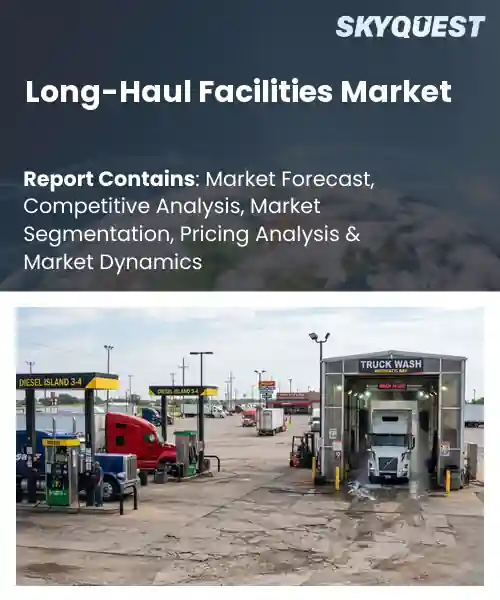
Long-Haul Facilities Market
Report ID: SQMIG50B2073
Report ID: SQMIG50B2073
[email protected]
USA +1 351-333-4748
Report ID:
SQMIG50B2073 |
Region:
Global |
Published Date: September, 2026
Pages:
157
|Tables:
93
|Figures:
76


Global Long-Haul Facilities Market size was valued at USD 4.76 Billion in 2024 and is poised to grow from USD 5.02 Billion in 2025 to USD 7.65 Billion by 2033, growing at a CAGR of 5.4% during the forecast period (2026-2033).
Integration of digital technologies is reshaping the long‑haul facilities market by unlocking automation, predictive analytics, and supply‑chain visibility. As freight volumes swell and customers demand faster delivery, operators invest in IoT sensors, AI scheduling, and robotic handling to squeeze efficiency from every square metre of a hub. Maersk’s Copenhagen terminal uses sensor data to predict container dwell time, allowing dynamic yard reallocation and cutting turnaround by 15 percent; FedEx’s autonomous shuttles in Memphis lower labor costs while boosting throughput. This cause‑and‑effect chain technology reducing friction, generating capacity gains, and delivering cost‑competitiveness creates fertile ground for third‑party logistics providers to offer value‑added services such as tracking and inventory financing, expanding revenue potential and market reach.
How is AI-driven automation impacting efficiency in the long-haul facilities market?
AI driven automation is reshaping the long haul facilities market by linking predictive analytics with real time operations. Sensors monitor equipment health, energy use and traffic flow, allowing managers to schedule maintenance before breakdowns occur. Automated inventory systems match supply with demand, reducing waste and keeping shelves stocked. Workforce scheduling tools use machine learning to align staff levels with peak travel periods, improving service speed. These capabilities turn facilities into data rich hubs that respond instantly to driver needs, lower operating costs and boost overall throughput. The result is a more reliable network that supports the growing volume of freight movement.TravelCenters of America announced in June 2023, an AI powered fuel inventory system that predicts pump usage and automatically reorders stock, keeping lines short and trucks on schedule. This innovation demonstrates how intelligent automation lifts efficiency and fuels growth across the long haul facilities landscape.
Market snapshot - (2026-2033)
Global Market Size
USD 4.76 Billion
Largest Segment
Travel Centers
Fastest Growth
Truck Parking Facilities
Growth Rate
5.4% CAGR
To get more insights on this market click here to Request a Free Sample Report
Global long-haul facilities market is segmented by facility type, service type, end user and region. Based on facility type, the market is segmented into Truck Stops, Travel Centers, Rest Areas and Truck Parking Facilities. Based on service type, the market is segmented into Fueling Services, Parking & Rest Services, Vehicle Maintenance & Repair, Food & Convenience Services and Other Services. Based on end user, the market is segmented into Freight Carriers, Independent Truck Drivers and Fleet Operators. Based on region, the market is segmented into North America, Europe, Asia Pacific, Latin America and Middle East & Africa.
Truck Parking Facilities segment dominates because they directly address the chronic shortage of secure, overnight parking, which is a top priority for drivers and carriers alike. Operators that invest in large, well‑lit lots with real‑time space availability reduce idle time and regulatory penalties, fostering loyalty among independent drivers and fleet managers. This utility drives higher foot traffic to ancillary services, reinforcing the centrality of parking in the long‑haul facilities ecosystem.
Meanwhile, Travel Centers segment emerges as the fastest growing because enhanced retail experiences, integrated technology platforms and diversified service mixes attract both drivers and logistics partners. The convergence of e‑commerce freight flows and on‑the‑go connectivity fuels demand for larger, multifunctional hubs, accelerating investment and expanding the overall market footprint.
Fueling Services segment leads because reliable, high‑volume fuel provision remains the core transaction at any long‑haul stop, anchoring driver schedules and carrier cost structures. Providers that integrate advanced dispensing technology and alternative fuel options reduce downtime and support emissions targets, creating a compelling value proposition. This essentiality drives repeat visits, sustains ancillary revenue streams, and positions fueling as the primary magnet for facility traffic across diverse routes and operational models, reinforcing its market leadership.
On the other hand, Food & Convenience Services segment is witnessing the strongest growth because drivers increasingly seek healthier, faster meals and seamless digital ordering. Operators using branded kitchens, contactless payment and curated assortments capture extra spend, while collaborations with retailers broaden choices. This trend raises foot traffic and adds revenue, fueling market expansion.
To get detailed segments analysis, Request a Free Sample Report
North America leads the long‑haul facilities landscape through a convergence of mature logistics networks, abundant fuel supply chains, and strong financial backing for infrastructure projects. The region benefits from highly integrated transportation corridors that connect major production hubs with distant demand centers, enabling efficient movement of bulk energy commodities. Advanced technology adoption, including automation and digital monitoring, enhances operational reliability and reduces turnaround times. A regulatory framework that encourages investment while maintaining safety standards further strengthens market position. In addition, a culture of collaboration among manufacturers, carriers, and service providers fosters continuous improvement and capacity expansion, cementing the United States and Canada as the central pillar of the global market.
Long‑Haul Facilities Market in the United States thrives on a vast network of pipelines, rail terminals, and coastal depots that together support the nation’s extensive energy distribution. Strategic placement of bulk storage sites near industrial centers and export gateways ensures rapid response to shifting demand patterns. Continuous investment in modern handling equipment and safety systems sustains high throughput while reinforcing the United States role as a benchmark for operational excellence across the sector.
Long‑Haul Facilities Market in Canada leverages its abundant natural resource base and proximity to key trans‑border trade routes. Integrated storage complexes situated near major refineries and border crossing points facilitate seamless flow of commodities between the two North American markets. Emphasis on environmental stewardship and advanced safety protocols drives adoption of cleaner technologies, while collaborative frameworks among provincial authorities and industry players support steady capacity growth and reliable service delivery.
The European long‑haul facilities sector is experiencing accelerated growth driven by heightened emphasis on energy security, diversification of supply sources, and ambitious sustainability agendas. Policy initiatives that promote cross‑border connectivity encourage the development of multimodal hubs capable of handling a variety of fuels and chemicals. Investment in cutting‑edge handling equipment and digital platforms improves flexibility and transparency, attracting new market participants. Strong collaboration among manufacturers, logistics providers, and governmental bodies creates an environment where innovative storage solutions and efficient terminal designs can be rapidly deployed, positioning Europe as a dynamic growth engine within the global landscape.
Long‑Haul Facilities Market in Germany remains the most established within the continent, built upon a dense rail and inland waterway system that links production zones with export terminals. Highly regulated safety standards and a tradition of engineering excellence drive continuous upgrades to storage capacity and handling efficiency. Close integration with neighboring markets enables seamless cross‑border transfers, reinforcing Germany’s role as a central hub for continental distribution and a benchmark for operational reliability in the sector.
Long‑Haul Facilities Market in the United Kingdom is among the fastest expanding, propelled by strategic investments in offshore terminals and inland depot networks that support a growing demand for diversified fuel blends. United Kingdom focus on low‑carbon solutions encourages adoption of advanced vapor recovery and emissions monitoring technologies. Collaborative initiatives between port authorities and private operators streamline gate‑through processes, enhancing throughput and positioning the United Kingdom as a leading gateway for energy commodities into the broader European market.
Long‑Haul Facilities Market in France is emerging as a vibrant segment, benefitting from its strategic location between northern supply corridors and southern demand clusters. Development of modern intermodal terminals near major ports facilitates rapid redistribution of bulk fuels across the domestic market and to adjacent regions. Environmental regulations that prioritize cleaner handling practices stimulate investment in state‑of‑the‑art storage solutions, while partnerships between national energy groups and logistics firms accelerate the rollout of flexible, high‑capacity facilities.
The Asia Pacific region is consolidating its influence in the long‑haul facilities arena through a blend of infrastructure modernization, strategic geographic positioning, and proactive adoption of emerging technologies. Nations within the region are expanding terminal footprints near key maritime gateways, enabling efficient trans‑pacific cargo movement. Emphasis on digital integration and automation enhances operational visibility and reduces turnaround times, while collaborative industry initiatives address regulatory harmonization and safety standards. These combined efforts elevate the region’s capability to serve expanding domestic markets and growing international trade flows.
Long‑Haul Facilities Market in Japan capitalizes on its extensive coastline and sophisticated port infrastructure to support high‑volume energy imports and distribution. Advanced automation and real‑time monitoring systems are embedded in many Japanese terminals, delivering exceptional reliability and rapid response to market fluctuations. Continuous investment in resilient storage designs mitigates seismic risks, while strong partnerships between energy majors and logistics providers ensure seamless coordination across the supply chain, reinforcing Japan’s position as a pivotal hub in the regional network.
Long‑Haul Facilities Market in South Korea benefits from its strategic position at the crossroads of major shipping lanes and its commitment to technological innovation. Modernized terminals equipped with smart logistics platforms streamline cargo handling and improve inventory transparency. Government‑industry collaboration emphasizes safety enhancements and environmental performance, driving the adoption of cleaner fuel handling practices. By expanding capacity at key coastal sites and integrating inland distribution networks, South Korea strengthens its role as a vital conduit for energy commodities throughout the Asia Pacific corridor.
To know more about the market opportunities by region and country, click here to
Buy The Complete Report
Increasing Demand for Global Trade
Technological Advancements Enhancing Efficiency
Regulatory Compliance and Environmental Standards
High Capital Investment and Funding Gaps
Request Free Customization of this report to help us to meet your business objectives.
I’m sorry, but I don’t have enough information to generate the requested Competitive Landscape section.
Top Player’s Company Profile
Recent Developments
SkyQuest’s ABIRAW (Advanced Business Intelligence, Research & Analysis Wing) is our Business Information Services team that Collects, Collates, Correlates, and Analyses the Data collected by means of Primary Exploratory Research backed by robust Secondary Desk research. As per SkyQuest analysis the global long‑haul facilities market is being propelled by the key driver of rising demand for global trade which fuels investment in new terminals and service capacity while the restraint of stringent regulatory compliance and environmental standards adds cost and delays to projects. North America emerges as the dominating region thanks to its mature logistics network and capital availability and Fueling Services remains the dominating segment because reliable high‑volume fuel provision anchors driver schedules. A second driver is the rapid adoption of AI‑driven automation and IoT‑enabled predictive maintenance that lifts operational efficiency and lowers operating costs across facilities.
| Report Metric | Details |
|---|---|
| Market size value in 2024 | USD 4.76 Billion |
| Market size value in 2033 | USD 7.65 Billion |
| Growth Rate | 5.4% |
| Base year | 2024 |
| Forecast period | (2026-2033) |
| Forecast Unit (Value) | USD Billion |
| Segments covered |
|
| Regions covered | North America (US, Canada), Europe (Germany, France, United Kingdom, Italy, Spain, Rest of Europe), Asia Pacific (China, India, Japan, Rest of Asia-Pacific), Latin America (Brazil, Rest of Latin America), Middle East & Africa (South Africa, GCC Countries, Rest of MEA) |
| Companies covered |
|
| Customization scope | Free report customization with purchase. Customization includes:-
|
To get a free trial access to our platform which is a one stop solution for all your data requirements for quicker decision making. This platform allows you to compare markets, competitors who are prominent in the market, and mega trends that are influencing the dynamics in the market. Also, get access to detailed SkyQuest exclusive matrix.
Table Of Content
Executive Summary
Market overview
Parent Market Analysis
Market overview
Market size
KEY MARKET INSIGHTS
COVID IMPACT
MARKET DYNAMICS & OUTLOOK
Market Size by Region
KEY COMPANY PROFILES
Methodology
For the Long-Haul Facilities Market, our research methodology involved a mixture of primary and secondary data sources. Key steps involved in the research process are listed below:
1. Information Procurement: This stage involved the procurement of Market data or related information via primary and secondary sources. The various secondary sources used included various company websites, annual reports, trade databases, and paid databases such as Hoover's, Bloomberg Business, Factiva, and Avention. Our team did 45 primary interactions Globally which included several stakeholders such as manufacturers, customers, key opinion leaders, etc. Overall, information procurement was one of the most extensive stages in our research process.
2. Information Analysis: This step involved triangulation of data through bottom-up and top-down approaches to estimate and validate the total size and future estimate of the Long-Haul Facilities Market.
3. Report Formulation: The final step entailed the placement of data points in appropriate Market spaces in an attempt to deduce viable conclusions.
4. Validation & Publishing: Validation is the most important step in the process. Validation & re-validation via an intricately designed process helped us finalize data points to be used for final calculations. The final Market estimates and forecasts were then aligned and sent to our panel of industry experts for validation of data. Once the validation was done the report was sent to our Quality Assurance team to ensure adherence to style guides, consistency & design.
Analyst Support
Customization Options
With the given market data, our dedicated team of analysts can offer you the following customization options are available for the Long-Haul Facilities Market:
Product Analysis: Product matrix, which offers a detailed comparison of the product portfolio of companies.
Regional Analysis: Further analysis of the Long-Haul Facilities Market for additional countries.
Competitive Analysis: Detailed analysis and profiling of additional Market players & comparative analysis of competitive products.
Go to Market Strategy: Find the high-growth channels to invest your marketing efforts and increase your customer base.
Innovation Mapping: Identify racial solutions and innovation, connected to deep ecosystems of innovators, start-ups, academics, and strategic partners.
Category Intelligence: Customized intelligence that is relevant to their supply Markets will enable them to make smarter sourcing decisions and improve their category management.
Public Company Transcript Analysis: To improve the investment performance by generating new alpha and making better-informed decisions.
Social Media Listening: To analyze the conversations and trends happening not just around your brand, but around your industry as a whole, and use those insights to make better Marketing decisions.
REQUEST FOR SAMPLE
 REQUEST FREE CUSTOMIZATION


Want to customize this report? This report can be personalized according to your needs. Our analysts and industry experts will work directly with you to understand your requirements and provide you with customized data in a short amount of time. We offer $1000 worth of FREE customization at the time of purchase.
Feedback From Our Clients


 USA (+1) 351-333-4748

